Categories Health


Someone with decades of training gives someone with none advice usually packed into 1-3 mins. Huge amount is based on trust. Huge potential for bias built in. But also there is no obligation to provide real alternative options.
MAiD isn't eugenics. The task for the medical profession is to ensure informed consent. Failures on that front should result in enforcement of the law. But Bill C-7 is the result of the existing regime imposing unnecessary, unconstitutional harms by blocked access to MAiD.
— Emmett Macfarlane (@EmmMacfarlane) February 13, 2021
I am classified as 'gifted' (obnoxious and ableist term). I mention because of what I am about to say. You all know that I was an ambulatory wheelchair user previously - could stand - but contractures have ended that. When I pleaded for physio, turned down. But did you know...
I recently was chatting with a doctor I know and explaining what happened and the day the physiatrist told me it was too late and nothing could be done. The doctor asked if I'd like one of her friends/colleagues to give second opinion. I said yes please! So...
She said can you send me MRI and other imaging they did to determine it wasn't possible to address your contractures.
Me: What?
Dr.: They did a MRI first before deciding right?
Me: No
Dr: What did they do??!
Me: Examined me for 2 minutes.
Dr: I am very angry rn. Can't talk.
My point is you don't even know if you are making "informed" decisions because the only source of information you have is the person who has already decided what they think you should do. And may I remind you of a word called 'compliance.'

On the 19th March 2020 the WHO released this guidance intended for healthcare workers (HCWs), healthcare managers and IPC teams at the facility level & at national and district/provincial level:https://t.co/C4aV2BnMPj pic.twitter.com/tCk1EyLskV
— Robin Monotti (@robinmonotti) December 21, 2020
It clearly does indicate both the risks of bacterial infection & to prescribe broad spectrum antibiotics as part of treatment:
"Collect blood cultures for bacteria that cause pneumonia and sepsis, ideally before antimicrobial therapy. DO NOT
delay antimicrobial therapy"
"6. Management of severe COVID-19: treatment of co-infections
Give empiric antimicrobials [broad spectrum antibiotics] to treat all likely pathogens causing SARI and sepsis as soon as possible, within 1 hour
of initial assessment for patients with sepsis."
"Empiric antibiotic treatment should be based on the clinical diagnosis (community-acquired
pneumonia, health care-associated pneumonia [if infection was acquired in health care setting] or sepsis), local epidemiology &
susceptibility data, and national treatment guidelines"
"When there is ongoing local circulation of seasonal influenza, empiric therapy with a neuraminidase inhibitor [anti-viral influenza drugs] should
be considered for the treatment for patients with influenza or at risk for severe disease."


this is LA department of health services hospital census. it's essentially identical to the levels from last year.
the media have had a severe tendency to overstate these issues. https://t.co/ktTPIbKcdQ
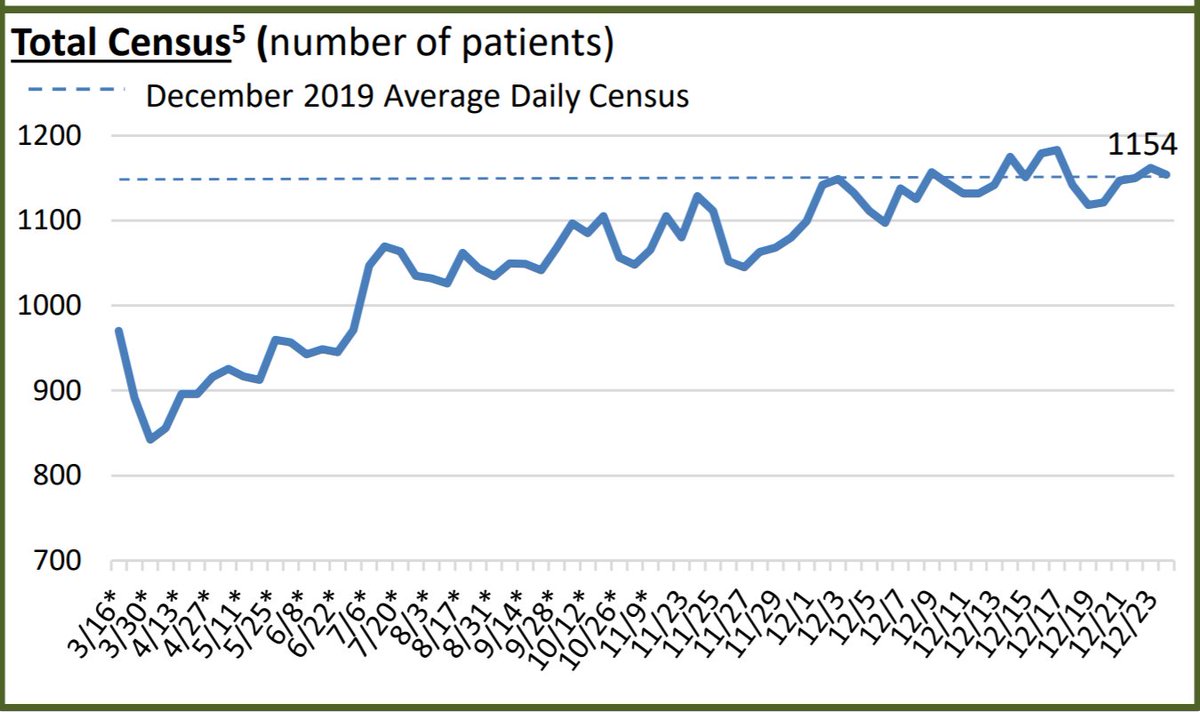
Overwhelmed LA hospitals brace for new wave as staff move gurneys into gift shops with a patient dying every 10 MINUTES. https://t.co/CW19DYzCn9
— John FitzGerald (@TheTweetOfJohn) December 27, 2020
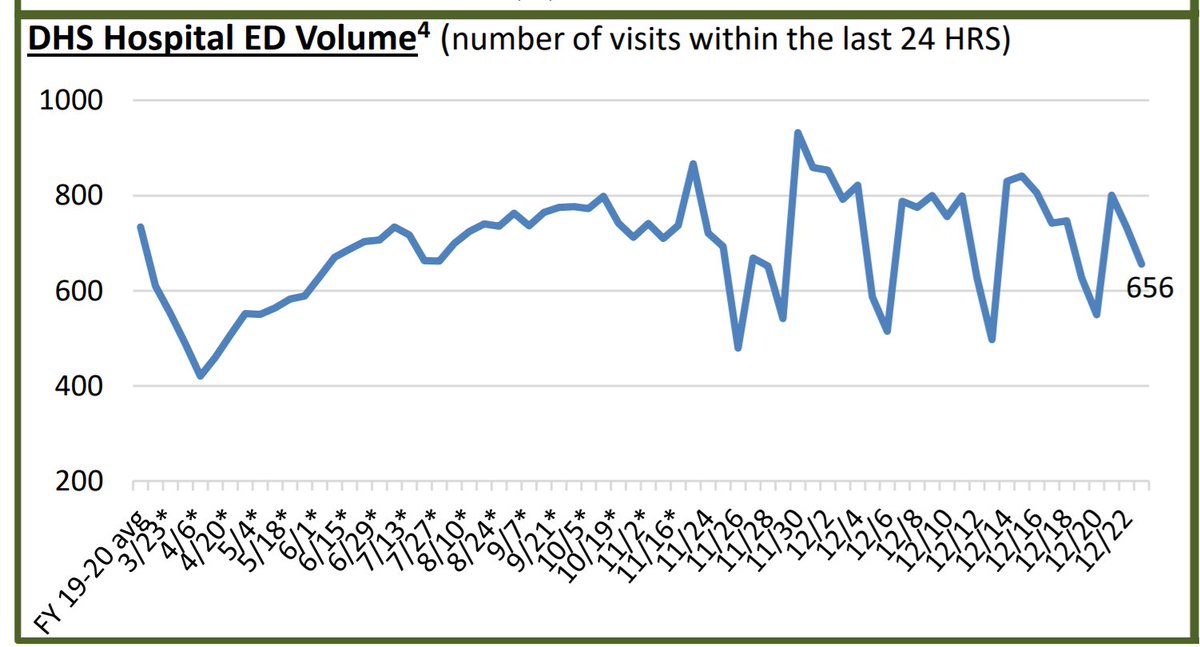
as you can see, visits to emergency departments have been quite stable for 4 months.
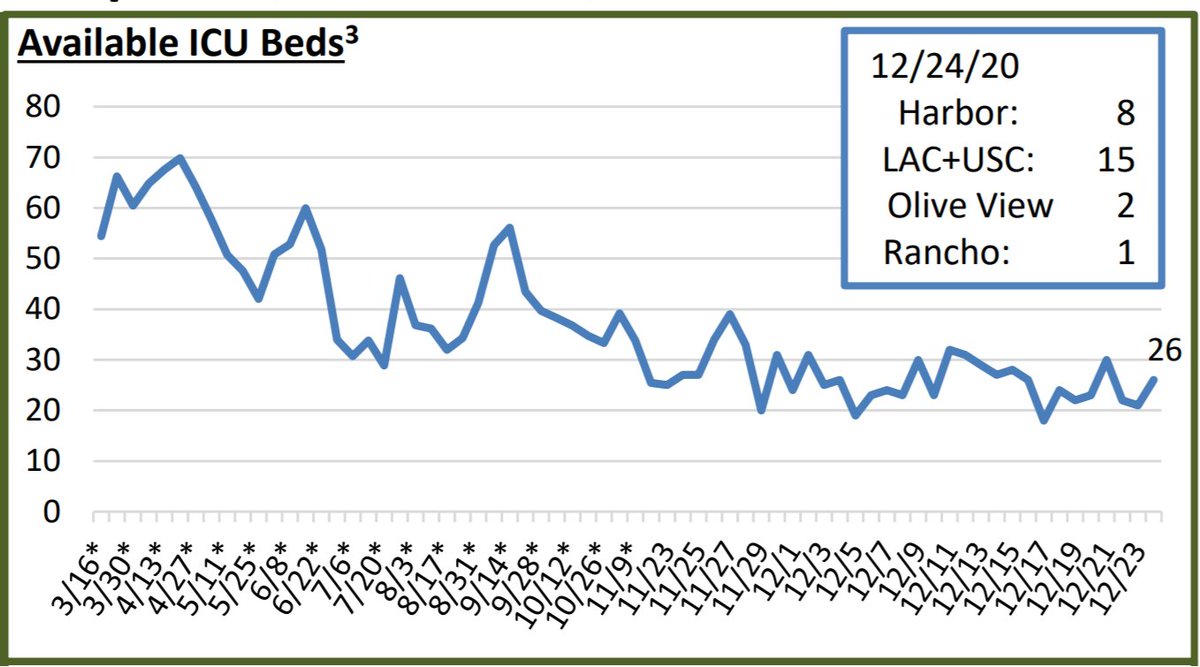
and ICU bed availability has been flat for the whole month of december.
keep in mind that 90-100% ICU capacity is normal this time of year and that all ICU's must be able to flex to 120% (by federal law) and most can hit 150%.
and if you will not take my word for it, just ask the CEO's of the hospitals in texas everyone was so breathless about this summer.
they were not worried. and they were
it's sort of interesting:
— el gato malo (@boriquagato) June 26, 2020
everyone is freaking out about texas hospitals except for the people who actually run texas hospitals.
this pretty much tells you everything you need to know about the panic patrol and their relationship to facts.https://t.co/4H4ocDFoCs
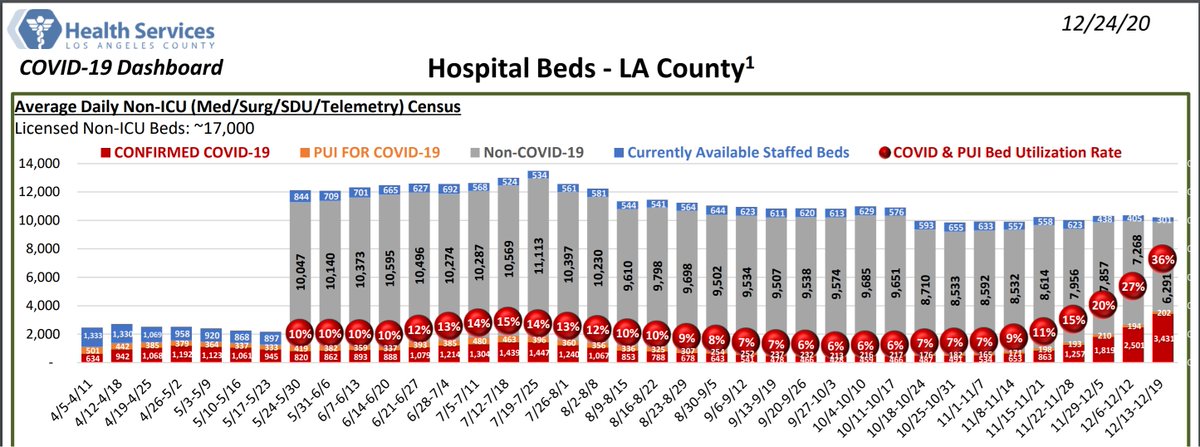
hospital census in LA seems to be about 3000 patients below where it was in july.
this seems to imply a drop in staffed beds which, contrary to the narrative is not from "exhaustion" but rather from people being laid off or staying home because kids are not in school.

It’s just a big boost to insurer profits & will shutter independent physician practices & rural hospitals!
1/x
Just joined other House and Senate leaders in announcing a surprise billing agreement. Under this agreement, the days of patients receiving devastating surprise out-of-network medical bills will be over. https://t.co/HELY6OiPtS
— Rep. Frank Pallone (@FrankPallone) December 12, 2020
The Independent Dispute Resolution (IDR) in this compromise directs arbiter to consider “in network median rates” when settling disputes which is a sham arbitration & tantamount to benchmarking aka rate setting
Who dictates in network rates?
Insurers!
2/x
This bill prohibits use of charge data (aka usual & customary) which is another way of saying doctors must accept whatever poor contract terms or low balled payment offers insurers are jamming down their throats
This is just giving more power to profitable insurers
3/x
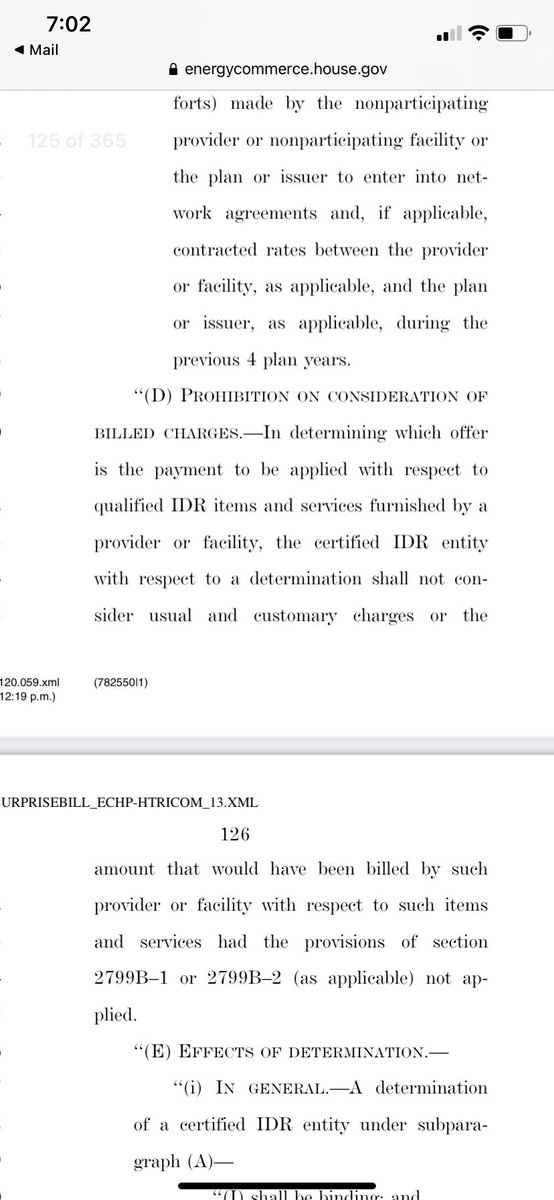
The reason why arbitration works in states like NY, TX is that it levels playing field, directs arbiters to consider independent price database like @FAIRHealth that can’t be manipulated by either side
Insurers have total control over “median in network” rates w their monopolies
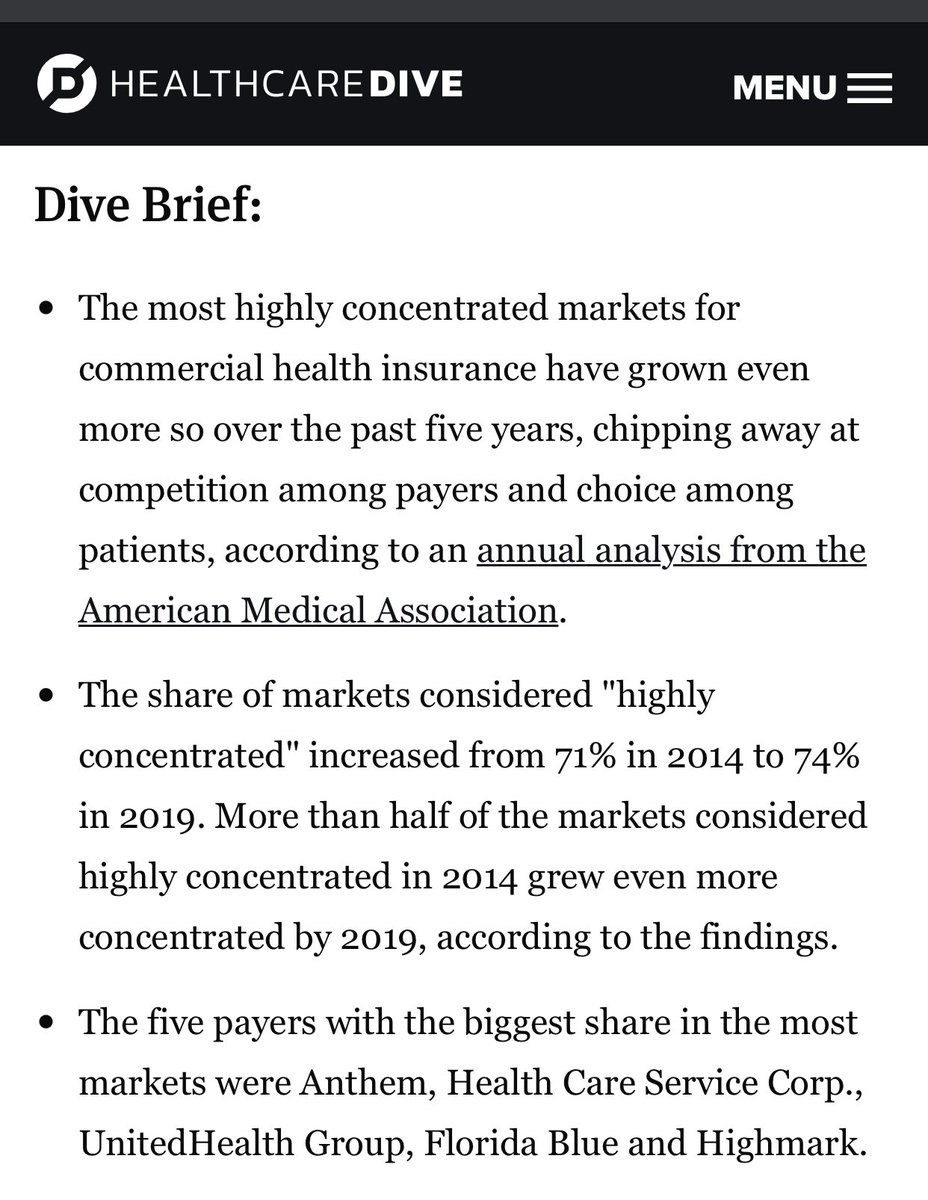
When insurers have control over terms of arbitration, they will do everything in their power to do what any respectable publicly traded corporation will do: tilt the terms in their favor to increase


It\u2019s #CervicalCancerPreventionWeek \U0001f499
— myGP (@myGPapp) January 18, 2021
Here\u2019s how you can help to raise awareness:
\U0001f431 Share an image of the cat that best reflects your undercarriage/flower/bits (technical term vulva!) current look.
#\u20e3Use the Hashtag #myCat.
\U0001f46dTell and tag your friends to let them know. pic.twitter.com/8aHf96ynjT
More importantly, the statistic being used in the campaign is misleading. It says 57% of women put off cervical screening if they can't get waxed. But on further investigation, that's not accurate.
The page here goes on to say "57% of women who regularly have their pubic hair professionally removed would put off attending their cervical screening appointment if they hadn’t been able to visit a beauty salon."
So the 57% represents a concern not across the whole population of women, but only those who regularly get waxed. So how big of an issue is this across the whole population? And what else is stopping people getting smears?
I think campaigns for cancer screening are really tricky because there is so much nuance that often doesn't fit into a catchy headline or hashtag. It's certainly not easy and is part of a bigger conversation.


Because of the way I like teaching (research design, research methods and mechanics of research), ....
... I quickly realized that teaching Note-Taking Techniques, Reading Strategies, and Synthesis Methods was complicated. It's kind of a chicken and egg problem. What do students need to learn first, reading or taking notes? Teaching strategies for both is hard to do simultaneously
I tried the following sequence:
- Reading Strategies
- Note-Taking Techniques
- Synthesis Methods
- Writing Tips
Turns out that students are thrust into the "you need to read a lot to understand what I am teaching" model quite early during their programmes. This poses challenges
Normally, I would assign Adler and Van Doren's "How to Read a Book" https://t.co/F8vQIIKSfg so that my students can learn various levels of reading.
Only problem? A&VD is a massive 350 pages' book. Just imagine the amount of time it's going to take them to even *skim it*.
After teaching this class over the summer at ITAM and this fall at CIDE and FLACSO, at the Masters and PhD levels, and after decades of teaching undergraduates, I am convinced now that
(a) students need a range (repertoire) of reading strategies




A very big welcome to everyone joining today’s conversation. Our guest today needs no introduction especially in the sphere of cancer control and advocacy. Welcome @runciecwc
#CheatCervicalCancer
Our First guest is Runcie Chidebe @runciecwc.
— Smile With Me (#CheatCervicalCancer) (@SMILEWithmeNGO) January 31, 2021
He is a patient advocate and global health expert. He is the ED of @projectpinkblue, a cancer nonprofit focused on cancer control in Nigeria. He is engaged in supporting people battling with cancer, fundraising for indigent patients, pic.twitter.com/6tKYkq4h4F
@runciecwc Q1: So Runcie @runciecwc, we see all the amazing work you do as an advocate.
Can you share with us some of the work that you have been doing in cancer control in Nigeria?
#CheatCervicalCancer
@runciecwc That’s amazing. Your work speaks for you. Thanks for all you do.
Q2: What is this @WHO Global Strategy to accelerate the Elimination of CervicalCancer? Can you elaborate on it?
#CheatCervicalCancer
@runciecwc @WHO Q3: In your experience, so far what are the greatest challenges you have identified with cancer control in Nigeria?
#CheatCervicalCancer.
@runciecwc @WHO Q4: Interestingly, we have seen that your organization is part of the Coalition of CSOs against Cervical Cancer in Nigeria, @CervicalCancerN, what is the goal of this Coalition? #CheatCervicalCancer