Folks, we need to talk about this Vitamin D trial. I have no stake in this game - take Vitamin D if you want but this pre-print is super sus.

The paper is presented as a randomized trial of vitamin D supplementation in hospitalized patients with COVID. Interesting and important question! And the results appear dramatic:

If true, this would be one of (if not THE most) effective treatments for COVID. But there are problems...
The first clue something is up is that the randomized groups aren't the same size:
It took me a while to figure out why this was, then I saw in the text that INDIVIDUALS were not randomized, WARDS in the hospital were.
OK - 8 wards, 5 randomized to Vitamin D, 3 to usual care. (Why not 4 and 4?? - but whatever). So this is actually a CLUSTER-randomized trial. That means you need to use CLUSTERED statistics to analyze it. They do not.
This is a big problem. But there is more. It seems that, even if the wards were randomized, the PATIENTS weren't randomized to the wards.
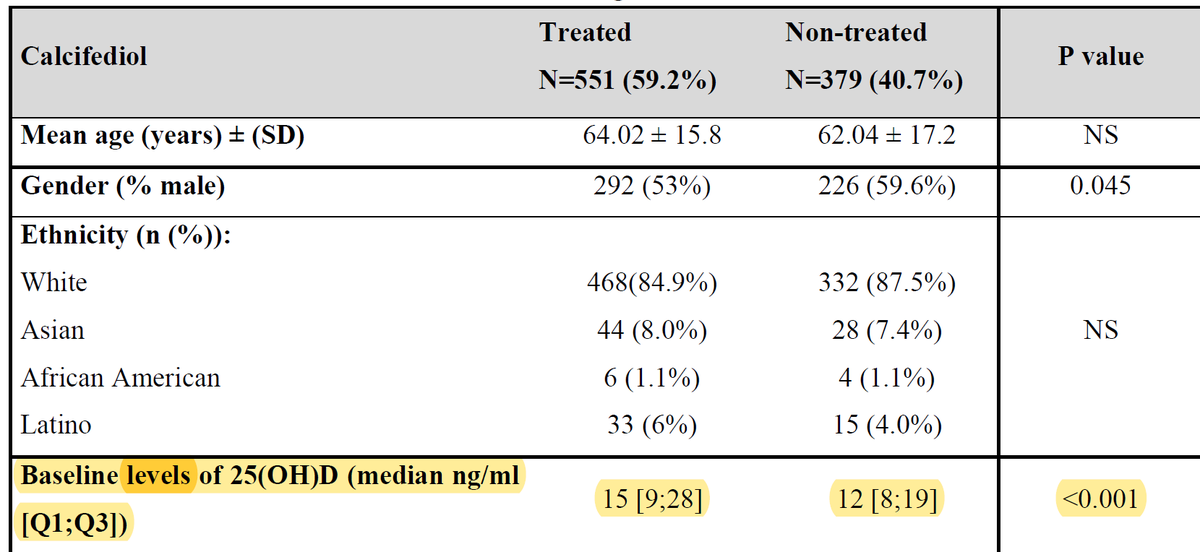
In other words, some hospital wards take different patients than others (different risk factors, etc). This is why we see this really weird finding in Table 1:
Baseline vitamin D levels dramatically lower in the "non-treated" group. Why? Preseumaby because different types of people got admitted to the wards than were randomized to usual care.
You'd expect people with low levels of Vitamin D to do worse - that has been shown multiple times - perhaps because higher Vitamin D levels are associated with less comorbidities.
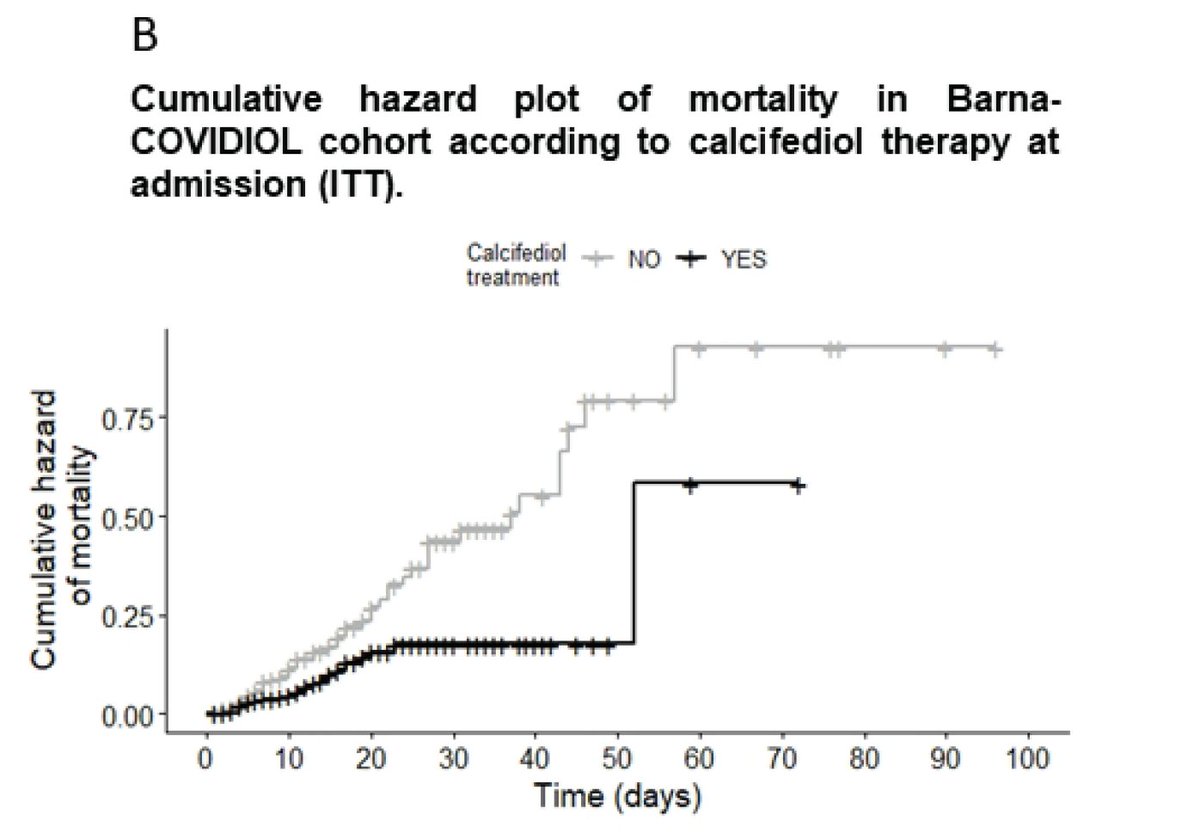
Here's their Kaplan-Meier curve. It doesn't make sense. What do they mean by 'cumulative hazard' of mortality? What units are these? The overall mortality was 10% by their report.
I get frustrated with peer-review too, but this is why it's so important. This is super basic stuff - you don't call your study a randomized trial when it's a cluster randomized trial. And peer-reviewers would 100% have asked them to go back and redo the stats.
The authors could solve this, btw, by releasing a de-identified dataset (including the ward number) for this study. We could analyze it in about an hour at least for topline results using appropriate stats.
And again, is there harm from Vitamin D? Minimal honestly. The harm from promotion of studies like this is tweets like this that try to dissuade people from getting vaccinated and doing other protective measures.
https://t.co/XVmsiajpBr
So please, read skeptically. Pre-prints have been a boon in COVID times but this study is just... not well done. Be aware. (/END)

More from Health

Before we get too far into 2021, I thought I’d write a thread recapping some of the research that came out of my lab in 2020. Most of this work was led by my talented team of graduate students, Kerrianne Morrison, @kmdebrabander, and @DesiRJones.

Back in January, a news story was published about Kerrianne’s study showing improved social interaction outcomes for autistic adults when paired with another autistic partner.

A detailed thread about the study and a link to the paper can be found here (feel free to DM me your email address if you’d like a copy of the full paper for this study or any of our studies):


Another paper published early in 2020 (it appeared a few months earlier online) showed that traditional standalone tasks of social cognition are less predictive of functional and social skills among autistic adults than commonly assumed in autism research.


Next, @kmdebrabander led and published an innovative study about how well autistic and non-autistic adults can predict their own cognitive and social cognitive performance.
Some thoughts on this: Firstly, it might be personal preference, but I am not keen on this kind of campaign as I feel like it trivialises cancer. Sometimes the serious message gets lost because people are sharing pics of cats or whatever and the important context is gone.


More importantly, the statistic being used in the campaign is misleading. It says 57% of women put off cervical screening if they can't get waxed. But on further investigation, that's not accurate.

The page here goes on to say "57% of women who regularly have their pubic hair professionally removed would put off attending their cervical screening appointment if they hadn’t been able to visit a beauty salon."

So the 57% represents a concern not across the whole population of women, but only those who regularly get waxed. So how big of an issue is this across the whole population? And what else is stopping people getting smears?

I think campaigns for cancer screening are really tricky because there is so much nuance that often doesn't fit into a catchy headline or hashtag. It's certainly not easy and is part of a bigger conversation.

You May Also Like