I'm excited to share a new growth framework that @danhockenmaier and I have been developing (with help from the amazing @reforge crew)
I've been finding myself coming back to this framework often when talking to founders about growth.
Thread
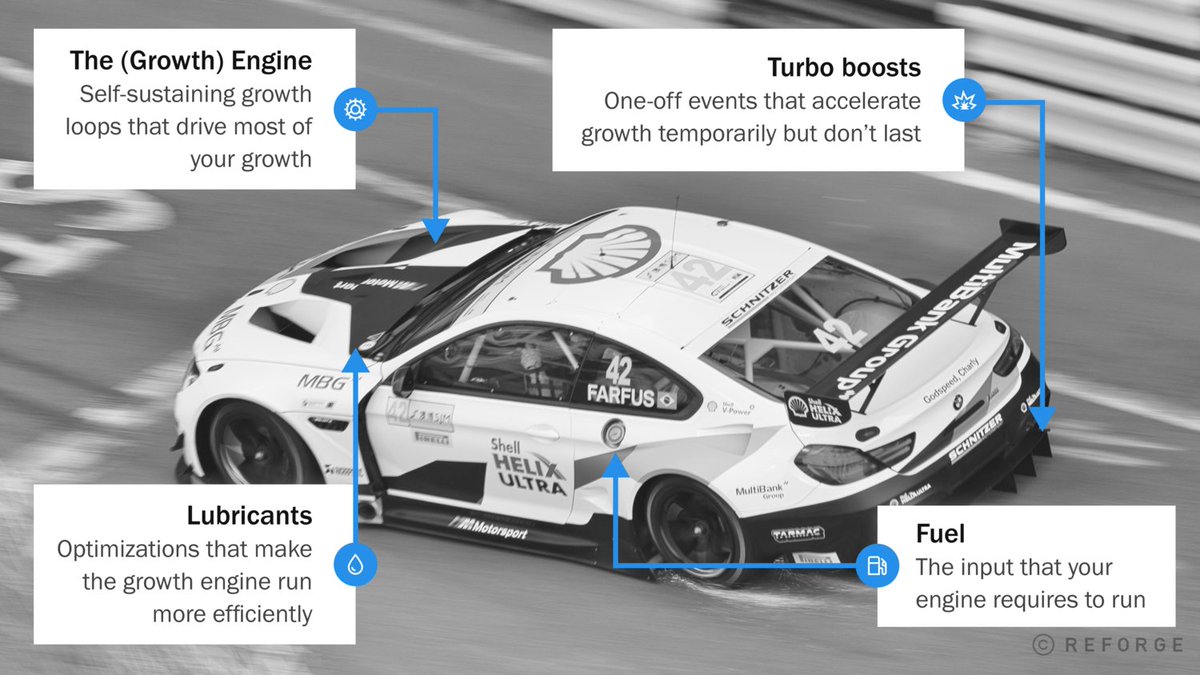
2. 💥 Turbo boosts: One-off events that accelerate growth temporarily but don’t last (e.g. PR, events, Super Bowl ads)
4. ⛽ Fuel: The input that your engine requires to run (e.g. capital, content, users).
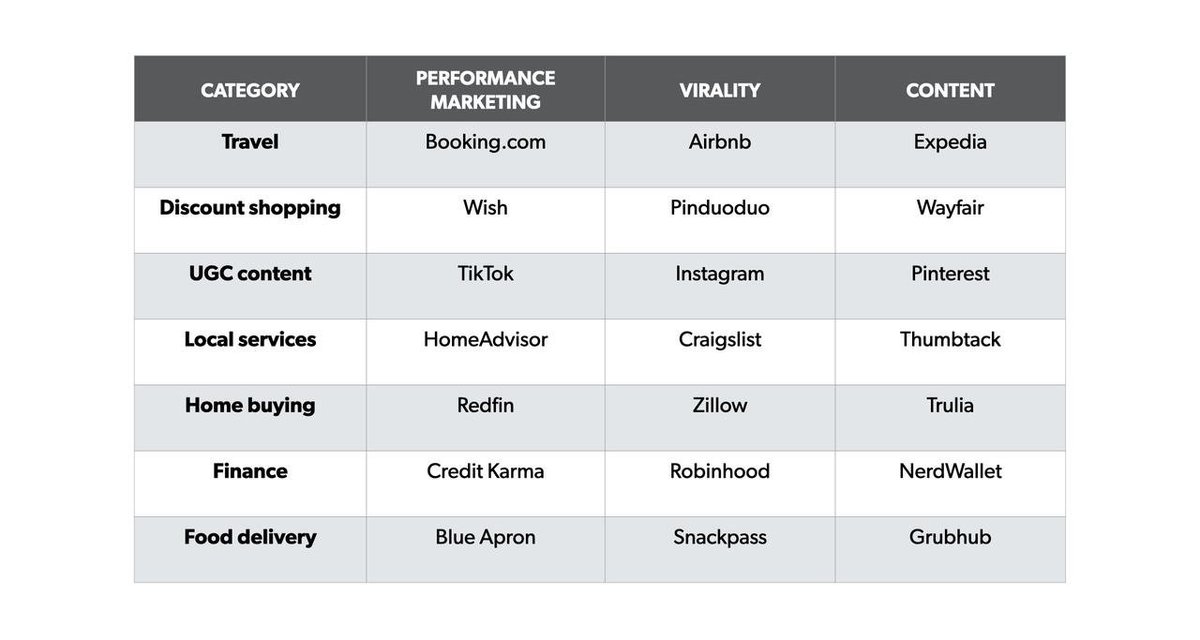
Companies grow primarily through four possible Growth Engines:
• Performance marketing: FB, AdWords, TV, etc.
• Virality: Word-of-mouth, referrals, inviting friends, etc.
• Content: SEO, shareable videos, or newsletters, etc.
• Sales: Salespeople
• Uber/Lyft: Virality + Performance marketing
• Snapchat: Virality
• Zoom: Virality + Sales
• Slack: Virality + Sales
• Salesforce: Sales
https://t.co/djWwLzhqOk
Next, we have Turbo Boosts. Similar to a turbocharger in a car, these are tactics that can accelerate growth for a period of time but don’t deliver ongoing acceleration. They include things like:
• PR
• Events
• Brand marketing campaigns
Third, we have lubricants. Lubricants don’t drive growth directly, but instead optimize the efficiency of your engine. Also, without enough lubrication, your engine will stop. There are 3 broad categories of lubricants:
• Conversion
• Activation
• Retention
https://t.co/MlrmElVjF0
Finally, we have Fuel. Without it, even the most optimized engine won’t run. The type of fuel required is specific to the type of growth engine you’re running:
• Paid marketing and sales engines primarily need capital, which can be invested in ads or salespeople
• Content engines unsurprisingly need more content, which can be used to attract users.
• Viral engines require only more users, who in turn refer additional users.
Huge shout-out to @bbalfour and @onecaseman for their help with this post, and to my brother-from-another-mother @danhockenmaier
https://t.co/ZGW1qWT5zC
More from Lenny Rachitsky



The most sophisticated growth team no one talks about: @WishShopping
1. The #1 shopping app in 40+ countries
2. Rumored to often be the #1 spender on FB and Google
3. 2 million items sold daily
I sat down with @cplimon to learn about the notoriously secretive company. Read on 👇
1/ Your brand constraint is Wish's opportunity
Wish's superpower is leaving no room for taste or opinion. It's what happens when a machine builds a company based on data. The founder didn't plan to sell cheap goods to low-socioeconomic customers, but where the data took him.
"Until you work at a place like Wish, you don't know what data-driven is. Everyone else is data-driven when it's convenient, when it agrees with your opinions. Wish is great at ignoring their own emotions. It's data-driven with as much intellectual honesty as possible."
For example
2/ Differentiate by serving the under-served
Most of Wish’s initial sales came from places like Florida, greater LA county, and middle-America. Specifically, zip codes with 95% Spanish speakers. Later, Africa, Latin America and Eastern Europe (avg household income $18,000/year)
1. The #1 shopping app in 40+ countries
2. Rumored to often be the #1 spender on FB and Google
3. 2 million items sold daily
I sat down with @cplimon to learn about the notoriously secretive company. Read on 👇
1/ Your brand constraint is Wish's opportunity
Wish's superpower is leaving no room for taste or opinion. It's what happens when a machine builds a company based on data. The founder didn't plan to sell cheap goods to low-socioeconomic customers, but where the data took him.
"Until you work at a place like Wish, you don't know what data-driven is. Everyone else is data-driven when it's convenient, when it agrees with your opinions. Wish is great at ignoring their own emotions. It's data-driven with as much intellectual honesty as possible."
For example
cursed wish ads pic.twitter.com/eMlx4LqgKA
— big meaty claws (@leisurepIex) June 4, 2019
2/ Differentiate by serving the under-served
Most of Wish’s initial sales came from places like Florida, greater LA county, and middle-America. Specifically, zip codes with 95% Spanish speakers. Later, Africa, Latin America and Eastern Europe (avg household income $18,000/year)
More from Tech


Recently, the @CNIL issued a decision regarding the GDPR compliance of an unknown French adtech company named "Vectaury". It may seem like small fry, but the decision has potential wide-ranging impacts for Google, the IAB framework, and today's adtech. It's thread time! 👇
It's all in French, but if you're up for it you can read:
• Their blog post (lacks the most interesting details): https://t.co/PHkDcOT1hy
• Their high-level legal decision: https://t.co/hwpiEvjodt
• The full notification: https://t.co/QQB7rfynha
I've read it so you needn't!
Vectaury was collecting geolocation data in order to create profiles (eg. people who often go to this or that type of shop) so as to power ad targeting. They operate through embedded SDKs and ad bidding, making them invisible to users.
The @CNIL notes that profiling based off of geolocation presents particular risks since it reveals people's movements and habits. As risky, the processing requires consent — this will be the heart of their assessment.
Interesting point: they justify the decision in part because of how many people COULD be targeted in this way (rather than how many have — though they note that too). Because it's on a phone, and many have phones, it is considered large-scale processing no matter what.
It's all in French, but if you're up for it you can read:
• Their blog post (lacks the most interesting details): https://t.co/PHkDcOT1hy
• Their high-level legal decision: https://t.co/hwpiEvjodt
• The full notification: https://t.co/QQB7rfynha
I've read it so you needn't!
Vectaury was collecting geolocation data in order to create profiles (eg. people who often go to this or that type of shop) so as to power ad targeting. They operate through embedded SDKs and ad bidding, making them invisible to users.
The @CNIL notes that profiling based off of geolocation presents particular risks since it reveals people's movements and habits. As risky, the processing requires consent — this will be the heart of their assessment.
Interesting point: they justify the decision in part because of how many people COULD be targeted in this way (rather than how many have — though they note that too). Because it's on a phone, and many have phones, it is considered large-scale processing no matter what.


Here is a simple example of a machine learning model.
I put it together a long time ago, and it was very helpful! I sliced it apart a thousand times until things started to make sense.
It's TensorFlow and Keras.
If you are starting out, this may be a good puzzle to solve.
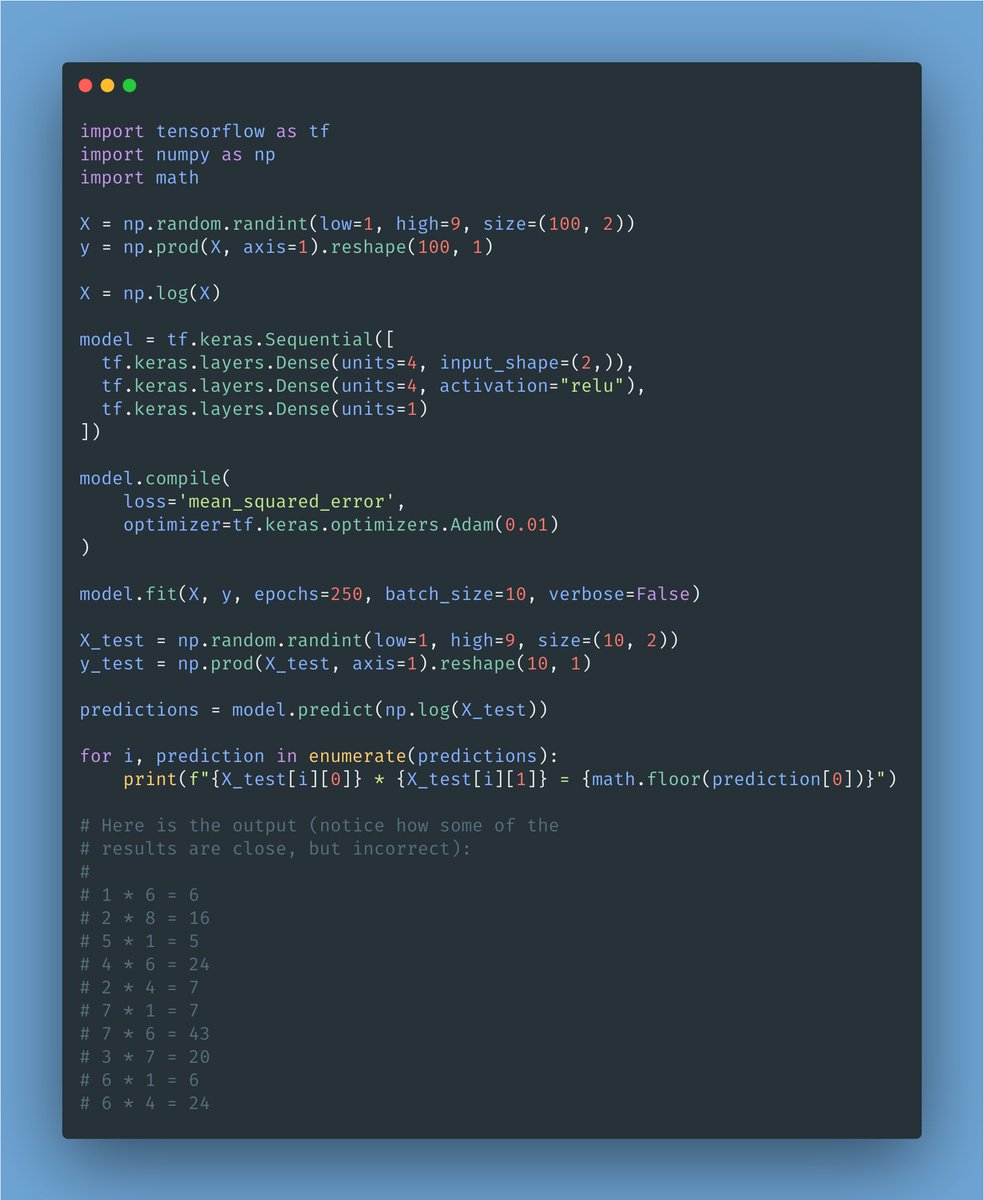
The goal of this model is to learn to multiply one-digit
I put it together a long time ago, and it was very helpful! I sliced it apart a thousand times until things started to make sense.
It's TensorFlow and Keras.
If you are starting out, this may be a good puzzle to solve.
The goal of this model is to learn to multiply one-digit
It is a good example of coding, what is the model?
— Freddy Rojas Cama (@freddyrojascama) February 1, 2021
You May Also Like


Master Thread of all my threads!
Hello!! 👋
• I have curated some of the best tweets from the best traders we know of.
• Making one master thread and will keep posting all my threads under this.
• Go through this for super learning/value totally free of cost! 😃
1. 7 FREE OPTION TRADING COURSES FOR
2. THE ABSOLUTE BEST 15 SCANNERS EXPERTS ARE USING
Got these scanners from the following accounts:
1. @Pathik_Trader
2. @sanjufunda
3. @sanstocktrader
4. @SouravSenguptaI
5. @Rishikesh_ADX
3. 12 TRADING SETUPS which experts are using.
These setups I found from the following 4 accounts:
1. @Pathik_Trader
2. @sourabhsiso19
3. @ITRADE191
4.
4. Curated tweets on HOW TO SELL STRADDLES.
Everything covered in this thread.
1. Management
2. How to initiate
3. When to exit straddles
4. Examples
5. Videos on
Hello!! 👋
• I have curated some of the best tweets from the best traders we know of.
• Making one master thread and will keep posting all my threads under this.
• Go through this for super learning/value totally free of cost! 😃
1. 7 FREE OPTION TRADING COURSES FOR
A THREAD:
— Aditya Todmal (@AdityaTodmal) November 28, 2020
7 FREE OPTION TRADING COURSES FOR BEGINNERS.
Been getting lot of dm's from people telling me they want to learn option trading and need some recommendations.
Here I'm listing the resources every beginner should go through to shorten their learning curve.
(1/10)
2. THE ABSOLUTE BEST 15 SCANNERS EXPERTS ARE USING
Got these scanners from the following accounts:
1. @Pathik_Trader
2. @sanjufunda
3. @sanstocktrader
4. @SouravSenguptaI
5. @Rishikesh_ADX
The absolute best 15 scanners which experts are using.
— Aditya Todmal (@AdityaTodmal) January 29, 2021
Got these scanners from the following accounts:
1. @Pathik_Trader
2. @sanjufunda
3. @sanstocktrader
4. @SouravSenguptaI
5. @Rishikesh_ADX
Share for the benefit of everyone.
3. 12 TRADING SETUPS which experts are using.
These setups I found from the following 4 accounts:
1. @Pathik_Trader
2. @sourabhsiso19
3. @ITRADE191
4.
12 TRADING SETUPS which experts are using.
— Aditya Todmal (@AdityaTodmal) February 7, 2021
These setups I found from the following 4 accounts:
1. @Pathik_Trader
2. @sourabhsiso19
3. @ITRADE191
4. @DillikiBiili
Share for the benefit of everyone.
4. Curated tweets on HOW TO SELL STRADDLES.
Everything covered in this thread.
1. Management
2. How to initiate
3. When to exit straddles
4. Examples
5. Videos on
Curated tweets on How to Sell Straddles
— Aditya Todmal (@AdityaTodmal) February 21, 2021
Everything covered in this thread.
1. Management
2. How to initiate
3. When to exit straddles
4. Examples
5. Videos on Straddles
Share if you find this knowledgeable for the benefit of others.