
Earlier today, I gave a talk at the @SubstackInc's writer conference about building a writing habit. Below are the ten concrete strategies I shared that have helped me publish a post every week for 1.5 years 👇
This was maybe 50% of my initial motivation. Having told people I was going to write weekly made me feel bad when even thinking about skipping a week. It gave me just enough nudge to keep going.
https://t.co/R0EWblrHnW
I'm kicking off an experiment. Inspired by the great @joulee, and building off of the great inbound questions I continue to get from ya'll -- I\u2019m going to start using my newsletter to answer your questions. \U0001f44b
— Lenny Rachitsky (@lennysan) September 12, 2019
Sign up belowhttps://t.co/z1F1efMcue
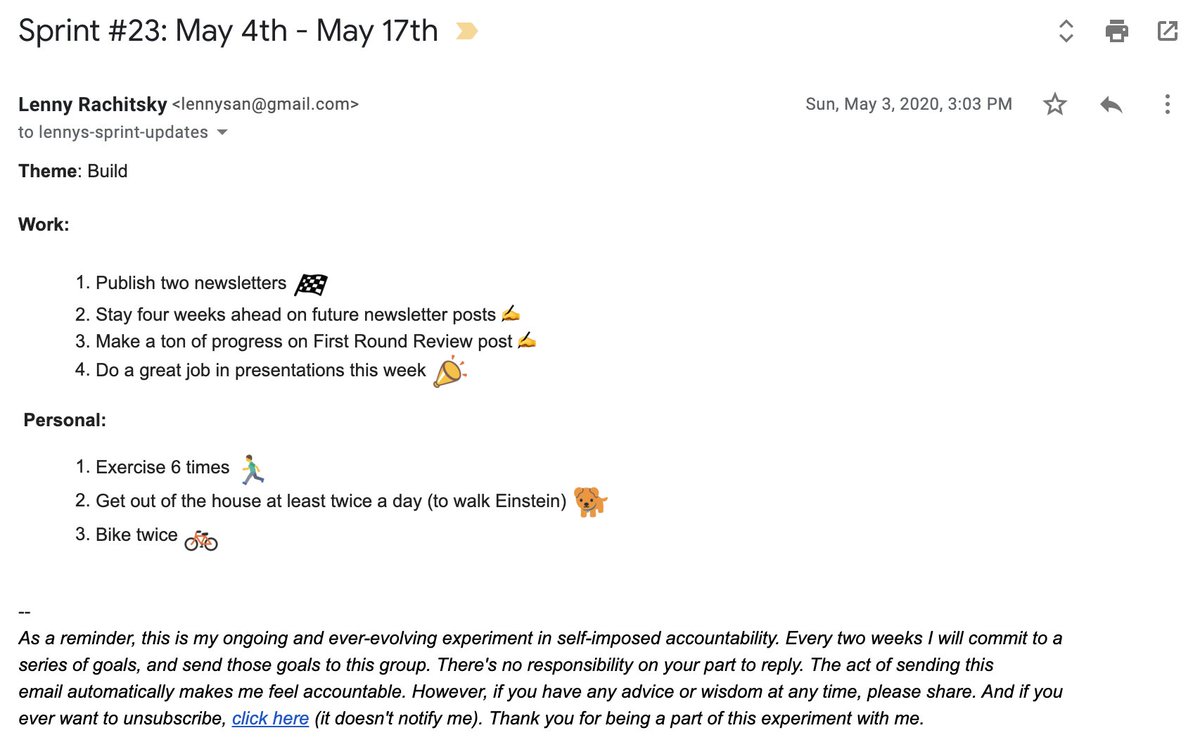
https://t.co/ZH6Dm87jFr
Life alert: I\u2019m adding a paid plan to my newsletter \U0001f91e
— Lenny Rachitsky (@lennysan) April 7, 2020
After much prodding from readers and friends, I\u2019m going to take the leap and give this life-path a shot.
Consider subscribing and joining me on this journey \U0001f64fhttps://t.co/gtFm4POGSQ
Writing is hard enough. Write about things that you're genuinely energized by, excited to learn more about, or curious about. Don't force yourself to write things you think you *should* or *need* to write about.
It won't last.
Here's what your pace should feel like, IMHO. Writing a newsletter is a marathon. Don't burn yourself out. I personally love the weekly cadence. Daily newsletters blow my mind.

Consistency + quality = you win.
Valuable, interesting, creative work always comes from focused, distraction-free time. But the world is always trying to take this time away from you. You need to find strategies to protect this time. Read this book.
https://t.co/cWaAYRzZMd
If you do have a job, can you add 3-hour blocks of time the mornings of M/W/F? Or on a weekend?
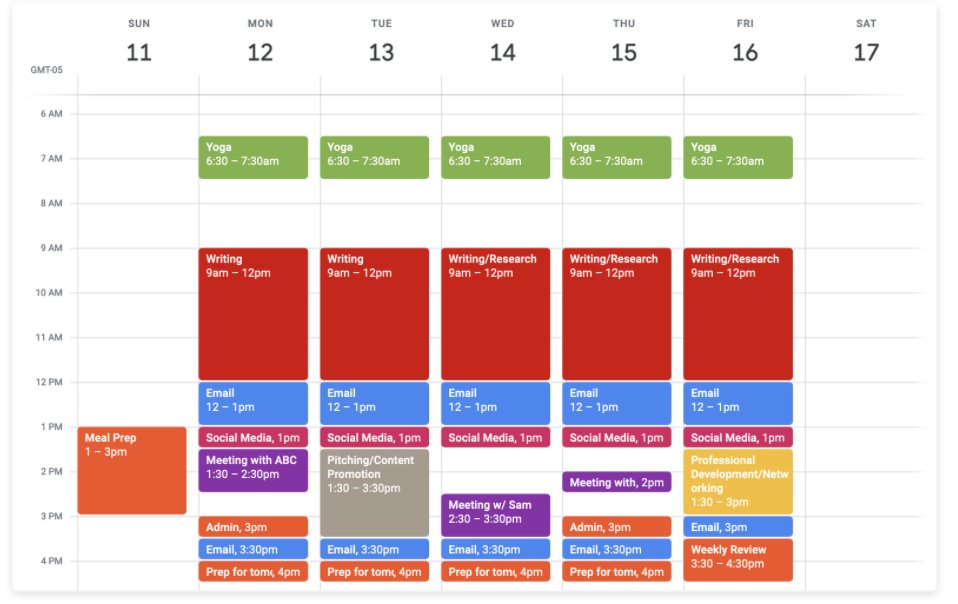
https://t.co/oZ9qOgC7nW
We have puny brains with no ability to avoid distractions. Embrace "ignorance is bliss." Shut off notifications by turning on DND.
At a minimum, do this during your deep work time. Ideally, all day.
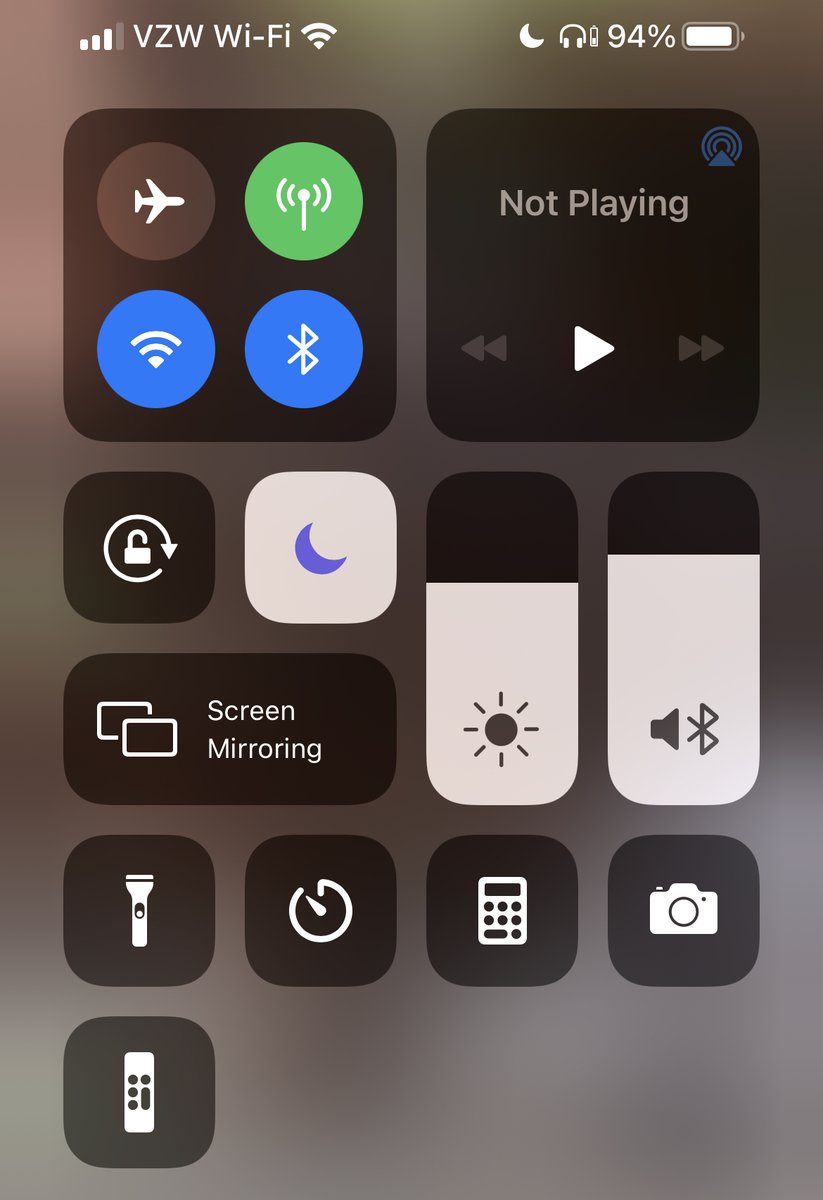
1. A TODO app to prioritize your tasks (I use @centered_app)
2. A doc tool to organize your content (I use @coda_hq)
3. A note-taking tool for quick notes (I use https://t.co/YHvgJvV9dt)
4. Tools to help you with writing (I use @Grammarly and https://t.co/tTNv9lH9Ik)
5. Nutrients to boost energy and focus (I drink tea and @magicmind)
6. A platform for hosting/sending content (I use @SubstackInc)
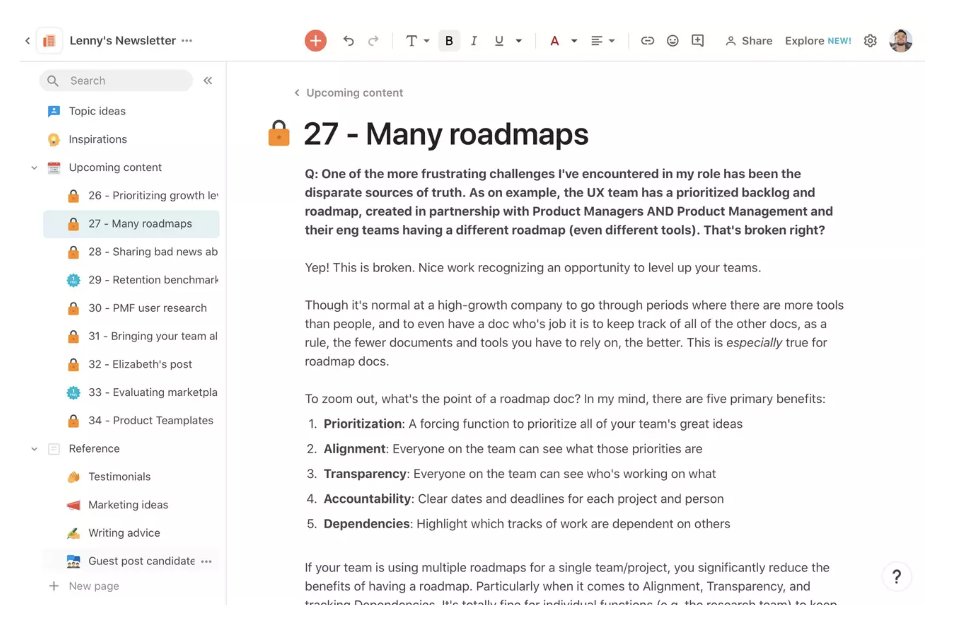
When you have time to write, you want to avoid the blank page as much as possible. What helps me is having a place to dump random idea as they come, which I can build and add to over time. I use Coda pages for this.
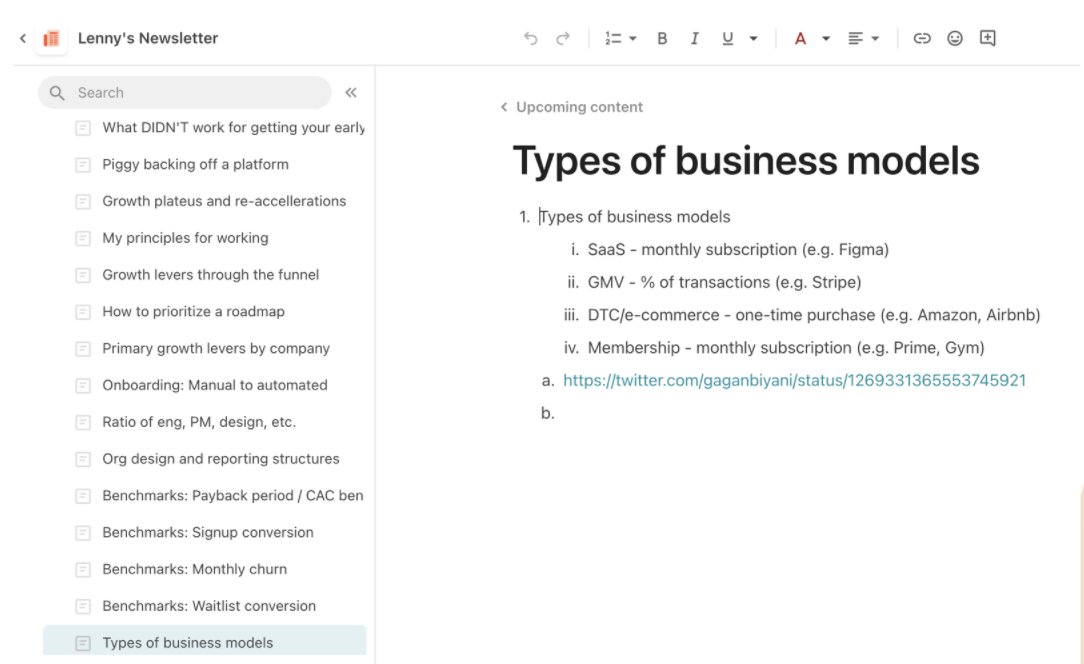

More from Lenny Rachitsky
Matt Mochary has been CEO coach to @naval, the founders of OpenAI, Notion, Rippling, Robinhood, Coinbase, Reddit, Plaid, Flexport, Opendoor, partners at Sequoia, YC, Benchmark, and many others.
He also open-sourced his entire curriculum, templates and all. Here's a link 👇
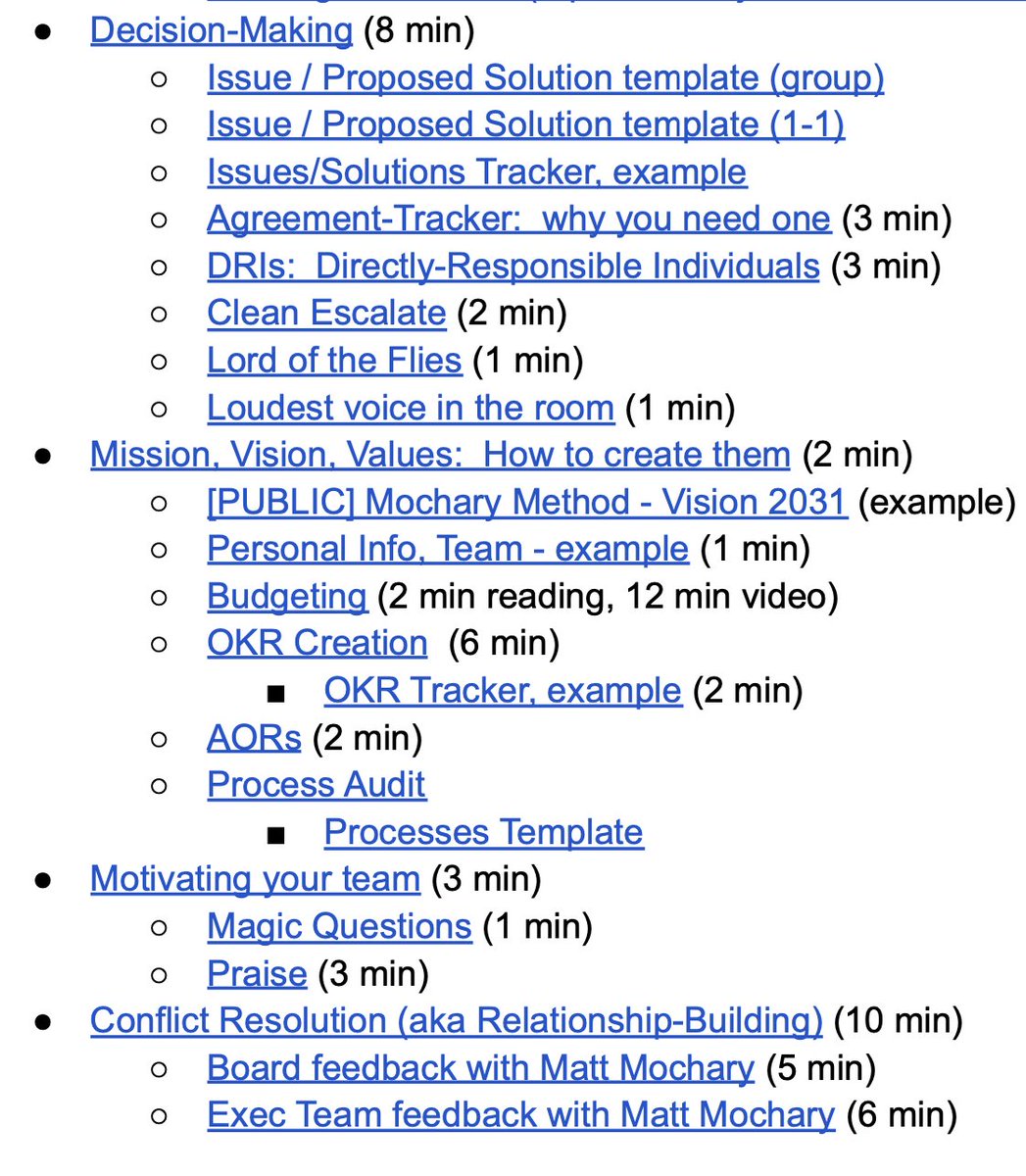
The Mochary Method Curriculum ➔ https://t.co/A8J51IzYhz
My recent conversation with @mattmochary where we talk about fear, anger, innovation, how to lay people off well, and his coaching practice ➔
Also in podcast form ➔
For more from Matt, buy this book
He also open-sourced his entire curriculum, templates and all. Here's a link 👇
The Mochary Method Curriculum ➔ https://t.co/A8J51IzYhz
My recent conversation with @mattmochary where we talk about fear, anger, innovation, how to lay people off well, and his coaching practice ➔
Also in podcast form ➔
For more from Matt, buy this book
The most sophisticated growth team no one talks about: @WishShopping
1. The #1 shopping app in 40+ countries
2. Rumored to often be the #1 spender on FB and Google
3. 2 million items sold daily
I sat down with @cplimon to learn about the notoriously secretive company. Read on 👇
1/ Your brand constraint is Wish's opportunity
Wish's superpower is leaving no room for taste or opinion. It's what happens when a machine builds a company based on data. The founder didn't plan to sell cheap goods to low-socioeconomic customers, but where the data took him.
"Until you work at a place like Wish, you don't know what data-driven is. Everyone else is data-driven when it's convenient, when it agrees with your opinions. Wish is great at ignoring their own emotions. It's data-driven with as much intellectual honesty as possible."
For example
2/ Differentiate by serving the under-served
Most of Wish’s initial sales came from places like Florida, greater LA county, and middle-America. Specifically, zip codes with 95% Spanish speakers. Later, Africa, Latin America and Eastern Europe (avg household income $18,000/year)
1. The #1 shopping app in 40+ countries
2. Rumored to often be the #1 spender on FB and Google
3. 2 million items sold daily
I sat down with @cplimon to learn about the notoriously secretive company. Read on 👇
1/ Your brand constraint is Wish's opportunity
Wish's superpower is leaving no room for taste or opinion. It's what happens when a machine builds a company based on data. The founder didn't plan to sell cheap goods to low-socioeconomic customers, but where the data took him.
"Until you work at a place like Wish, you don't know what data-driven is. Everyone else is data-driven when it's convenient, when it agrees with your opinions. Wish is great at ignoring their own emotions. It's data-driven with as much intellectual honesty as possible."
For example
cursed wish ads pic.twitter.com/eMlx4LqgKA
— big meaty claws (@leisurepIex) June 4, 2019
2/ Differentiate by serving the under-served
Most of Wish’s initial sales came from places like Florida, greater LA county, and middle-America. Specifically, zip codes with 95% Spanish speakers. Later, Africa, Latin America and Eastern Europe (avg household income $18,000/year)
More from Culture



One of the authors of the Policy Exchange report on academic free speech thinks it is "ridiculous" to expect him to accurately portray an incident at Cardiff University in his study, both in the reporting and in a question put to a student sample.
Here is the incident Kaufmann incorporated into his study, as told by a Cardiff professor who was there. As you can see, the incident involved the university intervening to *uphold* free speech principles:
Here is the first mention of the Greer at Cardiff incident in Kaufmann's report. It refers to the "concrete case" of the "no-platforming of Germaine Greer". Any reasonable reader would assume that refers to an incident of no-platforming instead of its opposite.

Here is the next mention of Greer in the report. The text asks whether the University "should have overruled protestors" and "stepped in...and guaranteed Greer the right to speak". Again the strong implication is that this did not happen and Greer was "no platformed".
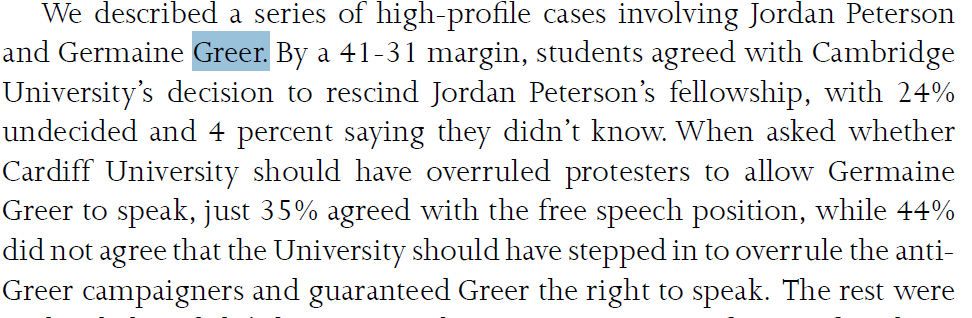
The authors could easily have added a footnote at this point explaining what actually happened in Cardiff. They did not.
This is ridiculous. Students were asked for their views on this example and several others. The study findings and conclusions were about student responses not the substance of each case. Could\u2019ve used hypotheticals. The responses not the cases were the basis of the conclusions.
— Eric Kaufmann (@epkaufm) February 17, 2021
Here is the incident Kaufmann incorporated into his study, as told by a Cardiff professor who was there. As you can see, the incident involved the university intervening to *uphold* free speech principles:
The UK govt\u2019s paper on free speech in Unis (with implications for Wales) is getting a lot of attention.
— Richard Wyn Jones (@RWynJones) February 16, 2021
Worth noting then that an important part of the evidence-base on which it rests relates to (demonstrably false) claims about my own institution
1/https://t.co/buoGE7ocG7
Here is the first mention of the Greer at Cardiff incident in Kaufmann's report. It refers to the "concrete case" of the "no-platforming of Germaine Greer". Any reasonable reader would assume that refers to an incident of no-platforming instead of its opposite.
Here is the next mention of Greer in the report. The text asks whether the University "should have overruled protestors" and "stepped in...and guaranteed Greer the right to speak". Again the strong implication is that this did not happen and Greer was "no platformed".
The authors could easily have added a footnote at this point explaining what actually happened in Cardiff. They did not.

I woke up this morning to hundreds of notifications from this tweet, which is literally just a quote from a book I am giving away tonight.
The level of vitriol in the replies is a new experience for me on here. I love Twitter, but this is the dark side of it.
Thread...
First, this quote is from a book which examines castes and slavery throughout history. Obviously Wilkerson isn’t claiming slavery was invented by America.
She says, “Slavery IN THIS LAND...” wasn’t happenstance. American chattel slavery was purposefully crafted and carried out.
That’s not a “hot take” or a fringe opinion. It’s a fact with which any reputable historian or scholar agrees.
Second, this is a perfect example of how nefarious folks operate here on Twitter...
J*mes Linds*y, P*ter Bogh*ssian and others like them purposefully misrepresent something (or just outright ignore what it actually says as they do in this case) and then feed it to their large, angry following so they will attack.
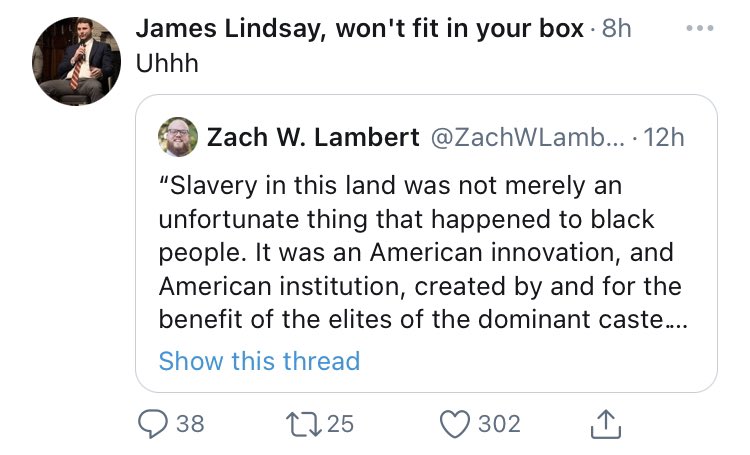
The attacks are rarely about ideas or beliefs, because purposefully misrepresenting someone’s argument prevents that from happening. Instead, the attacks are directed at the person.
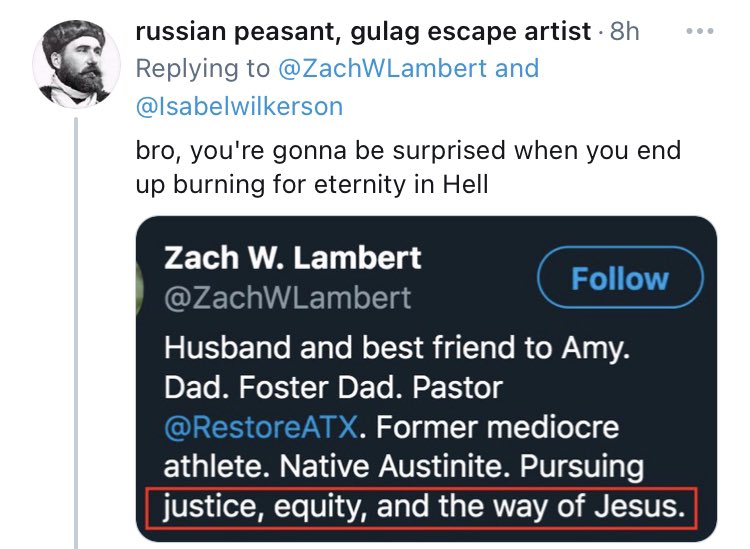
The level of vitriol in the replies is a new experience for me on here. I love Twitter, but this is the dark side of it.
Thread...
\u201cSlavery in this land was not merely an unfortunate thing that happened to black people. It was an American innovation, and American institution, created by and for the benefit of the elites of the dominant caste.\u201d @Isabelwilkerson
— Zach W. Lambert (@ZachWLambert) February 11, 2021
First, this quote is from a book which examines castes and slavery throughout history. Obviously Wilkerson isn’t claiming slavery was invented by America.
She says, “Slavery IN THIS LAND...” wasn’t happenstance. American chattel slavery was purposefully crafted and carried out.
That’s not a “hot take” or a fringe opinion. It’s a fact with which any reputable historian or scholar agrees.
Second, this is a perfect example of how nefarious folks operate here on Twitter...
J*mes Linds*y, P*ter Bogh*ssian and others like them purposefully misrepresent something (or just outright ignore what it actually says as they do in this case) and then feed it to their large, angry following so they will attack.
The attacks are rarely about ideas or beliefs, because purposefully misrepresenting someone’s argument prevents that from happening. Instead, the attacks are directed at the person.


You May Also Like

MASTER THREAD on Short Strangles.
Curated the best tweets from the best traders who are exceptional at managing strangles.
• Positional Strangles
• Intraday Strangles
• Position Sizing
• How to do Adjustments
• Plenty of Examples
• When to avoid
• Exit Criteria
How to sell Strangles in weekly expiry as explained by boss himself. @Mitesh_Engr
• When to sell
• How to do Adjustments
• Exit
Beautiful explanation on positional option selling by @Mitesh_Engr
Sir on how to sell low premium strangles yourself without paying anyone. This is a free mini course in
1st Live example of managing a strangle by Mitesh Sir. @Mitesh_Engr
• Sold Strangles 20% cap used
• Added 20% cap more when in profit
• Booked profitable leg and rolled up
• Kept rolling up profitable leg
• Booked loss in calls
• Sold only
2nd example by @Mitesh_Engr Sir on converting a directional trade into strangles. Option Sellers can use this for consistent profit.
• Identified a reversal and sold puts
• Puts decayed a lot
• When achieved 2% profit through puts then sold
Curated the best tweets from the best traders who are exceptional at managing strangles.
• Positional Strangles
• Intraday Strangles
• Position Sizing
• How to do Adjustments
• Plenty of Examples
• When to avoid
• Exit Criteria
How to sell Strangles in weekly expiry as explained by boss himself. @Mitesh_Engr
• When to sell
• How to do Adjustments
• Exit
1. Let's start option selling learning.
— Mitesh Patel (@Mitesh_Engr) February 10, 2019
Strangle selling. ( I am doing mostly in weekly Bank Nifty)
When to sell? When VIX is below 15
Assume spot is at 27500
Sell 27100 PE & 27900 CE
say premium for both 50-50
If bank nifty will move in narrow range u will get profit from both.
Beautiful explanation on positional option selling by @Mitesh_Engr
Sir on how to sell low premium strangles yourself without paying anyone. This is a free mini course in
Few are selling 20-25 Rs positional option selling course.
— Mitesh Patel (@Mitesh_Engr) November 3, 2019
Nothing big deal in that.
For selling weekly option just identify last week low and high.
Now from that low and high keep 1-1.5% distance from strike.
And sell option on both side.
1/n
1st Live example of managing a strangle by Mitesh Sir. @Mitesh_Engr
• Sold Strangles 20% cap used
• Added 20% cap more when in profit
• Booked profitable leg and rolled up
• Kept rolling up profitable leg
• Booked loss in calls
• Sold only
Sold 29200 put and 30500 call
— Mitesh Patel (@Mitesh_Engr) April 12, 2019
Used 20% capital@44 each
2nd example by @Mitesh_Engr Sir on converting a directional trade into strangles. Option Sellers can use this for consistent profit.
• Identified a reversal and sold puts
• Puts decayed a lot
• When achieved 2% profit through puts then sold
Already giving more than 2% return in a week. Now I will prefer to sell 32500 call at 74 to make it strangle in equal ratio.
— Mitesh Patel (@Mitesh_Engr) February 7, 2020
To all. This is free learning for you. How to play option to make consistent return.
Stay tuned and learn it here free of cost. https://t.co/7J7LC86oW0


Facebook originally a CIA program called "LifeLog".
LifeLog, via DARPA, terminated on Feb 4th, 2004.
Facebook was launched on Feb 4th, 2004.
Many of the LifeLog team became execs at FB.
Zuckerberg is a figurehead.
CIA allowed Cambridge to help Trump win
https://t.co/enzOXDCogV

Pentagon Kills LifeLog
LifeLog, via DARPA, terminated on Feb 4th, 2004.
Facebook was launched on Feb 4th, 2004.
Many of the LifeLog team became execs at FB.
Zuckerberg is a figurehead.
CIA allowed Cambridge to help Trump win
https://t.co/enzOXDCogV
Project: Lifelog
— Robert Horan (@Robby12692) December 13, 2018
Started by DARPA in 1999, the goal of Lifelog was to create a database on civilians without their knowledge, and track everything they do.
The project "ended" on Feb 4th, 2004.
Facebook began the exact same day.
The CIA funneled tens of millions into Facebook. pic.twitter.com/r7hwF0v9kh
Pentagon Kills LifeLog

