About 20% beyond core case of government-critical speech in formally public spaces and media I'd say.
There are only 3 real challenges to free speech at the tech level a) the need for CDNs at scale b) distortions of net neutrality c) nation-state firewalls.
All other claims are about social governance on private sites, where applying free speech doctrine is a stretch at best
About 20% beyond core case of government-critical speech in formally public spaces and media I'd say.
That's a genuine de facto increase in practical, informal free speech/expression.
This is reasonable. You should not expect no-strings-attached access to the attention of potentially billions of people under the same terms as ranting from a soapbox in a 19th century town square.
More from Venkatesh Rao
Both this thread and the outraged response threads are... something.
This is why I never wanted kids. Way too much responsibility for another human’s development. Depending on the child, this might either be the day they discovered who they were or the day that traumatized them into a lifelong fuckup. Either way I don’t want to direct the show.
As far as the can opener goes, it wouldn’t even occur to me to try and turn it into a teachable moment. That sounds vaguely quixotic. I’d just show them how immediately. I think my default is to try and instruct clearly but not demonstrate unless the person is truly disoriented.
I think there’s basically a right answer here: show the kid. If the kid has the aptitude they’ll enjoy the mechanism so much they’ll develop the figure-it-out skill with other devices. If not, it’s a training data point that will build remedial levels of intuition more slowly.
I think perseverance is both misframed and over-rated as a virtue. Misframed as in: everybody has potential for it in some areas and lacks it in others. Aptitude is those areas where perseverance comes easily to you. Meta-skill of knowing where/why you persist is more important.
So, yesterday my daughter (9) was hungry and I was doing a jigsaw puzzle so I said over my shoulder \u201cmake some baked beans.\u201d She said, \u201cHow?\u201d like all kids do when they want YOU to do it, so I said, \u201cOpen a can and put it in pot.\u201d She brought me the can and said \u201cOpen it how?\u201d
— john roderick (@johnroderick) January 2, 2021
This is why I never wanted kids. Way too much responsibility for another human’s development. Depending on the child, this might either be the day they discovered who they were or the day that traumatized them into a lifelong fuckup. Either way I don’t want to direct the show.
As far as the can opener goes, it wouldn’t even occur to me to try and turn it into a teachable moment. That sounds vaguely quixotic. I’d just show them how immediately. I think my default is to try and instruct clearly but not demonstrate unless the person is truly disoriented.
I think there’s basically a right answer here: show the kid. If the kid has the aptitude they’ll enjoy the mechanism so much they’ll develop the figure-it-out skill with other devices. If not, it’s a training data point that will build remedial levels of intuition more slowly.
I think perseverance is both misframed and over-rated as a virtue. Misframed as in: everybody has potential for it in some areas and lacks it in others. Aptitude is those areas where perseverance comes easily to you. Meta-skill of knowing where/why you persist is more important.
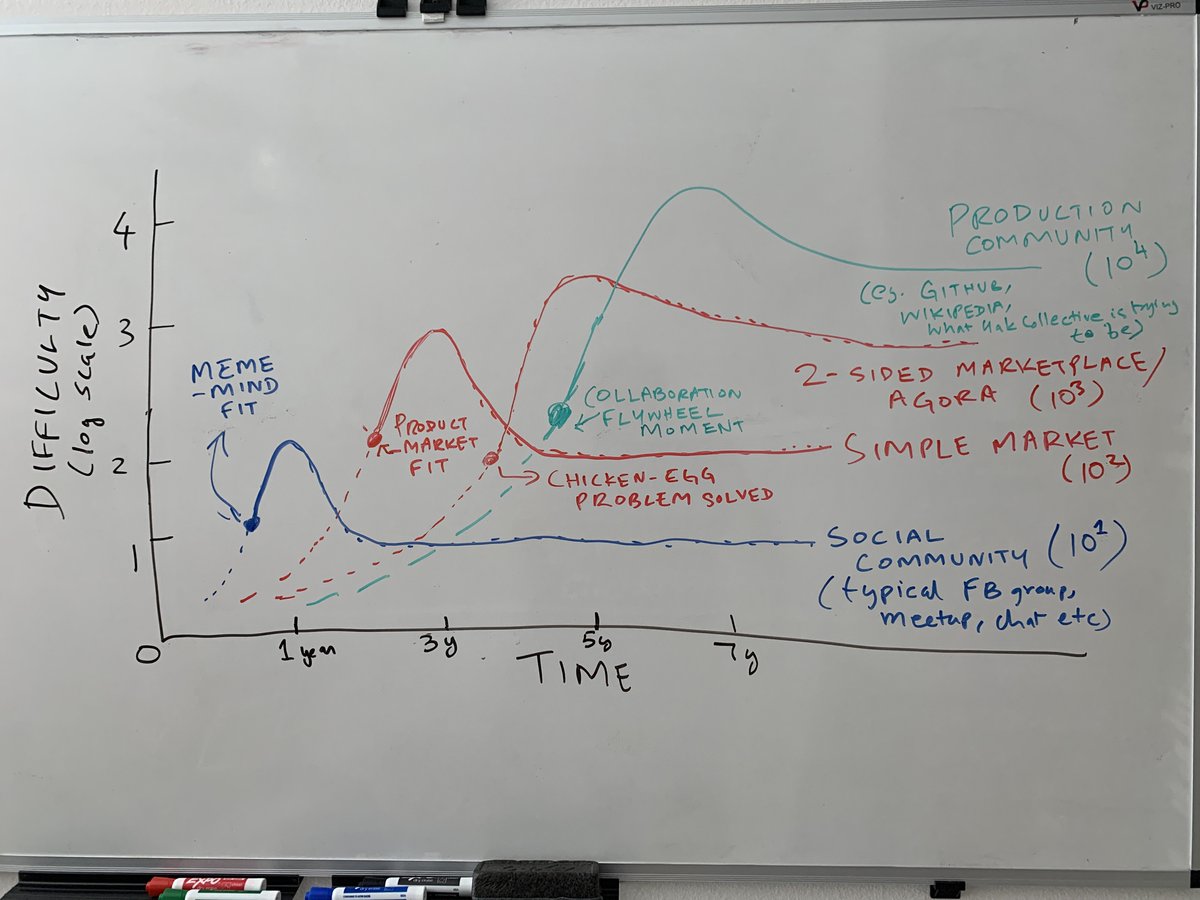
I’m guessing these responses really reflect people’s weighted averages (age*current average effort fraction) though I kept it simple and asked for just averages.
I suspect a healthy weighted average should be ~ (age-20)/2. So a 30 year old should be at 5, a 40 year old at 10, a 50 year old at 15 etc.
Standard deviation should be ~average/3 maybe, so distribution spreads as you age and accumulate projects and get better at them.
Other things being equal, people get good at starting in their 20s, at follow through in 30s, at finishing in 40s.
No point learning food follow through until you’ve found a few good starts to bet on. No point getting good at finishing until a few projects have aged gracefully.
I’m in the 7+ range myself. Probably 8-9. Slightly less than healthy for my age.
I suspect most self-judgments on being good starters/follow-through-ers/finishers are really flawed because of the non-ergodicity of project management skill learning. You can’t learn good practices for the 3 phases in an arbitrary order. On,y one order actually works.
Poll: where is the temporal center of gravity of all your live projects based on average age of start-dates?
— Venkatesh Rao (@vgr) January 17, 2021
I suspect a healthy weighted average should be ~ (age-20)/2. So a 30 year old should be at 5, a 40 year old at 10, a 50 year old at 15 etc.
Standard deviation should be ~average/3 maybe, so distribution spreads as you age and accumulate projects and get better at them.
Other things being equal, people get good at starting in their 20s, at follow through in 30s, at finishing in 40s.
No point learning food follow through until you’ve found a few good starts to bet on. No point getting good at finishing until a few projects have aged gracefully.
I’m in the 7+ range myself. Probably 8-9. Slightly less than healthy for my age.
I suspect most self-judgments on being good starters/follow-through-ers/finishers are really flawed because of the non-ergodicity of project management skill learning. You can’t learn good practices for the 3 phases in an arbitrary order. On,y one order actually works.
More from Tech


You May Also Like




1/ Here’s a list of conversational frameworks I’ve picked up that have been helpful.
Please add your own.
2/ The Magic Question: "What would need to be true for you
3/ On evaluating where someone’s head is at regarding a topic they are being wishy-washy about or delaying.
“Gun to the head—what would you decide now?”
“Fast forward 6 months after your sabbatical--how would you decide: what criteria is most important to you?”
4/ Other Q’s re: decisions:
“Putting aside a list of pros/cons, what’s the *one* reason you’re doing this?” “Why is that the most important reason?”
“What’s end-game here?”
“What does success look like in a world where you pick that path?”
5/ When listening, after empathizing, and wanting to help them make their own decisions without imposing your world view:
“What would the best version of yourself do”?
Please add your own.
2/ The Magic Question: "What would need to be true for you
1/\u201cWhat would need to be true for you to\u2026.X\u201d
— Erik Torenberg (@eriktorenberg) December 4, 2018
Why is this the most powerful question you can ask when attempting to reach an agreement with another human being or organization?
A thread, co-written by @deanmbrody: https://t.co/Yo6jHbSit9
3/ On evaluating where someone’s head is at regarding a topic they are being wishy-washy about or delaying.
“Gun to the head—what would you decide now?”
“Fast forward 6 months after your sabbatical--how would you decide: what criteria is most important to you?”
4/ Other Q’s re: decisions:
“Putting aside a list of pros/cons, what’s the *one* reason you’re doing this?” “Why is that the most important reason?”
“What’s end-game here?”
“What does success look like in a world where you pick that path?”
5/ When listening, after empathizing, and wanting to help them make their own decisions without imposing your world view:
“What would the best version of yourself do”?