Mark Zuckerberg on NYT story: "To suggest we weren't interested in knowing the truth or wanted to hide what we knew or wanted to prevent investigations is simply untrue."
The entire discussion around Facebook\u2019s disclosures of what happened in 2016 is very frustrating. No exec stopped any investigations, but there were a lot of heated discussions about what to publish and when. https://t.co/dSOpKy767l
— Alex Stamos (@alexstamos) November 15, 2018
Why isn\u2019t Sheryl Sandberg on this call?
— Dylan Byers (@DylanByers) November 15, 2018
Zuckerberg: Blah blah. I generally don't talk about specific cases of that in public. Blah blah.
Zuckerberg: I learned about this yesterday. In general, I think you're right. This might be normal in Washington but it's not the kind of thing we want Facebook associated with.
Facebook: ... We are bringing the world closer together.
Zuckerberg: We have made personnel changes. Hey, we just hired a new global policy and comms chief. Let's focus on that.
"I am quite focused on finding ways to get more independence into our systems in other ways."
Zuckerberg: Transparency is one of the bigger areas where we have to continue to do more.
Zuckerberg: "I think someone on our comms team must have hired them."
Comms team, meet the bus that just ran you over.
Worthwhile to read through this whole thread of Stamos replying to our report: https://t.co/0QXNjU0waB
— Sheera Frenkel (@sheeraf) November 15, 2018
Zuckerberg: Sheryl learned about this at the same time that I did. Overall Sheryl is doing great work for the company. She has been a very important partner to me and will continue to be.
Mark Zuckerberg: I have no idea what's happening inside my own company and neither does Sheryl.
Zuckerberg: We are doing the right things to fix the issues. I am fully committed to getting this right.
More from Tech
Recently, the @CNIL issued a decision regarding the GDPR compliance of an unknown French adtech company named "Vectaury". It may seem like small fry, but the decision has potential wide-ranging impacts for Google, the IAB framework, and today's adtech. It's thread time! 👇
It's all in French, but if you're up for it you can read:
• Their blog post (lacks the most interesting details): https://t.co/PHkDcOT1hy
• Their high-level legal decision: https://t.co/hwpiEvjodt
• The full notification: https://t.co/QQB7rfynha
I've read it so you needn't!
Vectaury was collecting geolocation data in order to create profiles (eg. people who often go to this or that type of shop) so as to power ad targeting. They operate through embedded SDKs and ad bidding, making them invisible to users.
The @CNIL notes that profiling based off of geolocation presents particular risks since it reveals people's movements and habits. As risky, the processing requires consent — this will be the heart of their assessment.
Interesting point: they justify the decision in part because of how many people COULD be targeted in this way (rather than how many have — though they note that too). Because it's on a phone, and many have phones, it is considered large-scale processing no matter what.
It's all in French, but if you're up for it you can read:
• Their blog post (lacks the most interesting details): https://t.co/PHkDcOT1hy
• Their high-level legal decision: https://t.co/hwpiEvjodt
• The full notification: https://t.co/QQB7rfynha
I've read it so you needn't!
Vectaury was collecting geolocation data in order to create profiles (eg. people who often go to this or that type of shop) so as to power ad targeting. They operate through embedded SDKs and ad bidding, making them invisible to users.
The @CNIL notes that profiling based off of geolocation presents particular risks since it reveals people's movements and habits. As risky, the processing requires consent — this will be the heart of their assessment.
Interesting point: they justify the decision in part because of how many people COULD be targeted in this way (rather than how many have — though they note that too). Because it's on a phone, and many have phones, it is considered large-scale processing no matter what.
The 12 most important pieces of information and concepts I wish I knew about equity, as a software engineer.
A thread.
1. Equity is something Big Tech and high-growth companies award to software engineers at all levels. The more senior you are, the bigger the ratio can be:
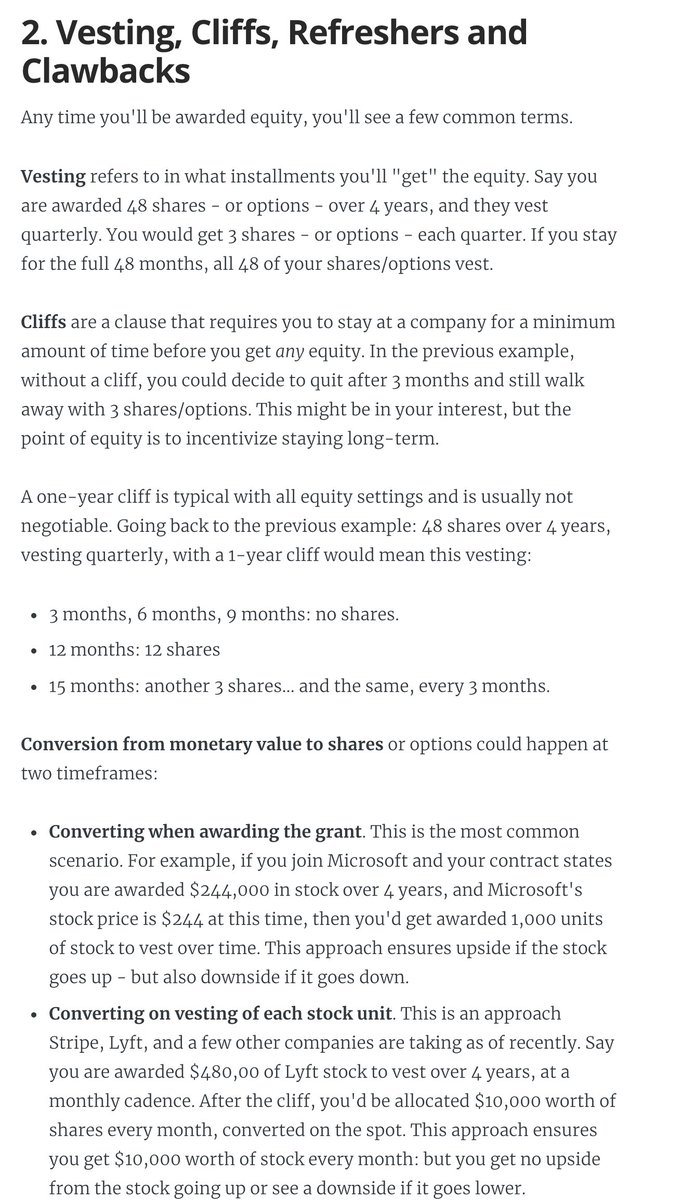
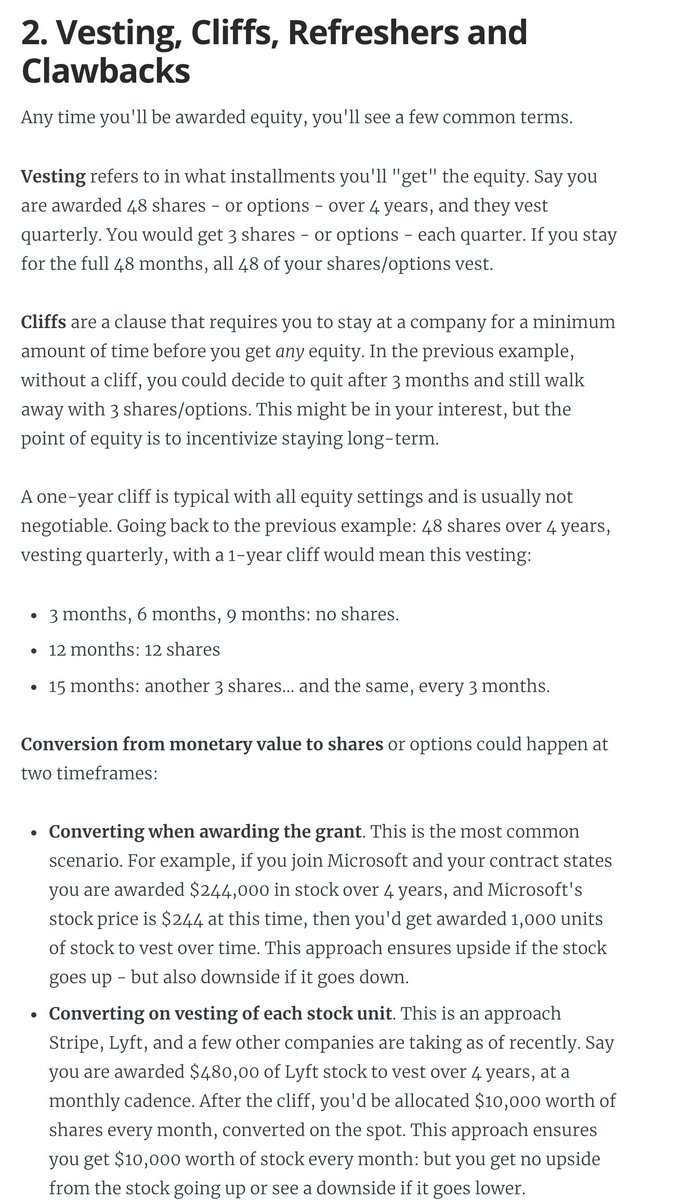
2. Vesting, cliffs, refreshers, and sign-on clawbacks.
If you get awarded equity, you'll want to understand vesting and cliffs. A 1-year cliff is pretty common in most places that award equity.
Read more in this blog post I wrote: https://t.co/WxQ9pQh2mY
3. Stock options / ESOPs.
The most common form of equity compensation at early-stage startups that are high-growth.
And there are *so* many pitfalls you'll want to be aware of. You need to do your research on this: I can't do justice in a tweet.
https://t.co/cudLn3ngqi
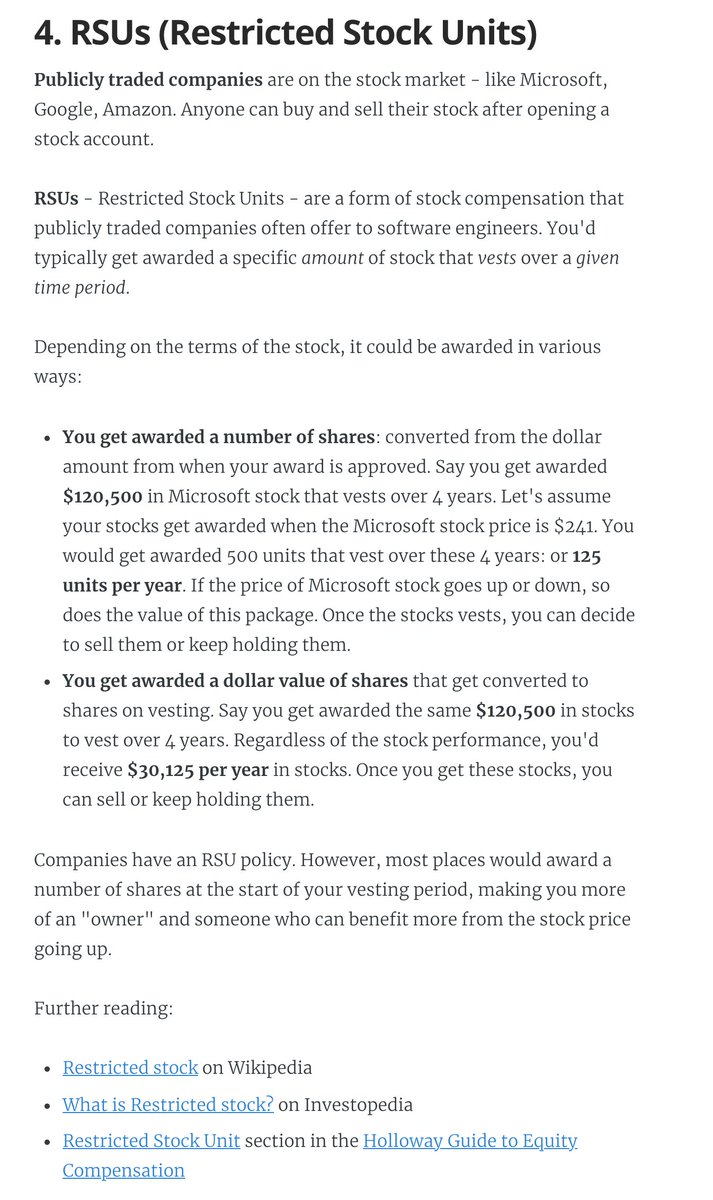
4. RSUs (Restricted Stock Units)
A common form of equity compensation for publicly traded companies and Big Tech. One of the easier types of equity to understand: https://t.co/a5xU1H9IHP
5. Double-trigger RSUs. Typically RSUs for pre-IPO companies. I got these at Uber.
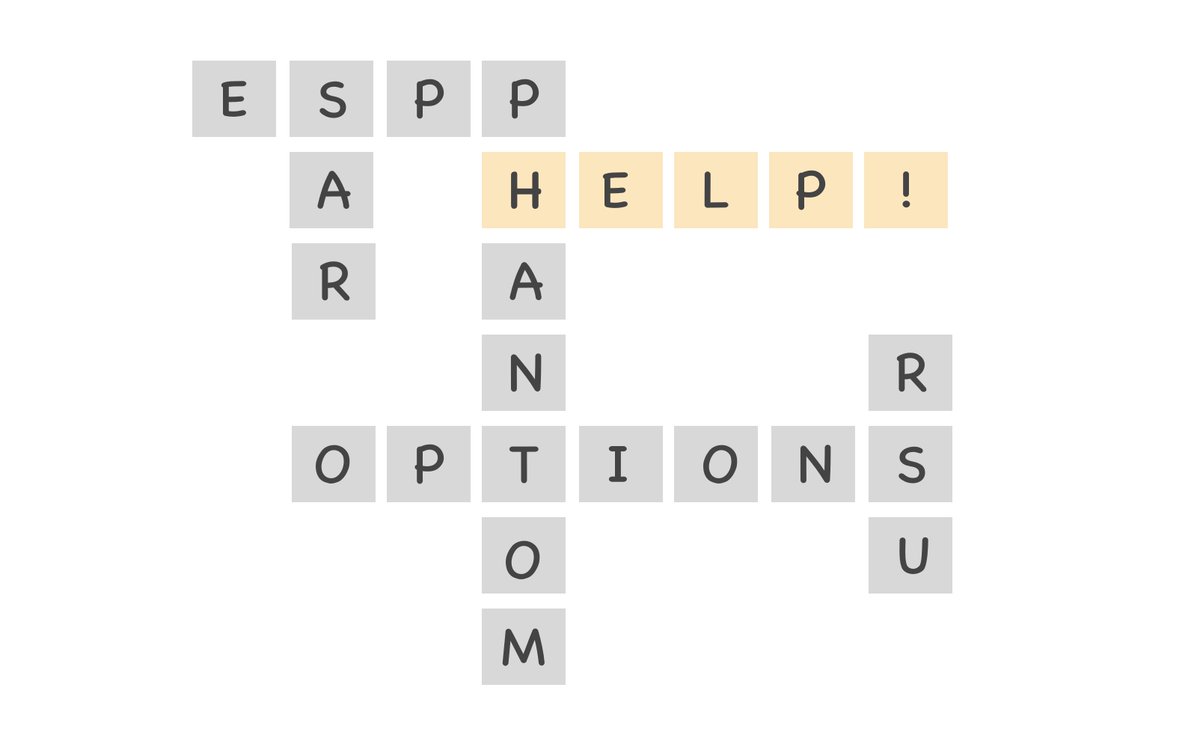
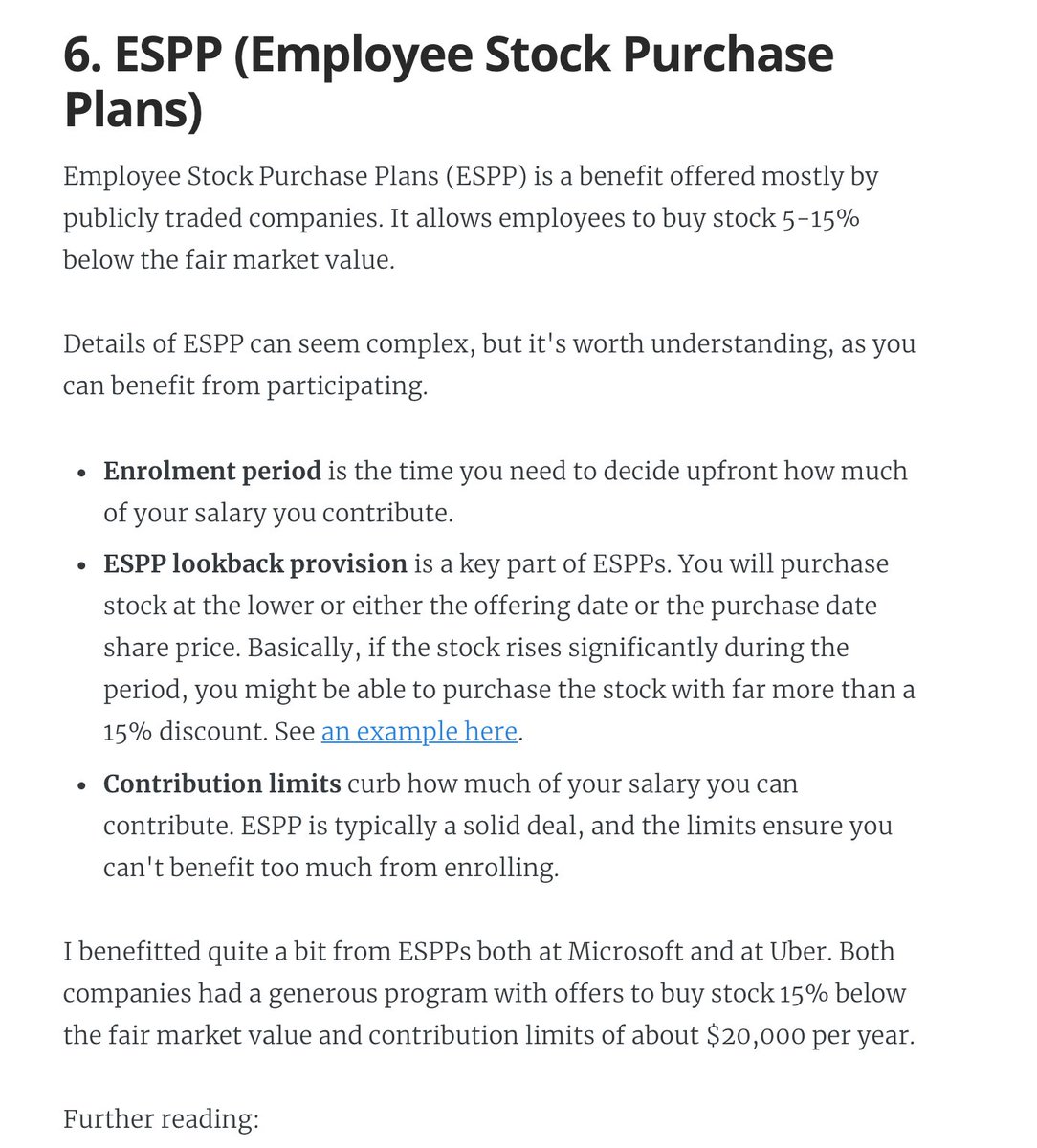
6. ESPP: a (typically) amazing employee perk at publicly traded companies. There's always risk, but this plan can typically offer good upsides.
7. Phantom shares. An interesting setup similar to RSUs... but you don't own stocks. Not frequent, but e.g. Adyen goes with this plan.
A thread.
1. Equity is something Big Tech and high-growth companies award to software engineers at all levels. The more senior you are, the bigger the ratio can be:
2. Vesting, cliffs, refreshers, and sign-on clawbacks.
If you get awarded equity, you'll want to understand vesting and cliffs. A 1-year cliff is pretty common in most places that award equity.
Read more in this blog post I wrote: https://t.co/WxQ9pQh2mY
3. Stock options / ESOPs.
The most common form of equity compensation at early-stage startups that are high-growth.
And there are *so* many pitfalls you'll want to be aware of. You need to do your research on this: I can't do justice in a tweet.
https://t.co/cudLn3ngqi
4. RSUs (Restricted Stock Units)
A common form of equity compensation for publicly traded companies and Big Tech. One of the easier types of equity to understand: https://t.co/a5xU1H9IHP
5. Double-trigger RSUs. Typically RSUs for pre-IPO companies. I got these at Uber.
6. ESPP: a (typically) amazing employee perk at publicly traded companies. There's always risk, but this plan can typically offer good upsides.
7. Phantom shares. An interesting setup similar to RSUs... but you don't own stocks. Not frequent, but e.g. Adyen goes with this plan.
You May Also Like
First thread of the year because I have time during MCO. As requested, a thread on the gods and spirits of Malay folk religion. Some are indigenous, some are of Indian origin, some have Islamic
Before I begin, it might be worth explaining the Malay conception of the spirit world. At its deepest level, Malay religious belief is animist. All living beings and even certain objects are said to have a soul. Natural phenomena are either controlled by or personified as spirits
Although these beings had to be respected, not all of them were powerful enough to be considered gods. Offerings would be made to the spirits that had greater influence on human life. Spells and incantations would invoke their
Two known examples of such elemental spirits that had god-like status are Raja Angin (king of the wind) and Mambang Tali Arus (spirit of river currents). There were undoubtedly many more which have been lost to time
Contact with ancient India brought the influence of Hinduism and Buddhism to SEA. What we now call Hinduism similarly developed in India out of native animism and the more formal Vedic tradition. This can be seen in the multitude of sacred animals and location-specific Hindu gods
i wonder if you can make a thread bout witchcraft in malaysia.. or list of our own local gods/deites..
— r a y a \U0001f319 (@lcvelylilith) February 20, 2020
Before I begin, it might be worth explaining the Malay conception of the spirit world. At its deepest level, Malay religious belief is animist. All living beings and even certain objects are said to have a soul. Natural phenomena are either controlled by or personified as spirits
Although these beings had to be respected, not all of them were powerful enough to be considered gods. Offerings would be made to the spirits that had greater influence on human life. Spells and incantations would invoke their
Animist ceremonies of a religious or magical nature were normally held for the purpose of divination or making a request. This would either be done at a keramat or at a shrine similar to the Thai spirit houses or Chinese roadside shrines pic.twitter.com/I1hliyi0x3
— \u2745\u1710\u170b\u1713\u170e (@uglyluhan) June 16, 2019
Two known examples of such elemental spirits that had god-like status are Raja Angin (king of the wind) and Mambang Tali Arus (spirit of river currents). There were undoubtedly many more which have been lost to time
Contact with ancient India brought the influence of Hinduism and Buddhism to SEA. What we now call Hinduism similarly developed in India out of native animism and the more formal Vedic tradition. This can be seen in the multitude of sacred animals and location-specific Hindu gods