First, It does not acknowledge the fact that Yudkowsky is, at heart, a complete crank. This remains, to my mind, crucial to understanding the rationalist community’s influence on the world: they’re sci-fi writers being mistaken for scientists.
I’m quoted in this, which does about as good a job overviewing the topic as a New York Times profile can be expected to.
First, It does not acknowledge the fact that Yudkowsky is, at heart, a complete crank. This remains, to my mind, crucial to understanding the rationalist community’s influence on the world: they’re sci-fi writers being mistaken for scientists.
That’s it. That’s the meaning.
I have so much I could say about this, having been on the peripheries of this world for many years now. But I will say from personal experience this world is rife with violence against women both in and out of the "rationalist" community, from online harassment to rape and DV. https://t.co/fpG4tiX4Ms
— Alexandra Walling (@chorizanthe) February 13, 2021
More from Tech


These past few days I've been experimenting with something new that I want to use by myself.
Interestingly, this thread below has been written by that.
Let me show you how it looks like. 👇🏻
When you see localhost up there, you should know that it's truly an experiment! 😀
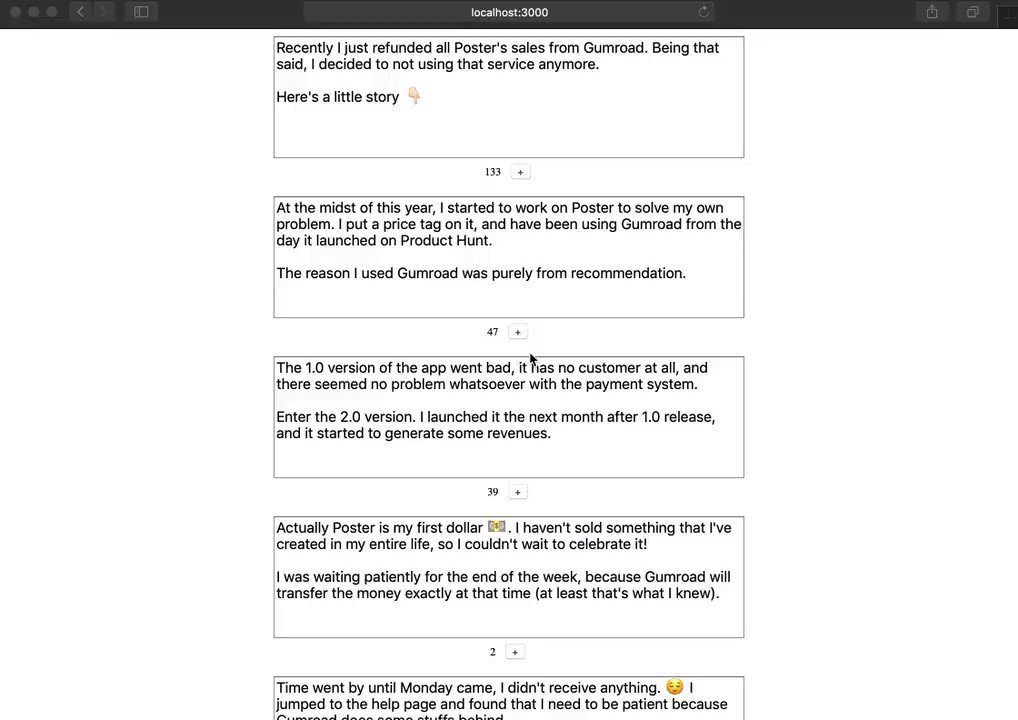
It's a dead-simple thread writer that will post a series of tweets a.k.a tweetstorm. ⚡️
I've been personally wanting it myself since few months ago, but neglected it intentionally to make sure it's something that I genuinely need.
So why is that important for me? 🙂
I've been a believer of a story. I tell stories all the time, whether it's in the real world or online like this. Our society has moved by that.
If you're interested by stories that move us, read Sapiens!
One of the stories that I've told was from the launch of Poster.
It's been launched multiple times this year, and Twitter has been my go-to place to tell the world about that.
Here comes my frustration.. 😤
Interestingly, this thread below has been written by that.
Let me show you how it looks like. 👇🏻
Recently I just refunded all Poster's sales from Gumroad. Being that said, I decided to not using that service anymore.
— Wilbert Liu \U0001f468\U0001f3fb\u200d\U0001f3a8 (@wilbertliu) November 19, 2018
Here's a little story \U0001f447\U0001f3fb
When you see localhost up there, you should know that it's truly an experiment! 😀
It's a dead-simple thread writer that will post a series of tweets a.k.a tweetstorm. ⚡️
I've been personally wanting it myself since few months ago, but neglected it intentionally to make sure it's something that I genuinely need.
So why is that important for me? 🙂
I've been a believer of a story. I tell stories all the time, whether it's in the real world or online like this. Our society has moved by that.
If you're interested by stories that move us, read Sapiens!
One of the stories that I've told was from the launch of Poster.
It's been launched multiple times this year, and Twitter has been my go-to place to tell the world about that.
Here comes my frustration.. 😤

1. One of the best changes in recent years is the GOP abandoning libertarianism. Here's GOP Rep. Greg Steube: “I do think there is an appetite amongst Republicans, if the Dems wanted to try to break up Big Tech, I think there is support for that."
2. And @RepKenBuck, who offered a thoughtful Third Way report on antitrust law in 2020, weighed in quite reasonably on Biden antitrust frameworks.
3. I believe this change is sincere because it's so pervasive and beginning to result in real policy changes. Example: The North Dakota GOP is taking on Apple's app store.
4. And yet there's a problem. The GOP establishment is still pro-big tech. Trump, despite some of his instincts, appointed pro-monopoly antitrust enforcers. Antitrust chief Makan Delrahim helped big tech, and the antitrust case happened bc he was recused.
5. At the other sleepy antitrust agency, the Federal Trade Commission, Trump appointed commissioners
@FTCPhillips and @CSWilsonFTC are both pro-monopoly. Both voted *against* the antitrust case on FB. That case was 3-2, with a GOP Chair and 2 Dems teaming up against 2 Rs.
2. And @RepKenBuck, who offered a thoughtful Third Way report on antitrust law in 2020, weighed in quite reasonably on Biden antitrust frameworks.
3. I believe this change is sincere because it's so pervasive and beginning to result in real policy changes. Example: The North Dakota GOP is taking on Apple's app store.
Republican North Dakota legislators have introduced #SB2333, a bill that prohibits large tech companies from locking their users into a single app store or payment processor.https://t.co/PgyhgOhFAl
— Cory Doctorow #BLM (@doctorow) February 11, 2021
1/ pic.twitter.com/KZ8BMFQoPO
4. And yet there's a problem. The GOP establishment is still pro-big tech. Trump, despite some of his instincts, appointed pro-monopoly antitrust enforcers. Antitrust chief Makan Delrahim helped big tech, and the antitrust case happened bc he was recused.
5. At the other sleepy antitrust agency, the Federal Trade Commission, Trump appointed commissioners
@FTCPhillips and @CSWilsonFTC are both pro-monopoly. Both voted *against* the antitrust case on FB. That case was 3-2, with a GOP Chair and 2 Dems teaming up against 2 Rs.