Next up at #enigma2021, Sanghyun Hong will be speaking about "A SOUND MIND IN A VULNERABLE BODY: PRACTICAL HARDWARE ATTACKS ON DEEP LEARNING"
(Hint: speaker is on the
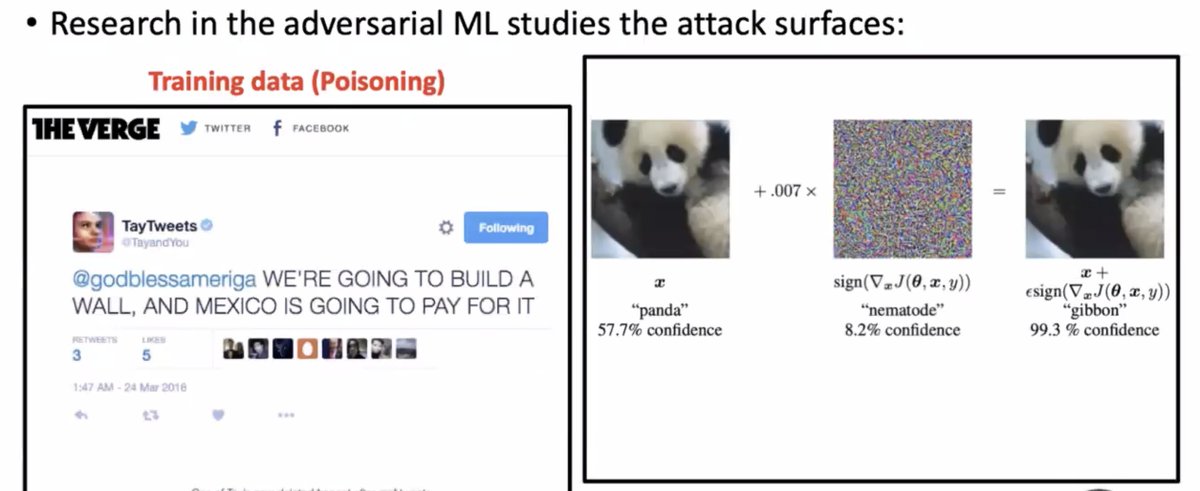
* looks at the robustness in an isolated manner
* doesn't look at the whole ecosystem and how the model is used -- ML models are running in real hardware with real software which has real vulns!
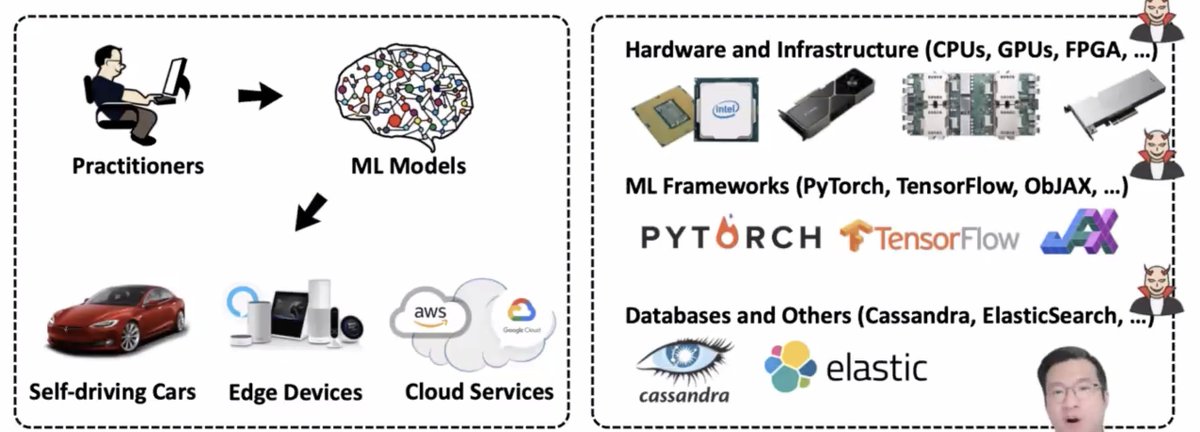
e.g. fault injection attacks, side-channel attacks
* co-location of VMs from different users
* weak attackers with less subtle control
The cloud providers try to secure things, e.g. protections against Rowhammer
... BUT this focuses on the average or best case, not the worst cast!
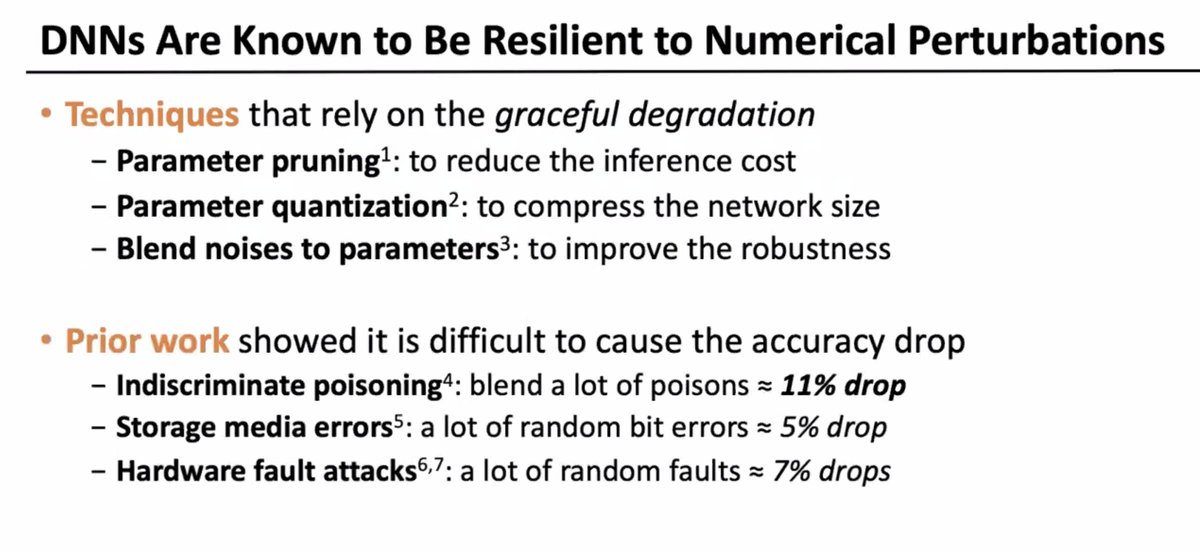
* negligible effect on the average case accuracy
* but flipping one bit can make significant amount of damage for particular queries
How much damage can a single bit flip cause?
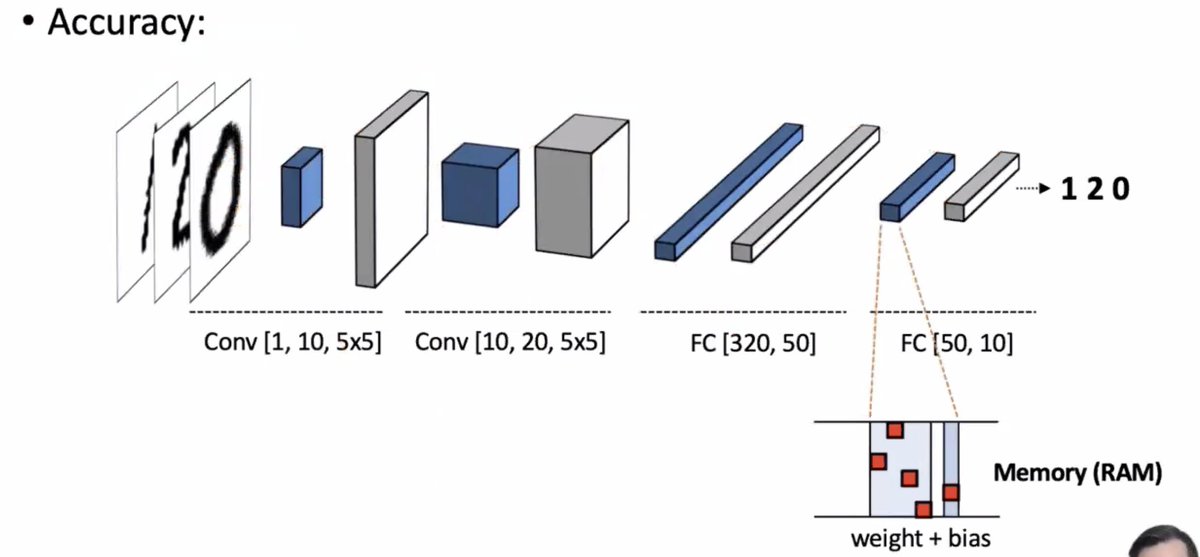


Some strong attackers might be able to hit an "achilles" bit (one that's really going to mess with the model), but weaker attackers are going to hit bits more randomly.
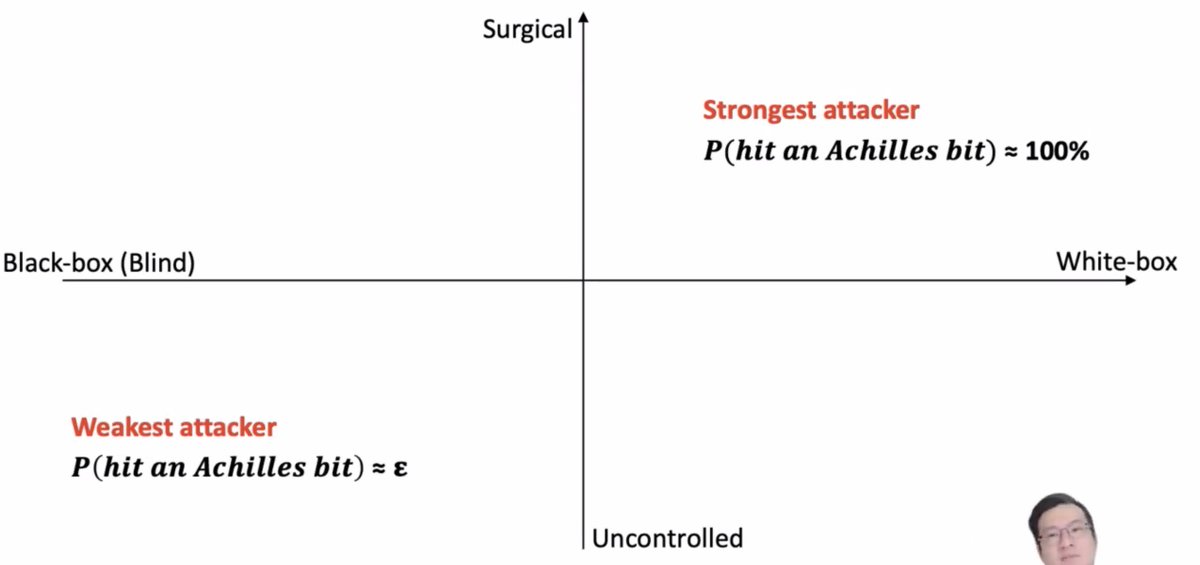


The attacker might want to get their hands on fancy DNNs which are considered trade secrets and proprietary to their creators. They're expensive to make! They need good training data! People want to protect them!
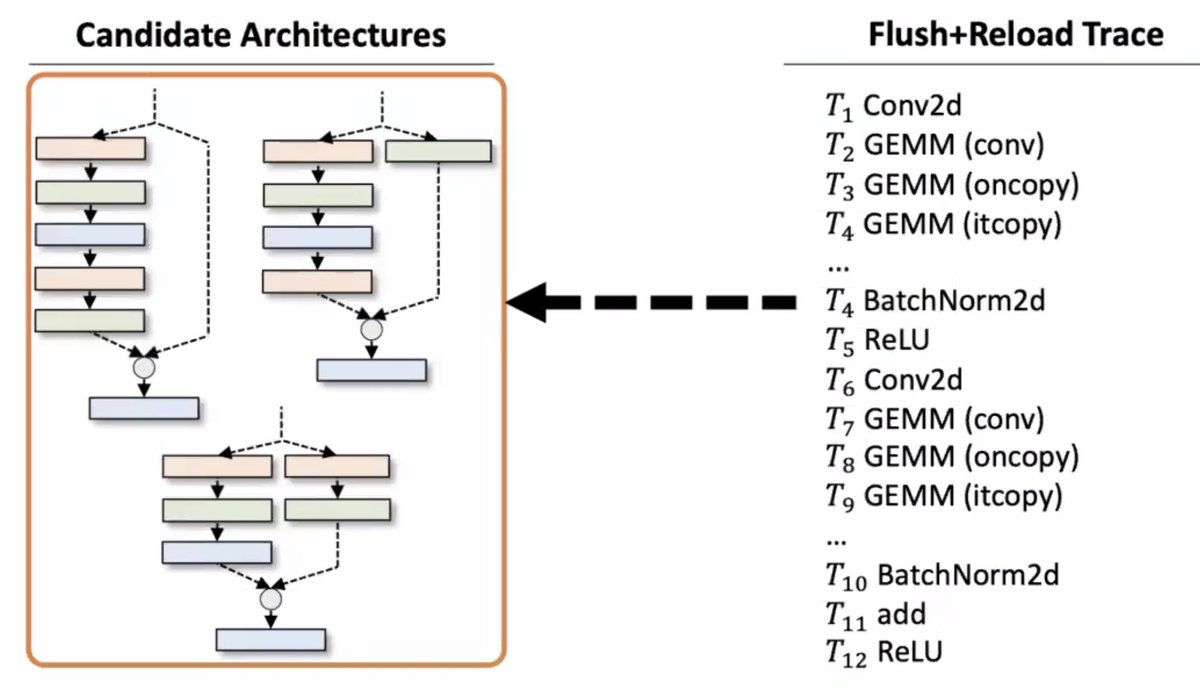
Does this work? Apparently so: they tried it out using a cache side-channel attack and got back the architectures of the fancy DNN back.

More from Lea Kissner


More from Science

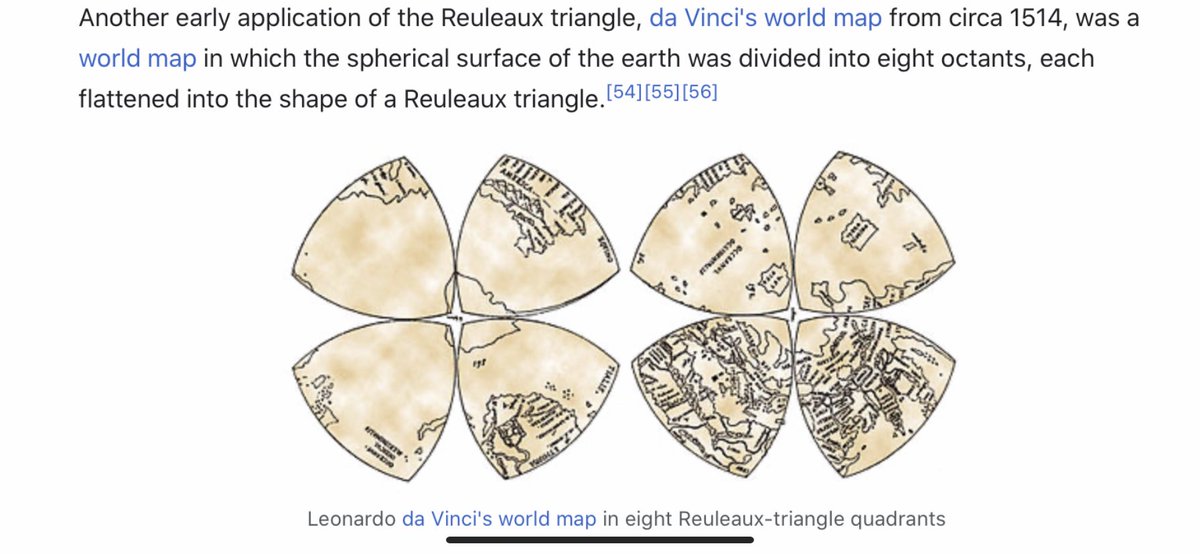
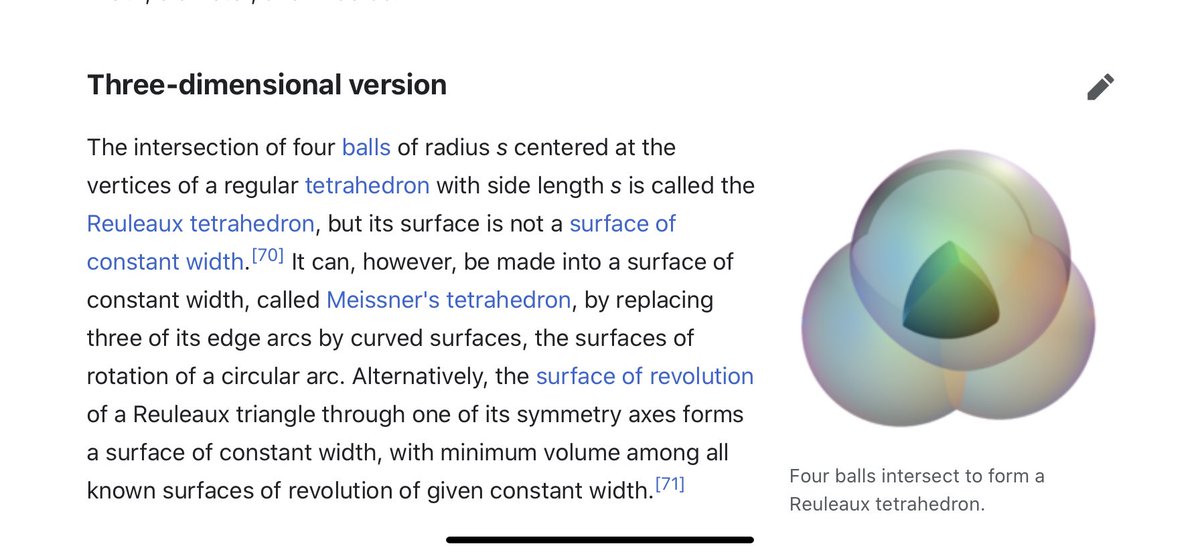
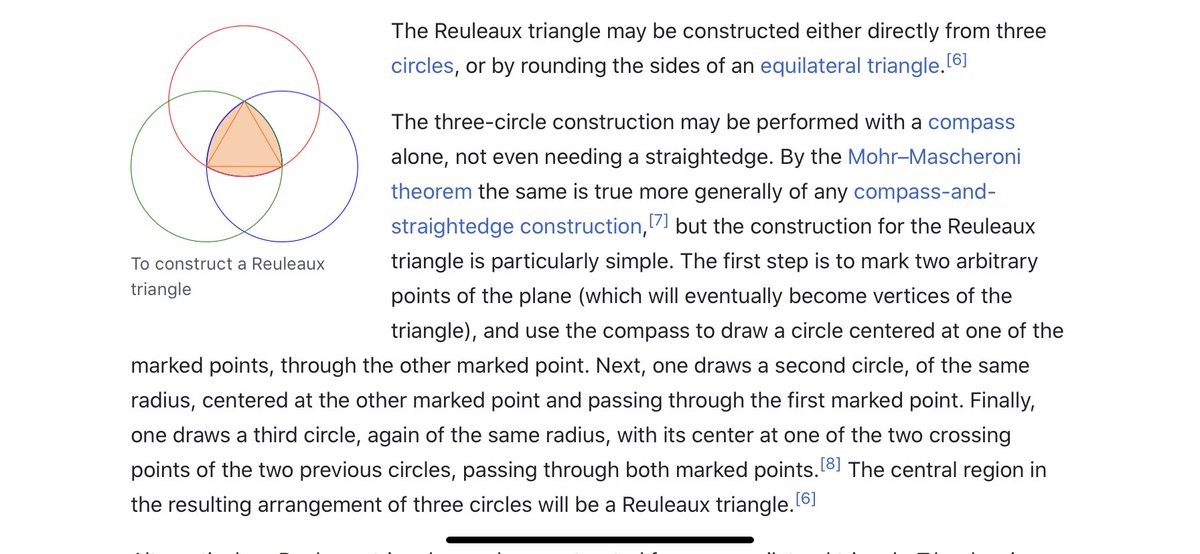
I think we have to expand our thinking about the toroidal sphere even more. When looking at maps, I noticed the da Vinci map, from 1514, which uses the Reuleaux Triangle. This triangle is formed from 3 intersecting circles, and is in the center of a trefoil.
The trefoil is the focal point in many gothic structures, repeatedly and prominently shown. It is represented in many ways. ‘Going down the rabbit hole’ now makes sense, if you understand the center point of the ears is the center of the torus, with the rabbit trefoil.
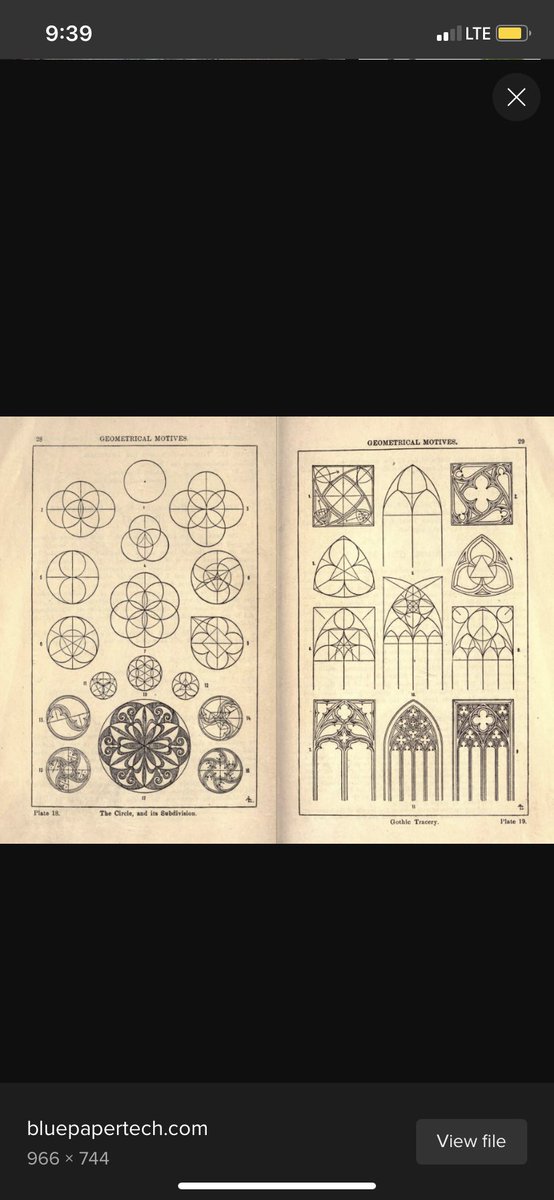
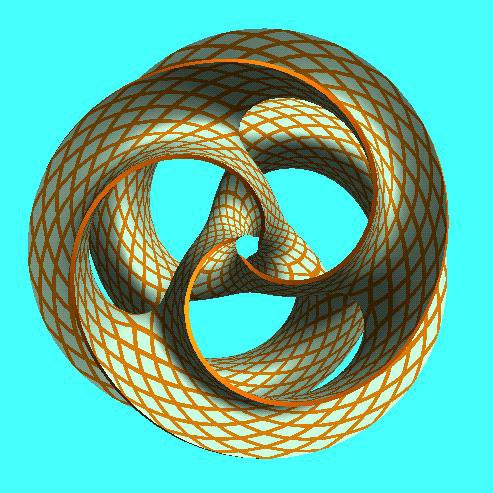
The trefoil can be found within the toroidal field. Here is a fun site, where you can manipulate it yourself. https://t.co/FCMcybuuFC
The wiki page makes it seem like there isn’t much of importance with the Reuleaux Triangle, besides being used for coinage, or some stupid bike. But the Wankel engine is an interesting engine, using this geometric design https://t.co/ayPOgkAqGN
https://t.co/m9EaWwF796
The trefoil is the focal point in many gothic structures, repeatedly and prominently shown. It is represented in many ways. ‘Going down the rabbit hole’ now makes sense, if you understand the center point of the ears is the center of the torus, with the rabbit trefoil.
The trefoil can be found within the toroidal field. Here is a fun site, where you can manipulate it yourself. https://t.co/FCMcybuuFC
The wiki page makes it seem like there isn’t much of importance with the Reuleaux Triangle, besides being used for coinage, or some stupid bike. But the Wankel engine is an interesting engine, using this geometric design https://t.co/ayPOgkAqGN
https://t.co/m9EaWwF796

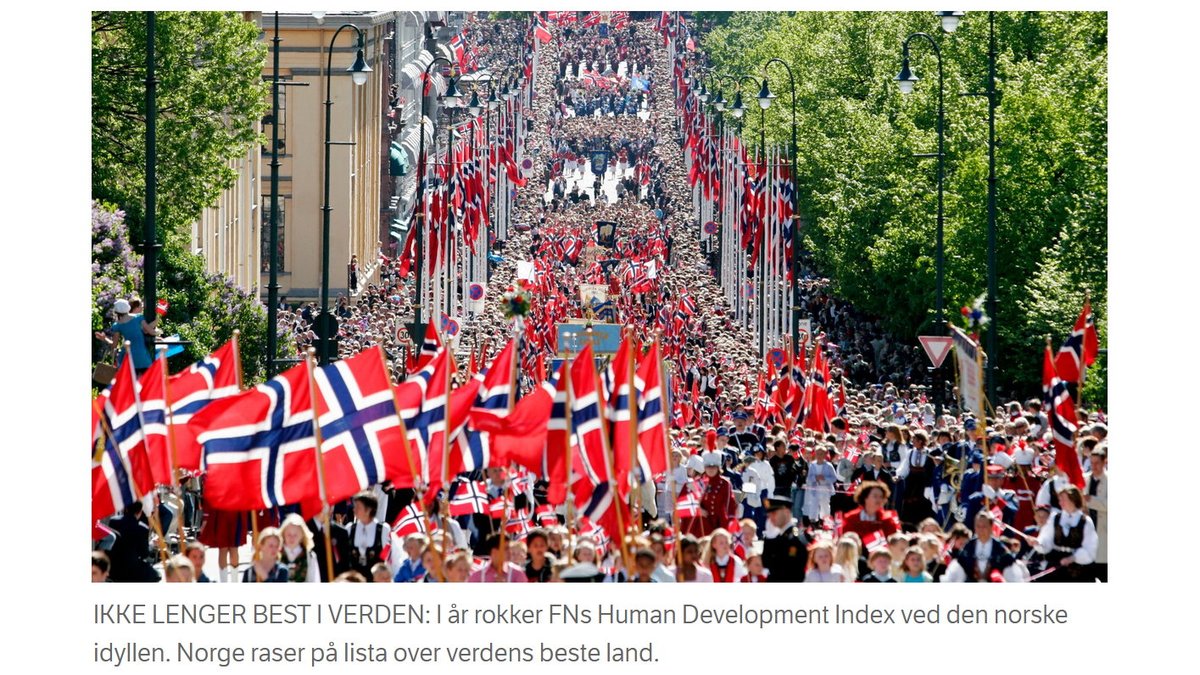
"NO LONGER BEST IN THE WORLD"
UNEP's new Human Development Index includes a new (separate) index: Planetary pressures-adjusted HDI (PHDI). News in Norway is that its position drops from #1 to #16 because of this, while Ireland rises from #2 to #1.
Why?
https://t.co/aVraIEzRfh
Check out Norway's 'Domestic Material Consumption'. Fossil fuels are no different here to Ireland's. What's different is this huge 'non-metallic minerals' category.
(Note also the jump in 1998, suggesting data problems.)
https://t.co/5QvzONbqmN
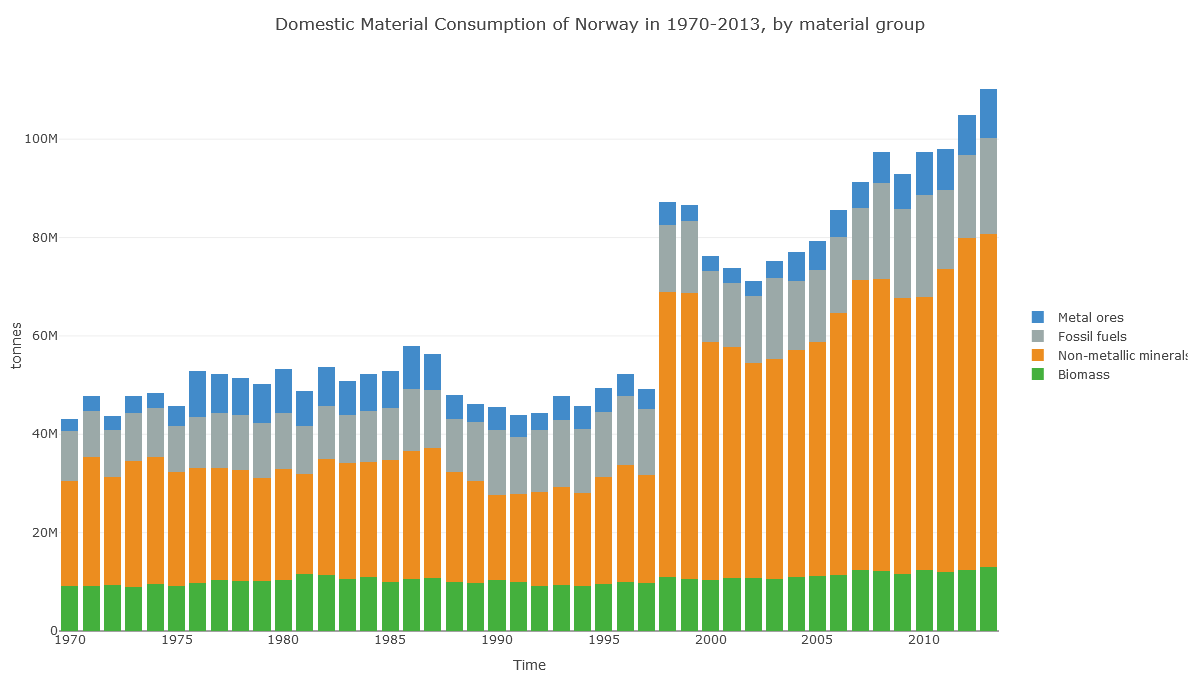
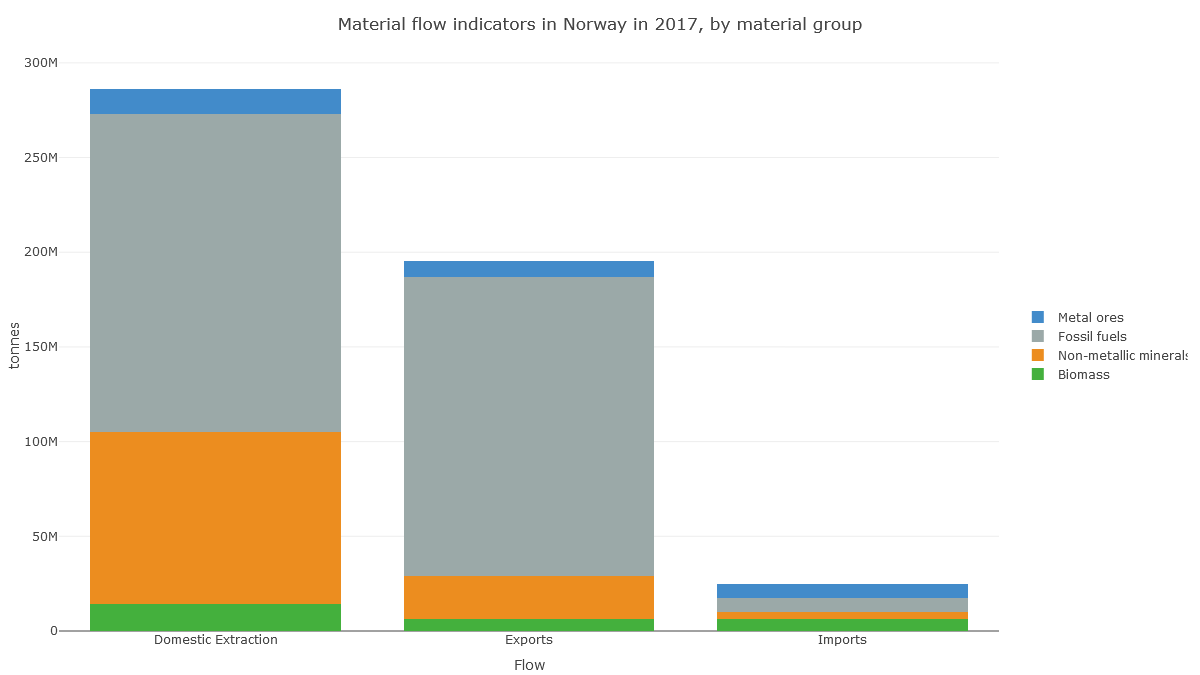
In Norway's case, it looks like the apparent consumption equation (production+imports-exports) for non-metal minerals is dominated by production: extraction of material in Norway.
https://t.co/5QvzONbqmN
And here we see that this production of non-metallic minerals is sand, gravel and crushed rock for construction. So it's about Norway's geology.
https://t.co/y6rqWmFVWc
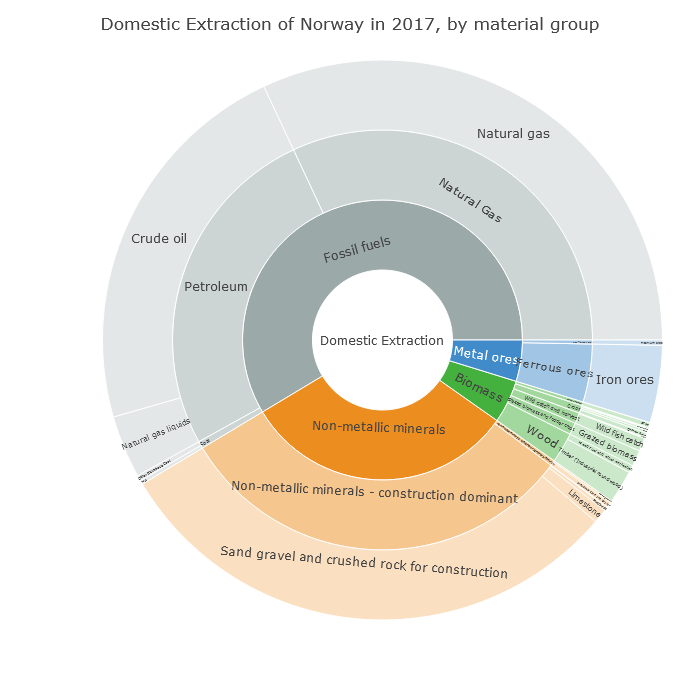
Norway drops 15 places on the PHDI list not because of its CO₂ emissions (fairly high at 41st highest in the world per capita), but because of its geology, because it shifts a lot of rock whenever it builds anything.
UNEP's new Human Development Index includes a new (separate) index: Planetary pressures-adjusted HDI (PHDI). News in Norway is that its position drops from #1 to #16 because of this, while Ireland rises from #2 to #1.
Why?
https://t.co/aVraIEzRfh
Check out Norway's 'Domestic Material Consumption'. Fossil fuels are no different here to Ireland's. What's different is this huge 'non-metallic minerals' category.
(Note also the jump in 1998, suggesting data problems.)
https://t.co/5QvzONbqmN
In Norway's case, it looks like the apparent consumption equation (production+imports-exports) for non-metal minerals is dominated by production: extraction of material in Norway.
https://t.co/5QvzONbqmN
And here we see that this production of non-metallic minerals is sand, gravel and crushed rock for construction. So it's about Norway's geology.
https://t.co/y6rqWmFVWc
Norway drops 15 places on the PHDI list not because of its CO₂ emissions (fairly high at 41st highest in the world per capita), but because of its geology, because it shifts a lot of rock whenever it builds anything.

https://t.co/a6yrWK5dqg

https://t.co/Xe5xFdtDfO
https://t.co/e3RBxj0ly3
https://t.co/cJlCMqyP2v
https://t.co/5n5TK67iKB

https://t.co/Xe5xFdtDfO
https://t.co/e3RBxj0ly3
1. Monkey Outrage!
— Billy Bostickson \U0001f3f4\U0001f441&\U0001f441 \U0001f193 (@BillyBostickson) August 17, 2020
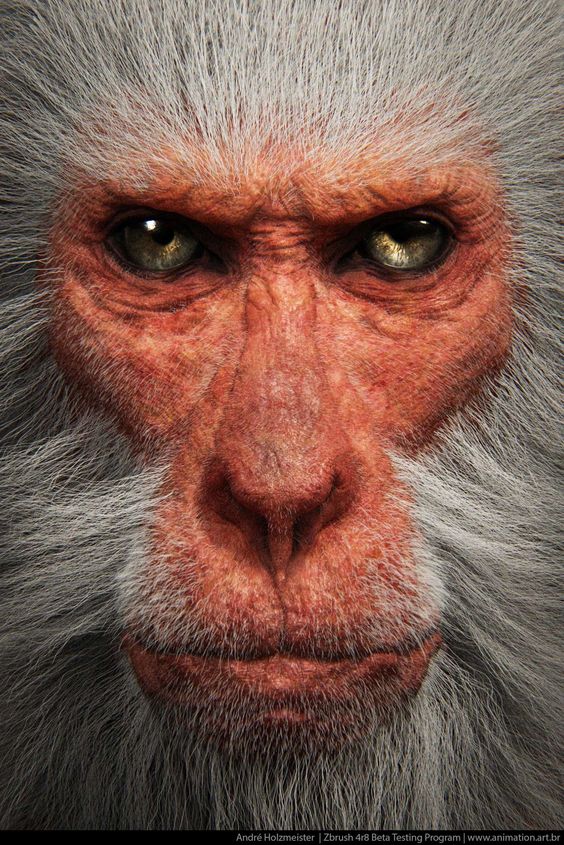
The worst treatment was kept for the monkeys. The macaques breed of monkeys are small, relatively light primates, which are often used for animal experiments at LPT. \u2018They are kept in cramped conditions in small cages. https://t.co/6D0yisjd9B
https://t.co/cJlCMqyP2v
11. Max Planck Monkey Photos (2) pic.twitter.com/0yE9D6iswp
— Billy Bostickson \U0001f3f4\U0001f441&\U0001f441 \U0001f193 (@BillyBostickson) August 17, 2020
https://t.co/5n5TK67iKB

Hi, I'm #MarvellousMarthy & this is a mini #GlobalScienceShow to celebrate @WomenScienceDay. I'd like to tell you about my STEM Role Model @MarineMumbles. Stick around for @philjemmett who’s up next. #WomenInSTEM #WomenInScience4SDGs #WomenInScience #girlsinSTEM
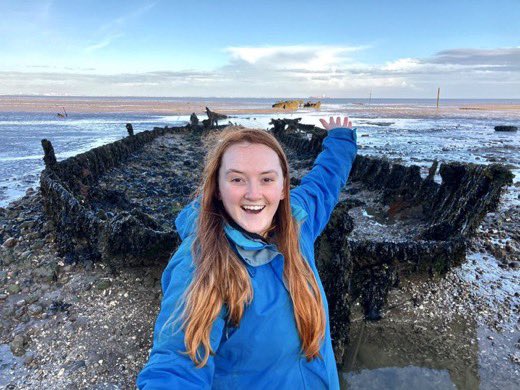
Go to https://t.co/fAM7lPSznm to watch my film. I love Rockpooling now as a hobby & I have got Mummy & Daddy into it too. I have learnt loads about marine life over the last year & Elizabeth @marinemumbles has shared her ❤️ of the oceans with me. I LOVE crabs 🦀 🦀🦀!!
This is Gem, Marthy’s Mummy. There have been so many other STEM women who have truly inspired #MarvellousMarthy over the past year: @DrJoScience has ignited a love of experiments, @ScienceAmbass has brought giggles with some fab experiment-alongs, @HanaAyboob for introducing her
to some amazing #SciArt, @BryonyMathew for releasing some fabulous books to help raise aspirations, @Astro_Nicole & @Victrix75 for allowing her to interview them as part of #worldspaceweek & @AmeliaJanePiper for the ongoing support since she won the SciComm presenter competition.
So, as you can tell from the film, Marthy adores Elizabeth & is truly inspired by her. Since engaging with her for the first time about 10 months ago, Marthy has developed a very keen & passionate interest for all things Marine! The @angleseyseazoo can vouch for this!!!!
Go to https://t.co/fAM7lPSznm to watch my film. I love Rockpooling now as a hobby & I have got Mummy & Daddy into it too. I have learnt loads about marine life over the last year & Elizabeth @marinemumbles has shared her ❤️ of the oceans with me. I LOVE crabs 🦀 🦀🦀!!
This is Gem, Marthy’s Mummy. There have been so many other STEM women who have truly inspired #MarvellousMarthy over the past year: @DrJoScience has ignited a love of experiments, @ScienceAmbass has brought giggles with some fab experiment-alongs, @HanaAyboob for introducing her
to some amazing #SciArt, @BryonyMathew for releasing some fabulous books to help raise aspirations, @Astro_Nicole & @Victrix75 for allowing her to interview them as part of #worldspaceweek & @AmeliaJanePiper for the ongoing support since she won the SciComm presenter competition.
So, as you can tell from the film, Marthy adores Elizabeth & is truly inspired by her. Since engaging with her for the first time about 10 months ago, Marthy has developed a very keen & passionate interest for all things Marine! The @angleseyseazoo can vouch for this!!!!

All modern research questions frame your mindset and self-frame research paradigm. Broad thinking: how little of everything can a citizen survive on; how cheap can your upkeep be? /1
When an American patient lands in an Austrian hospital for a back problem, a doctor tells him to perform a set of exercises.
- How many?
- Do you have anything else to do? /2
This interchange illustrates two mindsets colliding at bedside. How little can I get away with vs there is no limit to effort when it comes to your wellness. /3
When you were robbed of movement, somebody started selling you exercise. To understand that digging a ditch, to build a house, or to carry a child around, or waking to your grandparents for an hour is not the same as jogging on a treadmill... will reveal what research hides.
/4
When I talk about doing a purposeful activity outdoors, I look at complexity of movement, purpose, meaning, sun, and air, even an opportunity to meet a neighbor... that is now reduced to a calcium pill, vitamin D, an antidepressant, an osteoporosis shot, and an oxygen tank. /5
Is moderate exercise enough to live as long as possible, or should you be doing vigorous exercise? And what proportion is best? This article has the answers. https://t.co/YJqpaaI0UR
— Sebastian Rushworth M.D. (@sebrushworth) January 24, 2021
When an American patient lands in an Austrian hospital for a back problem, a doctor tells him to perform a set of exercises.
- How many?
- Do you have anything else to do? /2
This interchange illustrates two mindsets colliding at bedside. How little can I get away with vs there is no limit to effort when it comes to your wellness. /3
When you were robbed of movement, somebody started selling you exercise. To understand that digging a ditch, to build a house, or to carry a child around, or waking to your grandparents for an hour is not the same as jogging on a treadmill... will reveal what research hides.
/4
When I talk about doing a purposeful activity outdoors, I look at complexity of movement, purpose, meaning, sun, and air, even an opportunity to meet a neighbor... that is now reduced to a calcium pill, vitamin D, an antidepressant, an osteoporosis shot, and an oxygen tank. /5
You May Also Like

H was always unseen in S2NL :)
Those who exited at 1500 needed money. They can always come back near 969. Those who exited at 230 also needed money. They can come back near 95.
Those who sold L @ 660 can always come back at 360. Those who sold S last week can be back @ 301
Those who exited at 1500 needed money. They can always come back near 969. Those who exited at 230 also needed money. They can come back near 95.
Those who sold L @ 660 can always come back at 360. Those who sold S last week can be back @ 301
Sir, Log yahan.. 13 days patience nhi rakh sakte aur aap 2013 ki baat kar rahe ho. Even Aap Ready made portfolio banakar bhi de do to bhi wo 1 month me hi EXIT kar denge \U0001f602
— BhavinKhengarSuratGujarat (@IntradayWithBRK) September 19, 2021
Neuland 2700 se 1500 & Sequent 330 to 230 kya huwa.. 99% retailers/investors twitter par charcha n EXIT\U0001f602