SICSS brings together social scientists & data scientists interested in computational social science for 1-2 week events with intensive study & collaborative research.
Topics covered include automated text analysis, web scraping, non-probability sampling, digital experiments, ethics & much more.
All education materials created for SICSS are available open-source so that people who are unable to participate can still learn. You can also use them in your teaching. Here are materials from previous years:
https://t.co/eClPRGEDc7
Because of COVID, all SICSS locations will be online only in 2021.
.@chris_bail and I will be organizing SICSS-Princeton from June 14-25. Applications are due Feb 22.
https://t.co/EvxnmwUK8L
In addition to SICSS-Princeton, there will be 19 partner locations organized by SICSS alumni and the broader SICSS community.
SICSS-Beijing. Organized by Yan Leng (SICSS 2018), Tian Yang, Yuan Yuan (SICSS 2019).
https://t.co/DxQJU2eH74
SICSS-Bologna. Organized by Filippo Andreatta, Giampiero Giacomello, Marco Albertini, Matthew Loveless, Nicolò Cavalli (SICSS 2018).
https://t.co/HBs9Q7ZOhl
SICSS-Chicago. Organized by Kat Albrecht (SICSS 2017), Carrie Stallings, Andrew Papachristos.
https://t.co/tWBHdmLN2v
SICSS-FGV/DAPP Brazil. Organized by Marco Aurelio Ruediger, Tiago Ventura (SICSS 2019), Amaro Grassi, Danilo Carvalho.
https://t.co/v4ukan2rwn
SICSS-Helsinki. Organized by Matti Nelimarkka (SICSS 2017).
https://t.co/X5UNpqxWEb
SICSS-Howard/Mathematica. Organized by Naniette Coleman (SICSS 2019).
https://t.co/nh2XszHgrc
SICSS-HSE University. Organized by Elizaveta Sivak (SICSS 2019), Sofia Dokuka, Ivan Smirnov.
https://t.co/Gipe04pTiR
SICSS-Istanbul. Organized by Akin Unver, Yunus Emre Tapan.
https://t.co/krRyUqUZpE
SICSS-Law. Organized by Rūta Liepiņa (SICSS 2020), Monika Leszczynska (SICSS 2019), Catalina Goanta.
https://t.co/gS1OVYXfCq
SICSS-Lisbon. Organized by Qiwei Han (SICSS 2020), Filipa Reis.
https://t.co/lKgt2DQvRD
SICSS-London. Organized by Andrea Baronchelli, Joshua Becker (SICSS 2017), Nicola Perra, Milena Tsvetkova, Mike Yeomans (SICSS 2017).
https://t.co/ajGCK9DLJy
SICSS-Montréal. Organized by Vissého Adjiwanou (SICSS 2017).
https://t.co/8ynqJ5AAhB
SICSS-Oxford. Organized by Christopher Barrie (SICSS 2019), Charles Rahal, Francesco Rampazzo (SICSS 2018), Tobias Rüttenauer (SICSS 2019).
https://t.co/7guXRlZzhJ
SICSS-Rutgers. Organized by Michael Kenwick, Katie McCabe (SICSS 2019), Katya Ognyanova, Andrey Tomashevskiy.
https://t.co/dD8AqRK4Xf
SICSS-Stellenbosch. Organized by Douglas Parry (SICSS 2019), Richard Barnett (SICSS 2018).
https://t.co/ptcbTIaIKG
SICSS-Taiwan. Organized by Feng-Yi Liu (SICSS 2019), Robin Lee (SICSS 2020).
https://t.co/540Vqgj0or
SICSS-Tokyo. Organized by Hirokazu Shirado (SICSS 2017), Makiko Nakamuro.
https://t.co/guC2J4NvFC
SICSS-UCLA. Organized by Jenny Brand, Alina Arseniev-Koehler (SICSS 2018), Bernard Koch, Pablo Geraldo.
https://t.co/9OK8pPiuYg
SICSS-Zurich. Organized by Elliott Ash (SICSS 2017), Malka Guillot (SICSS 2019), Philine Widmer (SICSS 2019).
https://t.co/bl7rMP5URp
All SICSS locations welcome applications from people with different backgrounds, interests & experiences. Also, all locations have pre-arrival materials to make sure that everyone is ready to participate and learn.
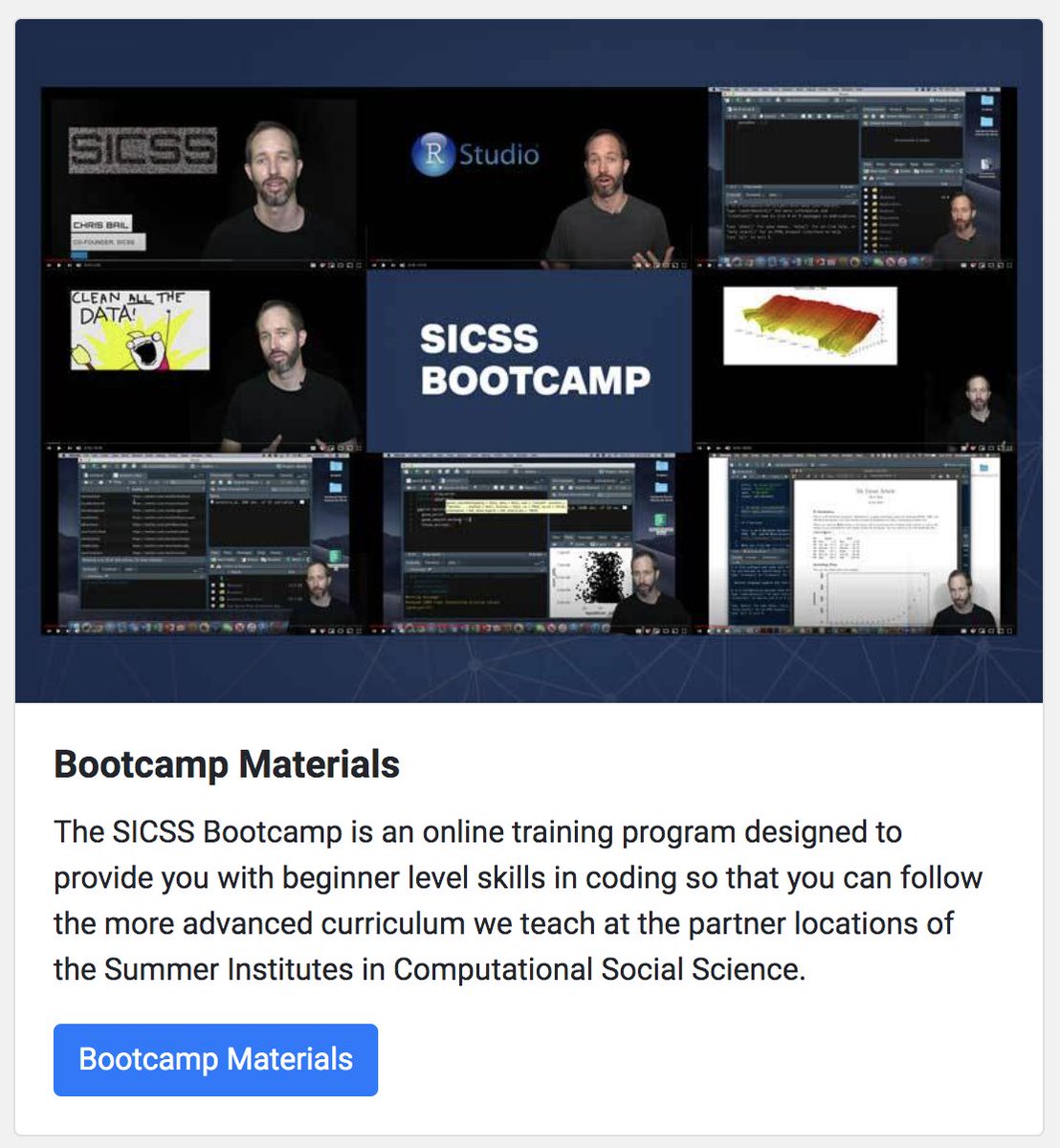
If you are new to computational social science, check out
@chris_bail's new SICSS bootcamp. This online training program is designed to provide you with beginner level skills in coding so that you can follow the more advanced curriculum we teach at SICSS.
https://t.co/ZXr3RrAIha
SICSS is available at no cost to participants thanks to grants from
@RussellSageFdn, @SloanFoundation, @SSRC &
@facebook. Some SICSS locations have also received support from other funders.
So far more about 650 people have participated in SICSS. You can learn about them here:
https://t.co/UpvCET1tSN
You can learn more about hosting a partner location at your university, company, government agency, or organization here:
https://t.co/M2ZYNuGs3l
You can learn more about SICSS here:
https://t.co/wolhtZIMc5
Thank you to the entire SICSS community for making SICSS 2021 possible.