Wonder why your Ph.D./Master's application is being rejected?
Here are some insider reasons (from a committee member) that result in such "Love Letters" 👇
- A Short Thread
This occurs when you do not upload the requested documents needed to evaluate your file. Think of a candidate that did not send a GRE score when the institution clearly requires it for admission.
This is particularly interesting because based on reports from this resource person, it is not particularly about how little your experience is but how you communicate it error-free or at least extensively minimized. This gives headache!
More from Science





"The new answer to a 77-year-old problem"
😭
https://t.co/hm9NoaU4nr
https://t.co/8fKDiKjSWc
https://t.co/jkaicC1F2x
https://t.co/PpxWT4Jef4
😭
The new answer to a 77-year-old problem in data analysis, published today in @naturemethods. Instead of significance tests, use estimation graphics. Our software suite DABEST makes it easy for everyone to visualize effect sizes.https://t.co/UzwXJ7EUC5 pic.twitter.com/VtxyY0xaRM
— Adam Claridge-Chang (@adamcchang) June 19, 2019
https://t.co/hm9NoaU4nr
Open letter to journal editors: dynamite plots must die. Dynamite plots, also known as bar and line graphs, hide important information. Editors should require authors to show readers the data and avoid these plots. https://t.co/0GNKEIUCJL pic.twitter.com/OS9ytEFRZN
— Rafael Irizarry (@rafalab) February 22, 2019
https://t.co/8fKDiKjSWc
Couldn't find D3 code for grouped horisontal box plots that show data points so I made this @mbostock @thisisalfie https://t.co/cQjDPhyZdw pic.twitter.com/y6RNmDB2p3
— Ulrik Lyngs (@ulyngs) June 28, 2017
https://t.co/jkaicC1F2x
made a pkg for pirate plots in ggplot: add any of points/means/bars/CIs/violins \u2013 better than ye olde bar/box plotshttps://t.co/Z2m2kW3hsl pic.twitter.com/npAirPQexM
— Mika Braginsky (@mbraginsky) September 28, 2017
https://t.co/PpxWT4Jef4
See the new #PowerBI visual awesomeness for data points & sources, box-&-whisker plots! https://t.co/dOmgoxWfDE pic.twitter.com/HAUOAMJEJW
— Microsoft Power BI (@MSPowerBI) February 1, 2016

So it turns out that an organization I thought was doing good work, the False Memory Syndrome Foundation (associated with Center for Inquiry, James Randi, and Martin Gardner) was actually caping for pedophiles. Uhhhh oops?
Since this, bizarrely, turned out to be one of my longest videos ever (??) here's a quick thread to sum it up for those of you like myself with short attention spans. 1/10
In the '90s the False Memory Syndrome Foundation was founded to call attention to the problem of adults suddenly "remembering" child abuse that never actually happened, often under hypnosis. Skeptics like James Randi & Martin Gardner joined their board. 2/10
A new article reveals that the FMSF was founded by parents who had been credibly and PRIVATELY accused of molestation by their now-adult daughter. They publicized the accusation, destroyed the daughter's reputation, and started the foundation. 3/10
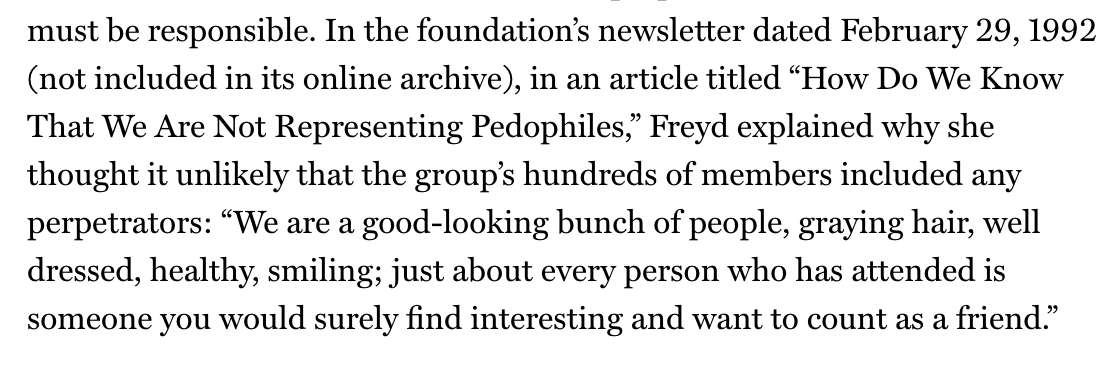
The FMSF assumed any accused pedo who joined was innocent, saying "We are a good-looking bunch of people, graying hair, well dressed, healthy, smiling; just about every person who has attended is someone you would surely find interesting and want to count as a friend" 😬 4/10
I was Wrong about False Memories: Satanic Panic, Pedophiles, Ted Bundy, and the Lost in the Mall Studies https://t.co/6XKTfGOqwl
— skepchicks (@skepchicks) January 15, 2021
Since this, bizarrely, turned out to be one of my longest videos ever (??) here's a quick thread to sum it up for those of you like myself with short attention spans. 1/10
In the '90s the False Memory Syndrome Foundation was founded to call attention to the problem of adults suddenly "remembering" child abuse that never actually happened, often under hypnosis. Skeptics like James Randi & Martin Gardner joined their board. 2/10
A new article reveals that the FMSF was founded by parents who had been credibly and PRIVATELY accused of molestation by their now-adult daughter. They publicized the accusation, destroyed the daughter's reputation, and started the foundation. 3/10
The FMSF assumed any accused pedo who joined was innocent, saying "We are a good-looking bunch of people, graying hair, well dressed, healthy, smiling; just about every person who has attended is someone you would surely find interesting and want to count as a friend" 😬 4/10

Ever since @JesseJenkins and colleagues work on a zero carbon US and this work by @DrChrisClack and colleagues on incorporating DER, I've been having the following set of thoughts about how to reduce the risk of failure in a US clean energy buildout. Bottom line is much more DER.
Typically, when we see zero-carbon electricity coupled to electrification of transport and buildings, implicitly standing behind that is totally unprecedented buildout of the transmission system. The team from Princeton's modeling work has this in spades for example.
But that, more even than the new generation required, runs straight into a thicket/woodchipper of environmental laws and public objections that currently (and for the last 50y) limit new transmission in the US. We built most transmission prior to the advent of environmental law.
So what these studies are really (implicitly) saying is that NEPA, CEQA, ESA, §404 permitting, eminent domain law, etc, - and the public and democratic objections that drive them - will have to change in order to accommodate the necessary transmission buildout.
I live in a D supermajority state that has, for at least the last 20 years, been in the midst of a housing crisis that creates punishing impacts for people's lives in the here-and-now and is arguably mostly caused by the same issues that create the transmission bottlenecks.
Rooftop solar can play a key role in a transition to 100% renewable energy - and it can help American's pocketbooks #GoSolarhttps://t.co/6p9jb62EGW
— Environment America (@EnvAm) January 14, 2021
Typically, when we see zero-carbon electricity coupled to electrification of transport and buildings, implicitly standing behind that is totally unprecedented buildout of the transmission system. The team from Princeton's modeling work has this in spades for example.
But that, more even than the new generation required, runs straight into a thicket/woodchipper of environmental laws and public objections that currently (and for the last 50y) limit new transmission in the US. We built most transmission prior to the advent of environmental law.
So what these studies are really (implicitly) saying is that NEPA, CEQA, ESA, §404 permitting, eminent domain law, etc, - and the public and democratic objections that drive them - will have to change in order to accommodate the necessary transmission buildout.
I live in a D supermajority state that has, for at least the last 20 years, been in the midst of a housing crisis that creates punishing impacts for people's lives in the here-and-now and is arguably mostly caused by the same issues that create the transmission bottlenecks.