Mollyycolllinss Categories For later read

Instead of gathering dusts in my bookmarks I have compiled them into one guide:
With: @gaganbiyani @RomeenSheth @josephflaherty @yoheinakajima @daytonmills @micahjay1 @paigefinnn @dunkhippo33 @amanda_robs @pinverrr
1/10. Adjusting your mental mode to the process of
At Udemy, we were 3 first-time entrepreneurs trying to raise seed capital. We made every mistake in the book.
— Gagan Biyani (@gaganbiyani) October 7, 2020
We got 200+ no\u2019s and wasted 12 months fundraising.
We eventually pulled through, just barely. \U0001f605
This thread shares our mistakes as lessons for founders.
**Read On**
2/10. Fundamentals for building the slide
0/ There\u2019s a lot of noise on how to pitch your startup.
— Romeen Sheth (@RomeenSheth) January 5, 2021
Keep it simple. Every good pitch boils down to five ingredients. If you have all 5, you'll get funded. Miss 1 and it can be fatal.
I made a chart describing how the ingredients relate to each other.
Let's dig in \U0001f447 pic.twitter.com/pSeH8yzfKp
3/10. How to craft the most important slide in the
Every pitch deck needs a \u201cteam\u201d slide.
— Joseph Flaherty (@josephflaherty) January 31, 2020
At the early stage of a startup when the product concept is fuzzy and revenue is non-existent, VCs are essentially backing the team above all else.
But almost all team slides are sub-optimal.
Here are two ways they could be better:
/1
4/10. One way of raising a seed round:
How to raise a seed round. Just one process, adjust accordingly. Missing lots of nuance. \U0001f447
— Yohei Nakajima \U0001f64b\U0001f3fb\u200d\u2642\ufe0f (@yoheinakajima) December 20, 2020

This is very important for people in leadership positions. \u201cHey, have a second?\u201d can send someone with anxiety into a world of panic. Did I mess something up? Am
— Seth Vargo (@sethvargo) January 23, 2021
I getting fired? Is my manager quitting? Is the company going under? https://t.co/AFltjJ0NNe
Once, long ago, my manager came to me on a Friday afternoon: "Are you going to be here on Monday?" 2/
Now, this is the 1990s: to work from home, you needed a modem (!!) -- and at the time, I owned no computer so even that wasn't happening. So I was emphatically going to be there on Monday, if for no other reason that I had nowhere else to work. 3/
"Yes, of course I'm going to be here on Monday."
"Okay, we need to talk Monday."
"Is there something wrong? Can we talk now?"
"Let's talk Monday." 4/
My early-twentysomething self was (obviously?) very anxious, so I immediately went to the office of the senior engineer in the group (and my mentor), Jeff Bonwick to see if he knew of anything that I might have screwed up... 5/



I cannot explain it, but it seems like the concept of "separation of powers" has become deeply alien and upsetting to most people. *Nothing* can be independent. And so we keep blurring the powers, and it causes systemic dysfunction. There's no long-term view.
— Kerry (@kerry62189) December 24, 2020
Naturally, this tends to lessen the public's respect for the whole system. It doesn't sound very attractive, or at least sounds like a particularly inefficient way of guarding against radical change. "They wanted to force compromise," is better, but also backfires.
It confuses the public into being mad that everyone "can't just get a long and compromise," like it's a matter of personal attitudes and conflict is a sign something is wrong. A more invigorating and accurate framing:
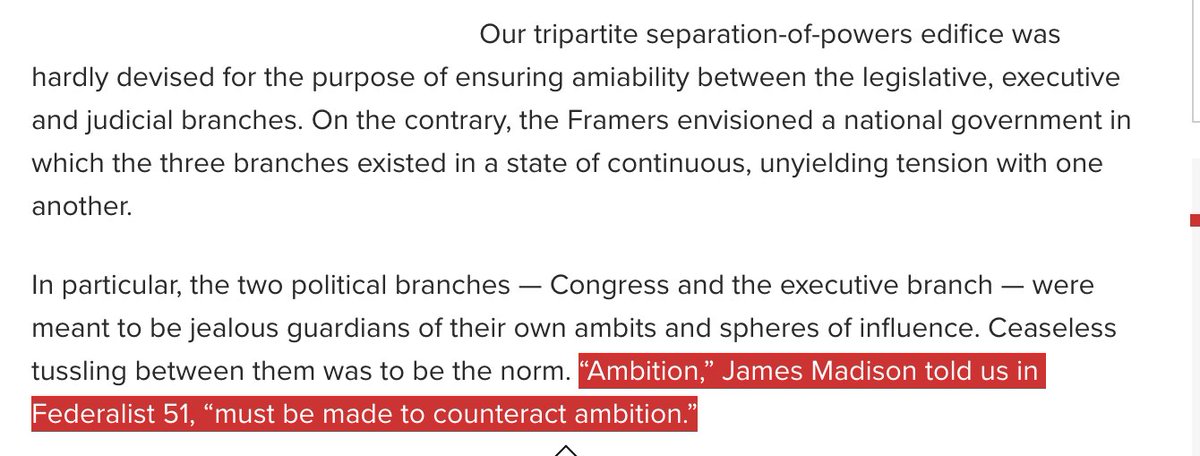
We've basically inverted this framing into something very demoralizing. "Congress isn't supposed to do anything," rather than "Congress is gunning for a showdown." And we're so confused that one of the impeachment charges against Trump was "Obstruction of Congress."
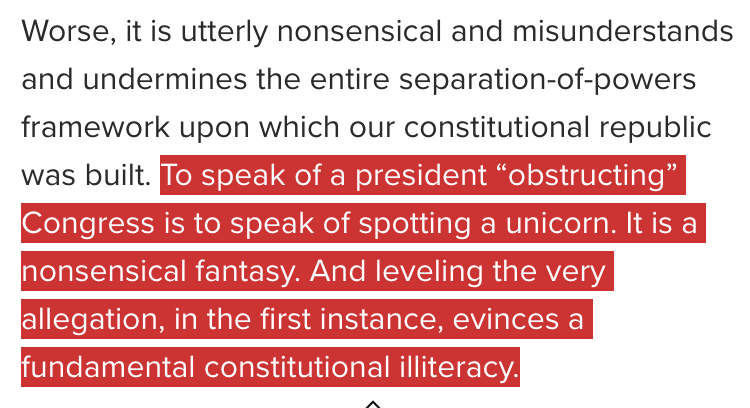
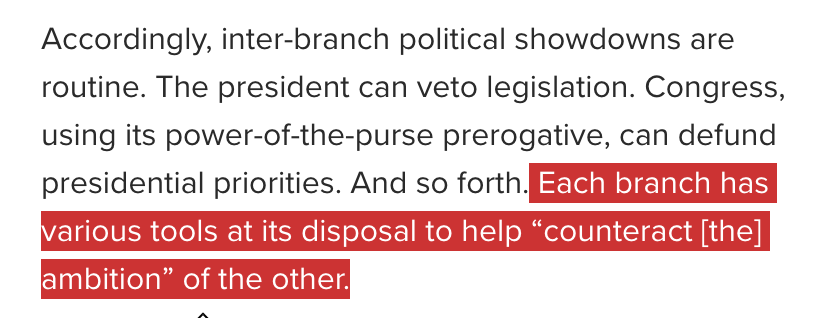
The point is that the branches were supposed to be actively tactical, and were given a set of tools to use against each other. Not "do nothing."


Popping back on briefly to share some insights on media consumption, spread of conspiracy theories, & epistemelogical divides.
— hannah anderson (@sometimesalight) January 12, 2021
1. The increased burden of sifting fact from fiction is one that only the economically privileged have the bandwidth to keep up with day-to-day, especially w/the SPEED of news generation we've seen in the last 6-10 years. This contributes to polarization & significantly... 2/12
... disadvantages blue collar America (on the left and the right) in an info economy, and is a massive catalyst for populist sentiments that make it exponentially harder for already-weak institutions to lead or swim against the tide (see Yuval Levin's "A Time to Build"). 3/12
2. I cannot agree more effusively with @sometimesalight's point re: social media & narrative. Social media platforms function as counterfeit institutions (social spaces that form identity via narrative, connection via shared purpose, & virtue via participation). 4/12
Prior to SocMed's ubiquity(approx. 2010), sifting/weighing primarily happened in traditional institutions (esp. churches) where perspectives tempered by wisdom, virtue, & relationship both evaluated & prioritized info. They served as both refuge & filter, solvent & catalyst. 5/12

