
In my annual, ritual meditation on King, I keep thinking about those misused,spontaneous references to his “four little children” in “I Have a Dream.” As many have noted, this passage has been pressed into the work of domesticating King’s radical project, into inserting him 1/
More from For later read


1. A little DRASTIC Project you may be able to help with?
We want to collate all references to DRASTIC in academic papers & media articles
Here are a few:
medium article by @emmecola
thorough report by @netpoette
@ColinDavdButler 's Paper
Please add any links to this thread. Tks!

2. More References
Papers by @MonaRahalkar and @BahulikarRahul
Papers by @Rossana38510044 and @ydeigin
Medium articles & papers by
@gdemaneuf & @Rdemaistre
Papers by @flavinkins (Daoyu Zhang)
Papers by "Anon" & "interneperson"
French News - le Monde
Can anyone remember any more?
3. More References
Papers & Blog Posts by @Harvard2H (Sirotkin & Sirotkin)
260 Questions for WHO collated by @billybostickson
If you find mentions of our individual names or "DRASTIC" in Papers or News, please forward here to this thread as links or screenshots.
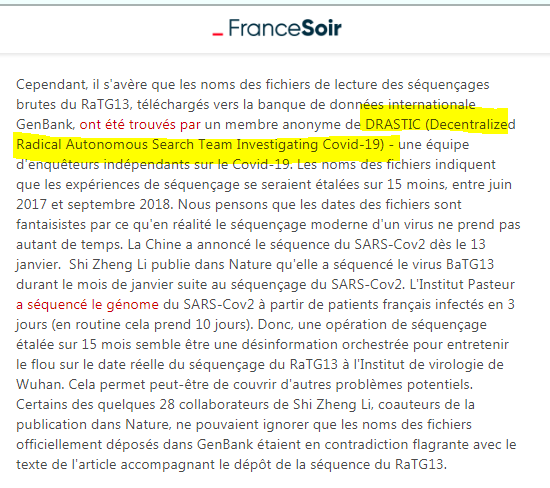
Histoire du COVID-19 – chapitre 6 - Partie 2 : Pourquoi le séquençage complet du virus RaTG13 n'a pas été communiqué par Shi Zheng Li avant février 2020 ? https://t.co/MYEZZSAzaE
SARS-CoV-2: lab-origin hypothesis gains traction
BY ANNETTE GARTLAND ON OCTOBER 12, 2020
https://t.co/sPs1y8Herg
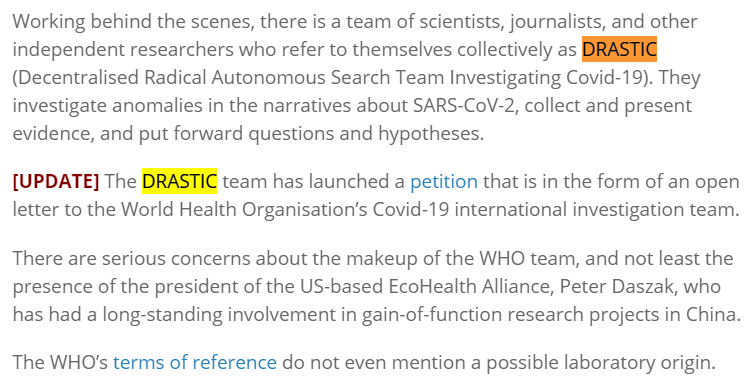
We want to collate all references to DRASTIC in academic papers & media articles
Here are a few:
medium article by @emmecola
thorough report by @netpoette
@ColinDavdButler 's Paper
Please add any links to this thread. Tks!
2. More References
Papers by @MonaRahalkar and @BahulikarRahul
Papers by @Rossana38510044 and @ydeigin
Medium articles & papers by
@gdemaneuf & @Rdemaistre
Papers by @flavinkins (Daoyu Zhang)
Papers by "Anon" & "interneperson"
French News - le Monde
Can anyone remember any more?
3. More References
Papers & Blog Posts by @Harvard2H (Sirotkin & Sirotkin)
260 Questions for WHO collated by @billybostickson
If you find mentions of our individual names or "DRASTIC" in Papers or News, please forward here to this thread as links or screenshots.
Histoire du COVID-19 – chapitre 6 - Partie 2 : Pourquoi le séquençage complet du virus RaTG13 n'a pas été communiqué par Shi Zheng Li avant février 2020 ? https://t.co/MYEZZSAzaE
SARS-CoV-2: lab-origin hypothesis gains traction
BY ANNETTE GARTLAND ON OCTOBER 12, 2020
https://t.co/sPs1y8Herg



You May Also Like


Master Thread of all my threads!
Hello!! 👋
• I have curated some of the best tweets from the best traders we know of.
• Making one master thread and will keep posting all my threads under this.
• Go through this for super learning/value totally free of cost! 😃
1. 7 FREE OPTION TRADING COURSES FOR
2. THE ABSOLUTE BEST 15 SCANNERS EXPERTS ARE USING
Got these scanners from the following accounts:
1. @Pathik_Trader
2. @sanjufunda
3. @sanstocktrader
4. @SouravSenguptaI
5. @Rishikesh_ADX
3. 12 TRADING SETUPS which experts are using.
These setups I found from the following 4 accounts:
1. @Pathik_Trader
2. @sourabhsiso19
3. @ITRADE191
4.
4. Curated tweets on HOW TO SELL STRADDLES.
Everything covered in this thread.
1. Management
2. How to initiate
3. When to exit straddles
4. Examples
5. Videos on
Hello!! 👋
• I have curated some of the best tweets from the best traders we know of.
• Making one master thread and will keep posting all my threads under this.
• Go through this for super learning/value totally free of cost! 😃
1. 7 FREE OPTION TRADING COURSES FOR
A THREAD:
— Aditya Todmal (@AdityaTodmal) November 28, 2020
7 FREE OPTION TRADING COURSES FOR BEGINNERS.
Been getting lot of dm's from people telling me they want to learn option trading and need some recommendations.
Here I'm listing the resources every beginner should go through to shorten their learning curve.
(1/10)
2. THE ABSOLUTE BEST 15 SCANNERS EXPERTS ARE USING
Got these scanners from the following accounts:
1. @Pathik_Trader
2. @sanjufunda
3. @sanstocktrader
4. @SouravSenguptaI
5. @Rishikesh_ADX
The absolute best 15 scanners which experts are using.
— Aditya Todmal (@AdityaTodmal) January 29, 2021
Got these scanners from the following accounts:
1. @Pathik_Trader
2. @sanjufunda
3. @sanstocktrader
4. @SouravSenguptaI
5. @Rishikesh_ADX
Share for the benefit of everyone.
3. 12 TRADING SETUPS which experts are using.
These setups I found from the following 4 accounts:
1. @Pathik_Trader
2. @sourabhsiso19
3. @ITRADE191
4.
12 TRADING SETUPS which experts are using.
— Aditya Todmal (@AdityaTodmal) February 7, 2021
These setups I found from the following 4 accounts:
1. @Pathik_Trader
2. @sourabhsiso19
3. @ITRADE191
4. @DillikiBiili
Share for the benefit of everyone.
4. Curated tweets on HOW TO SELL STRADDLES.
Everything covered in this thread.
1. Management
2. How to initiate
3. When to exit straddles
4. Examples
5. Videos on
Curated tweets on How to Sell Straddles
— Aditya Todmal (@AdityaTodmal) February 21, 2021
Everything covered in this thread.
1. Management
2. How to initiate
3. When to exit straddles
4. Examples
5. Videos on Straddles
Share if you find this knowledgeable for the benefit of others.


