Categories For later read

Poll: where is the temporal center of gravity of all your live projects based on average age of start-dates?
— Venkatesh Rao (@vgr) January 17, 2021
I suspect a healthy weighted average should be ~ (age-20)/2. So a 30 year old should be at 5, a 40 year old at 10, a 50 year old at 15 etc.
Standard deviation should be ~average/3 maybe, so distribution spreads as you age and accumulate projects and get better at them.
Other things being equal, people get good at starting in their 20s, at follow through in 30s, at finishing in 40s.
No point learning food follow through until you’ve found a few good starts to bet on. No point getting good at finishing until a few projects have aged gracefully.
I’m in the 7+ range myself. Probably 8-9. Slightly less than healthy for my age.
I suspect most self-judgments on being good starters/follow-through-ers/finishers are really flawed because of the non-ergodicity of project management skill learning. You can’t learn good practices for the 3 phases in an arbitrary order. On,y one order actually works.


Stephens goes on in his column (which never saw light of day) to cite famous Lee Atwater quote that uses racial slur, and which NYT has cited \u201cat least seven times.\u201d
— Dylan Byers (@DylanByers) February 11, 2021
"Is this now supposed to be a scandal?\u201d he asks.
...
Four times. The column used the n-word (in the context of a quote) four times. https://t.co/14vPhQZktB
That is correct. In his draft he quotes Atwater using the word (4 times) and he does not redact it.
— Dylan Byers (@DylanByers) February 11, 2021
For context: In 2019, a Times reporter was reprimanded for several incidents of racial insensitivity on a trip with high school students, including one in which he used the n-word in a discussion of racial slurs.
That incident became public late last month, and late last week, after 150 Times employees complained about how it had been handled, the reporter in question resigned.
In the course of all that, the Times' executive editor said that the paper does not "tolerate racist language regardless of intent.” This was the quote that Bret Stephens was pushing back against in his column. (Which, again, was deep-sixed by the paper.)


There\u2019s this crazy horseshoe where where having a strong emphasis on human sinfulness just turns into a power washer that blasts all harm and wrong-doing down to the same level of things people (re: men) inevitably do given half a chance. https://t.co/BLOWzpf1RA
— Laura Robinson (@LauraRbnsn) February 13, 2021
On the one hand, there's a high standard of holiness. On the other hand, there's a model of growth that is basically "Try Harder to Mean it More." Identify the relevant scriptural truth & believe it with all of your sincerity so that you may access the Holy Spirit's help to obey.
Helping sincere believers believe and obey the Bible facts is pretty much all the Holy Spirit does these days, other than convict us of our sins in light of the Bible facts.
If you know you are sincere and hate your sin and believe the right Bible facts as hard as you can but continue to be enslaved to your pornography addiction, what else left for you to do? Just Really, Just Really, Just Really Trust God and Give it to Him?
To suggest that there are other strategies available sounds to those formed in this model of growth like one is also suggesting that the Bible is insufficient, but it also suggests something just as threatening- that there are aspects of reality that are not immediately apparent.

then @peregrimmer is going to show how to make disappeared info reappear: "as if by magic." #lawOfFunny #ScipionicTroll#peirce
— the squad (6'3") (@RafasItchyButt) December 13, 2020
giordano bruno was burned for having a good memory. socrates warned against writing things down since the power to write history is the power to direct a nation by deceit.
there is a tale of a man from Russia who had a perfect memory. perfect eidetic recall.
a buddy of mine always pointed out that you could always bring a random dot stereogram test to arbitrary precision until he flunked. the guy who passed would be a God.
due to its full taps of the Internet, the NSA can compare moment to moment data and figure out stuff like CIA media manipulation.

Introducing our new series: “IDFN top 10 articles every fellow should read”🔖
#1: SAB management
by @mmcclean1 @LeMiguelChavez
Reviewers @KaBourgi, @IgeGeorgeMD, @Courtcita, @MDdreamchaser
We know is subjective & expect feedback/future improvements 👇
1. Clinical management of Staphylococcus aureus bacteremia: a review.
https://t.co/9tBCtp9mlP
👉 A must read written by Holland et al. where they review the evidence of the management of SAB.
2. Impact of Infectious Disease Consultation on Quality of Care, Mortality, and Length of Stay in Staphylococcus aureus Bacteremia: Results From a Large Multicenter Cohort Study.
https://t.co/XujO68pCuH
👉ID consult associated with reduced inpatient mortality.
3. Predicting Risk of Endocarditis Using a Clinical Tool (PREDICT): Scoring System to Guide Use of Echocardiography in the Management of Staphylococcus aureus Bacteremia
https://t.co/otcA1pxjAw
👉Predictive risk factors for infective endocarditis, and thus the need for TEE.
4. The Cefazolin Inoculum Effect Is Associated With Increased Mortality in Methicillin-Susceptible Staphylococcus aureus Bacteremia.
https://t.co/CQZiryVWZz
👉Presence of cefazolin inoculum effect in the infecting isolate was associated with an increase 30-day mortality.

As is the corollary question being tossed about, "How to heal the Nation?".
There is a #systems principle
An excellent piece that raises a key question going forward:
— Bob Geiger (@GeigerNews) January 16, 2021
Should we ever "unify" with the worst among us?
"Unifying with those seeking white supremacy, voter suppression, and government overthrow seems like the very definition of madness."https://t.co/UgmPQfy05F
that is a powerful insight into these, & related, questions.
"You cannot solve a problem at the same level it was created."
If the problem we were solving for were some detail, 'where to place a road; what $ to allocate to this or that project' sort of thing, then the way to
think about the problem, the impasse, is to appeal first to the functions of prior planning, history - meaning what did we do the last time, maybe pragmatics...Eventually, if the organization (whether business, community, or governance) may make a decision and that becomes the
decision. Often, typically, the decision is some sort of amalgam of the various ideas and 'camps' in the room. Rarely, but sometimes, the decision is made out of pure hierarchy..."What the boss says goes, I don't care what you think..." sort of thing. Largely that is old school
and is not the normal way of conflict resolution. Especially in the context of solving a problem.
But a decision is made, and typically people, and the various factions, come together and get to work in the context of the decision. Sometimes called 'teamwork'.

Folks, this is the single dumbest election lawsuit of the entire cycle, and I've read kraken filings front to back. https://t.co/PLHTf7HhbM
— Akiva Cohen (@AkivaMCohen) December 22, 2020
Here's the decision. Some highlights follow
Pretty sure I said this, using slightly different words!
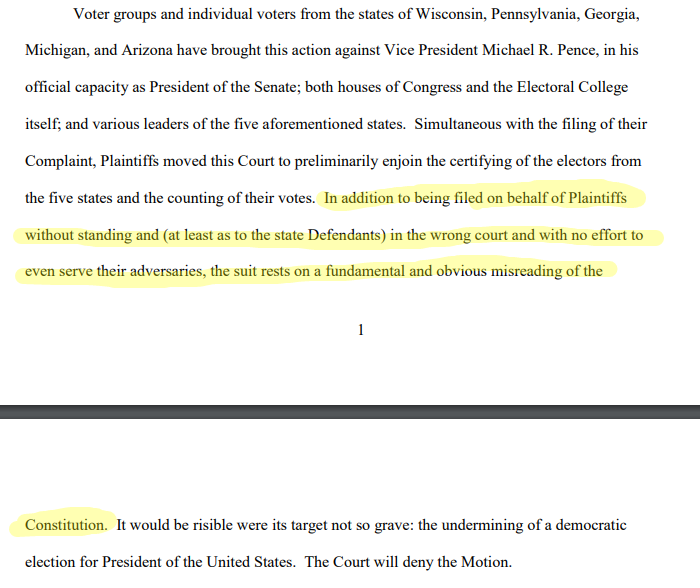
Hey, @questauthority, it sounds like Judge Boasberg was about as pleased about the long "none of this matters but we want to say it anyway" section as we expected him to be
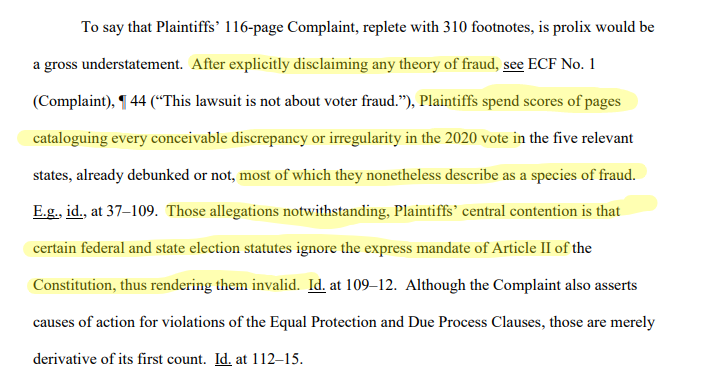
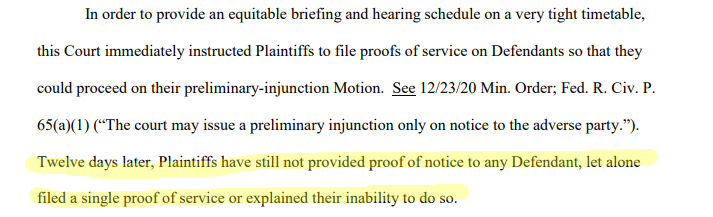
You CANNOT run into court claiming there's an emergency and you need an expedited schedule so you can be heard before 1/6 and then just not bother serving anyone for 12 days


Tell me about a great movie-going experience you'll never forget.
— Kristy Puchko (@KristyPuchko) December 3, 2020
Not as a memorial, but as a chance--right now--for us all to tap into that communal joy of the cinematic experience. pic.twitter.com/GqJfqUZ5as
The strange thing is that I don't think I had even heard of "Aladdin" until she said anything. Maybe? I'm not sure. But I don't remember feeling like we were expecting to see it. I don't remember being disappointed. But to her, I think it felt like one more way she had failed us.
This was in the final year of her marriage to her second husband--our first "stepfather"--and there were reasons the three of us were in this car and not back at our place with him and his two kids. He was very abusive, and these car rides felt like a break.
So, we were sitting there in the car while she was contemplating how to get us out of this situation, but by now, it had become almost a weekly ritual, which was not lost on us, obviously. So, we're sitting there, and she starts crying and says the thing about "Aladdin".
And then, while crying, she says: "You've never been to the movies," which was true. My sister and I had not been to a movie theater up to that point in our short lives. I remember saying "that's okay", and my sister said the same and put her little hand on my mother's arm.


We’re not under some sort of major persecution. That’s not what this is. A thread. 1/8
BREAKING: Pastor James Coates of GraceLife Church of Edmonton was just carried off to jail in hand and ankle cuffs. The condition of his release is that he cannot preach. His wife/kids are not allowed to see him.
— Jeremy (on Theology) (@TheologyJeremy) February 17, 2021
The 1st Canadian pastor to be jailed for holding a church service pic.twitter.com/AKMPVWgFXw
This church was fined for breaking health orders in Dec. They continued to break them. So the pastor was arrested and released on conditions of... you guessed it, not breaking health orders. And then they broke the health orders. 2/8
So then he was arrested and told he couldn’t hold church services in person if he was to be released. He refused. He’s still in custody.
Here is my frustration as a Christian in Canada:
1. They were able to gather, with some conditions. They didn’t like those. 3/8
2. He is not actually unable to preach. He is just unable to hold church services because they broke the conditions given by the public health office in Alberta. He says he can’t in good conscience do that, so they are keeping him in jail (because he will break the law). 4/8
3. This is the 1st article of The Canadian Charter of Rights and Freedoms: “guarantees the rights and freedoms set out in it subject only to such reasonable limits prescribed by law as can be demonstrably justified in a free and democratic society.” 5/8

TL; DR
Wrong questions give you wrong answers.
We assuredly should want 2 doses, the only issue is the timing of 2nd dose. And a brief delay is a risk worth taking.
But let's prioritize >65 year old 2nd doses at same time.
1/9
Great, in depth, thread explaining why we need to stop \u201creserving\u201d the second dose & double our immediate capacity to vaccinate widely. https://t.co/2QmfkK6oDF
— (((Howard Forman))) (@thehowie) January 1, 2021
First, let's start with @VirusesImmunity brilliant thread:
We know enough to know that there is vast benefit from giving substantial immunity to as many as possible as quickly as possible.
My first tweet of 2021 is going to be about 1 dose vs. 2 dose vaccine. I have tweeted in the past of the immunological advantages of a 2 dose vaccine. However, given the enhanced transmission variants on the rise, we need a modified strategy. (1/n) https://t.co/si1bxgKqbf
— Prof. Akiko Iwasaki (@VirusesImmunity) January 1, 2021
We also know that the timing of second dose was never set in stone. Pfizer chose to give second dose at 19-23 days; Moderna chose at 28-31 days. They tested at these levels and proved safety and efficacy. Safety is not at issue with delayed dosing. Efficacy probably is.
3/9
Most of medicine, as practiced, has not been subjected to rigorous clinical trials for various reasons. We weigh available evidence & act accordingly. We pivot when new evidence is available. We should want more RCTs, but they are often unethical or impossible to perform. 4/9
Ideally, Pfizer &/or Moderna would have already done a single dose arm. JNJ is testing both a single-dose & 2-dose regimen. We will have some data in a few weeks on the 1-dose regimen.
But we don't live in an ideal world. We live in the real world.

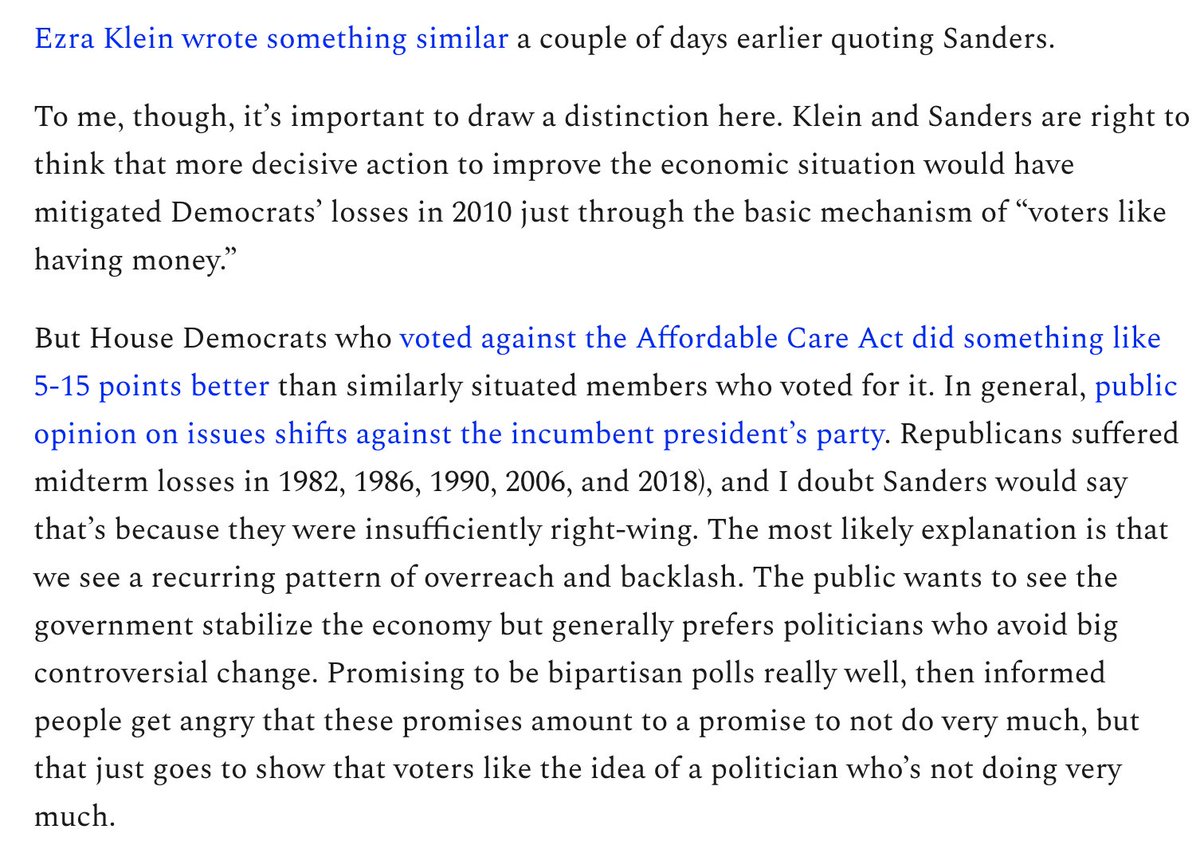
Over at Mischiefs of Faction, @Smotus makes a similar point: https://t.co/al6fS5tZXP
I want to be clear here: I’m saying that the Affordable Care act was, from a political perspective, badly designed, and that *a different health care plan* might’ve led to a better Dem performance in 2010. But these arguments don't grapple with that.
To @Smotus’s point, Pelosi released those House Democrats at the end, not the beginning. Having covered the beginning of this, I can tell you a lot of those Democrats thought a bipartisan health care bill would be great politics for them!
But they didn’t get that.
This is key. The ACA was built on the political theory that:
1. Bipartisan policy is easier to pass — and more popular once passed.
2. Working off of the Heritage Foundation/Romney template could get you a bipartisan health bill.
1 was probably right. 2 was utterly wrong.