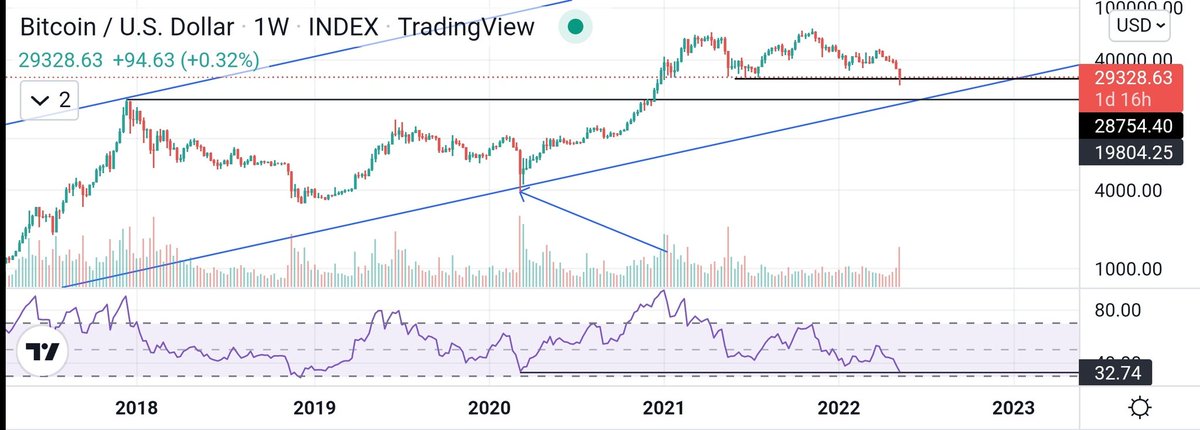
#Bitcoin weekly RSI is at the same level as it was during the March'20 crash.
Two possibilities:
1) Reversal
2) Crash to test the lower bound of the channel or even lower, as most of the crashes are preceded by oversold readings.
As of now, 2 has a higher probability.
More from Mayank Narula


More from Bitcoin


$BTC views
Price needs to let volatility wear off before its next big move. Thinking 30K-40K range for the next 1-2 weeks. Then either 50K straight or after piercing 30K and bouncing back above 30K within 1-2 days.
$27500-$27000 is the key area. If price heads back down to 30K, expect 30K to be breached, fall to that area, and bounce back. FAST. All very fast.

What do I do with this information?
Simple.
I'm trading the range against a core position. Buying when price pushes lower, selling when higher. It's like playing the achordeon. There's always air left inside.
Where exactly?
Nowhere.
I don't use limits for that. $BTC is liquid enough to trade at market without issues.
I'm watching PA, volume and rates for buying and euphoria as reflected in rates for reducing.
Decision making is dynamic. Nothing is set in stone. But most likely if price heads back down to 30K 'll be holding off next time. The gameplan is to have ammo to buy the dip (to redeploy). If 30K breaks absolutely no buying until down to 27Ks or back above 30K.
Price needs to let volatility wear off before its next big move. Thinking 30K-40K range for the next 1-2 weeks. Then either 50K straight or after piercing 30K and bouncing back above 30K within 1-2 days.
My $BTC short-term view after long deliberation and some flip flopping is rangebound in 30K-40K until the curve and vols come off a further. Then, 50K. I wouldn't be surprised if 30K is briefly breached but the risk is to the upside. Those calling for 20K missing the big picture.
— Alex (@classicmacro) January 12, 2021
$27500-$27000 is the key area. If price heads back down to 30K, expect 30K to be breached, fall to that area, and bounce back. FAST. All very fast.
What do I do with this information?
Simple.
I'm trading the range against a core position. Buying when price pushes lower, selling when higher. It's like playing the achordeon. There's always air left inside.
Where exactly?
Nowhere.
I don't use limits for that. $BTC is liquid enough to trade at market without issues.
I'm watching PA, volume and rates for buying and euphoria as reflected in rates for reducing.
Decision making is dynamic. Nothing is set in stone. But most likely if price heads back down to 30K 'll be holding off next time. The gameplan is to have ammo to buy the dip (to redeploy). If 30K breaks absolutely no buying until down to 27Ks or back above 30K.