As promised, a thread explaining our newest BioRxiv paper, where we’ve discovered that C. elegans can transfer memories of pathogen avoidance to naïve individuals.

What if one worm could tell another that it has learned it is infected with a pathogen, and warn others? The idea of memory transfer has a checkered past, since the earliest reports of memory transfer in planaria.
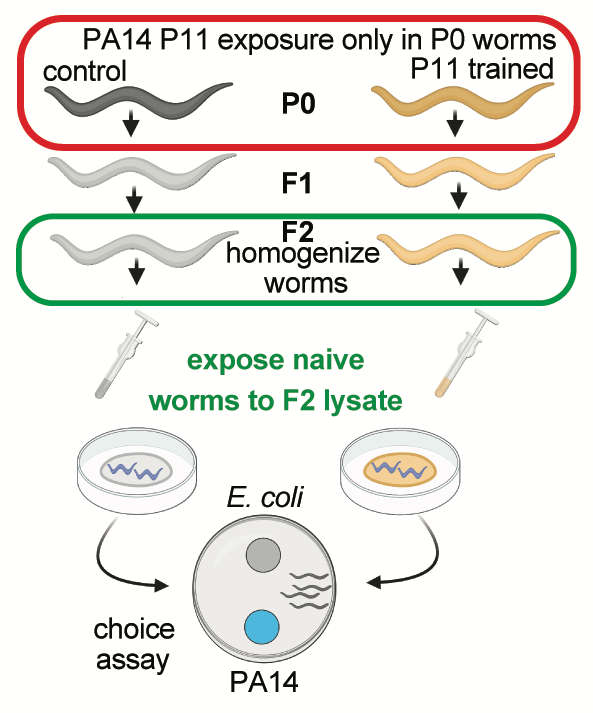
We- @rebeccasmoore1 and Rachel Kaletsky, primarily- have been studying how C. elegans learns to avoid Pseudomonas after becoming sick. We previously found that they eat bacterial small RNAs, and one small RNA (P11) that is only around when the bacteria are pathogenic triggers...
...an avoidance response that happens not only in mothers, but is remembered by four generations of their progeny. We know that this process involves uptake and Dicer processing of small RNAs in the intestine, germline amplification, piRNAs,
and downregulation of a neuronal gene, maco-1, in the ASI neuron.
But how does the germline get a signal to the neurons once the worm has eaten bacterial small RNA? Do all C. elegans “read” pathogenic bacteria small RNAs and use it to avoid Pseudomonas, and pass it on to their progeny? These were our original questions.
But one day we also wondered, Is there something inside trained worms – or their progeny or grandprogeny – that could actually transmit this information to other, untrained worms?
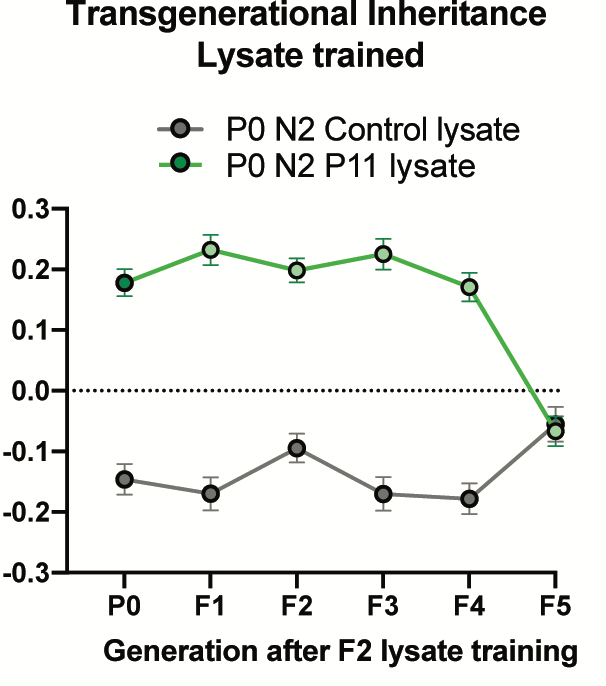
So we homogenized (ground up) grandkids of P11-trained grandmothers, and exposed untrained worms to that lysate (worm juice) – and they acquired avoidance! They basically transferred their memories to the other worms. This was crazy to us.
Lysates from the F3 and F4, but not F5 (when worms lose avoidance) also conferred avoidance on untrained animals. Moreover, this lysate training, like Pseudomonas or P11 training, also induces memory for 4 generations, resetting in F5, and is specific to Pseudomonas.
So what is in that lysate that is so important? Here we were influenced by work done by @JasonSynaptic's lab, showing that the Ty3/Gypsy-related Arc protein can carry RNA between neurons.
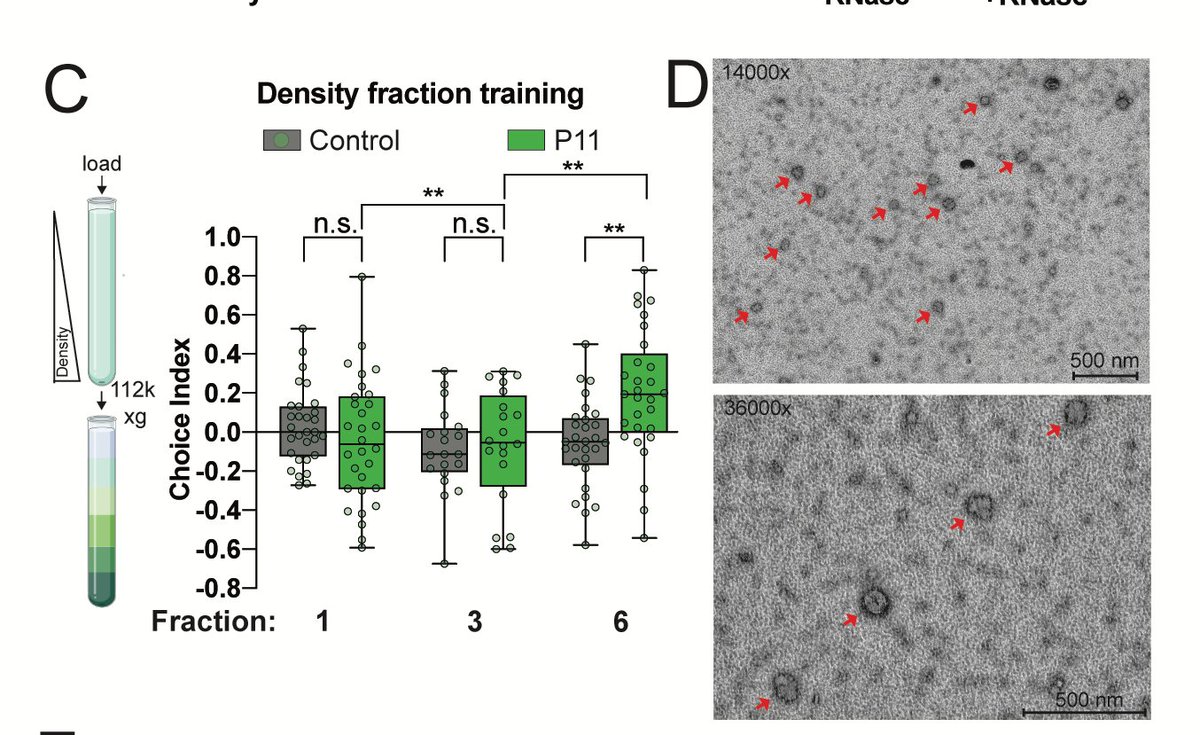
Hypothesizing that a similar capsid-like protein might be responsible, Chen Lesnik used density ultracentrifugation to fraction the lysate, then tested these fractions. Only the heaviest – the one where capsids might be – induced avoidance behavior.
With help from Edith Blackman in @zgitai’s lab, we did EM, and found vesicle-like particles (VLPs) in that fraction. Those capsids also protect RNA. (There wasn’t quite enough to build sequencing libraries from, though, so we’ll be working on finding out what’s inside.)
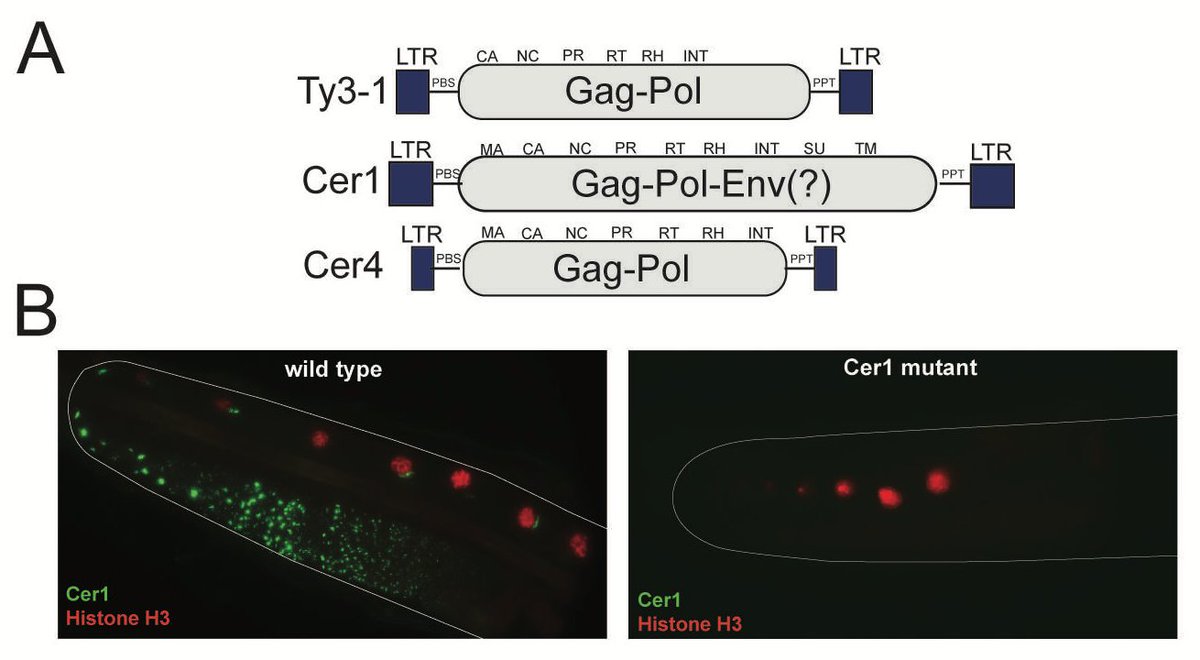
Next, inspired by Jim Priess’ work, we tested Cer1, a Ty3/Gypsy transposon that forms VLPs in the germline. https://t.co/37zRUD3wSI
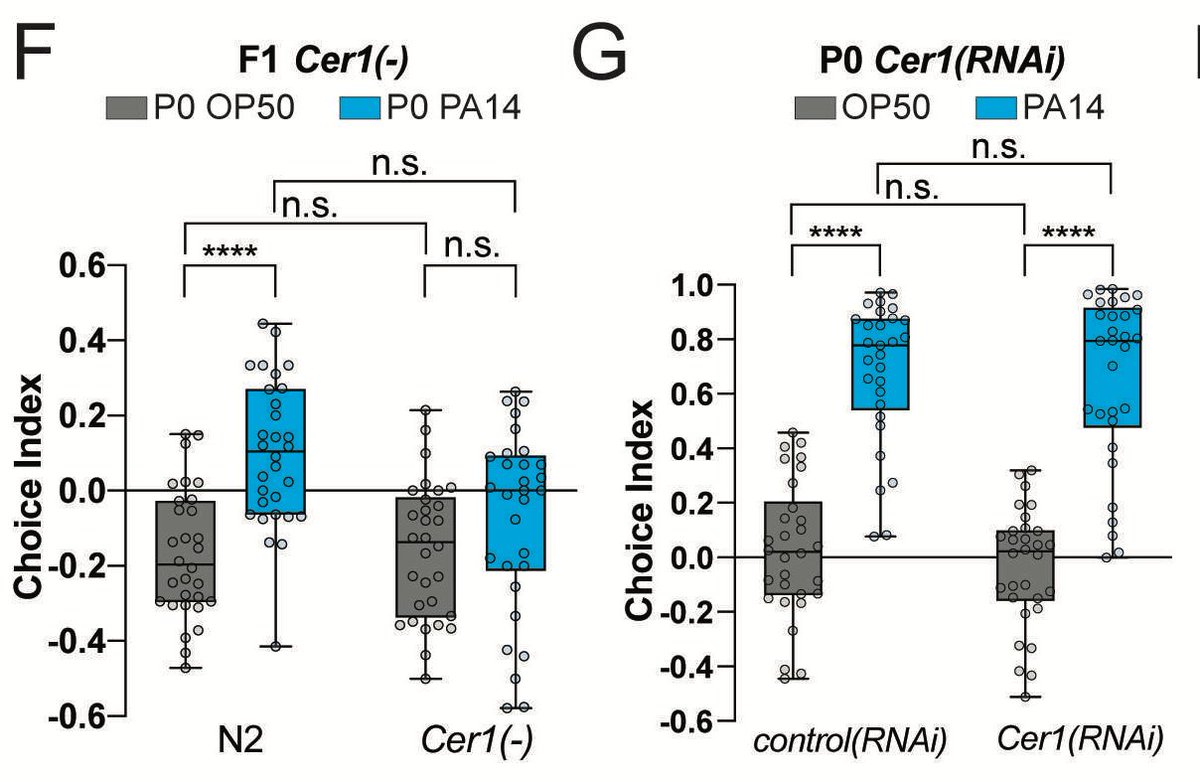
Sure enough, loss of Cer1 eliminated the whole thing: small RNA-mediated pathogenic learning, transgenerational inheritance, daf-7 activation in the ASI neuron, and lysate induction of memory transfer were all absent.
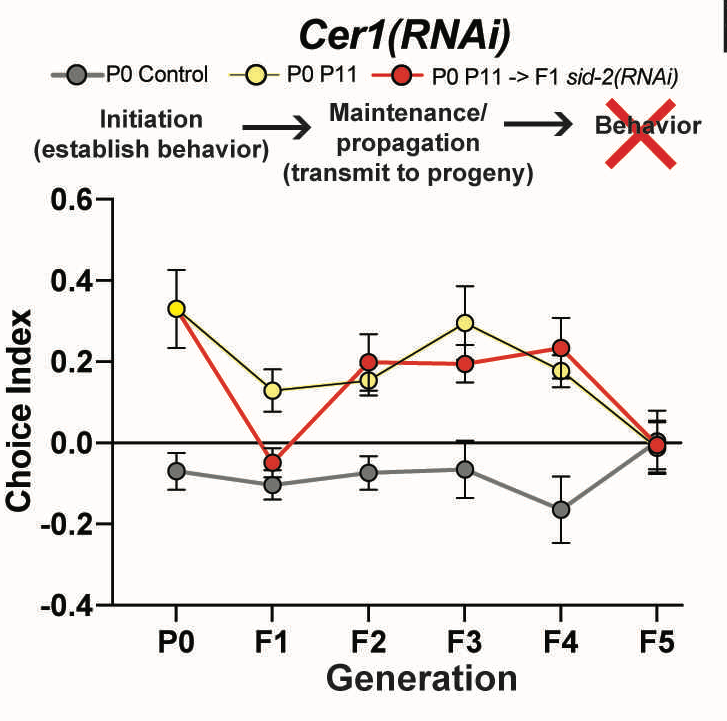
When we knocked Cer1 down only in later generations, we can see that Cer1 is not required in the maintenance step, but more likely in the transmission of message from germline to neurons, since its pattern is more like daf-7 (neurons) than prg-1 (germline).
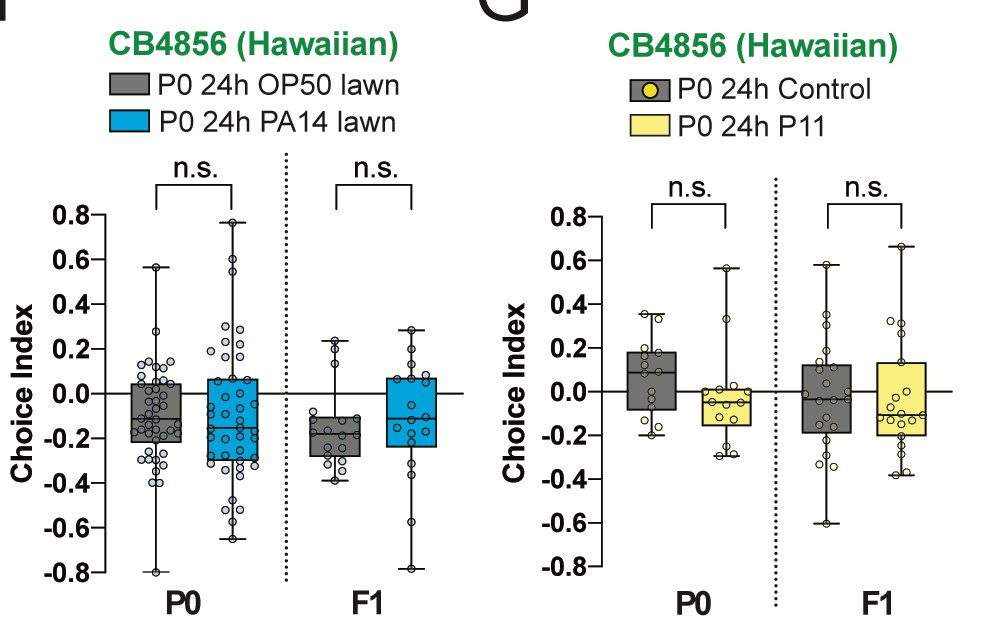
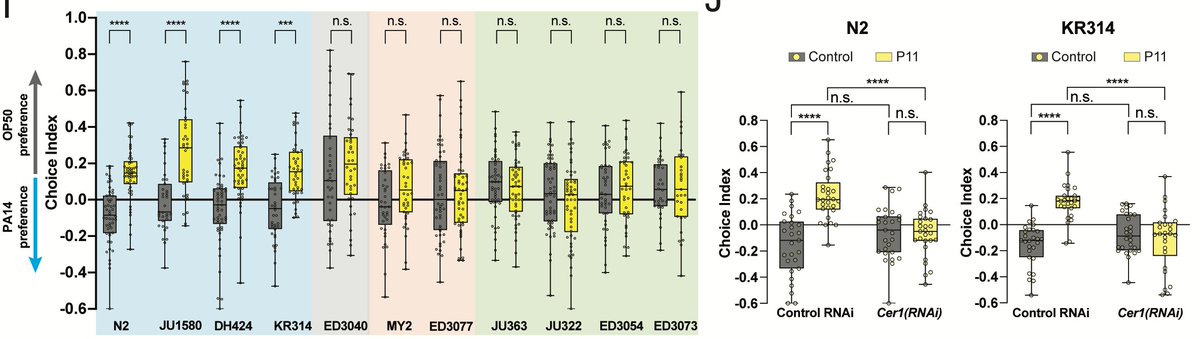
Finally, we came back to our original question, how conserved is the ability to learn to avoid Pseudomonas, and to pass it on to progeny? We found that some wild strains (JU1580) have this ability, but others (Hawaiian) do not.
@leonidkruglyak’s group had already found that Cer1 is present in some wild strains, and not in others, so we tested them. You guessed it: wild strains that have Cer1 could do it, and without it they couldn’t. And knocking it out of a wild strain prevents this ability.
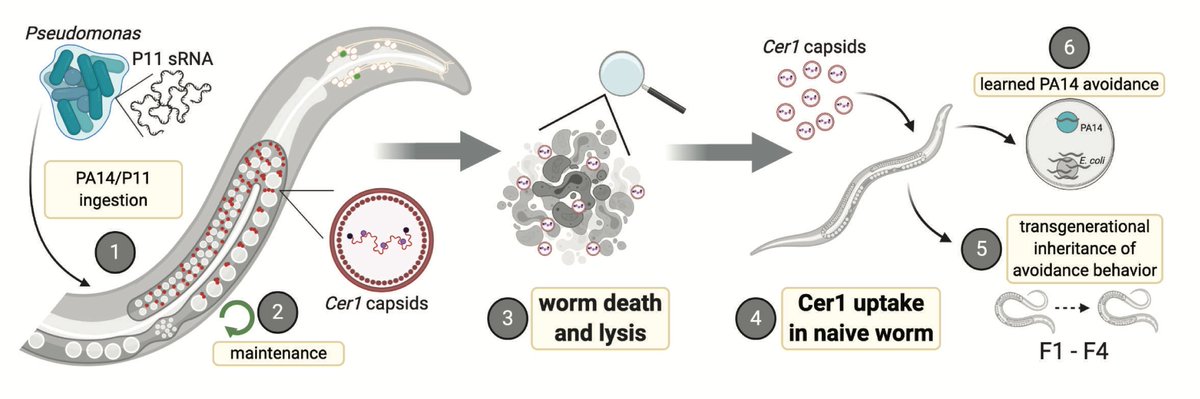
Cer1 likely conveys learned pathogen avoidance by carrying RNA from the germline to neurons; breaking open the worms allows other worms to use this information. But would that ever happen in nature? (What’s the physiological relevance, right, @OdedRechavi ?)
First, worms infected with Pseudomonas die quickly, and often lyse (break open) when they do, so it is possible for neighboring worms to ingest these particles.
2ndly, Pseudomonas-infected mothers often die of matricide (bagging), and those progeny might even eat these particles in the mother. Learning to avoid this pathogen that they are normally attracted to could offer a benefit, even though Cer1 is generally bad for uninfected worms.
Thus, memory transfer – passing on the wisdom of their experiences and subsequent learned pathogenic avoidance – both to their fellow C. elegans and to their descendants – might offer an advantage, even under pretty bad conditions.
Cer1 is kind of like a membership card, since the recipient worms need Cer1 in their genome in order to take advantage of this wisdom.
Three different lines of questions all led us toward Cer1’s role in memory transfer: differences in wild strains’ ability to learn small RNA-mediated avoidance, signaling from the germline to neurons, and parallels between Arc in mammals and Ty3/Gypsy in worms.
As always, I’d like to thank Rachel and @rebeccasmoore1 for a staggering amount of work that they did in record time, from the time we thought of it about a year ago, and before and after the lab was shut for 4 months.
Chen Lesnik contributed her biochemistry skills, Vanessa Cota did the beautiful germline IF, Edith Blackman in the Gitai lab did EM, and Lance Parsons helped with bioinformatics.
And of course this all grew out of many good discussions about crazy ideas with Rachel, Rebecca, and Zemer, and with others, including @carrie_adler and @jasonsynapic

More from Science

Hugh Everett's birthday! Pioneer of the Many-Worlds Interpretation of quantum mechanics. Let us celebrate by thinking about ontological extravagance. I will do so by way of analogy, because I have found that everyone loves analogies and nobody ever willfully misconstrues them.


We look at the night sky and see photons arriving to us, emitted by distant stars. Let's contrast two different theories about how stars emit photons.

One theory says, we know how stars shine, and our equations predict that they emit photons roughly uniformly in all directions. Call this the "Many-Photons Interpretation" (MPI).

But! Others object. That is *so many photons*. Most of which we don't observe, and can't observe, since they're moving away at the speed of light. It's too ontologically extravagant to posit a huge number of unobservable things!

So they suggest a "Photon Collapse Interpretation." According to this theory, the photons emitted toward us actually exist. But photons that would be emitted in directions we will never observe simply collapse into utter non-existence.
💥and so it begins..💥
It's time, my friends 🤩🤩

[Thread] #ProjectOdin


https://t.co/fO90N78fta


new quantum-based internet #ElonMusk #QVS #QFS

Political justification ⏬⏬
#ProjectOdin


#ProjectOdin #Starlink #ElonMusk #QuantumInternet
JUST ONE PERSON—UK 🇬🇧 scientists think one immunocompromised person who cleared virus slowly & only partially wiped out an infection, leaving behind genetically-hardier viruses that rebound & learn how to survive better. That’s likely how #B117 started. 🧵 https://t.co/bMMjM8Hiuz


2) The leading hypothesis is that the new variant evolved within just one person, chronically infected with the virus for so long it was able to evolve into a new, more infectious form.

same thing happened in Boston in another immunocompromised person that was sick for 155 days.

3) What happened in Boston with one 45 year old man who was highly infectious for 155 days straight before he died... is exactly what scientists think happened in Kent, England that gave rise to #B117.


4) Doctors were shocked to find virus has evolved many different forms inside of this one immunocompromised man. 20 new mutations in one virus, akin to the #B117. This is possibly how #B1351 in South Africa 🇿🇦 and #P1 in Brazil 🇧🇷 also evolved.


5) “On its own, the appearance of a new variant in genomic databases doesn’t tell us much. “That’s just one genome amongst thousands every week. It wouldn’t necessarily stick out,” says Oliver Pybus, a professor of evolution and infectious disease at Oxford.
https://t.co/hXlo8qgkD0
Look like that they got a classical case of PCR Cross-Contamination.
They had 2 fabricated samples (SRX9714436 and SRX9714921) on the same PCR run. Alongside with Lung07. They did not perform metagenomic sequencing on the “feces” and they did not get


A positive oral or anal swab from anywhere in their sampling. Feces came from anus and if these were positive the anal swabs must also be positive. Clearly it got there after the NA have been extracted and were from the very low-level degraded RNA which were mutagenized from

The Taq.
https://t.co/yKXCgiT29w to see SRX9714921 and SRX9714436.
Human+Mouse in the positive SRA, human in both of them. Seeing human+mouse in identical proportions across 3 different sequencers (PRJNA573298, A22, SEX9714436) are pretty straight indication that the originals

Were already contaminated with Human and mouse from the very beginning, and that this contamination is due to dishonesty in the sample handling process which prescribe a spiking of samples in ACE2-HEK293T/A549, VERO E6 and Human lung xenograft mouse.

The “lineages” they claimed to have found aren’t mutational lineages at all—all the mutations they see on these sequences were unique to that specific sequence, and are the result of RNA degradation and from the Taq polymerase errors accumulated from the nested PCR process
https://t.co/a6yrWK5dqg


https://t.co/Xe5xFdtDfO


https://t.co/e3RBxj0ly3


https://t.co/cJlCMqyP2v


https://t.co/5n5TK67iKB

You May Also Like