1. Monkey Outrage!
— Billy Bostickson \U0001f3f4\U0001f441&\U0001f441 \U0001f193 (@BillyBostickson) August 17, 2020
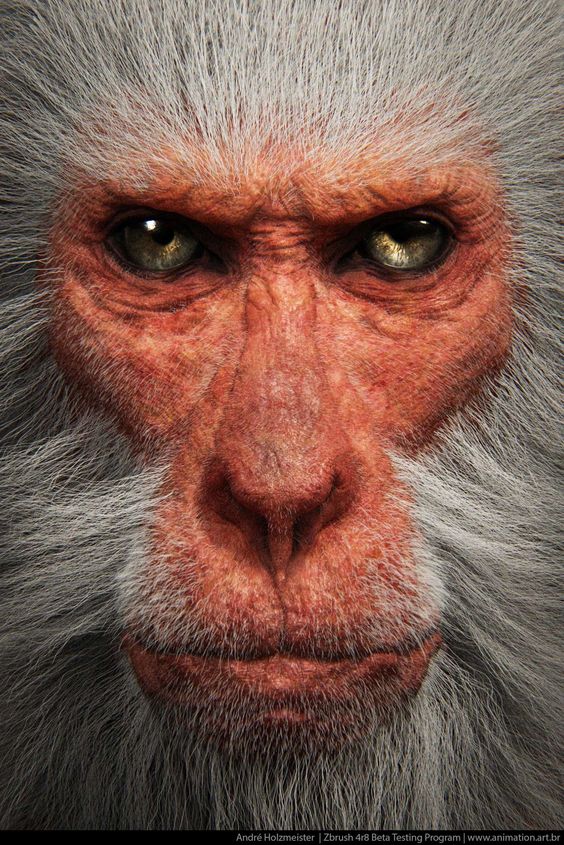
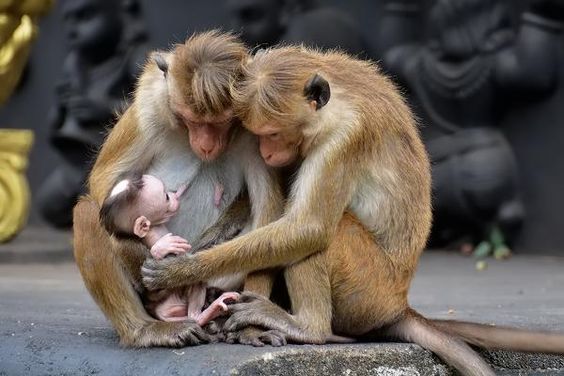
The worst treatment was kept for the monkeys. The macaques breed of monkeys are small, relatively light primates, which are often used for animal experiments at LPT. \u2018They are kept in cramped conditions in small cages. https://t.co/6D0yisjd9B
11. Max Planck Monkey Photos (2) pic.twitter.com/0yE9D6iswp
— Billy Bostickson \U0001f3f4\U0001f441&\U0001f441 \U0001f193 (@BillyBostickson) August 17, 2020

More from Billy Bostickson 🏴👁&👁 🆓



1. Some useful, albeit not fully developed, critiques of:
“The Origins of SARS-CoV-2: A Critical Review"
https://t.co/C9TyRyqHUr
have just been published here:
https://t.co/qCmzGCzRxn
by members of DRASTIC & others
@angoffinet @BahulikarRahul @MonaRahalkar @gdemaneuf
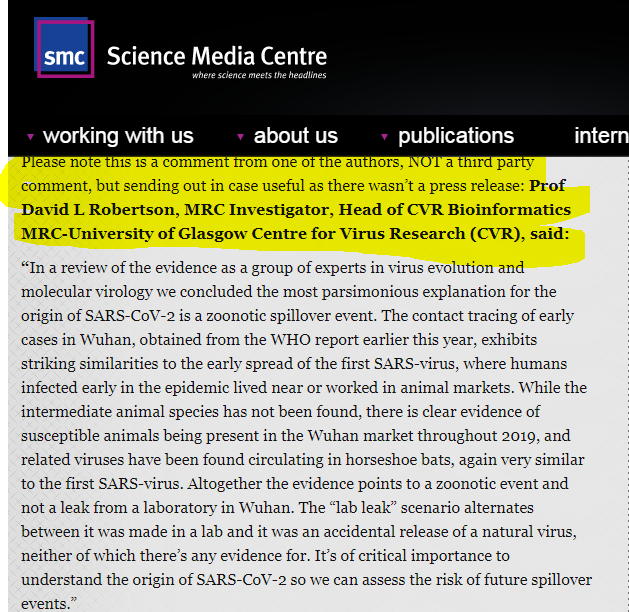
2. A refreshing contrast to the so-called "expert reactions" found here, including from one of the authors of the review (Prof David Robertson)!
"expert reaction to a preprint reviewing the evidence on the origins of SARS-CoV-2"
https://t.co/6kG6rstweP
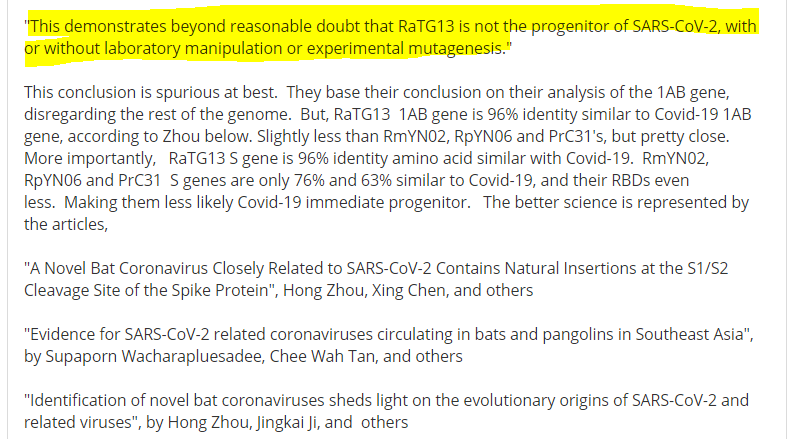
3. Peter Gutierrez points out in his response that 4 of the authors of “The Origins of SARS-CoV-2: A Critical Review”, also wrote “Proximal Origin of SARS-COV-2”.
His critique focuses on:
1. RaTG13
2. Enhanced adaptation to the human host
https://t.co/eW8b2iK5xe
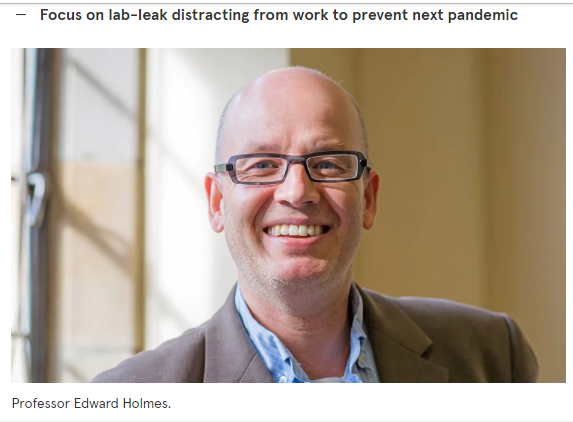
4. As to be expected, Sydney University and its iconic virologist, Eddie Holmes, who is "not available for interview", are crowing over this biased review
https://t.co/xrjpN1NxpO
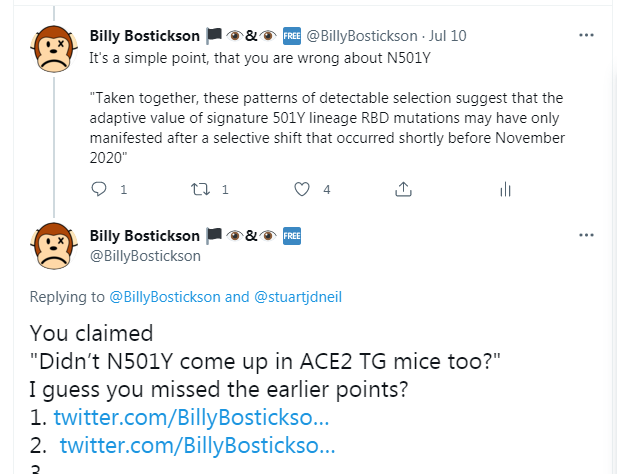
This review contains elementary errors as exposed here:
1. https://t.co/YJ50huifly
one of the authors (Stuart Neil) then claimed
"Didn’t N501Y come up in ACE2 TG mice too?
https://t.co/HscNSEKdrZ
“The Origins of SARS-CoV-2: A Critical Review"
https://t.co/C9TyRyqHUr
have just been published here:
https://t.co/qCmzGCzRxn
by members of DRASTIC & others
@angoffinet @BahulikarRahul @MonaRahalkar @gdemaneuf
2. A refreshing contrast to the so-called "expert reactions" found here, including from one of the authors of the review (Prof David Robertson)!
"expert reaction to a preprint reviewing the evidence on the origins of SARS-CoV-2"
https://t.co/6kG6rstweP
3. Peter Gutierrez points out in his response that 4 of the authors of “The Origins of SARS-CoV-2: A Critical Review”, also wrote “Proximal Origin of SARS-COV-2”.
His critique focuses on:
1. RaTG13
2. Enhanced adaptation to the human host
https://t.co/eW8b2iK5xe
4. As to be expected, Sydney University and its iconic virologist, Eddie Holmes, who is "not available for interview", are crowing over this biased review
https://t.co/xrjpN1NxpO
This review contains elementary errors as exposed here:
1. https://t.co/YJ50huifly
one of the authors (Stuart Neil) then claimed
"Didn’t N501Y come up in ACE2 TG mice too?
https://t.co/HscNSEKdrZ
All your natural origin friends in one place ;)
— Billy Bostickson \U0001f3f4\U0001f441&\U0001f441 \U0001f193 (@BillyBostickson) July 7, 2021
Origins of SARS-CoV-2: A Critical Reviewhttps://t.co/j4A4rtmi8S
via @Topo_Ligio
Fallacy of the "straw mouse", denying evolution in wild type mice, when the claim is actually that it may have "evolved" in hACE2 mice, NOT wild mice. pic.twitter.com/7LCnSAhw6g
"The coronavirus in Italy since September 2019"
Unexpected detection of SARS-CoV-2 antibodies in the prepandemic period in Italy
First Published November 11, 2020
https://t.co/nhlccks5AS
Smashed Paywall thanks to @Sci_Hub
https://t.co/wWPFJMjjFJ
Maybe a coincidence but an agreement was recently signed by the authors' institute and guess who?
https://t.co/vh7qX3hyPD
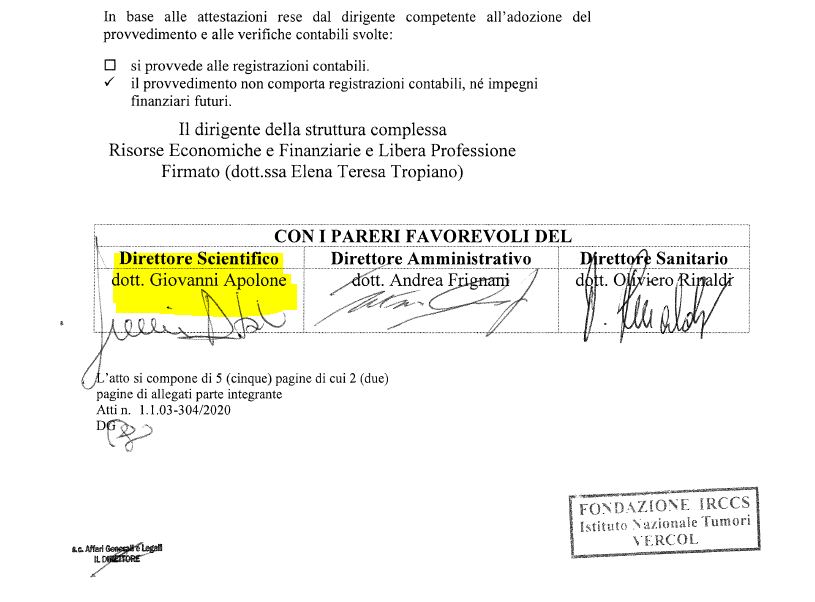
The Lead Author specifically of the paper:
"Unexpected detection of SARS-CoV-2 antibodies in the prepandemic period in Italy"
is Giovanni Apolone of the "Fondazione IRCCS Istituto Nazionale Tumori" Milan, Italy
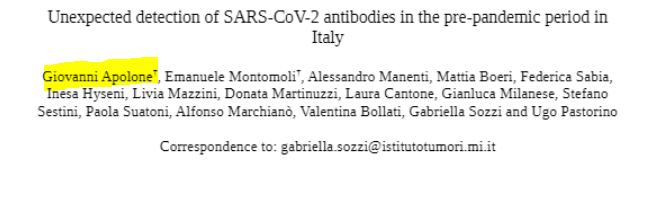
Some funding is involved....
Anyone good at Italian feel free to comment?
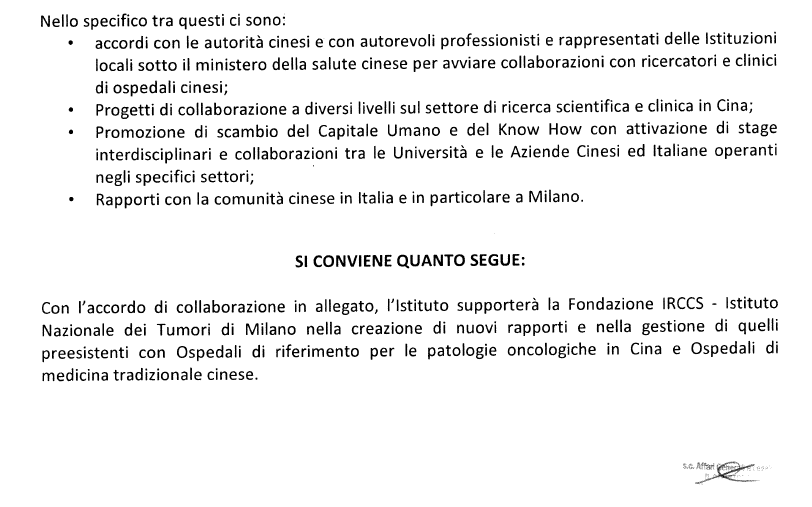
"You findee sars cov 2 in old sample back September time, we give you big fat red envelopeee, okey dokey?"
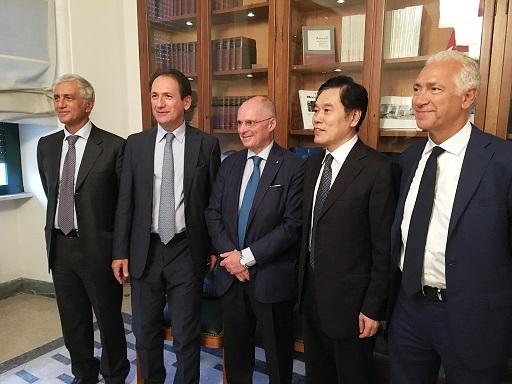
More has emerged regarding the Chinese connection
"Oncology research, Italy and China close to the collaboration protocol"
.https://t.co/Mt5hO9Dggc
Unexpected detection of SARS-CoV-2 antibodies in the prepandemic period in Italy
First Published November 11, 2020
https://t.co/nhlccks5AS
Smashed Paywall thanks to @Sci_Hub
https://t.co/wWPFJMjjFJ
Maybe a coincidence but an agreement was recently signed by the authors' institute and guess who?
https://t.co/vh7qX3hyPD
The Lead Author specifically of the paper:
"Unexpected detection of SARS-CoV-2 antibodies in the prepandemic period in Italy"
is Giovanni Apolone of the "Fondazione IRCCS Istituto Nazionale Tumori" Milan, Italy
Some funding is involved....
Anyone good at Italian feel free to comment?
"You findee sars cov 2 in old sample back September time, we give you big fat red envelopeee, okey dokey?"
More has emerged regarding the Chinese connection
"Oncology research, Italy and China close to the collaboration protocol"
.https://t.co/Mt5hO9Dggc
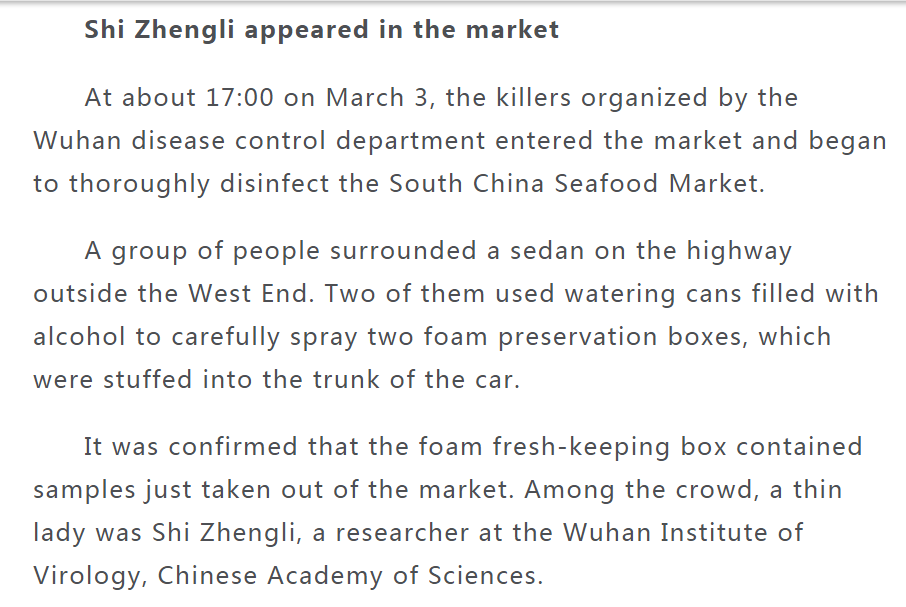
1/ BIO TERROR! History, Present and Future....
Human experimentation, modern nightmares and lone madmen in the twentieth
2/ BIO TERROR! History, Present and Future....
The History of Biological Weapons Use:
What We Know and What We Don't. W. Seth
3/ BIO TERROR! History, Present and Future....
Biological Warfare in the 17th Century
W. Seth Carus
https://t.co/GEnU8fUC3m
and
Biological Warfare Plan in the 17th Century—the Siege of Candia,
4/ BIO TERROR! History, Present and Future....
Biological Warfare at the 1346 Siege of Caffa
https://t.co/BQZ8riLq1o
The 'Hittite Plague', an Epidemic of Tularemia and the First Record of Biological
5/ BIO TERROR! History, Present and Future....
The Plague of Athens: An Ancient Act of Bioterrorism?
https://t.co/YjiG4PspCA
Applying Modern Immunology to the Plague of
Ancient
Human experimentation, modern nightmares and lone madmen in the twentieth
2/ BIO TERROR! History, Present and Future....
The History of Biological Weapons Use:
What We Know and What We Don't. W. Seth
3/ BIO TERROR! History, Present and Future....
Biological Warfare in the 17th Century
W. Seth Carus
https://t.co/GEnU8fUC3m
and
Biological Warfare Plan in the 17th Century—the Siege of Candia,
4/ BIO TERROR! History, Present and Future....
Biological Warfare at the 1346 Siege of Caffa
https://t.co/BQZ8riLq1o
The 'Hittite Plague', an Epidemic of Tularemia and the First Record of Biological
5/ BIO TERROR! History, Present and Future....
The Plague of Athens: An Ancient Act of Bioterrorism?
https://t.co/YjiG4PspCA
Applying Modern Immunology to the Plague of
Ancient
More from Science



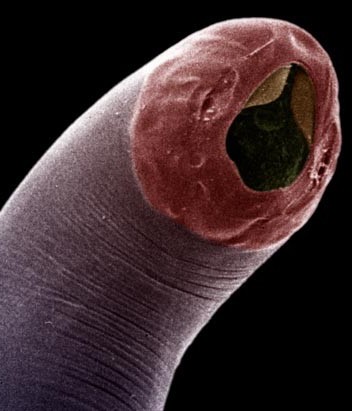


JUST ONE PERSON—UK 🇬🇧 scientists think one immunocompromised person who cleared virus slowly & only partially wiped out an infection, leaving behind genetically-hardier viruses that rebound & learn how to survive better. That’s likely how #B117 started. 🧵 https://t.co/bMMjM8Hiuz
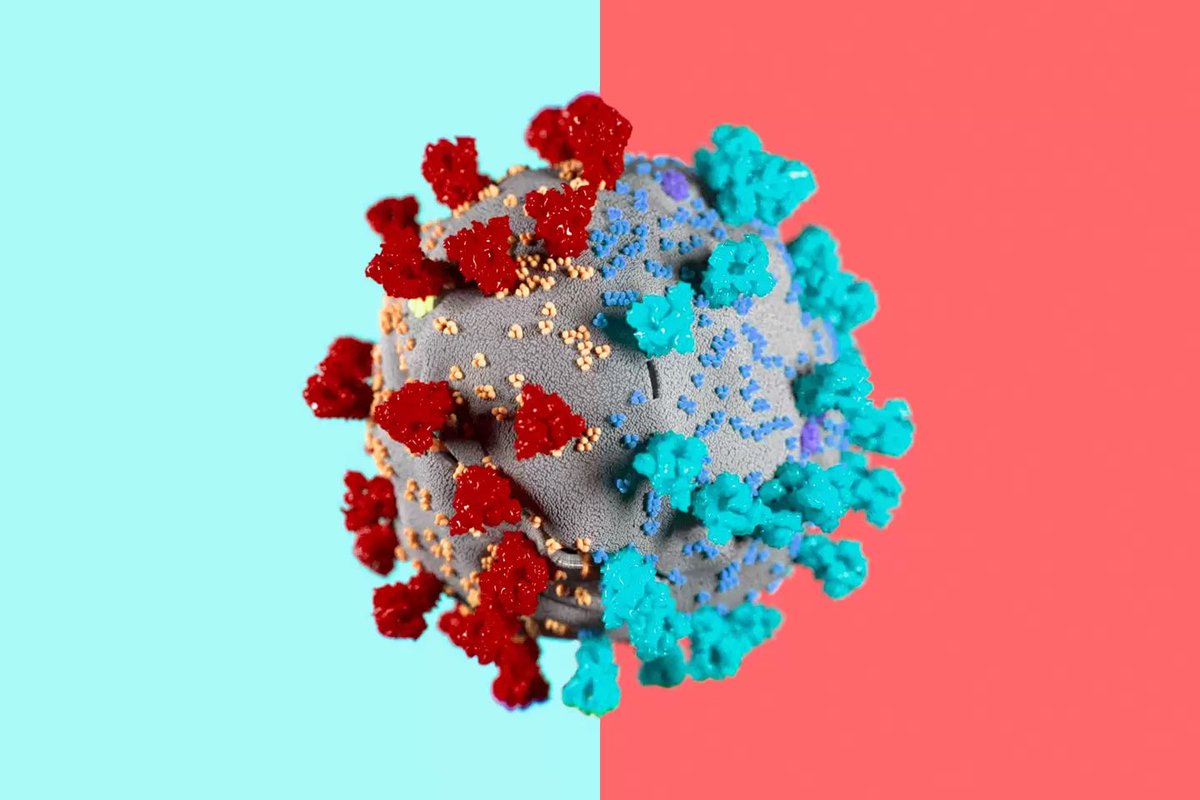
2) The leading hypothesis is that the new variant evolved within just one person, chronically infected with the virus for so long it was able to evolve into a new, more infectious form.
same thing happened in Boston in another immunocompromised person that was sick for 155 days.
3) What happened in Boston with one 45 year old man who was highly infectious for 155 days straight before he died... is exactly what scientists think happened in Kent, England that gave rise to #B117.
4) Doctors were shocked to find virus has evolved many different forms inside of this one immunocompromised man. 20 new mutations in one virus, akin to the #B117. This is possibly how #B1351 in South Africa 🇿🇦 and #P1 in Brazil 🇧🇷 also evolved.
5) “On its own, the appearance of a new variant in genomic databases doesn’t tell us much. “That’s just one genome amongst thousands every week. It wouldn’t necessarily stick out,” says Oliver Pybus, a professor of evolution and infectious disease at Oxford.
2) The leading hypothesis is that the new variant evolved within just one person, chronically infected with the virus for so long it was able to evolve into a new, more infectious form.
same thing happened in Boston in another immunocompromised person that was sick for 155 days.
3) What happened in Boston with one 45 year old man who was highly infectious for 155 days straight before he died... is exactly what scientists think happened in Kent, England that gave rise to #B117.
Immunocompromised 45 year old suffered from #COVID19 for 155 days before he died. The virus was changing very quickly inside the man's body\u2014it acquired a big cluster of >20 mutations\u2014resembled the same ones seen in #B117 & #B1351. (NPR audio Part 1 of 2)\U0001f9f5https://t.co/7kWiBZ1xGk pic.twitter.com/ZJ7AExB78Y
— Eric Feigl-Ding (@DrEricDing) February 8, 2021
4) Doctors were shocked to find virus has evolved many different forms inside of this one immunocompromised man. 20 new mutations in one virus, akin to the #B117. This is possibly how #B1351 in South Africa 🇿🇦 and #P1 in Brazil 🇧🇷 also evolved.
2) NPR report audio part 2 of 2:
— Eric Feigl-Ding (@DrEricDing) February 8, 2021
Dr. Li couldn't believe what they found. "I was shocked," he says. "When I saw the virus sequences, I knew that we were dealing with something completely different and potentially very important." pic.twitter.com/HT3Yt6djFd
5) “On its own, the appearance of a new variant in genomic databases doesn’t tell us much. “That’s just one genome amongst thousands every week. It wouldn’t necessarily stick out,” says Oliver Pybus, a professor of evolution and infectious disease at Oxford.