You can also check out everything going on by following the hashtag #GlobalScienceshow
Welcome to today's #GlobalScienceShow as part of #FUTURES2020
From now until 6pm GMT we have a new researcher every 20 minutes ready to share their work with you!
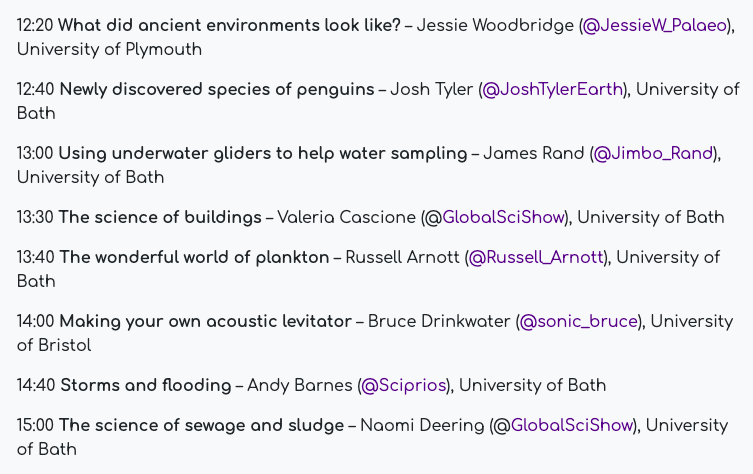
What's going on? Check out the schedule below for info on all presenters!
First up at 12.20pm is @JessieW_Palaeo
You can also check out everything going on by following the hashtag #GlobalScienceshow
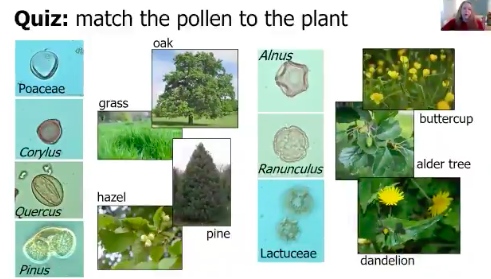
If you know me, then you know I LOVE A QUIZ!!!
#FUTURES2020
https://t.co/jB6sEmP5H3
Hi, my name is Jessie Woodbridge and I'm taking part in the #GlobalScienceShow
— Jessie Woodbridge (@JessieW_Palaeo) November 28, 2020
I'll be discussing #PastEnvironmentalChanges. Follow along with the whole show and check out @JoshTylerEarth who's up next! #FUTURES2020 @GlobalSciShow pic.twitter.com/1PfM7cLQgR
@JessieW_Palaeo #FUTURES2020
It's so exciting that three new species of Gentoo penguins were recently discovered 🐧🐧🐧
#FUTURES2020
https://t.co/AFOqapN8oS
Hi, my name is Josh Tyler and I'm taking part in the #GlobalScienceShow & #FUTURES2020.
— Josh Tyler (@JoshTylerEarth) November 28, 2020
I'll be tweeting about cryptic species and how we discovered three new species of gentoo penguin\U0001f427. Follow along with the whole show and check out @Jimbo_Rand who is up next. 1/12 pic.twitter.com/4TnkM9dnDB
\U0001f44b we updated @JoshTylerEarth\u2019s voice tweet to include *automatic* captions\u2026 pic.twitter.com/NHSXF4caGQ
— HeadlinerClip Caption (@HeadlinerClip) November 28, 2020
But in reality, these amazing machines could help us monitor bodies of water much more efficiently
https://t.co/5bqkx57HLj
Hello, my name is James Rand and I am taking part in @GlobalSciShow and I will talking about lake science and underwater gliders.
— James Rand (underwater glider developer) (@Jimbo_Rand) November 28, 2020
Ask any questions that you may have and dont forget to check out Valeria Cascione who is on at 1.20pm.#FUTURES2020 #GlobalScienceShow pic.twitter.com/FpKCh0XZcJ
\U0001f44b we updated @Jimbo_Rand\u2019s voice tweet to include *automatic* captions\u2026 pic.twitter.com/44MjpKvW9A
— HeadlinerClip Caption (@HeadlinerClip) November 28, 2020
More from Science

I want to share my thoughts, as someone who has been so alarmed by the so-called "dissident" scientists like Gupta, Heneghan, Kuldorff, Bhattacharya, & Ioannidis who consider themselves brave Galileos unfairly treated by "establishment scientists." I will try not to swear. 1/n
I want to talk about 3 things:
‼️Their fringe views are inhumane, unethical junk science that promotes harm
‼️They complain that they've been marginalized but this is simply untrue
‼️I am sick of people telling me we have to "listen to both sides." There aren't 2 sides here 2/n
These 'dissident' scientists have consistently downplayed COVID-19, urging policymakers not to take aggressive control measures. They claim it is not a serious threat. Gupta even went on TV saying people under 65 shouldn't worry about it!
RECEIPTS
They have consistently argued that policymakers should just let the virus rip, in an attempt to reach herd immunity by natural infection. Kuldorff *continues* to argue for this even now that we have many highly effective, safe vaccines.
We've never controlled a deadly, contagious pandemic before by just letting the virus spread, as this approach kills & disables too many people. In Manaus, Brazil, 66% of the city was infected & an astonishing *1 in 500* people died of COVID-19
If this is true raises the question of why certain (fringe & unethical) views got access to No.10 while others were ignored... https://t.co/A75HrSEqo4
— Prof. Devi Sridhar (@devisridhar) December 13, 2020
I want to talk about 3 things:
‼️Their fringe views are inhumane, unethical junk science that promotes harm
‼️They complain that they've been marginalized but this is simply untrue
‼️I am sick of people telling me we have to "listen to both sides." There aren't 2 sides here 2/n
These 'dissident' scientists have consistently downplayed COVID-19, urging policymakers not to take aggressive control measures. They claim it is not a serious threat. Gupta even went on TV saying people under 65 shouldn't worry about it!
RECEIPTS
They have consistently argued that policymakers should just let the virus rip, in an attempt to reach herd immunity by natural infection. Kuldorff *continues* to argue for this even now that we have many highly effective, safe vaccines.
Focused Protection: The Middle Ground between Lockdowns and "Let-it-rip". An essay by Jay Bhattacharya (@Stanford), @SunetraGupta (@UniofOxford) and @MartinKulldorff (@Harvard). https://t.co/T8uLxSFwgh
— Martin Kulldorff (@MartinKulldorff) December 11, 2020
We've never controlled a deadly, contagious pandemic before by just letting the virus spread, as this approach kills & disables too many people. In Manaus, Brazil, 66% of the city was infected & an astonishing *1 in 500* people died of COVID-19


You May Also Like


H was always unseen in S2NL :)
Those who exited at 1500 needed money. They can always come back near 969. Those who exited at 230 also needed money. They can come back near 95.
Those who sold L @ 660 can always come back at 360. Those who sold S last week can be back @ 301
Those who exited at 1500 needed money. They can always come back near 969. Those who exited at 230 also needed money. They can come back near 95.
Those who sold L @ 660 can always come back at 360. Those who sold S last week can be back @ 301
Sir, Log yahan.. 13 days patience nhi rakh sakte aur aap 2013 ki baat kar rahe ho. Even Aap Ready made portfolio banakar bhi de do to bhi wo 1 month me hi EXIT kar denge \U0001f602
— BhavinKhengarSuratGujarat (@IntradayWithBRK) September 19, 2021
Neuland 2700 se 1500 & Sequent 330 to 230 kya huwa.. 99% retailers/investors twitter par charcha n EXIT\U0001f602