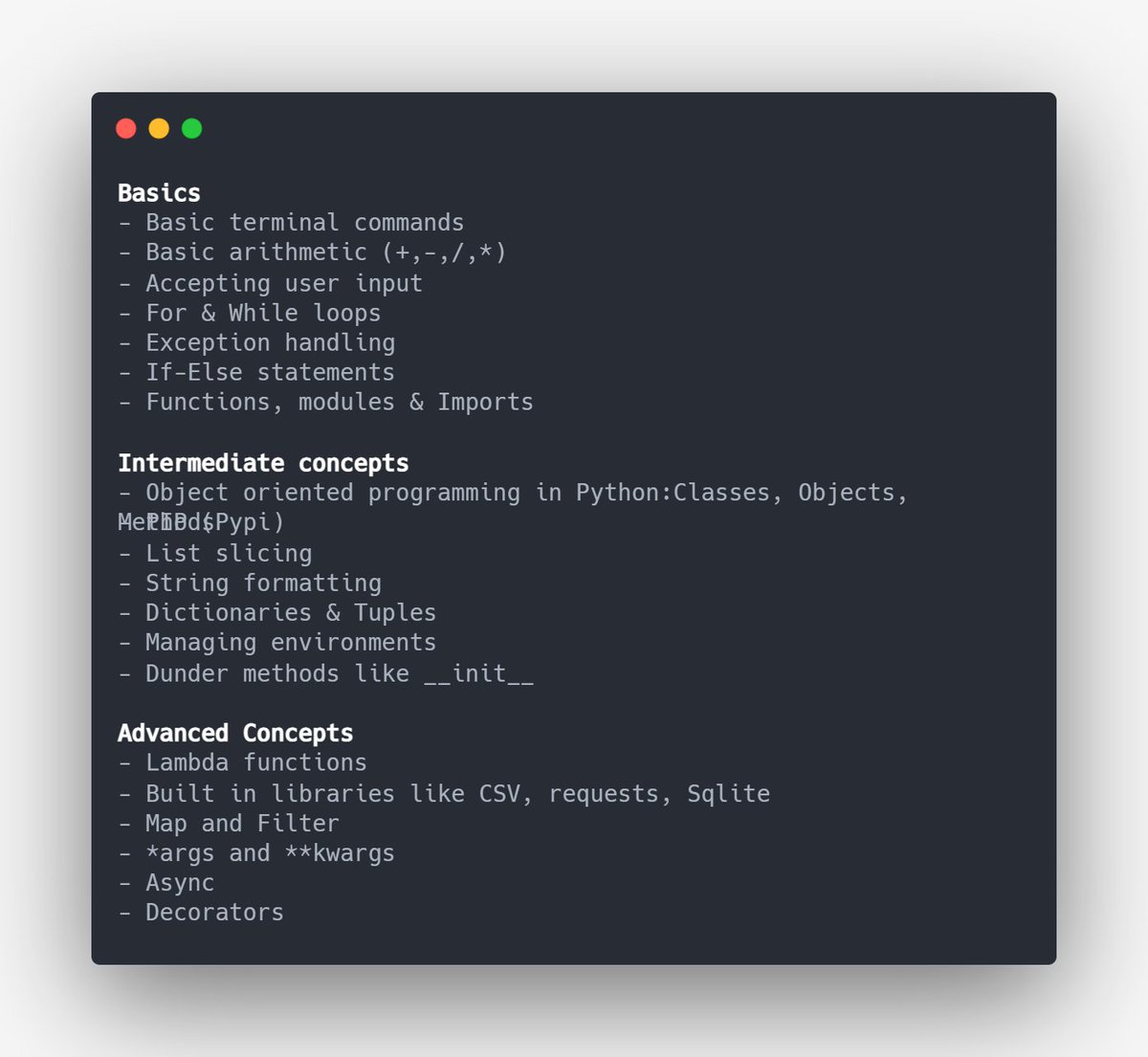
These are the tools you will need for machine learning in Python.

🧵👇

Anaconda

When you work in python, you'll be working with several frameworks and many of them work only on specific versions of python.

(2 / 13)
Now imagine downloading a new version of python and then installing it for every framework you want to work with 😬.

Meet Anaconda which allows you to run several versions of python. It comes pre-installed with several data science and machine learning frameworks.

(3 / 13)
Pip-env is also a way of maintaining several versions of Python and comes pre installed with Python.
You can use pip env or Anaconda, whichever works for you.

(4 / 13)
Jupyter Notebooks

Jupyter notebooks is an IDE just like VS code or Sublime. The special thing about jupyter is that you can parts of code in mini code editors called cells. This is great for prototyping and testing code.

(5 / 13)
Google Collab

Collab is a jupyter notebook running on google's servers which gives you access to GPUs and TPUs for training machine learning models faster for free, yes free.

(6 / 13)
Kaggle

I like to call Kaggle the codepen for machine learning and data science.This is the place where you show off you machine learning skills. You have access to datasets for which you can make machine learning models and compete with other people around the world.

(7 / 13)
TensorFlow

TensorFlow is a framework for machine learning,it has variants like TensorFlow.js for machine learning in the browser, TensorFlow lite for machine learning on mobile phones, and the standard TensorFlow library.

(8 / 13)
PyTorch

PyTorch is an open-source machine learning library based on the Torch library,used for applications such as computer vision and natural language processing. It is very similar to TensorFlow in the things you can do in it with differences in the syntax.

(9 / 13)
Matplotlib

Matplotlib is a library for plotting data into pie charts, bar charts, and whatever kinds of graphs you can imagine.

(10 / 13)
NumPy

Numpy replaces the lists in Python with its lists, but why? Aren't the default lists good enough? The thing is that NumPy lists are much faster than Python lists, hence the wide usage of NumPy.

(11 / 13)
SciKit Learn

SciKit learn is a machine learning library that features various classification, regression, and clustering algorithms including support vector machines. These are complex computations you may need in training your machine learning model.

(12 / 13)
This thread took over 3 hours to make, your support by following me if you like this content will be highly appreciated! 🙏🔥

Stay tuned for more threads, good luck in your machine learning journey.

(13 / 13🎉)

More from Pratham Prasoon

More from Machine learning

10 machine learning YouTube videos.

On libraries, algorithms, and tools.

(If you want to start with machine learning, having a comprehensive set of hands-on tutorials you can always refer to is fundamental.)

🧵👇

1⃣ Notebooks are a fantastic way to code, experiment, and communicate your results.

Take a look at @CoreyMSchafer's fantastic 30-minute tutorial on Jupyter Notebooks.

https://t.co/HqE9yt8TkB


2⃣ The Pandas library is the gold-standard to manipulate structured data.

Check out @joejamesusa's "Pandas Tutorial. Intro to DataFrames."

https://t.co/aOLh0dcGF5


3⃣ Data visualization is key for anyone practicing machine learning.

Check out @blondiebytes's "Learn Matplotlib in 6 minutes" tutorial.

https://t.co/QxjsODI1HB


4⃣ Another trendy data visualization library is Seaborn.

@NewThinkTank put together "Seaborn Tutorial 2020," which I highly recommend.

https://t.co/eAU5NBucbm
Really enjoyed digging into recent innovations in the football analytics industry.

>10 hours of interviews for this w/ a dozen or so of top firms in the game. Really grateful to everyone who gave up time & insights, even those that didnt make final cut 🙇‍♂️ https://t.co/9YOSrl8TdN


For avoidance of doubt, leading tracking analytics firms are now well beyond voronoi diagrams, using more granular measures to assess control and value of space.

This @JaviOnData & @LukeBornn paper from 2018 referenced in the piece demonstrates one method
https://t.co/Hx8XTUMpJ5


Bit of this that I nerded out on the most is "ghosting" — technique used by @counterattack9 & co @stats_insights, among others.

Deep learning models predict how specific players — operating w/in specific setups — will move & execute actions. A paper here: https://t.co/9qrKvJ70EN


So many use-cases:
1/ Quickly & automatically spot situations where opponent's defence is abnormally vulnerable. Drill those to death in training.
2/ Swap target player B in for current player A, and simulate. How does target player strengthen/weaken team? In specific situations?
This is a Twitter series on #FoundationsOfML.

❓ Today, I want to start discussing the different types of Machine Learning flavors we can find.

This is a very high-level overview. In later threads, we'll dive deeper into each paradigm... 👇🧵

Last time we talked about how Machine Learning works.

Basically, it's about having some source of experience E for solving a given task T, that allows us to find a program P which is (hopefully) optimal w.r.t. some metric


According to the nature of that experience, we can define different formulations, or flavors, of the learning process.

A useful distinction is whether we have an explicit goal or desired output, which gives rise to the definitions of 1️⃣ Supervised and 2️⃣ Unsupervised Learning 👇

1️⃣ Supervised Learning

In this formulation, the experience E is a collection of input/output pairs, and the task T is defined as a function that produces the right output for any given input.

👉 The underlying assumption is that there is some correlation (or, in general, a computable relation) between the structure of an input and its corresponding output and that it is possible to infer that function or mapping from a sufficiently large number of examples.

You May Also Like

1/“What would need to be true for you to….X”

Why is this the most powerful question you can ask when attempting to reach an agreement with another human being or organization?

A thread, co-written by @deanmbrody:


2/ First, “X” could be lots of things. Examples: What would need to be true for you to

- “Feel it's in our best interest for me to be CMO"
- “Feel that we’re in a good place as a company”
- “Feel that we’re on the same page”
- “Feel that we both got what we wanted from this deal

3/ Normally, we aren’t that direct. Example from startup/VC land:

Founders leave VC meetings thinking that every VC will invest, but they rarely do.

Worse over, the founders don’t know what they need to do in order to be fundable.

4/ So why should you ask the magic Q?

To get clarity.

You want to know where you stand, and what it takes to get what you want in a way that also gets them what they want.

It also holds them (mentally) accountable once the thing they need becomes true.

5/ Staying in the context of soliciting investors, the question is “what would need to be true for you to want to invest (or partner with us on this journey, etc)?”

Multiple responses to this question are likely to deliver a positive result.