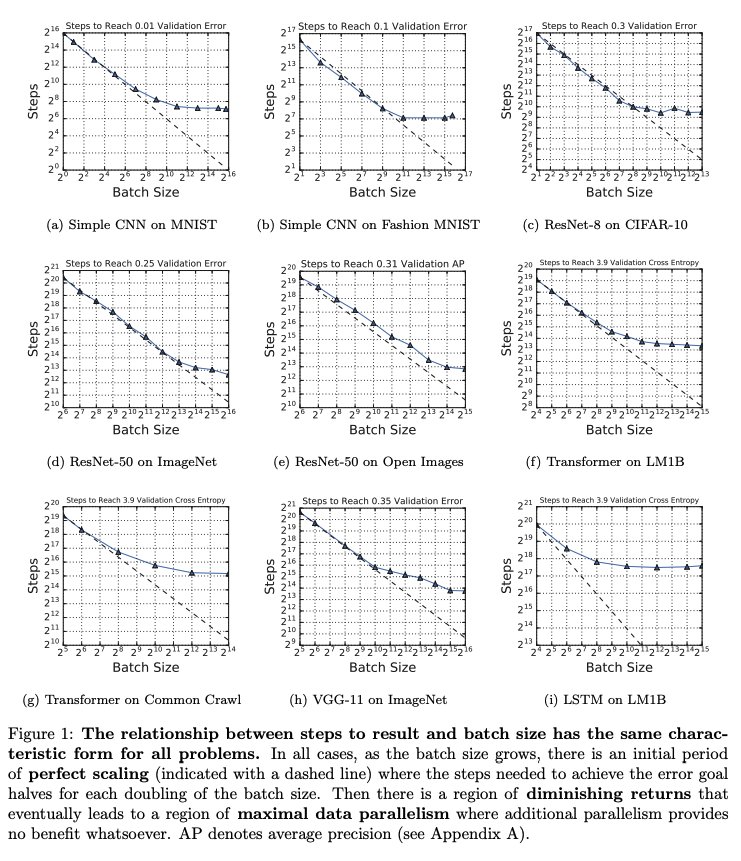
Important paper from Google on large batch optimization. They do impressively careful experiments measuring # iterations needed to achieve target validation error at various batch sizes. The main "surprise" is the lack of surprises. [thread]
https://t.co/7QIx5CFdfJ
More from Machine learning


This is a Twitter series on #FoundationsOfML.
❓ Today, I want to start discussing the different types of Machine Learning flavors we can find.
This is a very high-level overview. In later threads, we'll dive deeper into each paradigm... 👇🧵
Last time we talked about how Machine Learning works.
Basically, it's about having some source of experience E for solving a given task T, that allows us to find a program P which is (hopefully) optimal w.r.t. some metric
According to the nature of that experience, we can define different formulations, or flavors, of the learning process.
A useful distinction is whether we have an explicit goal or desired output, which gives rise to the definitions of 1️⃣ Supervised and 2️⃣ Unsupervised Learning 👇
1️⃣ Supervised Learning
In this formulation, the experience E is a collection of input/output pairs, and the task T is defined as a function that produces the right output for any given input.
👉 The underlying assumption is that there is some correlation (or, in general, a computable relation) between the structure of an input and its corresponding output and that it is possible to infer that function or mapping from a sufficiently large number of examples.
❓ Today, I want to start discussing the different types of Machine Learning flavors we can find.
This is a very high-level overview. In later threads, we'll dive deeper into each paradigm... 👇🧵
Last time we talked about how Machine Learning works.
Basically, it's about having some source of experience E for solving a given task T, that allows us to find a program P which is (hopefully) optimal w.r.t. some metric
I'm starting a Twitter series on #FoundationsOfML. Today, I want to answer this simple question.
— Alejandro Piad Morffis (@AlejandroPiad) January 12, 2021
\u2753 What is Machine Learning?
This is my preferred way of explaining it... \U0001f447\U0001f9f5
According to the nature of that experience, we can define different formulations, or flavors, of the learning process.
A useful distinction is whether we have an explicit goal or desired output, which gives rise to the definitions of 1️⃣ Supervised and 2️⃣ Unsupervised Learning 👇
1️⃣ Supervised Learning
In this formulation, the experience E is a collection of input/output pairs, and the task T is defined as a function that produces the right output for any given input.
👉 The underlying assumption is that there is some correlation (or, in general, a computable relation) between the structure of an input and its corresponding output and that it is possible to infer that function or mapping from a sufficiently large number of examples.



You May Also Like

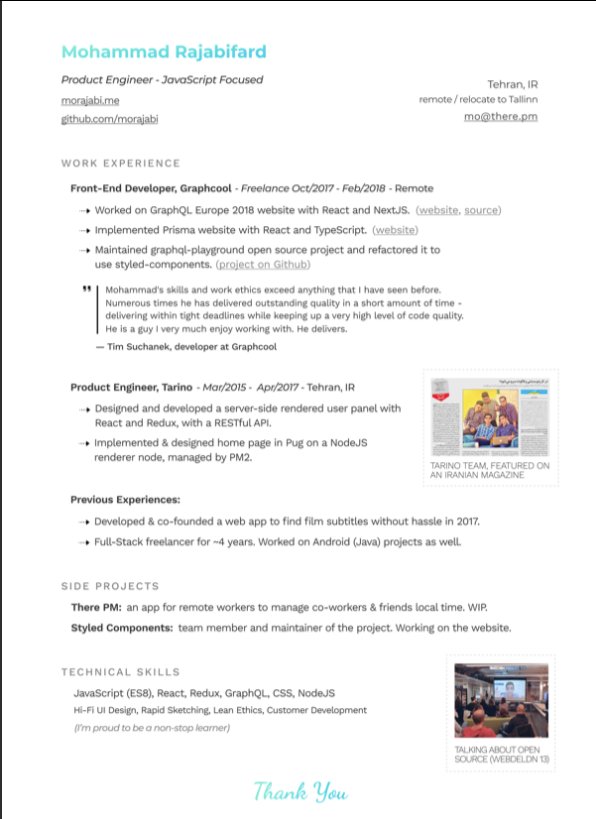
👨💻 Last resume I sent to a startup one year ago, sharing with you to get ideas:
- Forget what you don't have, make your strength bold
- Pick one work experience and explain what you did in detail w/ bullet points
- Write it towards the role you apply
- Give social proof
/thread
"But I got no work experience..."
Make a open source lib, make a small side project for yourself, do freelance work, ask friends to work with them, no friends? Find friends on Github, and Twitter.
Bonus points:
- Show you care about the company: I used the company's brand font and gradient for in the resume for my name and "Thank You" note.
- Don't list 15 things and libraries you worked with, pick the most related ones to the role you're applying.
-🙅♂️"copy cover letter"
"I got no firends, no work"
One practical way is to reach out to conferences and offer to make their website for free. But make sure to do it good. You'll get:
- a project for portfolio
- new friends
- work experience
- learnt new stuff
- new thing for Twitter bio
If you don't even have the skills yet, why not try your chance for @LambdaSchool? No? @freeCodeCamp. Still not? Pick something from here and learn https://t.co/7NPS1zbLTi
You'll feel very overwhelmed, no escape, just acknowledge it and keep pushing.
- Forget what you don't have, make your strength bold
- Pick one work experience and explain what you did in detail w/ bullet points
- Write it towards the role you apply
- Give social proof
/thread
"But I got no work experience..."
Make a open source lib, make a small side project for yourself, do freelance work, ask friends to work with them, no friends? Find friends on Github, and Twitter.
Bonus points:
- Show you care about the company: I used the company's brand font and gradient for in the resume for my name and "Thank You" note.
- Don't list 15 things and libraries you worked with, pick the most related ones to the role you're applying.
-🙅♂️"copy cover letter"
"I got no firends, no work"
One practical way is to reach out to conferences and offer to make their website for free. But make sure to do it good. You'll get:
- a project for portfolio
- new friends
- work experience
- learnt new stuff
- new thing for Twitter bio
If you don't even have the skills yet, why not try your chance for @LambdaSchool? No? @freeCodeCamp. Still not? Pick something from here and learn https://t.co/7NPS1zbLTi
You'll feel very overwhelmed, no escape, just acknowledge it and keep pushing.