2/
Okay ... ready to try the first one. I just read Alister McGrath's 'Theology: The Basics' and have been thinking through his chapter on The Church through the lens of the work I'm doing on Belonging, so here goes ...
🧵 1/
Thinking about ways to translate what I am doing at school into everyday words, and wonder if anyone would be interested in me trying to tweet some of my readings this year?
— Heather Morgan (she/her)\U0001f469\u200d\U0001f9bc\U0001f3f3\ufe0f\u200d\U0001f308 \U0001f1e8\U0001f1e6 (@poweredbylove2) January 3, 2021
I don't I can get them into single tweets, but if folks were interested I'd try 4 short synoptic threads.
2/
3/
4/
5/
6/
7/
https://t.co/73gulgNERo)
8/
9/
10/
11/
12/
13/
14/
15/
16/
Inclusion creates programs while belonging nurtures growth.
Inclusion allows for entrance while belonging celebrates presence.
17/
18/
19/
20/
21/
22/
23/
/end
More from Education

I held back from commenting overnight to chew it over, but I am still saddened by comments during a presentation I attended yesterday by Prof @trishgreenhalgh & @CIHR_IMHA.
The topic was “LongCovid, Myalgic Encephalomyelitis & More”.
I quote from memory.
1/n
#MECFS #LongCovid
The bulk of Prof @Trishgreenhalgh’s presentation was on the importance of recognising LongCovid patient’s symptoms, and pathways for patients which recognised their condition as real. So far so good.
She was asked about “Post Exertional Malaise”... 2/n
PEM has been reported by many patients, and is the hallmark symptom of ME/CFS, leading many to query whether LongCovid and ME/CFS are similar or have overlapping mechanisms.
@Trishgreenhalgh acknowledged the new @NiceComms advice for LongCovid was planned to complement... 3/n
the ME/CFS guidelines, acknowledging some similarities.
Then it all went wrong.
@TrishGreenhalgh noted the changes to the @NiceComms guidance for ME/CFS, removing support for Graded Exercise Therapy / Cognitive Behavioural Therapy. She noted there is a big debate about this. 4/n
That is correct: The BMJ published Prof Lynne Turner Stokes’ column criticising the change (Prof Turner-Stokes is a key proponent of GET/CBT, and I suspect is known to Prof @TrishGreenhalgh).
https://t.co/0enH8TFPoe
However Prof Greenhalgh then went off-piste.
5/n
The topic was “LongCovid, Myalgic Encephalomyelitis & More”.
I quote from memory.
1/n
#MECFS #LongCovid
Have you registered for IMHA's next webinar on Long-COVID? Guest speaker Professor Trisha Greenhalgh.
— CIHR-IMHA Community (@CIHR_IMHA) January 12, 2021
When? Tomorrow: *Jan 13th.* 12pm ET
A few spots are left, but going fast!
Registration required: https://t.co/T4PbWNA35Y@KarimKhan_IMHA @CIHR_IRSC @trishgreenhalgh pic.twitter.com/xlWKi4QKF1
The bulk of Prof @Trishgreenhalgh’s presentation was on the importance of recognising LongCovid patient’s symptoms, and pathways for patients which recognised their condition as real. So far so good.
She was asked about “Post Exertional Malaise”... 2/n
PEM has been reported by many patients, and is the hallmark symptom of ME/CFS, leading many to query whether LongCovid and ME/CFS are similar or have overlapping mechanisms.
@Trishgreenhalgh acknowledged the new @NiceComms advice for LongCovid was planned to complement... 3/n
the ME/CFS guidelines, acknowledging some similarities.
Then it all went wrong.
@TrishGreenhalgh noted the changes to the @NiceComms guidance for ME/CFS, removing support for Graded Exercise Therapy / Cognitive Behavioural Therapy. She noted there is a big debate about this. 4/n
That is correct: The BMJ published Prof Lynne Turner Stokes’ column criticising the change (Prof Turner-Stokes is a key proponent of GET/CBT, and I suspect is known to Prof @TrishGreenhalgh).
https://t.co/0enH8TFPoe
However Prof Greenhalgh then went off-piste.
5/n


OK I am going to be tackling this as surveillance/open source intel gathering exercise, because that is my background. I blew away 3 years of my life doing site acquisition/reconnaissance for a certain industry that shall remain unnamed and believe there is significant carryover.
This is NOT going to be zillow "here is how to google school districts and find walmart" we are not concerned with this malarkey, we are homeschooling and planting victory gardens and having gigantic happy families.
With that said, for my frog and frog-adjacent bros and sisters:
CHOICE SITES:
Zillow is obvious one, but there are many good sites like Billy Land, Classic Country Land, Landwatch, etc. and many of these specialize in owner financing (more on that later.) Do NOT treat these as authoritative sources - trust plat maps and parcel viewers.
TARGET IDENTIFICATION AND EVALUATION:
Okay, everyone knows how to google "raw land in x state" but there are other resources out there, including state Departments of Natural Resources, foreclosure auctions, etc. Finding the land you like is the easy part. Let's do a case study.
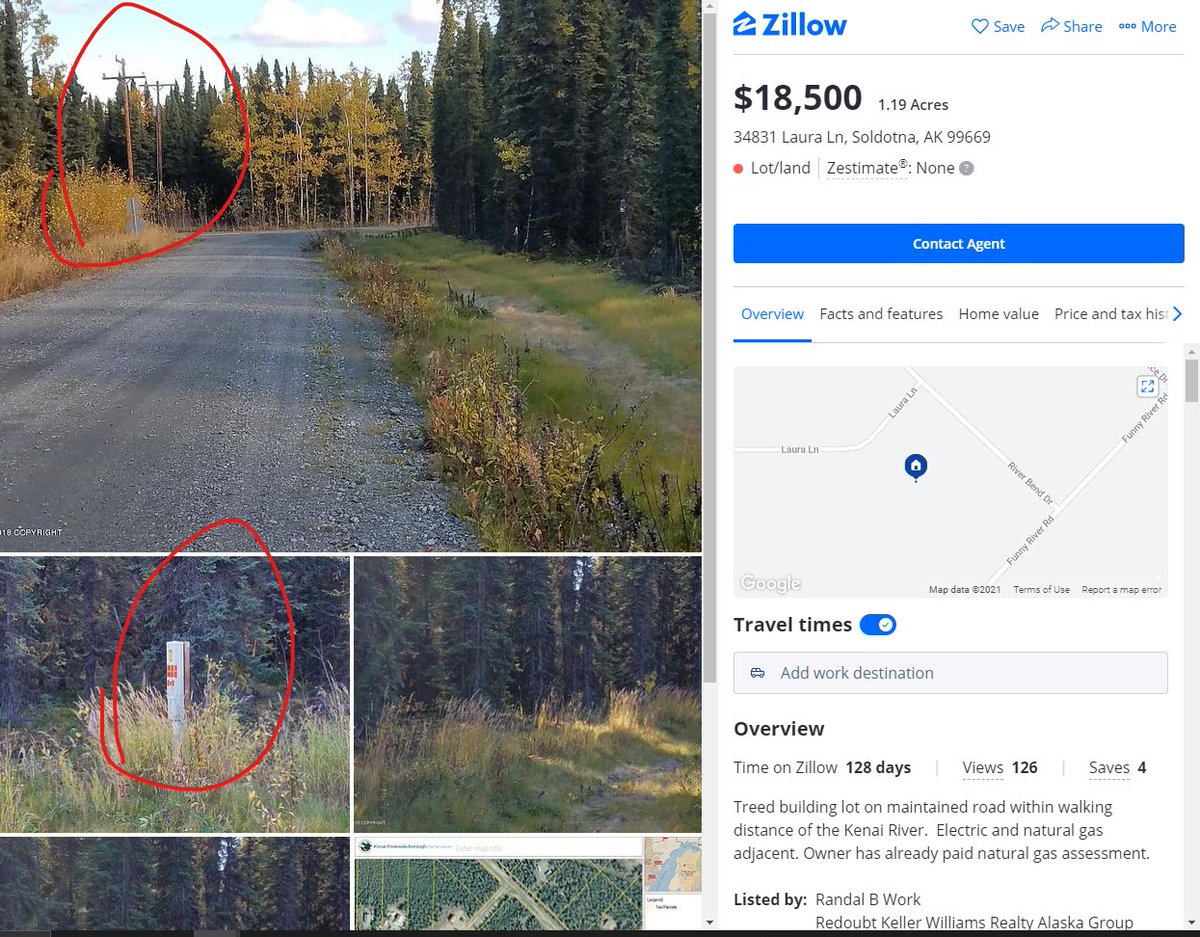
I'm going to target using an "off-grid but not" algorithm. This is a good piece in my book - middle of nowhere but still trekkable to civilization.
Note: visible power, power/fiber pedestal, utility corridor, nearby commercial enterprise(s), and utility pole shadows visible.
If I did thred on finding/acquiring decent raw land would that be something pepo are interested in
— Ovcharka (@ouroboros_outis) January 18, 2021
I think I know a bunch of weird tips/tricks for selection at this point that it might help u guys, lemme know
This is NOT going to be zillow "here is how to google school districts and find walmart" we are not concerned with this malarkey, we are homeschooling and planting victory gardens and having gigantic happy families.
With that said, for my frog and frog-adjacent bros and sisters:
CHOICE SITES:
Zillow is obvious one, but there are many good sites like Billy Land, Classic Country Land, Landwatch, etc. and many of these specialize in owner financing (more on that later.) Do NOT treat these as authoritative sources - trust plat maps and parcel viewers.
TARGET IDENTIFICATION AND EVALUATION:
Okay, everyone knows how to google "raw land in x state" but there are other resources out there, including state Departments of Natural Resources, foreclosure auctions, etc. Finding the land you like is the easy part. Let's do a case study.
I'm going to target using an "off-grid but not" algorithm. This is a good piece in my book - middle of nowhere but still trekkable to civilization.
Note: visible power, power/fiber pedestal, utility corridor, nearby commercial enterprise(s), and utility pole shadows visible.


Below is a list of awesome courses that dive into all different aspects of visual communication and storytelling.
Visual storytelling is a way for people to communicate their story using visuals and digital media such as video, graphics, and photography.
Visual Storytelling appeals to the emotions of the intended audience and it can humanize the business, giving the target market a way to relate to the business and their story.
1. The Art of Storytelling
2. Visual Thinking: Drawing Data to Communicate Ideas
https://t.co/YPiexr9RYJ
3. Find what fascinates you as you explore these visual storytelling
4. Awesome and affordable online art classes for artists of all skill levels! Take your art to the next level no matter where you are. https://t.co/k7xpp4sR4r
5. Digital Storytelling
6. Visual Storytelling | For Screenwriters & Novelists
https://t.co/FsZ7EFFVzo
7. Learn about storytelling with online courses and
Visual storytelling is a way for people to communicate their story using visuals and digital media such as video, graphics, and photography.
Visual Storytelling appeals to the emotions of the intended audience and it can humanize the business, giving the target market a way to relate to the business and their story.
1. The Art of Storytelling
2. Visual Thinking: Drawing Data to Communicate Ideas
https://t.co/YPiexr9RYJ
3. Find what fascinates you as you explore these visual storytelling
4. Awesome and affordable online art classes for artists of all skill levels! Take your art to the next level no matter where you are. https://t.co/k7xpp4sR4r
5. Digital Storytelling
6. Visual Storytelling | For Screenwriters & Novelists
https://t.co/FsZ7EFFVzo
7. Learn about storytelling with online courses and