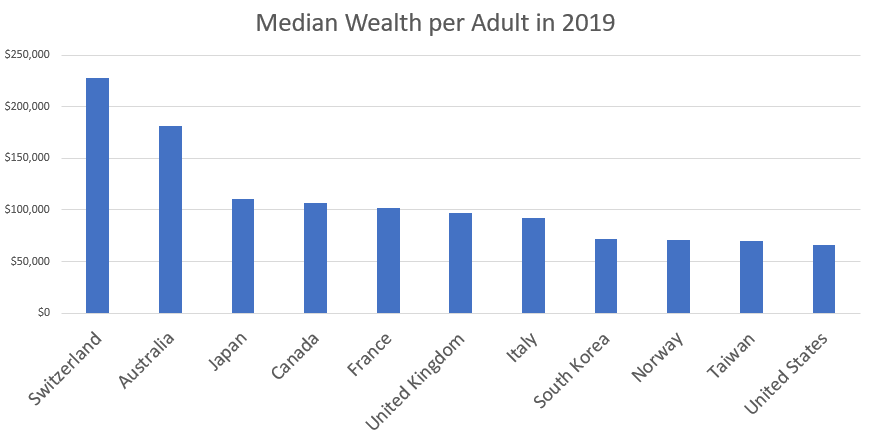
2/The typical American has surprisingly little wealth compared to the typical resident of many other developed countries.
This is a fact that is not widely known or appreciated.
3/Now, some people argue that stuff like Social Security or social insurance programs should be included in wealth. But I chose to focus on private wealth because I think having assets you can sell whenever you want is important to people.
https://t.co/rcRHSHkTMd
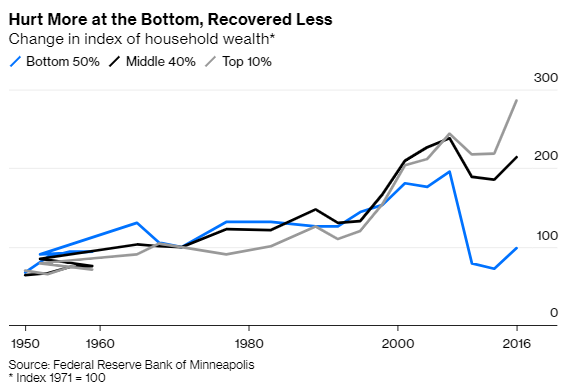
4/For many decades after World War 2, middle-class wealth in America was on a smooth upward trajectory.
Then the housing crash came, and all that changed. Suddenly the rich were still doing well but everyone else was seeing the end of their American Dream.
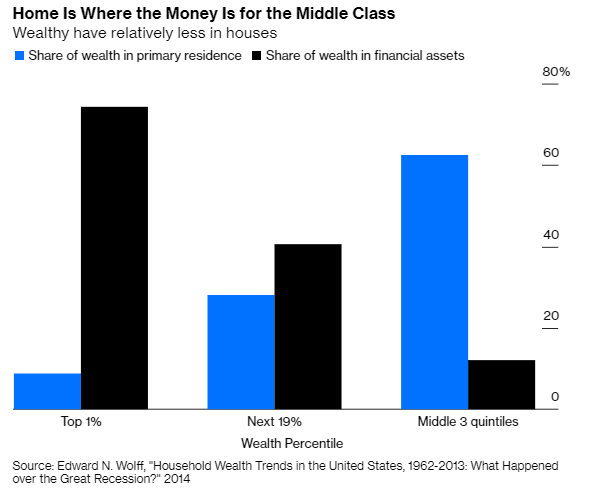
5/Why the divergence?
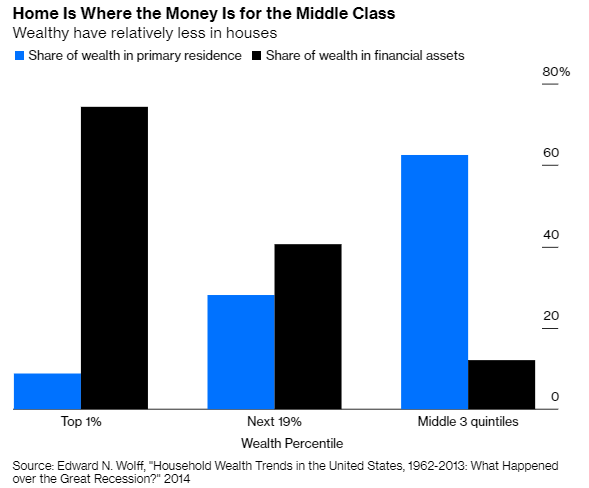
Because the American middle class has its wealth in houses -- specifically, in the houses they live in.
It's the rich who own stocks.
6/OK so how do we fix this? How do we get middle-class wealth *back*?
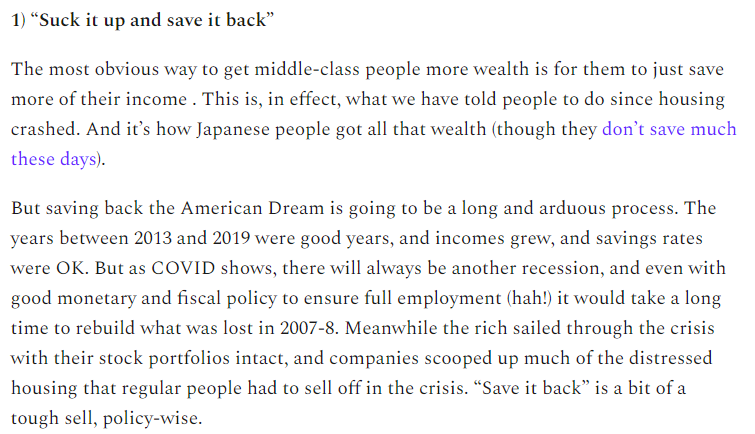
Well, the option we've apparently chosen so far is just to tell people "Suck it up. Start at the bottom, and save it all back."
Seems a bit inadequate, no?
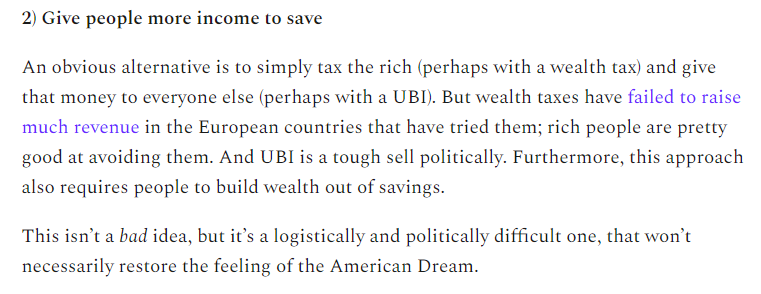
7/Now, we can give people more income -- for example, with UBI -- to help them save faster. I'm certainly not averse to that. But it's going to take a while, and it's politically tough, and it depends on people saving what we give them...
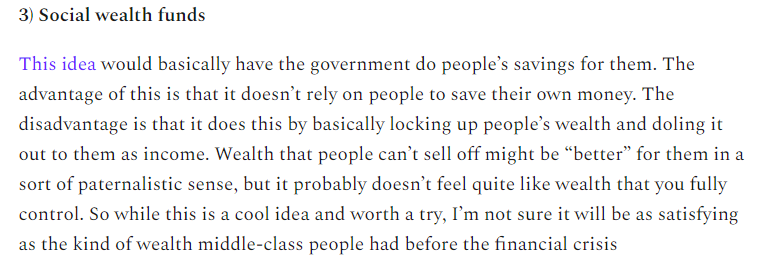
8/We can also have the government save money on people's behalf, with a Social Wealth Fund. But while it's a cool idea, I don't think it would feel like "real wealth" to lots of people, any more than Social Security does. It's more like UBI, really.
9/So that basically leaves: Housing. The way the American middle class traditionally gets its wealth.
Can we still use housing to generate broad middle-class wealth? Should we?
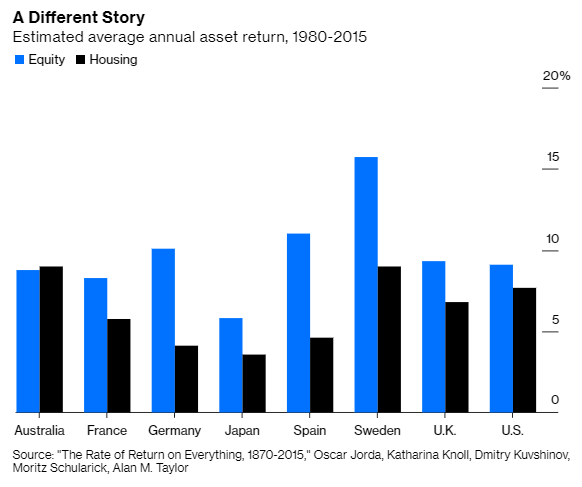
10/Well, the answer to the question of "can we" is "yes". The returns on housing are typically very good, when you include rental yield.
As long as people and companies keep moving to cities, the value of urban location (i.e. land) will appreciate.
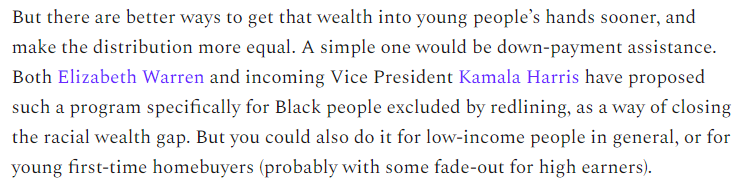
11/But SHOULD we distribute that wealth via home values?
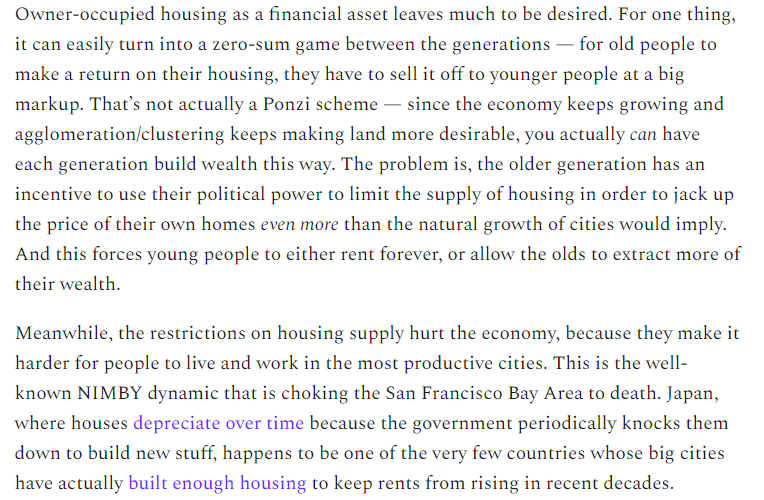
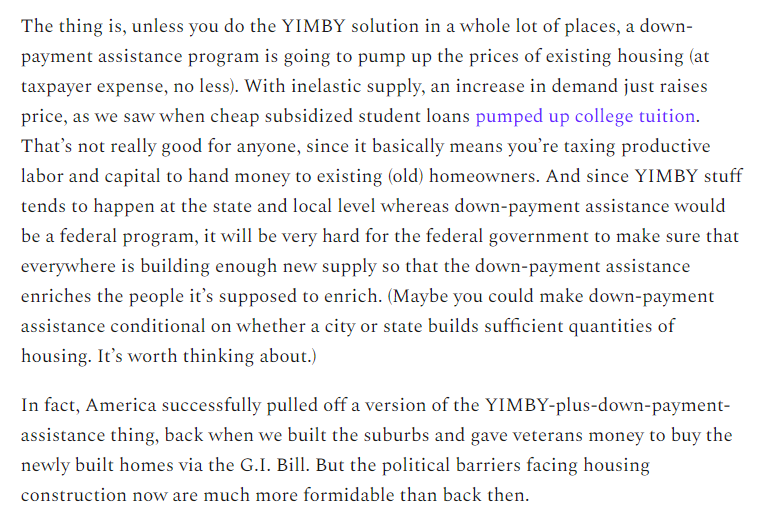
Doing so presents some obvious problems. It invites NIMBYism -- homeowners leveraging local government to push up the prices of their homes, even at the expense of the economy.
12/Owner-occupied housing is also an illiquid asset that's hard to diversify.
13/But there are advantages to building wealth through homeownership as well.
For one thing, most people SUCK at stock investing, but most people kinda-sorta understand homeownership.
14/Also, having a mortgage nudges people to save more each month, nudges them to invest in a riskier but higher-return asset class, and allows them to take on leverage -- all of which have their downsides, but which allow middle-class wealth to keep pace with the rich.
15/Finally, it's just...what the American middle class is used to.
It's hard to completely revamp our wealth-building system. We may simply be locked in.
16/But then the next question is: How can we change our housing system so that every generation can build wealth, instead of one generation (cough, Boomers, cough) getting all the wealth and then pulling up the ladder behind them?
17/Well, there's the YIMBY answer: Just make cities allow more private housing development, and more housing wealth will be created, and increased supply will push prices down, allowing young people to buy in.
18/A second idea is down-payment assistance -- having the federal government give first-time homebuyers and low-income homebuyers some money to help them buy a home.
19/The problem is, you have to do both YIMBYism AND down-payment assistance at the same time, so you don't just end up pumping up prices and handing taxpayer money to existing homeowners.
That's a tricky trick to pull off!
20/So I had another idea -- a Modified Singapore System, in which the government actually builds new housing and then sells it at discounted rates to first-time and low-income homebuyers.
https://t.co/2GwiFm7rib
21/This idea has plenty of challenges, of course. And some drawbacks too. But if we want to get wealth into the hands of the American masses fast, and if we're going to do it through housing, this is an idea worth considering.
(end)
https://t.co/Ask8xPgBrg
Oh, and if you like stuff like this, remember to sign up for my Substack's free email list!
https://t.co/FGppA1M8W6
Anyway, now back to your regularly scheduled coup attempt fallout...