On Jan 6, 2021, the always stellar Mr @deepakshenoy tweeted, this:
https://t.co/fa3GX9VnW0
Innocuous 1 sentence, but its a full economic theory at play.
Let me break it down for you. (1/n)
91 day TBills at 3.03%. Interest rates are even lower than RBI has them.
— Deepak Shenoy (@deepakshenoy) January 6, 2021
In essence, if RBI opts and continues to manage exchange rate, then that is "fiddling with the exchange rate"
RBI has done that in the past and has restarted it in 2020 - very explicitly. (3/n)
Implying INR will be bought from the open markets in order to prevent INR from falling vis a vis USD (4/n)
https://t.co/9kpWP7ovyM
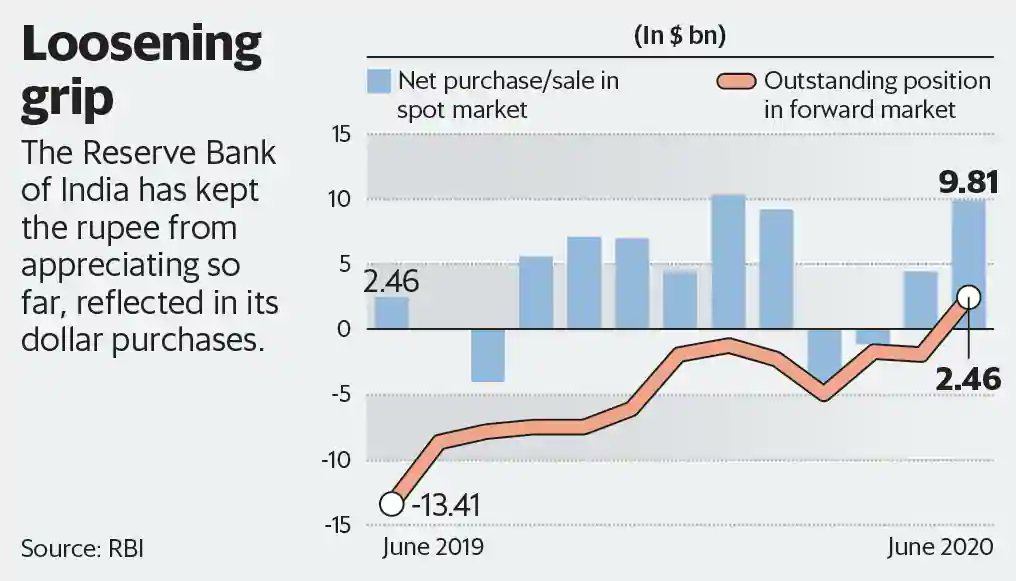
Which is what the subject of my Sept 2020 essay with @CFASocietyIndia was. (6/n)
This:
Consider three legs of a stool of an economy-
a. Ability of Dollar to flow in when excess in global economy
b. Fixed Exchange Rate
c. Ability to set interest rates (7/n)

You can choose any 2 of the 3 legs.
Choose : controlled interest rate (and hence low inflation) and fixed INR/USD rate, you cannot have an open economy.
Which India was till 1992. (8/n)
INR will fluctuate around.
Which India has adopted in the recent years. (9/n)
Many famous currency bets were made because central banks sought to ignore this theory. (10/n)
Because RBI has chosen to have a 'fixed exchange rate' (or at least as fixed as markets would allow) and an open economy, it is losing its influence on setting the interest rates in the market (12/n)
More from Economy


Thread on eminent people supporting farm laws:
Dr. Gita Gopinath, Chief Economist at IMF says "Farm bills are in right
Dr. Surjit Bhalla, executive director at IMF support farm
Godrej Agrovet Chairman Nadir Godrej tells Bloomberg that agriculture reforms are important for
Prof Ashok Gulati supports new farm
Vice-Chairman of Bharti Enterprises Rajan Bharti Mittal supports the new farm
Dr. Gita Gopinath, Chief Economist at IMF says "Farm bills are in right
Dr. Surjit Bhalla, executive director at IMF support farm
Godrej Agrovet Chairman Nadir Godrej tells Bloomberg that agriculture reforms are important for
Godrej Agrovet Chairman Nadir Godrej tells Bloomberg that agriculture reforms are important for India. pic.twitter.com/N6rnelLn0E
— BloombergQuint (@BloombergQuint) December 11, 2020
Prof Ashok Gulati supports new farm
Vice-Chairman of Bharti Enterprises Rajan Bharti Mittal supports the new farm