Not the easiest to follow, but for those interested in the big picture of trade relations between US, EU and China this exchange between @alanbeattie and @IanaDreyer is an essential read. Real debate on key issues, and good points on both sides.
V good points but overall I stick with the conclusion that this is a v risky deal.
— Alan Beattie (@alanbeattie) January 5, 2021
1. It\u2019s overstating it to say that COM now has final say over investment. FDI screening remains a MS competency. COM has had to take a v secondary supporting role over Huawei and 5G.
1/n https://t.co/RVg2jnoFgK
Blistering stuff from @noahbarkin on EU-China deal - a must read https://t.co/92a6rxBRtU pic.twitter.com/VHRtEiOiTy
— Finbarr Bermingham (@fbermingham) January 5, 2021
I disagree with the assertion, and I ask myself against what benchmark the EU is measured here. The EU\u2019s 2019 China Communication sets out a comprehensive strategy that treats China simultaneously as a negotiating partner, an ec competitor and a systemic rival. 1/5 https://t.co/xN1XRQlK1m
— Sabine Weyand (@WeyandSabine) January 5, 2021
More from David Henig
Quick intro to more analysis later - since Freeports are mentioned in this article worth making the point that it seems to me under the UK-EU deal that if the UK provides subsidies for them, or relaxes labour or environmental rules in them, the EU can take retaliatory action.
There has never been level playing field content like this in a trade deal. The idea it is any kind of UK win, when the UK's opening position was no enforceable commitments whatsoever, is ridiculous.
The EU can take retaliatory action against the UK if we weaken labour standards, weaken pretty firm climate change targets, unfairly subsidise, or just in general seem to be out of line. There are processes to follow, but it looks like the PM did it again...
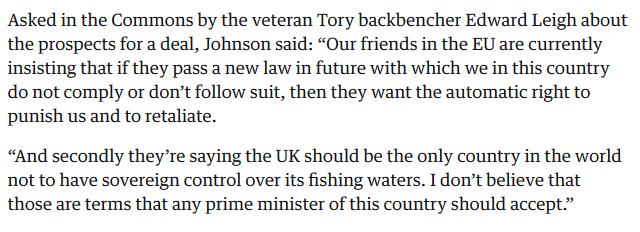
Final one for now. Quite how Labour gets itself in such a fuss about whether to support a deal with the strongest labour and environment commitments ever seen in a trade deal is a sign of just how far it hasn't moved on from leaving.
PS well... (sorry DAG). It certainly didn't have a good effect. And I think if we had settled LPF issues with the EU much earlier there is a good chance the conditions would have been far less stringent. By making an issue, we made it much worse.
Michael Gove: "Outside the EU, with a good trade deal in place, we can tackle the injustices and inequalities that have held Britain back."
— Jennifer Rankin (@JenniferMerode) December 26, 2020
The UK did not need to leave the EU to tackle injustices and inequalities at home. Not a new point, but true.https://t.co/fE4glUAylc
There has never been level playing field content like this in a trade deal. The idea it is any kind of UK win, when the UK's opening position was no enforceable commitments whatsoever, is ridiculous.
For the lawyers. Night. pic.twitter.com/5XvFMhcaeE
— Sam Lowe (@SamuelMarcLowe) December 25, 2020
The EU can take retaliatory action against the UK if we weaken labour standards, weaken pretty firm climate change targets, unfairly subsidise, or just in general seem to be out of line. There are processes to follow, but it looks like the PM did it again...
Final one for now. Quite how Labour gets itself in such a fuss about whether to support a deal with the strongest labour and environment commitments ever seen in a trade deal is a sign of just how far it hasn't moved on from leaving.
PS well... (sorry DAG). It certainly didn't have a good effect. And I think if we had settled LPF issues with the EU much earlier there is a good chance the conditions would have been far less stringent. By making an issue, we made it much worse.
As a lay person is it fair to say that the \u201cthreat\u201d to break international law in Ireland was possibly a strategic blunder that has now determined the future trajectory of the UK for the next 20 years? I can imagine most countries will study what\u2019s baked into this and replicate?
— Meister 1 (@blueelmacho) December 26, 2020
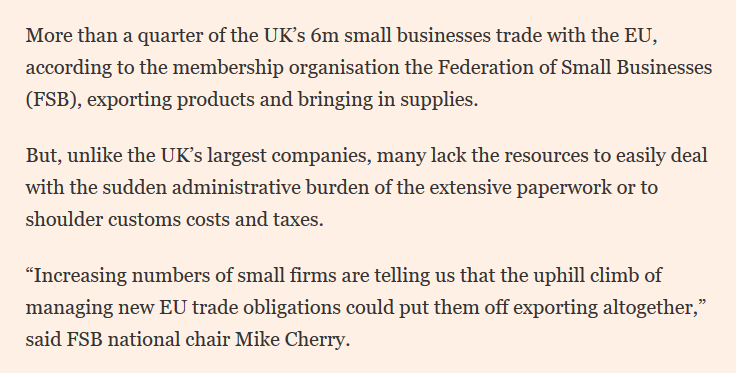
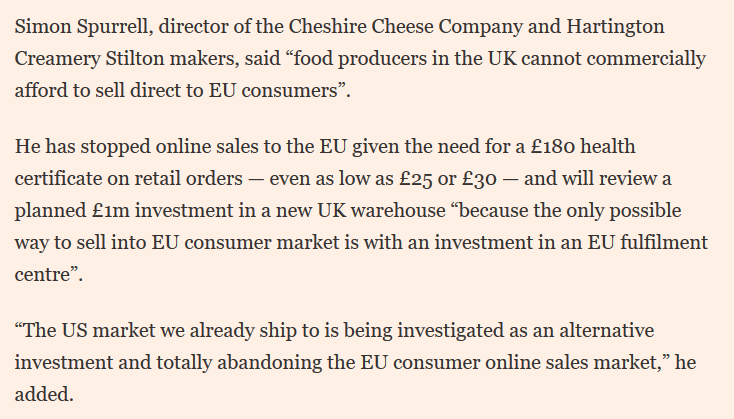
So many stories of new barriers to trade between UK and EU, but you might be thinking at some point these will run out. The government is certainly hoping so. Well they may slow down, but trade relations and regulations are not static, and changes will lead to further problems.
The likelihood of continued trade problems for a £650 bn trade relationship is why there should be a huge cross-government effort led by the Foreign Office and Department for International Trade to put in place the necessary resources to seek best results.
There isn't.
So the UK's relationship with the EU currently consists of two not particularly good deals and no consistent effort to manage current problems or prevent future ones. Joint committees are a second order problem to putting in place the right internal structures.
But that's been the consistent UK problem in relations with the EU since 2016. Lack of focus on getting the right internal structures, people, asks, strategy, too much attention on being tough and a single leader.
News just in. This doesn't necessarily mean the right structure being put into UK-EU relations. I suspect Frost's main role is to ensure no renegotiations with the EU.
Also, wonder what this says about the PM's trust in Michael Gove?
The likelihood of continued trade problems for a £650 bn trade relationship is why there should be a huge cross-government effort led by the Foreign Office and Department for International Trade to put in place the necessary resources to seek best results.
There isn't.
So the UK's relationship with the EU currently consists of two not particularly good deals and no consistent effort to manage current problems or prevent future ones. Joint committees are a second order problem to putting in place the right internal structures.
But that's been the consistent UK problem in relations with the EU since 2016. Lack of focus on getting the right internal structures, people, asks, strategy, too much attention on being tough and a single leader.
News just in. This doesn't necessarily mean the right structure being put into UK-EU relations. I suspect Frost's main role is to ensure no renegotiations with the EU.
Also, wonder what this says about the PM's trust in Michael Gove?
NEW: David Frost is joining Boris Johnson\u2019s Cabinet! The peer has been appointed a minister at the Cabinet Office, effective March 1.
— Sebastian Payne (@SebastianEPayne) February 17, 2021
Frost will also chair the partnership council overseeing the UK-EU trade deal and oversee reform to "maximise on the opportunities of Brexit"
More from Economy


I know I’ve been beating this redlining and wealth gap drum for 20+ years but here is a GREAT cliffs notes version.
But don’t take @ambermruffin’s word for it. You should get references...
A thread
How homes in Black neighborhoods are undervalued by $156
Every major bank in the US has been sued for mortgage discrimination and a study that included every mortgage in America found that Banks charge higher interest rates to nonblack customers
https://t.co/sx9tWWB98s
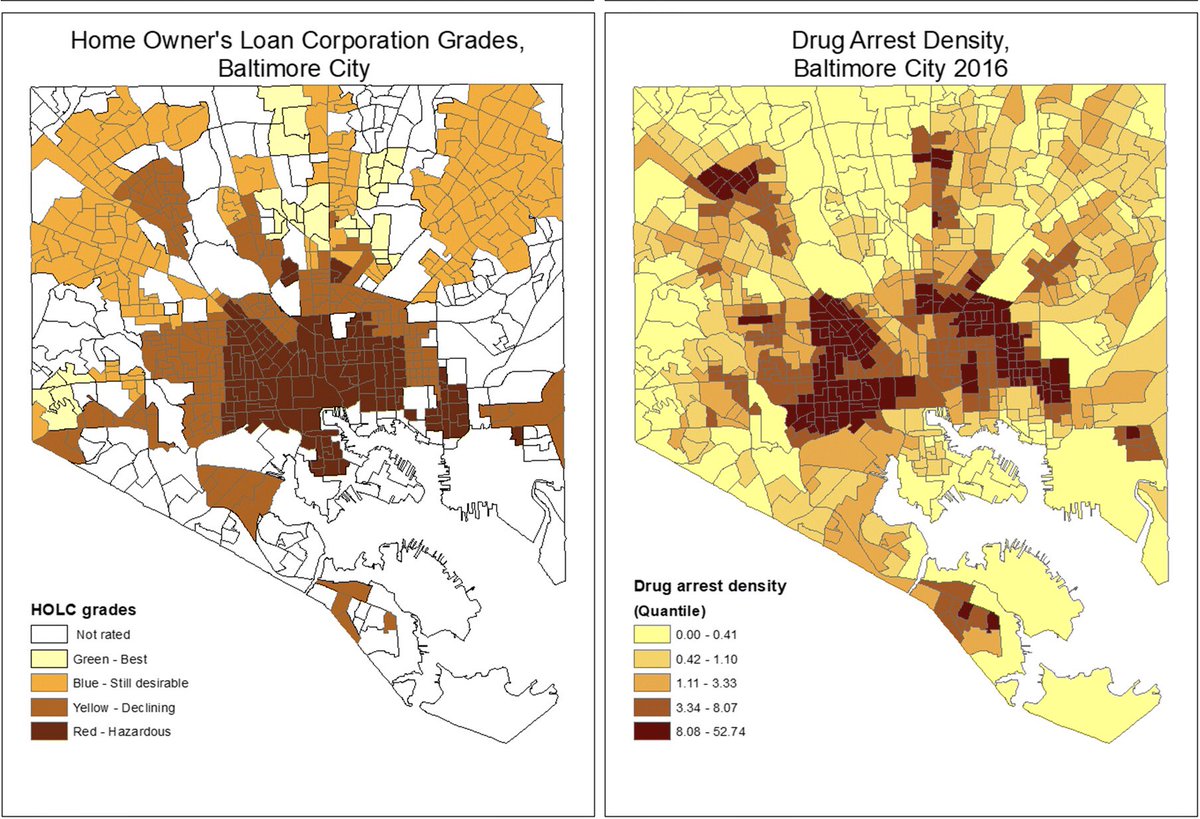
Baltimore redlined areas in 1935 vs Baltimore Drug arrests in 2016
But don’t take @ambermruffin’s word for it. You should get references...
A thread
How did systemic racism get so dang strong? Find out a few of the like bajilliondy ways in our new segment, How Did We Get Here! pic.twitter.com/f4HfISckXh
— amber ruffin (@ambermruffin) January 30, 2021
How homes in Black neighborhoods are undervalued by $156
Every major bank in the US has been sued for mortgage discrimination and a study that included every mortgage in America found that Banks charge higher interest rates to nonblack customers
https://t.co/sx9tWWB98s
Baltimore redlined areas in 1935 vs Baltimore Drug arrests in 2016
You May Also Like


To people who are under the impression that you can get rich quickly by working on an app, here are the stats for https://t.co/az8F12pf02
📈 ~12000 vistis
☑️ 109 transactions
💰 353€ profit (285 after tax)
I have spent 1.5 months on this app. You can make more $ in 2 days.
🤷♂️

I'm still happy that I launched a paid app bcs it involved extra work:
- backend for processing payments (+ permissions, webhooks, etc)
- integration with payment processor
- UI for license activation in Electron
- machine activation limit
- autoupdates
- mailgun emails
etc.
These things seemed super scary at first. I always thought it was way too much work and something would break. But I'm glad I persisted. So far the only problem I have is that mailgun is not delivering the license keys to certain domains like https://t.co/6Bqn0FUYXo etc. 👌
omg I just realized that me . com is an Apple domain, of course something wouldn't work with these dicks
📈 ~12000 vistis
☑️ 109 transactions
💰 353€ profit (285 after tax)
I have spent 1.5 months on this app. You can make more $ in 2 days.
🤷♂️
I'm still happy that I launched a paid app bcs it involved extra work:
- backend for processing payments (+ permissions, webhooks, etc)
- integration with payment processor
- UI for license activation in Electron
- machine activation limit
- autoupdates
- mailgun emails
etc.
These things seemed super scary at first. I always thought it was way too much work and something would break. But I'm glad I persisted. So far the only problem I have is that mailgun is not delivering the license keys to certain domains like https://t.co/6Bqn0FUYXo etc. 👌
omg I just realized that me . com is an Apple domain, of course something wouldn't work with these dicks