
For the lawyers. Night. pic.twitter.com/5XvFMhcaeE
— Sam Lowe (@SamuelMarcLowe) December 25, 2020
Quick intro to more analysis later - since Freeports are mentioned in this article worth making the point that it seems to me under the UK-EU deal that if the UK provides subsidies for them, or relaxes labour or environmental rules in them, the EU can take retaliatory action.
Michael Gove: "Outside the EU, with a good trade deal in place, we can tackle the injustices and inequalities that have held Britain back."
— Jennifer Rankin (@JenniferMerode) December 26, 2020
The UK did not need to leave the EU to tackle injustices and inequalities at home. Not a new point, but true.https://t.co/fE4glUAylc
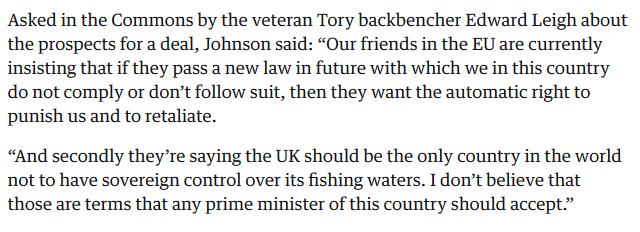
As a lay person is it fair to say that the \u201cthreat\u201d to break international law in Ireland was possibly a strategic blunder that has now determined the future trajectory of the UK for the next 20 years? I can imagine most countries will study what\u2019s baked into this and replicate?
— Meister 1 (@blueelmacho) December 26, 2020
If you're curious how other countries are presenting the UK-EU deal, this is the verdict from a French left-wing paper:
— Pascal \U0001f1ea\U0001f1fa\U0001f1ec\U0001f1e7 (@PascalLTH) December 25, 2020
It is "packed with regulatory brakes stopping London from undertaking social, ecological or fiscal dumping" https://t.co/aPCtyfPKmy
EU-UK TCA.
— Rem Korteweg (@remkorteweg) December 26, 2020
Happy Boxing Day!
https://t.co/39fVCycPUI
Government argue fact that the tribunals are not connected to ECJ, shows the win here on sovereignty ... only one reference in entire text to ECJ here on governance of UK access to EU programmes (eg Horizon), where ECJ arbitration judgements and orders will be enforceable in UK pic.twitter.com/WEIS8WYO01
— Faisal Islam (@faisalislam) December 26, 2020
May I be the first to say, \u201clol, that looks like a quota\u201d.
— Sam Lowe (@SamuelMarcLowe) December 26, 2020
(I\u2019m just joking, these aren\u2019t normal quotas. They are special rules of origin quotas: a certain tonnage of the product gets to use more accommodating rules of origin.) pic.twitter.com/BE2CyQIggS
Rather than negotiations, most of this year has just been choreography.
— Sam Lowe (@SamuelMarcLowe) December 25, 2020
Merry Christmas! \U0001f384
(Incidentally I'm reading as well, but copying the best points I see from others). https://t.co/BsJQU3sJWP
Last point from industry trade expert...
— Faisal Islam (@faisalislam) December 26, 2020
Export businesses will not lobby for lower standards/ aggressive regulatory competition in this environment, indeed EU-facing ones will lobby against such moves if it risks retaliatory tariffs. Thoughts? pic.twitter.com/1fluBNsy0e
At the very least negotiators should have been allowed a lot more freedom to prepare landing zone scenarios on fish months ago.
— Dmitry Grozoubinski (@DmitryOpines) December 26, 2020
Boris Johnson losing in negotiations with the EU is probably a victory for UK strategic interests
— Alexander Clarkson (@APHClarkson) December 26, 2020
The Deal has set up a framework for pragmatic UK reconvergence with the EU short of full integration in the EU system. Future governments can tack various bits of reconvergence to deal with specific UK voter complaints or business sector problems relatively smoothly. NAFTA model
— Alexander Clarkson (@APHClarkson) December 26, 2020
Lastly food industry, already smarting from events, say lack of equivalence for GB agrifood/ SPS problematic as it stands they say \u201cNew Zealand has a closer relationship on SPS with the EU than GB from Jan 1\u201d with an agreement that limits checks (1%) & simplifies paperwork
— Faisal Islam (@faisalislam) December 26, 2020
More from David Henig
Going to have to disagree with my learned friend here. If anyone moved on level playing field it was the UK, on the principle of a ratchet, or tariffs for divergence which was still being denied midweek. Changing the way in this might be achieved (many options) is insignificant.
It is the same "I move in principle you move in detail" shift we saw with the Northern Ireland protocol last year, when no PM could accept a border between GB and NI suddenly did, just as recently no PM would accept tariffs for divergence and seems to have done.
So, are we at deal yet? No, and it remains far from certain, but better than the gloom of Saturday. I still think the PM wants his ideal where everyone is happy, still hopes if only he can speak to Macron and Merkel he could get it, still to decide.
And even if there is a deal it is now too late for either business to adjust to it, or the EU to ratify it according to normal procedure. In both cases you'd think we'd need an extension, but there is a big shrug on this whole question. Nobody knows.
And so, yet again on Brexit, we wait. In particular, those who actually do the trade, the businesses we rely on, are forced to wait for a formal outcome while preparing as best they can. Let's see what happens.
Fish was never a deal breaker. Level playing field was
— Mujtaba Rahman (@Mij_Europe) December 14, 2020
But LPF now more likely to come together after @EU_Commission move (on trade test for unlocking remedial measures & scope of arbitration over remedial measures)
If it does, expect deal on \U0001f420\U0001f421 too
It is the same "I move in principle you move in detail" shift we saw with the Northern Ireland protocol last year, when no PM could accept a border between GB and NI suddenly did, just as recently no PM would accept tariffs for divergence and seems to have done.
So, are we at deal yet? No, and it remains far from certain, but better than the gloom of Saturday. I still think the PM wants his ideal where everyone is happy, still hopes if only he can speak to Macron and Merkel he could get it, still to decide.
Second, I still maintain that Johnson has not made a decision here. Some days he leans towards Deal, sometimes towards No Deal
— Jon Worth (@jonworth) December 14, 2020
He has been stuck for weeks, and still is. He\u2019d ideally just not decide *anything*
And even if there is a deal it is now too late for either business to adjust to it, or the EU to ratify it according to normal procedure. In both cases you'd think we'd need an extension, but there is a big shrug on this whole question. Nobody knows.
And so, yet again on Brexit, we wait. In particular, those who actually do the trade, the businesses we rely on, are forced to wait for a formal outcome while preparing as best they can. Let's see what happens.
So many stories of new barriers to trade between UK and EU, but you might be thinking at some point these will run out. The government is certainly hoping so. Well they may slow down, but trade relations and regulations are not static, and changes will lead to further problems.
The likelihood of continued trade problems for a £650 bn trade relationship is why there should be a huge cross-government effort led by the Foreign Office and Department for International Trade to put in place the necessary resources to seek best results.
There isn't.
So the UK's relationship with the EU currently consists of two not particularly good deals and no consistent effort to manage current problems or prevent future ones. Joint committees are a second order problem to putting in place the right internal structures.
But that's been the consistent UK problem in relations with the EU since 2016. Lack of focus on getting the right internal structures, people, asks, strategy, too much attention on being tough and a single leader.
News just in. This doesn't necessarily mean the right structure being put into UK-EU relations. I suspect Frost's main role is to ensure no renegotiations with the EU.
Also, wonder what this says about the PM's trust in Michael Gove?
The likelihood of continued trade problems for a £650 bn trade relationship is why there should be a huge cross-government effort led by the Foreign Office and Department for International Trade to put in place the necessary resources to seek best results.
There isn't.
So the UK's relationship with the EU currently consists of two not particularly good deals and no consistent effort to manage current problems or prevent future ones. Joint committees are a second order problem to putting in place the right internal structures.
But that's been the consistent UK problem in relations with the EU since 2016. Lack of focus on getting the right internal structures, people, asks, strategy, too much attention on being tough and a single leader.
News just in. This doesn't necessarily mean the right structure being put into UK-EU relations. I suspect Frost's main role is to ensure no renegotiations with the EU.
Also, wonder what this says about the PM's trust in Michael Gove?
NEW: David Frost is joining Boris Johnson\u2019s Cabinet! The peer has been appointed a minister at the Cabinet Office, effective March 1.
— Sebastian Payne (@SebastianEPayne) February 17, 2021
Frost will also chair the partnership council overseeing the UK-EU trade deal and oversee reform to "maximise on the opportunities of Brexit"
Morning. And its Groundhog Day today. https://t.co/gRs4Dc8RH2
Some useful threads will follow, first on the Northern Ireland protocol, where unfettered is still being defined...
And on fish and level playing field. The latter seems, has always seemed, the most problematic, because the UK has apparently ruled out any compromise on shared minumum levels even if not automatic. That would be a deal breaker, but seems... unnecessary.
Your reminder closing complex deals is never easy. But there are ways to facilitate and EU is good at doing this if you meet their red lines. But still the biggest concern that the UK never understood level playing field terms are fundamental to the EU.
In the UK, one man's decision. Allegedly backed by a Cabinet who in reality will be quite happy to blame the PM either way. The temptation to send Michael Gove to seal the deal and end his leadership ambitions must be there...
Source say Michel Barnier has told EU ambassadors that there has been no breakthrough on the fisheries question, and that reports to that effect were \u201ccompletely untrue\u201d
— Tony Connelly (@tconnellyRTE) December 7, 2020
Some useful threads will follow, first on the Northern Ireland protocol, where unfettered is still being defined...
The trouble with \u2018unfettered access\u2019...
— JPCampbellBiz - Wash your hands keep your distance (@JP_Biz) December 6, 2020
And on fish and level playing field. The latter seems, has always seemed, the most problematic, because the UK has apparently ruled out any compromise on shared minumum levels even if not automatic. That would be a deal breaker, but seems... unnecessary.
1/ On fish, both sides are far apart, but it sounds like the UK wants the EU to jump first before it, in turn, shows flexibility. The UK is offering a three year phase in but with an upfront payment of \u20ac300m in demersal fish (ie, out of the \u20ac650m EU boats catch in UK waters)
— Tony Connelly (@tconnellyRTE) December 6, 2020
Your reminder closing complex deals is never easy. But there are ways to facilitate and EU is good at doing this if you meet their red lines. But still the biggest concern that the UK never understood level playing field terms are fundamental to the EU.
In case it wasn't obvious the final choreography of a complex trade deal is complex. The big issues, and potentially some smallprint / related matters of relevance to both sides (for example I wonder if soon after a deal we hear about data or financial services equivalence?)
— David Henig (@DavidHenigUK) December 6, 2020
In the UK, one man's decision. Allegedly backed by a Cabinet who in reality will be quite happy to blame the PM either way. The temptation to send Michael Gove to seal the deal and end his leadership ambitions must be there...
Fact is: EU objectives/focus unlikely to change much in remaining 24-48 hours: fish, non-regression & ability to retaliate across sectors/entire agreement in case of systematic divergence by HMG
— Mujtaba Rahman (@Mij_Europe) December 7, 2020
Most in Cabinet want a deal. @BorisJohnson has big decision he now needs to make https://t.co/mJ49WLt3Qd
More from Brexit




You May Also Like









I just finished Eric Adler's The Battle of the Classics, and wanted to say something about Joel Christiansen's review linked below. I am not sure what motivates the review (I speculate a bit below), but it gives a very misleading impression of the book. 1/x
The meat of the criticism is that the history Adler gives is insufficiently critical. Adler describes a few figures who had a great influence on how the modern US university was formed. It's certainly critical: it focuses on the social Darwinism of these figures. 2/x
Other insinuations and suggestions in the review seem wildly off the mark, distorted, or inappropriate-- for example, that the book is clickbaity (it is scholarly) or conservative (hardly) or connected to the events at the Capitol (give me a break). 3/x
The core question: in what sense is classics inherently racist? Classics is old. On Adler's account, it begins in ancient Rome and is revived in the Renaissance. Slavery (Christiansen's primary concern) is also very old. Let's say classics is an education for slaveowners. 4/x
It's worth remembering that literacy itself is elite throughout most of this history. Literacy is, then, also the education of slaveowners. We can honor oral and musical traditions without denying that literacy is, generally, good. 5/x
As someone\u2019s who\u2019s read the book, this review strikes me as tremendously unfair. It mostly faults Adler for not writing the book the reviewer wishes he had! https://t.co/pqpt5Ziivj
— Teresa M. Bejan (@tmbejan) January 12, 2021
The meat of the criticism is that the history Adler gives is insufficiently critical. Adler describes a few figures who had a great influence on how the modern US university was formed. It's certainly critical: it focuses on the social Darwinism of these figures. 2/x
Other insinuations and suggestions in the review seem wildly off the mark, distorted, or inappropriate-- for example, that the book is clickbaity (it is scholarly) or conservative (hardly) or connected to the events at the Capitol (give me a break). 3/x
The core question: in what sense is classics inherently racist? Classics is old. On Adler's account, it begins in ancient Rome and is revived in the Renaissance. Slavery (Christiansen's primary concern) is also very old. Let's say classics is an education for slaveowners. 4/x
It's worth remembering that literacy itself is elite throughout most of this history. Literacy is, then, also the education of slaveowners. We can honor oral and musical traditions without denying that literacy is, generally, good. 5/x