"If you knew everything you needed to know and did everything right, is your existing business and delivery model still viable and competitive?"
The answer to that question determines if for you the problem is Brexit, or how Brexit was delivered.
#Brexit & #fishing: True to their word, it looks like British #seafood exporters are taking their concerns around #trade to the streets of London #Brexality pic.twitter.com/CIqmDQR69d
— Bryce Stewart (@BD_Stew) January 18, 2021
Over the past 15 days I have not only been running my company as normal but I have been faced with largest threat to its future since it began in 1992. This is #Brexit & here is my thread on just how bad things are getting. 1/26
— Daniel Lambert (Wines). \U0001f1ea\U0001f1fa\U0001f1eb\U0001f1f7\U0001f3f4\U000e0067\U000e0062\U000e0077\U000e006c\U000e0073\U000e007f\U0001f347\U0001f942 (@DanielLambert29) January 16, 2021
A live example of the issues on why businesses are not better prepared for post-Brexit red tape - thread
— Shane Brennan (@ColdChainShane) January 14, 2021
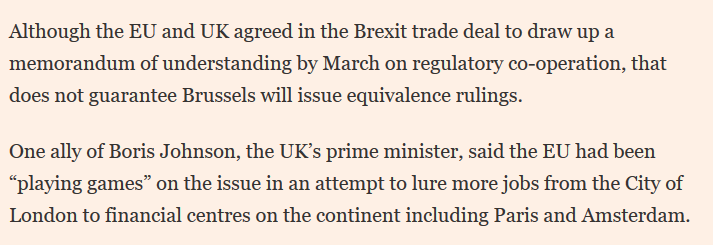
Over past few days I have been really annoyed with myself that I did not foresee and warn #coldchain members about key processes on food (SPS) exports that have come to fore pic.twitter.com/oBJYCJHoIc

A brexit advent calendar to count down to loss of our EU rights
— European Unity #FBPE \U0001f1ea\U0001f1fa\U0001f4b6\u2b50\ufe0f (@EuropeanUnity1) December 31, 2020
Box 31: Boris Johnson told us:
\u201cI\u2019m in favour of the single market\u201d
\u201cThe cost of getting out will be virtually nil\u201d
\u201cWe have an oven ready deal\u201d
\u201cThere is no threat to the Erasmus scheme\u201d
\u201cF**k business\u201d pic.twitter.com/w8KxDJYV4x
A brexit advent calendar to count down to loss of our EU rights
— European Unity #FBPE \U0001f1ea\U0001f1fa\U0001f4b6\u2b50\ufe0f (@EuropeanUnity1) December 30, 2020
Box 30: Nigel Farage told us:
\u201cIn a 52-48 referendum this would be unfinished business by a long way\u201d
\u201cI never promised brexit would be a huge success\u201d
\u201cIf brexit is a disaster, I will go and live abroad\u201d pic.twitter.com/UfO9gzoUPD
A brexit advent calendar to count down to loss of our EU rights
— European Unity #FBPE \U0001f1ea\U0001f1fa\U0001f4b6\u2b50\ufe0f (@EuropeanUnity1) December 29, 2020
Box 29: Andrea Leadsom told us:
\u201cI don\u2019t think the UK should leave the EU. It would be a disaster for our economy & lead to a decade of uncertainty\u201d
\u201cMy expectation is that there will not be an economic impact\u201d pic.twitter.com/SMSQ6ruG2h
A brexit advent calendar to count down to loss of our EU rights
— European Unity #FBPE \U0001f1ea\U0001f1fa\U0001f4b6\u2b50\ufe0f (@EuropeanUnity1) December 28, 2020
Box 28: Andrew Bridgen told us:
\u201cAs an English person I have the right to go to Ireland, I believe I can ask for a passport can\u2019t I?\u201d
\u201cWe won\u2019t be crashing out, we\u2019ll be cashing in\u201d pic.twitter.com/jFINFu8xNe
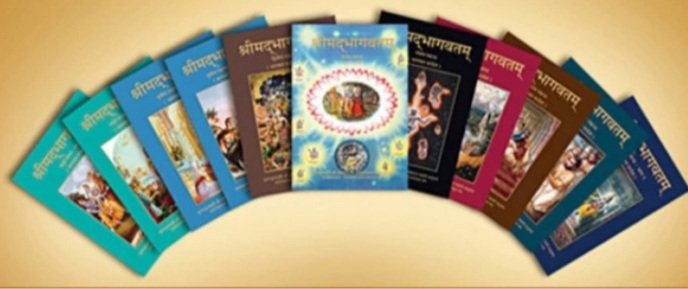
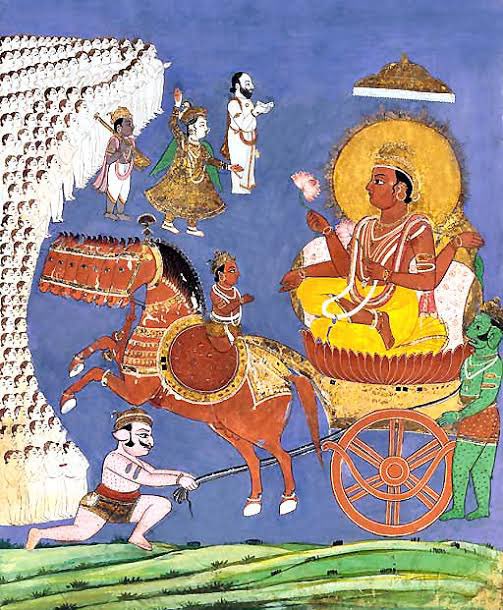
HOW LIFE EVOLVED IN THIS UNIVERSE AS PER OUR SCRIPTURES.
— Anshul Pandey (@Anshulspiritual) August 29, 2020
Well maximum of Living being are the Vansaj of Rishi Kashyap. I have tried to give stories from different-different Puran. So lets start.... pic.twitter.com/MrrTS4xORk
Thread on NARK(HELL) / \u0928\u0930\u094d\u0915
— Anshul Pandey (@Anshulspiritual) August 11, 2020
Well today i will take you to a journey where nobody wants to go i.e Nark. Hence beware of doing Adharma/Evil things. There are various mentions in Puranas about Nark, But my Thread is only as per Bhagwat puran(SS attached in below Thread)
1/8 pic.twitter.com/raHYWtB53Q
#THREAD
— Anshul Pandey (@Anshulspiritual) August 12, 2020
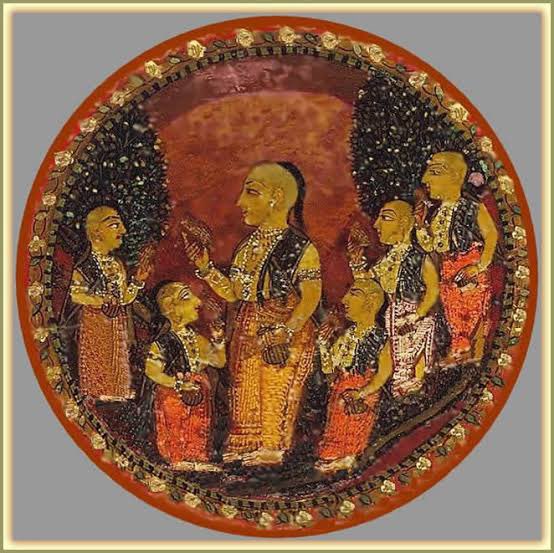
WHY PARENTS CHOOSE RELIGIOUS OR PARAMATMA'S NAMES FOR THEIR CHILDREN AND WHICH ARE THE EASIEST WAY TO WASH AWAY YOUR SINS.
Yesterday I had described the types of Naraka's and the Sin or Adharma for a person to be there.
1/8 pic.twitter.com/XjPB2hfnUC