This is the second time in one week that I have to engage with something written by a British academic on their assessment of Brexit & Ireland. In this case @HelenHet20 in @NewStatesman 🧵
More from Brexit

What's in the EU-UK Brexit deal on energy?
It may be Boxing day, but I've had a quick look
Title VIII: Energy is the key section (page 156 onwards)
▶️ Standard stuff on commitment to competition, unbundling and customer choice
▶️ UK Capacity Market no longer needs to try to integrate overseas Capacity providers & vice versa
(Article ENER.6, Clause 3, page. 160)
2/

▶️ Existing "exemptions" for selected interconnectors will continue to apply.
This means that these interconnectors can continue to sell capacity rights ahead of time, rather than all through close to real-time markets.
(Article ENER.11, page 162)
3/

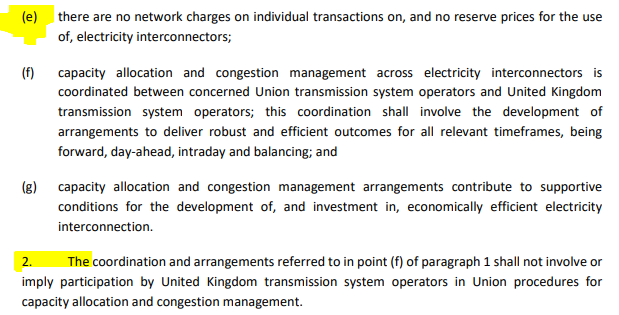
▶️ No network charges on individual interconnector transactions (as now)
▶️ But, UK cannot participate in EU procedures for capacity allocation and congestion management (more on this later)
(Article ENER.13, page 163)
4/
Gas trading: looks like the UK stays in the existing PRISMA gas trading platform.
Not my specialist area, but is this because PRISMA isn't an EU institution (unlike electricity market coupling)?
https://t.co/5GQJtZDpTa
(Article ENER. 15, page 164)
5/
It may be Boxing day, but I've had a quick look
Title VIII: Energy is the key section (page 156 onwards)
▶️ Standard stuff on commitment to competition, unbundling and customer choice
▶️ UK Capacity Market no longer needs to try to integrate overseas Capacity providers & vice versa
(Article ENER.6, Clause 3, page. 160)
2/
▶️ Existing "exemptions" for selected interconnectors will continue to apply.
This means that these interconnectors can continue to sell capacity rights ahead of time, rather than all through close to real-time markets.
(Article ENER.11, page 162)
3/
▶️ No network charges on individual interconnector transactions (as now)
▶️ But, UK cannot participate in EU procedures for capacity allocation and congestion management (more on this later)
(Article ENER.13, page 163)
4/
Gas trading: looks like the UK stays in the existing PRISMA gas trading platform.
Not my specialist area, but is this because PRISMA isn't an EU institution (unlike electricity market coupling)?
https://t.co/5GQJtZDpTa
(Article ENER. 15, page 164)
5/



#Brexitadventcalendar
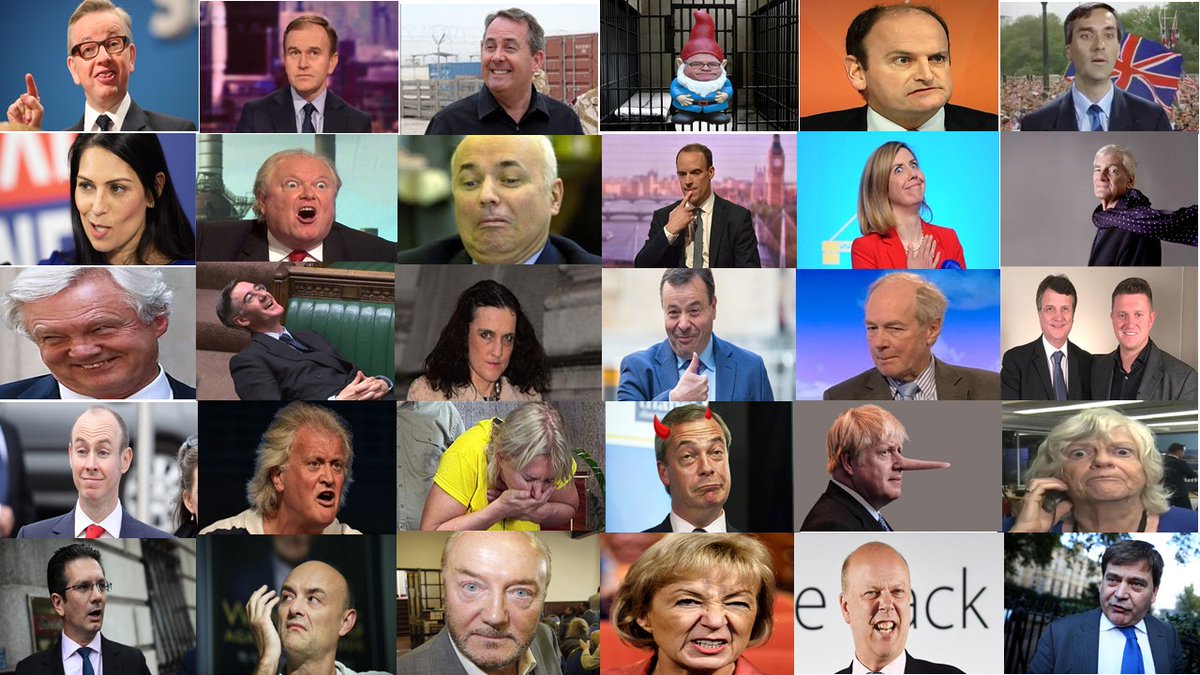
31 liars & hypocrites who facilitated brexit
Some are mad, some are bad
All are millionaires, some are billionaires
They’ll profit from UK companies failing, keep their money abroad to avoid UK tax and travel freely with their EU passports
#RejoinEU
https://t.co/mZRr9u1RPb
https://t.co/BY6hKloR9d
https://t.co/NdC0ltLeSM
https://t.co/BLnRLotso7
31 liars & hypocrites who facilitated brexit
Some are mad, some are bad
All are millionaires, some are billionaires
They’ll profit from UK companies failing, keep their money abroad to avoid UK tax and travel freely with their EU passports
#RejoinEU
https://t.co/mZRr9u1RPb
A brexit advent calendar to count down to loss of our EU rights
— European Unity #FBPE \U0001f1ea\U0001f1fa\U0001f4b6\u2b50\ufe0f (@EuropeanUnity1) December 31, 2020
Box 31: Boris Johnson told us:
\u201cI\u2019m in favour of the single market\u201d
\u201cThe cost of getting out will be virtually nil\u201d
\u201cWe have an oven ready deal\u201d
\u201cThere is no threat to the Erasmus scheme\u201d
\u201cF**k business\u201d pic.twitter.com/w8KxDJYV4x
https://t.co/BY6hKloR9d
A brexit advent calendar to count down to loss of our EU rights
— European Unity #FBPE \U0001f1ea\U0001f1fa\U0001f4b6\u2b50\ufe0f (@EuropeanUnity1) December 30, 2020
Box 30: Nigel Farage told us:
\u201cIn a 52-48 referendum this would be unfinished business by a long way\u201d
\u201cI never promised brexit would be a huge success\u201d
\u201cIf brexit is a disaster, I will go and live abroad\u201d pic.twitter.com/UfO9gzoUPD
https://t.co/NdC0ltLeSM
A brexit advent calendar to count down to loss of our EU rights
— European Unity #FBPE \U0001f1ea\U0001f1fa\U0001f4b6\u2b50\ufe0f (@EuropeanUnity1) December 29, 2020
Box 29: Andrea Leadsom told us:
\u201cI don\u2019t think the UK should leave the EU. It would be a disaster for our economy & lead to a decade of uncertainty\u201d
\u201cMy expectation is that there will not be an economic impact\u201d pic.twitter.com/SMSQ6ruG2h
https://t.co/BLnRLotso7
A brexit advent calendar to count down to loss of our EU rights
— European Unity #FBPE \U0001f1ea\U0001f1fa\U0001f4b6\u2b50\ufe0f (@EuropeanUnity1) December 28, 2020
Box 28: Andrew Bridgen told us:
\u201cAs an English person I have the right to go to Ireland, I believe I can ask for a passport can\u2019t I?\u201d
\u201cWe won\u2019t be crashing out, we\u2019ll be cashing in\u201d pic.twitter.com/jFINFu8xNe
Another head-banging day for the £112bn UK creative sector that is starting to ingest how difficult #Brexit is going to make their lives - and how little the government is really willing to do to fix the lack of a 'mobility' chapter in the EU-UK trade deal. Quick update.../1
First Equity @EquityUK put out a letter to @BorisJohnson warning that #brexit was a "towering hurdle" (you'd want Brian Blessed reading that part) to UK actors plying their trade in EU - a double whammy with #COVID19 /2
https://t.co/mXjTAISqZk
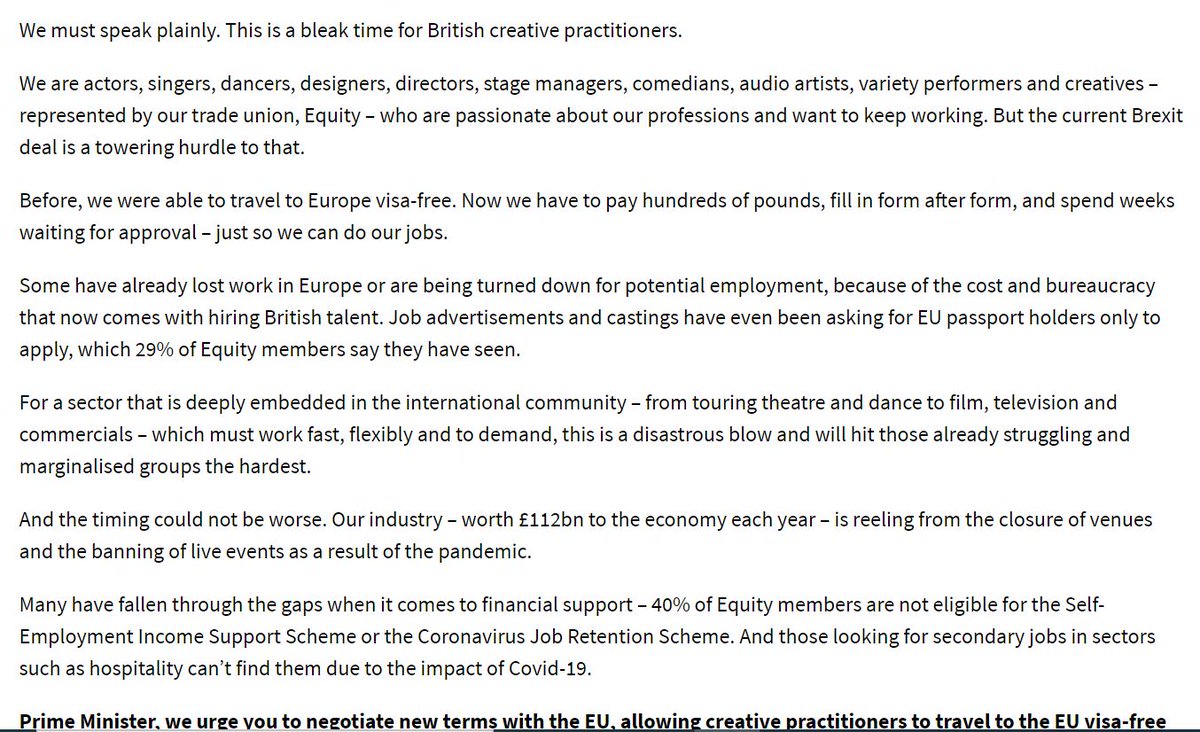
@BorisJohnson One third of Equity members say they've seen job ads asking for EU passport holders: "Before, we were able to travel to Europe visa-free. Now we have to pay hundreds of pounds, fill in form after form, and spend weeks waiting for approval" /3
@BorisJohnson Worth recalling that all this goes back to the UK desire NOT to have a 'mobility' provision within the TCA - all part of 'ending Free Movement' and the professional services folk - including musicians, actors, fashion models etc -are all victim of
@BorisJohnson What's the government going to do about all this? Good question, which brings us to todays @CommonsDCMS hearing in which the Culture Minister Caroline Dinenage @cj_dinenage frankly pin-balled around the issues /5
First Equity @EquityUK put out a letter to @BorisJohnson warning that #brexit was a "towering hurdle" (you'd want Brian Blessed reading that part) to UK actors plying their trade in EU - a double whammy with #COVID19 /2
https://t.co/mXjTAISqZk
@BorisJohnson One third of Equity members say they've seen job ads asking for EU passport holders: "Before, we were able to travel to Europe visa-free. Now we have to pay hundreds of pounds, fill in form after form, and spend weeks waiting for approval" /3
@BorisJohnson Worth recalling that all this goes back to the UK desire NOT to have a 'mobility' provision within the TCA - all part of 'ending Free Movement' and the professional services folk - including musicians, actors, fashion models etc -are all victim of
@BorisJohnson What's the government going to do about all this? Good question, which brings us to todays @CommonsDCMS hearing in which the Culture Minister Caroline Dinenage @cj_dinenage frankly pin-balled around the issues /5