Mollyycolllinss Categories Society


@EpsteinJon @HumeField @CarlosTorrelio @linfa_wang
of @EcoHealthNYC released the first draft of:
https://t.co/nbZPxmEdja
Why haven't US authorities forced them to?
@USAIDGH @OneHealthUCD @NIHDirector
@dylanbgeorge @cmyeaton
Dr. Alice Latinne Alice Latinne sampling a rodent in SE Sulawesi @PREDICTproject in 2017 and 2018 in Indonesia, before her work on bats with Zhengli Shi:
Origin & cross-species transmission of bat coronaviruses in China
Earliest Version: 2. May 31, 2020
https://t.co/vF0tGWDFjv

3.
8/End
— Ant\xf3nio Duarte (@AntGDuarte) November 18, 2020
\u2022 Are the unreported beta CoVs detected in Tongguan mine samples from 2014-2015 the 78XX group reported in Latinne et al (2020)?
\u2022 Is it a coincidence that this group seems closely related to RaTG13 and that a 7896 label shows up in RaTG13 amplicons?
h/t @franciscodeasis pic.twitter.com/BnE7xpfFmm
4. @franciscodeasis
What we know about the 7896 clade? Let's recap:
— Francisco de Asis (@franciscodeasis) November 18, 2020
1/ They were published in June 2020 as part of a batch of 630 viruses of Latinne et. (2020). No details were givenhttps://t.co/9r05e9rMKo
5. @MonaRahalkar
This is height of limited hangout! Show one and hide 8. Then after the pandemic quietly add these sequences without their exact locations!
— Mona (@MonaRahalkar) November 18, 2020
Glad that I asked valid questions in our Frontiers paper! Atleast the Mojiang mineshaft came out as Addendum! https://t.co/F9DD5QPTQp



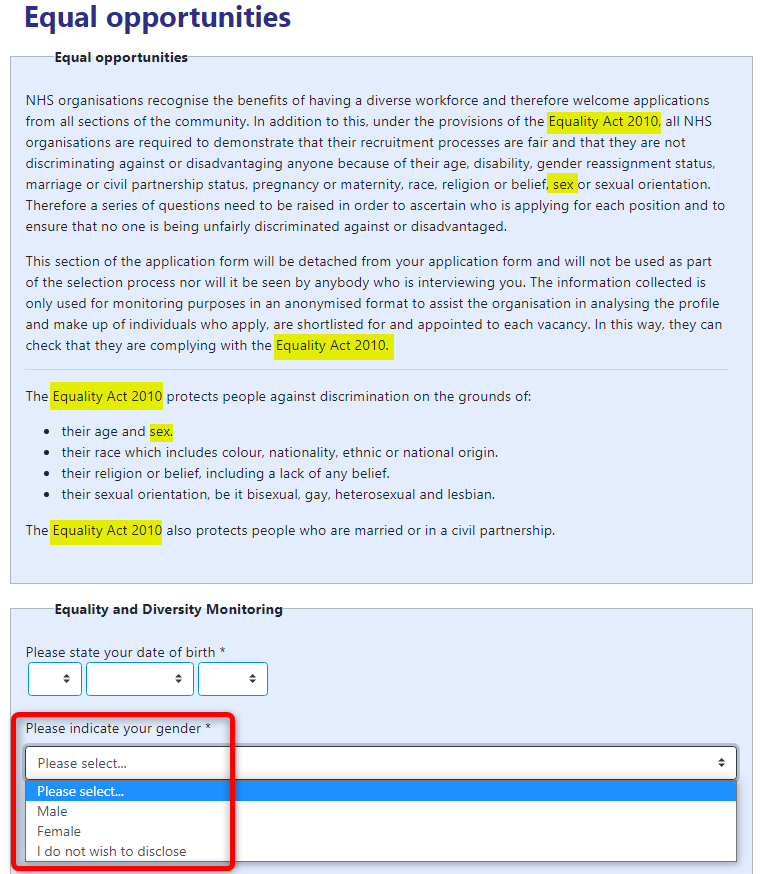
The Equal opportunities section of your job application mentions the Equality Act 2010 four times and lists sex as a protected characteristic twice.
However...
1/11
However, you then ask for the 'gender' of the applicant with options:
Male
Female.
2/11
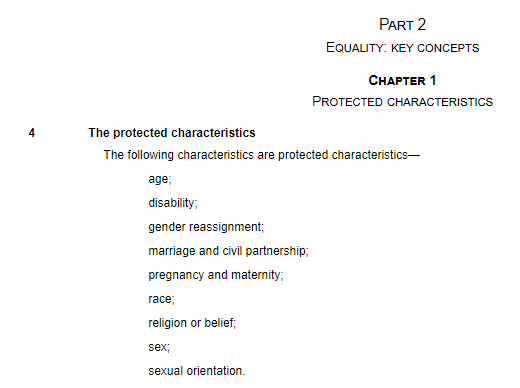
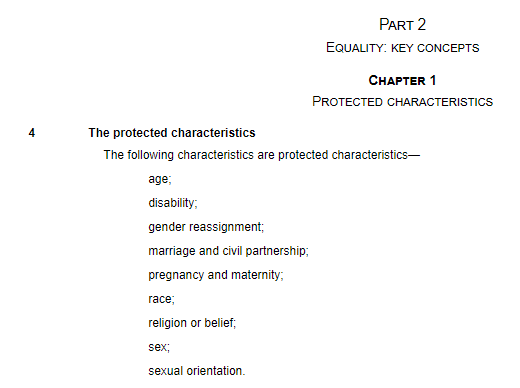
'Gender' is not a protected characteristic under the Equality Act 2010 and is not defined in the Act.
https://t.co/qisFhCiV1u
3/11
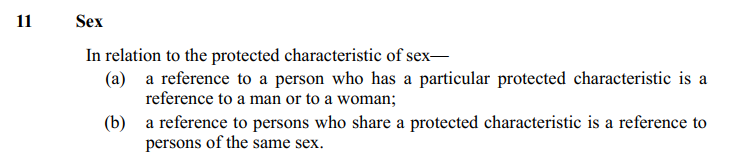
Sex is the protected characteristic and the only two possible options for sex are 'Female' and 'Male' as defined in the Act and consistent with biology.
https://t.co/CEJ0gkr6nF
'Gender' is not a synonym for sex.
4/11
Asking about a personal characteristic such as 'gender' that is not a protected characteristic under the Act, may be in breach of the GDPR by processing personal - and potentially Special Category - data without a lawful basis.
5/11


The Equal Ops Monitoring section in your job application asks for the 'Sex (Gender)' of the applicant with options:
Male
Female.
1/12
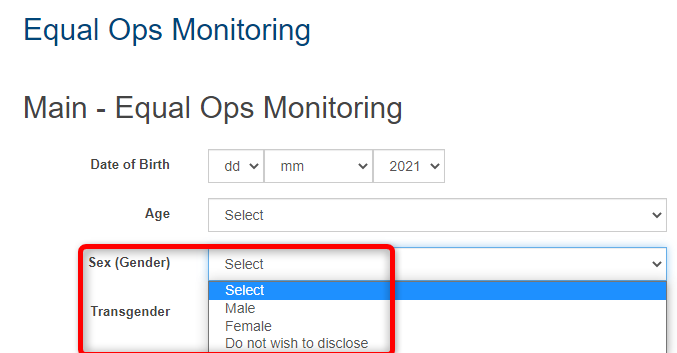
'Gender' is not a protected characteristic under the Equality Act 2010 and is not defined in the Act.
https://t.co/qisFhCiV1u
2/12
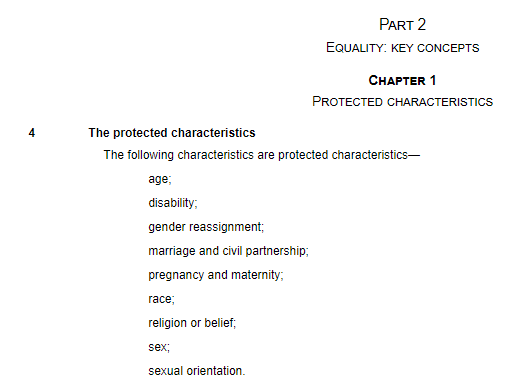
Sex is the protected characteristic and the only two possible options for sex are 'Female' and 'Male' as defined in the Act and consistent with biology.
https://t.co/CEJ0gkr6nF
'Gender' is not a synonym for sex.
3/12
You also ask about 'transgender'.
'Transgender' is not a protected characteristic under the Equality Act 2010 and is not defined in the Act.
4/12

There is a protected characteristic of 'gender reassignment', but the term 'transgender' is not used or defined in the Act.
https://t.co/2o53ufahzA
5/12

The Equal Opportunities Monitoring section in your job applications has 'gender' in what appears to be a list of protected characteristics under Equality Act 2010.
1/13
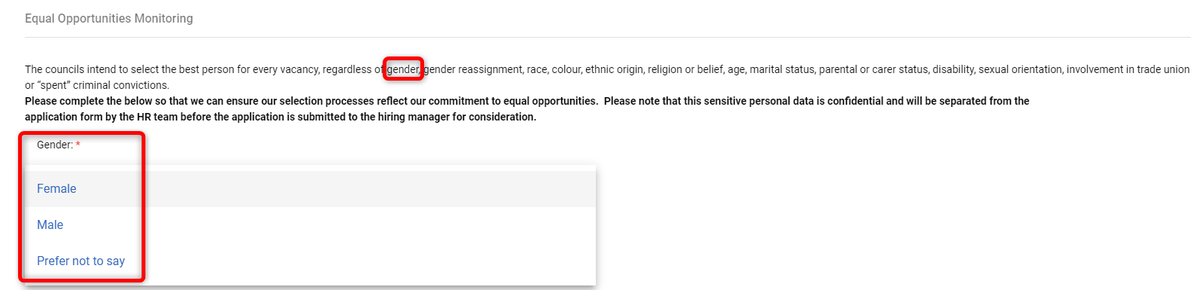
'Gender' is not a protected characteristic under the Equality Act 2010 and is not defined in the Act.
https://t.co/qisFhCiV1u
2/13
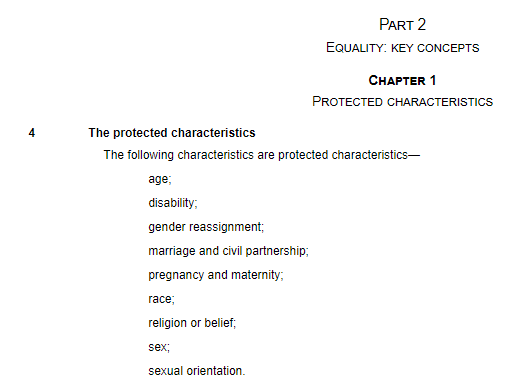
Sex is the protected characteristic under the Act, but that is not on your list.
'Gender' is not a synonym for sex.
3/13
You then ask for the 'gender' of the applicant with options:
Female
Male.
4/13
Again, 'gender' is not a protected characteristic under the Equality Act 2010 and is not defined in the Act.
https://t.co/qisFhCiV1u
5/13


With @seanoco78853943 and @LiviDeeHistory and John Privilege it's been a long road but very glad to see this report published today https://t.co/MpPPkmepxi
— Leanne McCormick (@Leannemcck) January 26, 2021
I (obviously) haven't had time to read the whole thing yet. (But at a first glance, it strikes me as well-written, so I have it on my list).
Like the ROI Commissioners, the academic authors here have huge power over the story. They carefully make themselves accountable for their scholarship and its effects. So here are some good things:
1) The Report attributes its origins to recommendations of UN Treaty bodies. It doesn't engage in sustained human-rights-based analysis, but doesn't ignore it either.
2) The researchers behind the report were appointed following a competitive tendering process.

'I do not accept that male violence is a thing.'
https://t.co/79KG1w83OB
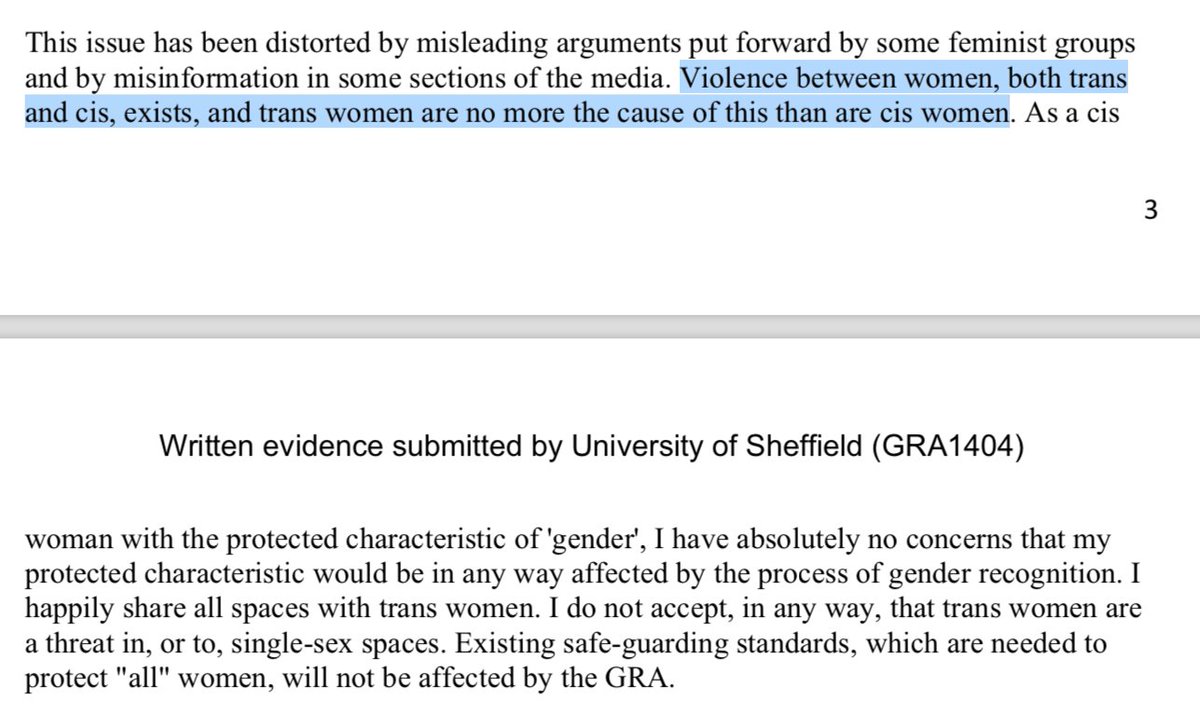
Stephen Whittle.
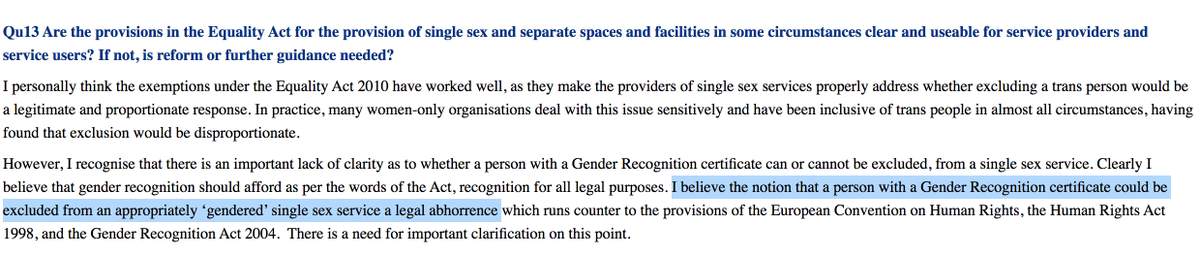
'I consider female people having any spaces or services to themselves, or being able to stipulate intimate care from people of their own sex, to be a legal abhorrence.'
https://t.co/MO9NVW3XpK
'Stonewall considers allowing ppl access to the spaces and services of the other sex on the basis of nothing but self declaration regardless of the obvious ways this can be abused and the evidence that it already has been to be sensible.'
https://t.co/QWsEayzeXd

'We still don't understand the law'

'Yeah, we really don't understand the law.'

The Equal Opportunities Monitoring in your job application asks for the 'gender' of the applicant and says "Please select either male or female based on your legal gender"...
1/16
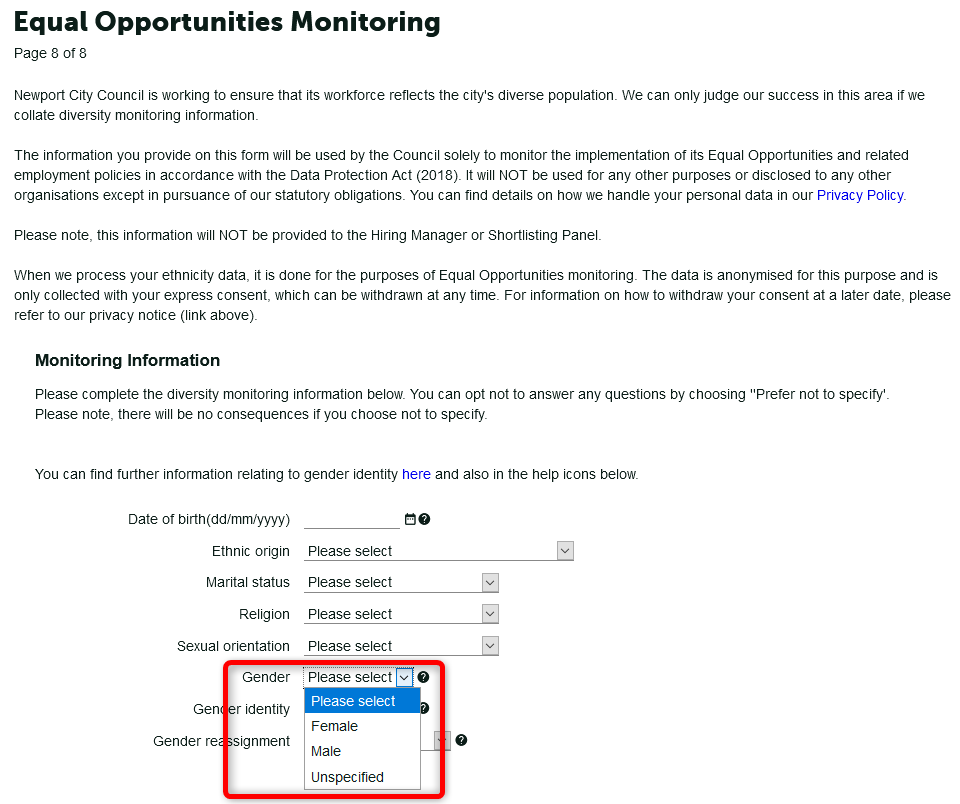
...with options:
Female
Male.
'Gender' is not a protected characteristic under the Equality Act 2010 and is not defined in the Act.
The term 'legal gender' is not used in the Act or defined in the Act.
https://t.co/qisFhCiV1u
2/16
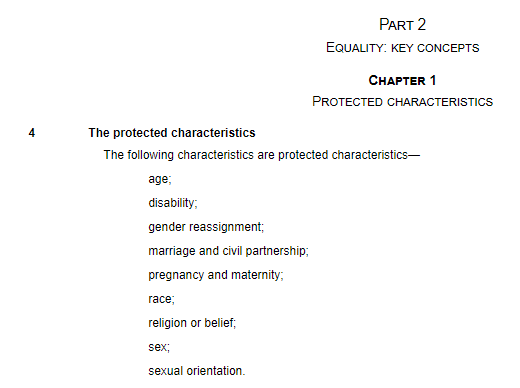
Sex is the protected characteristic and the only two possible options for sex are 'Female' and 'Male' as defined in the Act and consistent with biology, but you don't ask for that.
https://t.co/CEJ0gkr6nF
'Gender' is not a synonym for sex.
3/16
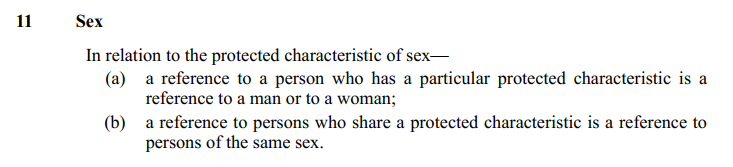
You then ask for the 'gender identity' of the applicant, saying "Gender identity is how you would describe your own gender; this could differ from your legal gender." with the same options of:
Female
Male.
4/16
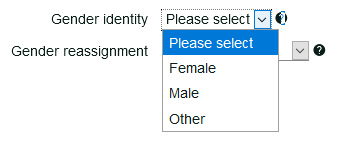
'Gender identity' is not a protected characteristic under the Equality Act 2010 and is not defined in the Act.
The term 'legal gender' is not used in the Act or defined in the


A new study found that giving low-income workers money upfront in their work period helped alleviate the mental burden of their financial problems and allowed them to be more productive \u2014 echoing other findings on the psychological impacts of poverty.https://t.co/zdxItTLDLZ
— NPR (@NPR) February 3, 2021
“Giving money to people in poverty solves poverty” is an obvious truth, which needs (another) study for proof, for the same reason that this finding will be ignored (again).
We don’t want to fix poverty, even if doing so helps everyone—not if it means life for the “undeserving.”
It’s not about saving money.
There's a great fear in this country that a single dollar might go to someone who might not deserve it; or that a single given dollar might be spent on something we deem unworthy.
We'll spend five dollars to prevent the waste of that one dollar.
The manifestations are everywhere. From the overt, gleefully cruel hostility of conservatism toward people in poverty, of course. But also hidden in almost everyone's assumptions.
Our use of charity as a way of controlling who gets helped, for example.
Charity isn't primarily an act.
— A.R. Moxon (@JuliusGoat) November 10, 2019
Before the act comes an alignment.
Charity is the natural fruit of a deep alignment with the virtue of generosity.
It sure shouldn't be a delivery mechanism for one's own beliefs about worthiness.
Even the reversal—a desire to prevent aid from going to "undeserving" wealthy who don't need it (true)—leads us to create obstacles to aid people in poverty often can't overcome, but wealthy people can.
Which is why wealthy people like means
Whenever someone proposes a means-testing solution, it's an indication they've internalized the lie, foundational to the United States, that some people deserve life and others don't.
— A.R. Moxon (@JuliusGoat) December 18, 2020
It's an expensive lie.
