Alex1Powell's Categories
Alex1Powell's Authors


Latest Saves







Answer :: NO ,Ravan was known to BUDDHISTs and he is Mentioned in "LANKAVATARA SUTRA "
A Thread on BUDDHIST RAVAN https://t.co/k8bfsl1EOJ

Did you know?
— \U0001f1ee\U0001f1f3Sonal \U0001f1ee\U0001f1f3 (@Dharm_Sthapana) December 12, 2020
Lanka was originally owned by Kuber.
He was the dikpal of North Direction and King of Gandharva Lok.
When Daityas Mali, Sumali and Malyavant couldn't defeat him in battle, they sent their sister to Sage Vishrava who was father of Kuber. pic.twitter.com/9tEcyVGbXT
The first chapter of the Lankavatara-sutra describes that Lord Buddha once incarnated along with many of his disciples, on the Malay mountain near Lankanagari.
The Tathagata Buddha began to preach with his powerful voice, which began to resonate in the sky(2/n)
Yakshadhiraja Ravana, sitting in the lankanagari at the bottom of the mountain, could not understand this mystery ; Curious when Ravana meditated, he saw that Lord Buddha is giving sermons on the Malay Mountains among many snakes and girls and surrounded by many disciples
(3/n)
Seeing such a divine vision, Mahatma Ravana had a fervent desire that 'I too should appear before God and take advantage of his visions and pray with respect to him that he should visit Lankanagari and do welfare of the Lankavasis (4/n)
Ravana proceeded towards the Malay with Yaksha-kanya and Divyangas on a chariot equipped with many flowers Lankadhipati Ravana, having reached there, performed three revolutions of Lord Buddha while sitting in the chariot
(5/n)

Will attempt to deep dives on each to build on some of my musings from earlier in the year on this topic 🤗 https://t.co/Amlnje1Qiq
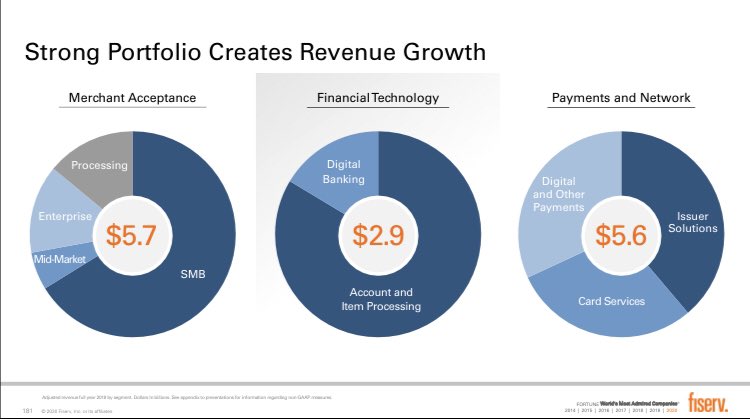
3) The revenue mix of $FISV today (post FDC merger) is roughly ~40% merchant acquiring, ~45% issuer processing and other payments related services, and ~15% core bank processing. Will take these in turn, then highlight growth levers I\u2019m most excited to watch in the coming years pic.twitter.com/yhvkCQrsF8
— BlueToothDDS (@BlueToothDDS) March 6, 2020
Will also try to bridge to an earlier thread laying out the $FISV growth algorithm and the operational/financial levers that support its medium-term outlook of 15-20% FCF/share growth
Here we focus on the top line, most notably the impressive acceleration across all 3 segments https://t.co/8HzMhEC5Bj
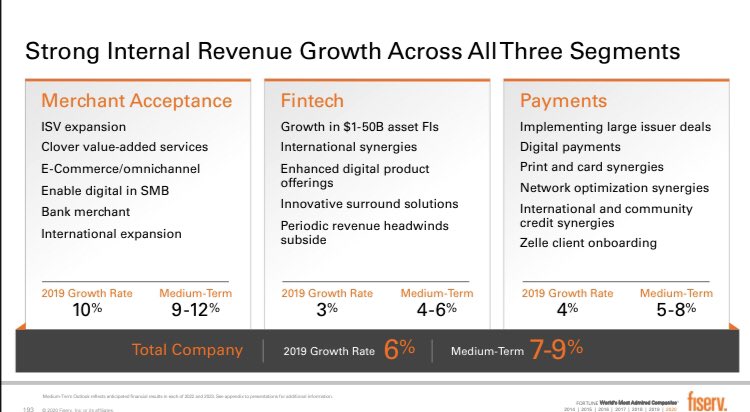
12) $FISV has both operational levers ($0.6B revenue synergies, $1.4B combined cost synergies + add\u2019l cost take out) and financial levers ($30B+ deployable FCF) to support its 15-20% compounded FCF/share growth
— BlueToothDDS (@BlueToothDDS) December 9, 2020
... and this is all before underlying business momentum (tomorrow) pic.twitter.com/JBtlGQIfBT
Let’s start with Merchant:
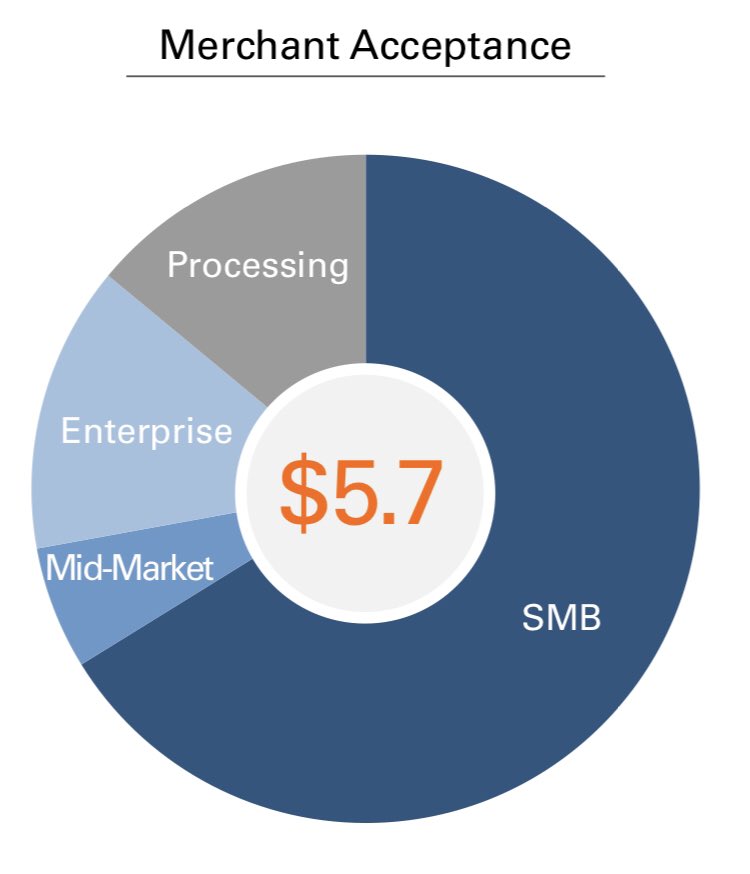
1) This segment, which ~40% of $FISV revenue today, is the #1 merchant acquirer globally processing $3T+ annually for 6M merchants worldwide
2/3 of revenue is from SMBs, ~20% from mid-to-enterprise merchants, remaining ~15% is wholesale processing
2) 🇺🇸 is 3/4 of the $FISV Merchant segment and the scale of this business is unmatched: it processes 40% of all in-person purchases in the US, covers 80% of all US zip codes and accounts for 10% of US GDP. This book of business is the most balanced in the industry https://t.co/Qlkk7lz3jQ
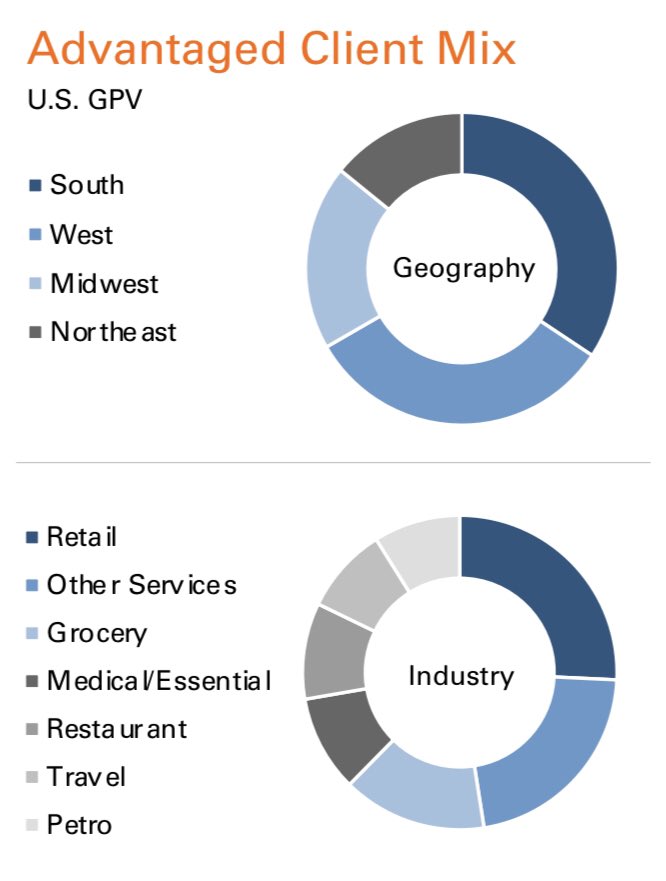
4) $FISV merchant business is the largest US acquirer processing $2.4 trillion of payments annually (including through JVs with BAC, WFC, PNC, C) accounting for 10% of \U0001f1fa\U0001f1f8 GDP. This segment includes Clover, which focuses on SMBs and is $105B runrate today growing at 40%+ annually pic.twitter.com/M5j4mbeiJX
— BlueToothDDS (@BlueToothDDS) March 6, 2020
3) Internationally, $FISV Merchant has strong position in EMEA (top 3 through various JVs and alliances) and several high growth countries, among others: India 🇮🇳 (top 3 with ~15% share), Argentina 🇦🇷 (~50% market share today), Brazil 🇧🇷 (routing ~30% of all electronic payments)

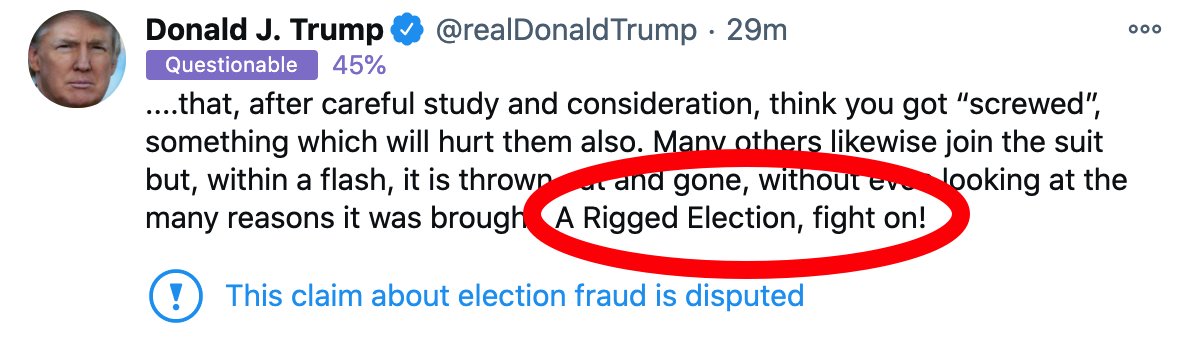
We will be INTERVENING in the Texas (plus many other states) case. This is the big one. Our Country needs a victory!
— Donald J. Trump (@realDonaldTrump) December 9, 2020
Because the TX case rested on the proposition that a national election can be nullified and “overturned” (a term Trump actually used in a tweet) on the grounds that it does not satisfy conditions determined by the incumbent president 2/9
and the states governed by that president’s political party--
(e..g., no votes by voters receiving mail-in ballots who do not request those ballots shall be deemed legitimate.) 3/9
This litigation was intended to nullify all the votes in all 50 states, and would have called for a new election. It challenged election procedures, not just election results. And it did not require any proof of fraud or undercounts or overcounts. 4/9
In other words, no national election can be legitimate that fails to reelect the incumbent president--in this case of course, Donald J. Trump, the Supreme Leader of the *real* America. 5/9

"A history of systemic racism has led to too few Black Americans working in the sciences. Autism research is not immune to this problem & the dearth of Black scientists & clinicians likely has contributed to health disparities among Black autistic people.\u201dhttps://t.co/6YBMKgEJh1
— Thinking Person's Guide To Autism (@thinkingautism) December 11, 2020
See: More than Tuskegee: Understanding Mistrust about Research Participation
Scharff, Mathews, Jackson, Hoffsuemmer, Martin, and Edwards 2/
Our community collectively witnesses racial disparities in health research and care and are collectively re-traumatized by them. As we speak, we see the contrast between #COVID19 outcomes like this 3/:
And #COVID19 outcomes like this 4/:
Gaining the trust of our community requires more than racial parity in medical and research personnel and increasing opportunities for African American researchers. The misdiagnoses, the lack of support, and harm to Black autistic people and their families are lifelong. 5/


Hillary and Soros had their own thread. This here is a list of others going down. Who are also legal disgraces and embarrassments to the USA
https://t.co/yLcbSi0GM7

\u201cWe\u2019ve not gotten any court to judge this (the vote) on its merit.\u201d @DanPatrick of Texas. It is a legal disgrace, an embarrassment to the USA!!!
— Donald J. Trump (@realDonaldTrump) December 12, 2020


Today I learned that I really need coffee ☕️ to operate properly. Made a trivial mistake and it took me forever to catch it. This would have been obv. with a statically typed lang.
Also, I'm using a notebook-style env. to play (like https://t.co/JgFUNSSRuD, here it's https://t.co/XrswSxjjwk). My take away from this fun experience + observations at work is that such notebooks are poison to the mind, fostering bad practices while not bringing much value.
I get that notebooks provide a nice environment for tutorials - you get a literate programming + a printf-debugger on steroids, which is very useful when suffering through tensor shape mismatch errors. It's useful for data science or ML 101.
But then I see people using Python notebooks to do actual work and it's horrifying to me. The natural tendency is to write notebooks as a series of cells mutating global state. So each cell has an implicit API defined by its interaction with the global state. 2/9
The API is implicitly a function of cell exec order, but then you can purposely (or mistakenly) exec cells in any order 😬. And this is on top of the usual issues you get with dynamically typed languages. No one can write maintainable code this way, but notebooks get a pass. 3/9