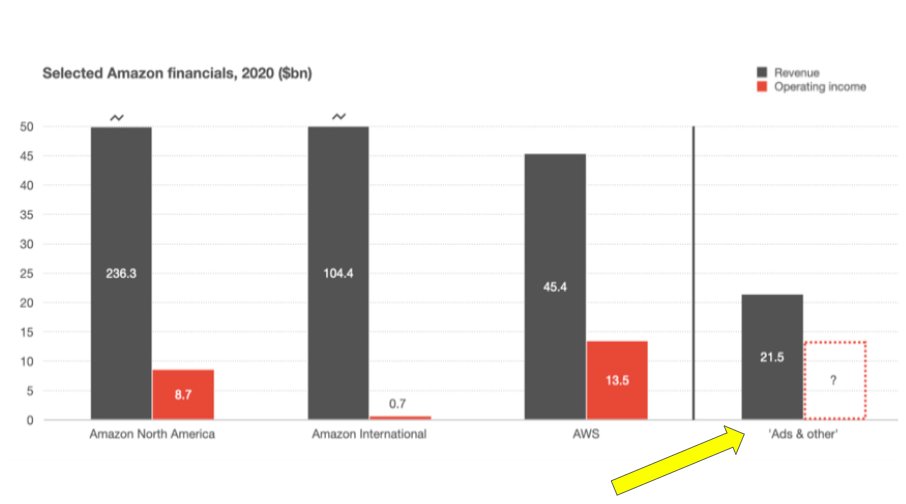
1/ Amazon doesn’t break out its ad business separately in financial filings. However, most analyst believe ads make up the majority of its “Other” revenue segment.
This figure has exploded from $1B in 2015 to a current annual run rate of ~$32B.
2/ In 2009, Bezos said “ads are the price you pay for a crappy product”.
But the business is so lucrative that Amazon’s interface has been swamped with ads:
◻️ First 3-7 search results (left in red)
◻️ Most of the product page (right in blue)
3/ Prior to the rise of ads, Amazon set out to build the ultimate organic customer recommendations engine.
The approach was codified in a famed 2003 research paper: “Amazon Recommendations: Item-to-Item Collaborative Filtering.”
4/ In recent years, Amazon organic recommendations:
◻️"Customers who bought this also bought this"
◻️"Customers who viewed also viewed"
Have been replaced w/ ads:
◻️ "Sponsored products related to"
◻️ "Brands related to this category"
5/ One of the few organic recommendations that still display is the trusty-old "Frequently bought together" feature.
(Of course, increasing the goods in someone's basket is worthwhile for Amazon)
6/ The road to Amazon ads started in 2005.
While Bezos didn’t like ads, he tapped Paul Kotas (who worked w/ him at DE Shaw) to run experiments on AMZN's valuable digital real estate.
The 1st project was banner ads. But it directed users off the platform and the idea was canned.
7/ The real motivation to build an ad business was spurred on by another tech giant: Google.
Amazon was dependent on Google search slots to drive traffic. The company even created a “Google Reliance” metric to track this dependence…which could potentially be existential.
8/ Google, of course, occupies a lucrative part of the buying funnel. It sells ads at the point that someone shows intent for a purchase.
However, Amazon owns the last foot of the transaction funnel: the purchase.
And, today, 60%+ of product searches actually start on Amazon.
9/ Amazon’s transaction data is valuable for 3rd-party merchants, which have grown from 3% of Amazon sales (2000) to ~60% of its $300B+ retail sales (2021).
To stand out, sellers are wiling to pay for sponsored placements (just like brands buying grocery store shelf space)
10/ Amazon sells a number of ad products:
◻️ sponsored products (search)
◻️ sponsored brand
◻️ sponsored display ads
◻️ sponsored posts
◻️ sponsored videos
Ads have grown so much that -- in 2018 -- it passed MSFT to become the 3rd biggest digital advertiser after FB and GOOGL.
11/ While Amazon says that ads are *optional*, getting buried on page 5 of search results is bad for business.
The avg. cost per click (CPC) on Amazon Ads is climbing. And it's not uncommon for merchants (~5m on Amazon) to spend up to 50% of a product on listing fees and ads.
12/ The economics of running a 3rd-party merchant business is trending towards scale.
A number of companies are raising big money to "roll up" Amazon merchants:
◻️ Thrasio ($3.4B raised)
◻️ Perch ($909m)
◻️ Heyday($800m)
◻️ Razor Group ($560m)
◻️Elevate Brands ($373m)
13/ Is Ads already Amazon's most profitable business line?
Using Google's 68% margin for its core business as a comp, Benedict Evans writes:
"Given [Amazon Ads] margin structure and incremental cost base, it's highly likely to be generating similar absolute profits to AWS." 🤯
14/ If you enjoyed that, I write threads breaking down tech and business 1-2x a week.
Def follow
@TrungTPhan to catch them in your feed.
Here's a one that might tickle your fancy:
https://t.co/B3SWUCF2cd
15/ Also: check out my Saturday email for some laughs, insights and the easiest way to stay on top of my content.
https://t.co/jGZs8brnVR
17/ Based on the latest quarterly filings, Amazon's "Other" segment -- mostly ads -- is currently on a $32B annual run rate (+49% YoY).
That's more than 2x the combined sales of Twitter, Snap and Pinterest ($12B).