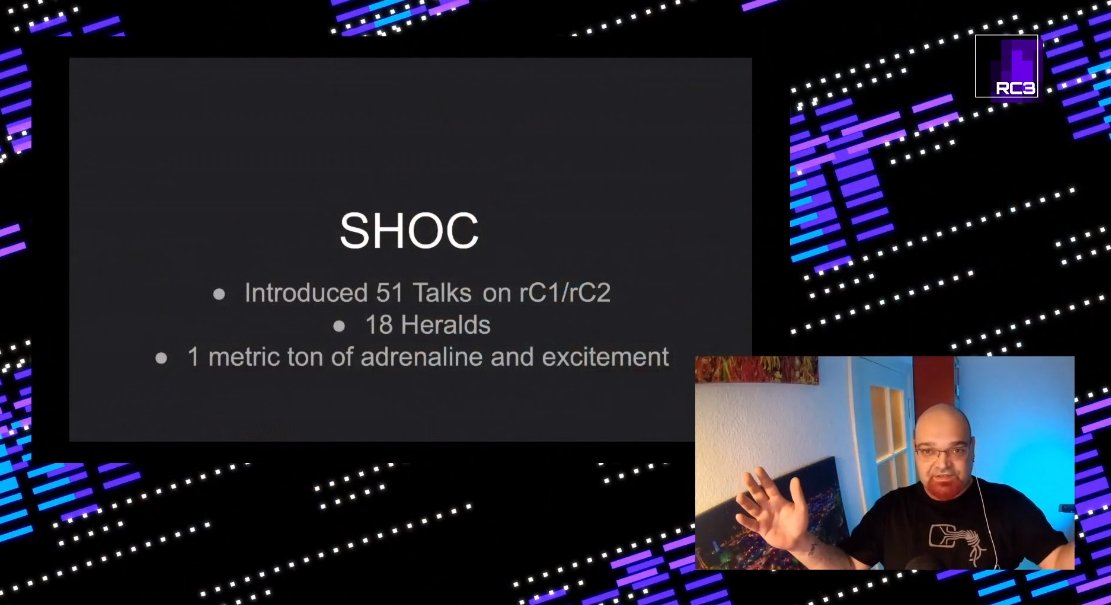
There were only 18 heralds for all the talks. It was really hard to pull off, this conference also started a news show. #rc3
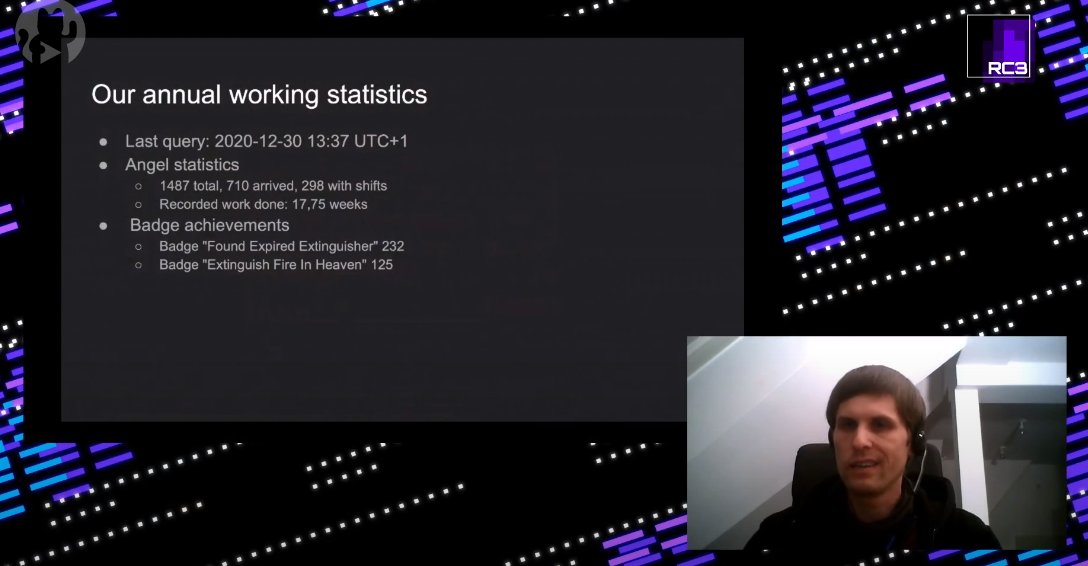
Next is the heaven team. 1487 total angels volunteered of which 710 arrived. 76 weeks worth of work hours were done by the angels. They prepared a few goodies for the RC3 world. Badges were given to show angels. Tried to keep traditions from the conference on RC3 world. #rc3
Huge thanks to all the angels who volunteered. This conference would not be possible with the help of everyone. #rc3
Next team is the signal angels, this is the first time that people had to do remote Q&A. The procedure was quite different to the in person event. There were 157 shifts filled by 61 angels. There were 5 unfilled shifts. #rc3
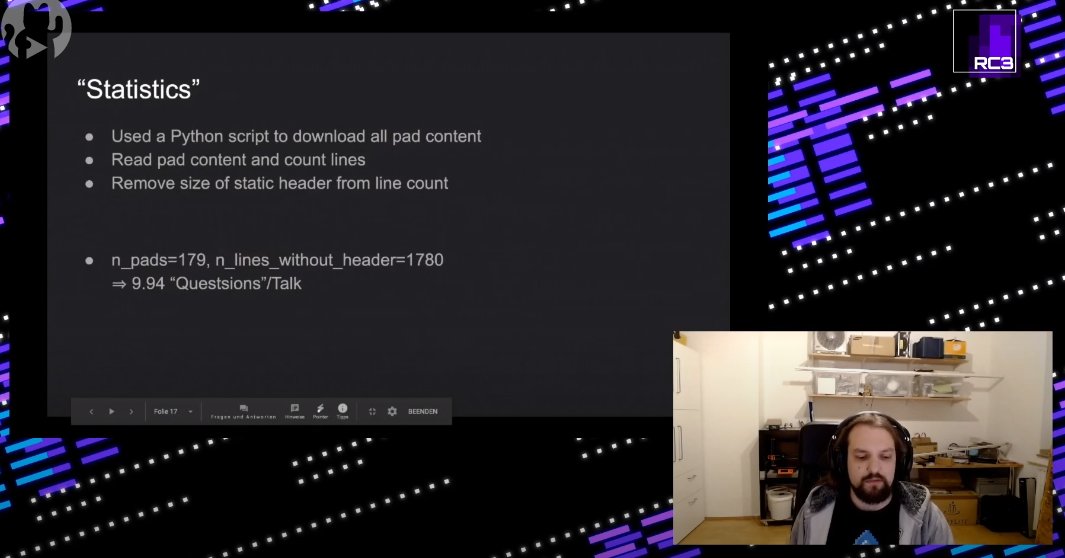
A few things went wrong, some questions were long and need to split apart. Formatted questions were also a challenged. There were on average of 9.94 questions per talk. #rc3
The next team is the line producers which handles the communication between everyone that handles the production of the talk. This includes the people behind the cameras, technical side and the speakers themselves. #rc3
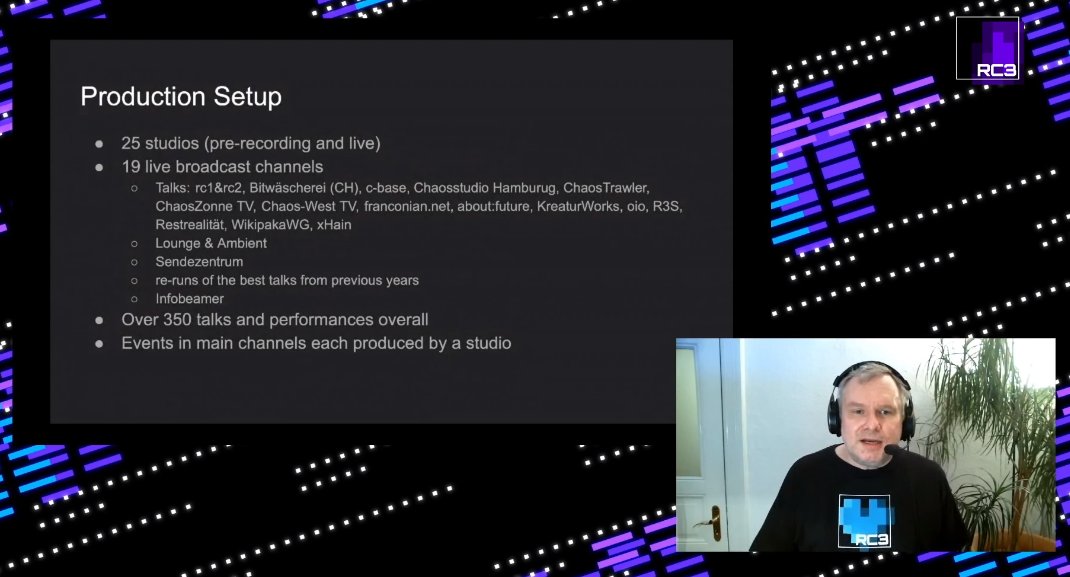
There were 25 studios (pre-recording and live). 19 live broadcast channels including main streams and assemblies. Over 350 talks and performances. Events in main channels produced by a studio. #rc3
There were 53 talks for the main channels. 18 of them were precorded, 3 live in a studio session
32 live via the internet. The team prepared 63 speakers and they coordinated production between the master control room and 12 live studios. #rc3
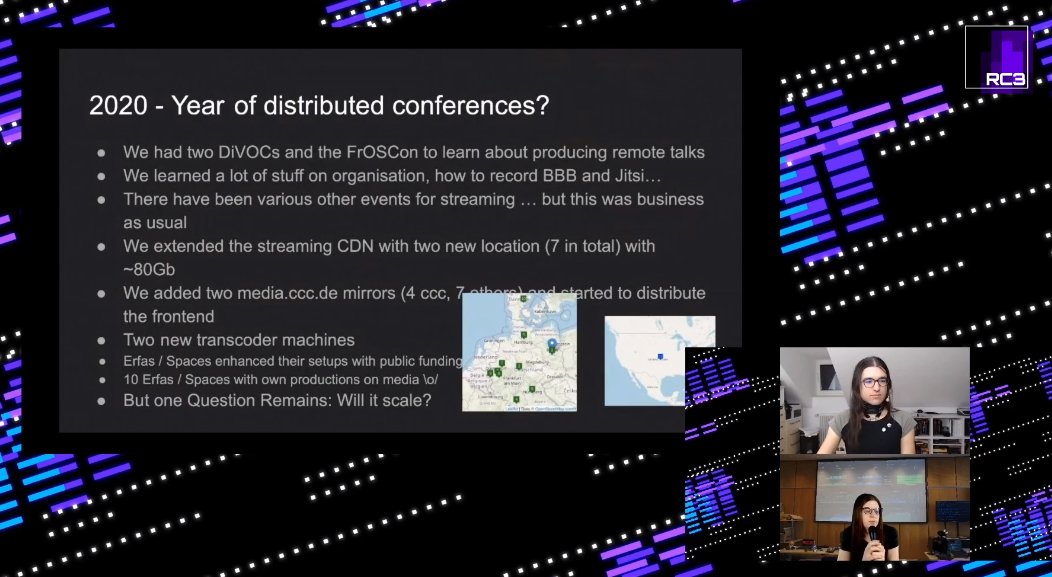
2020 was the year of remote talks, there were 2 prior events to learn from. 2 new CDNs were added which brings the total to 7 CDNs with a total bandwidth of ~80GB. Added 2 transcoder machines. Various spaces were able to enhance their setups with public funding. #rc3
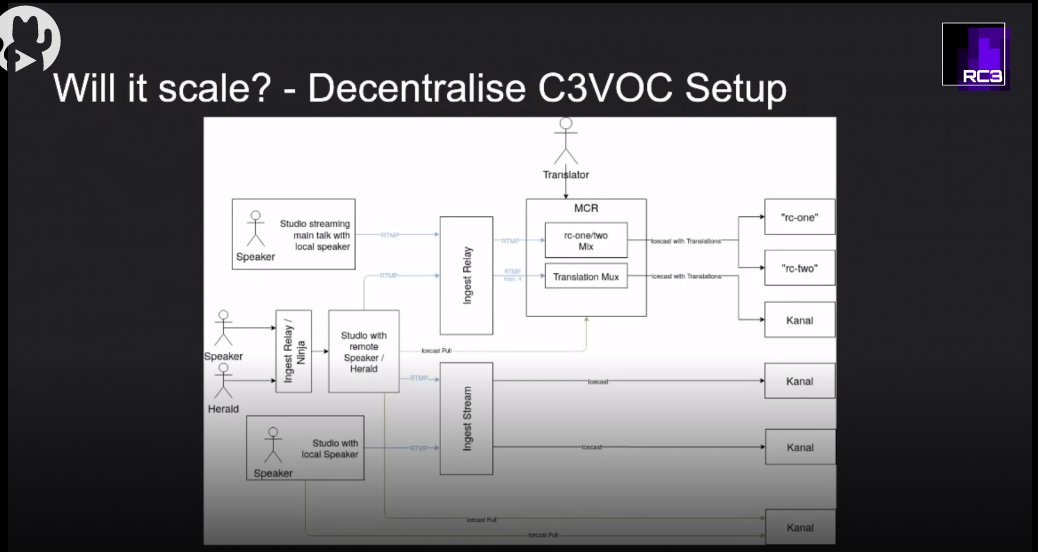
Below is the diagrams of the various input and processing channels. The various communication paths caused a number of issues due to the complexity. #rc3
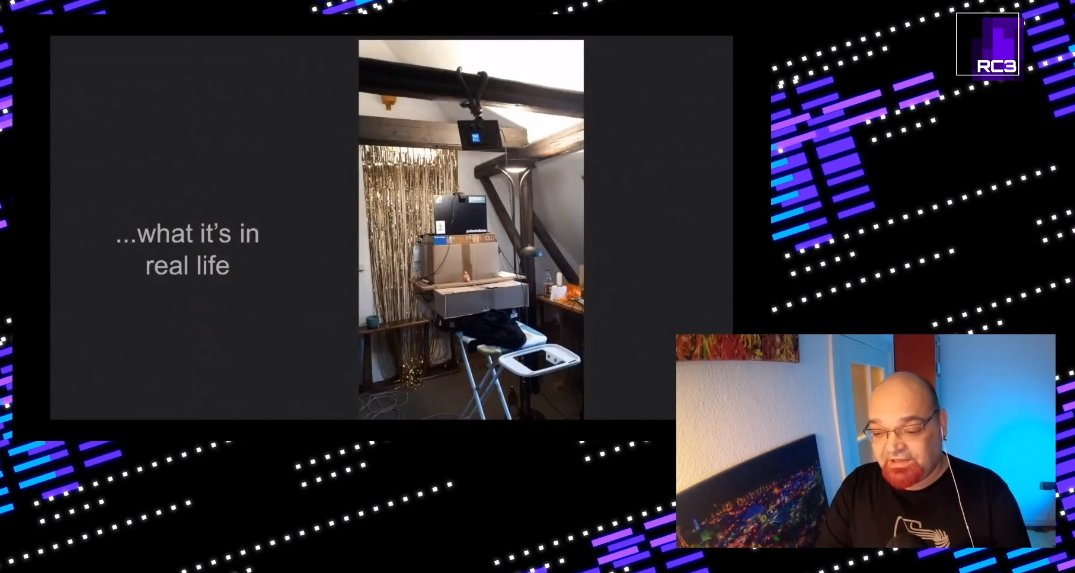
Some of the remote setups that were used as part of the broadcast for the various streams. #rc3
Some more remote setups that were used as part of the broadcast for the various streams. #rc3
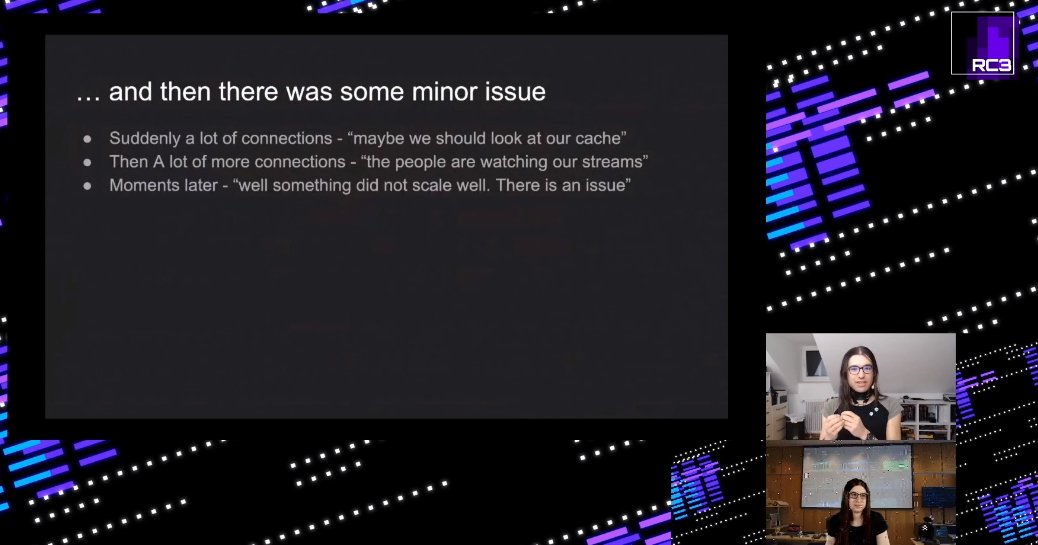
Then the issues started rolling in. A lot of both hardware and software investigations had to be done. There were many malformed packets that causes issues. #rc3
Next up is the c3 Lingo team. 36 volunteers translated 138 events which resulted 106 hours of translated video. 5 talks were translated to French, 3 talks were translated to Portuguese. There were quite a number of issues with audio and timing between multiple translators. #rc3
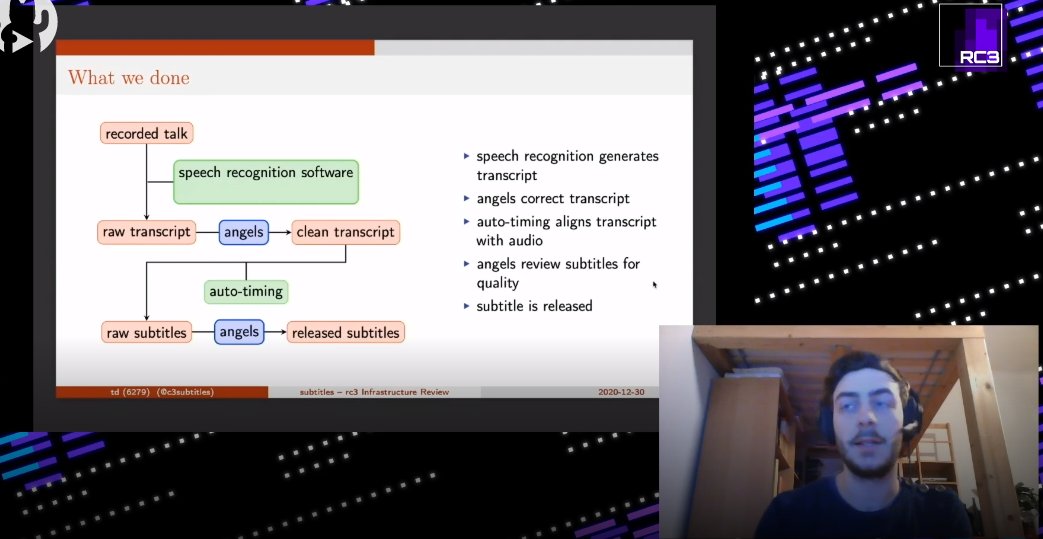
The next team is the subtitles team. The team uses speech recognition software to get a raw version of the subtitles afterwhich angels correct mistakes and do quality control. 68 angels worked 4 shifts on average. They worked 382 hours for 147 hours of content. #rc3
Next is the Phone Operation Center (POC). 1195 SIP extensions, There were 21K calls (in the previous conference, it was 300K calls). Eventphone setup a Decentralized DECT infrastructure (EPDDI) and there were a number of phones that were used. #rc3
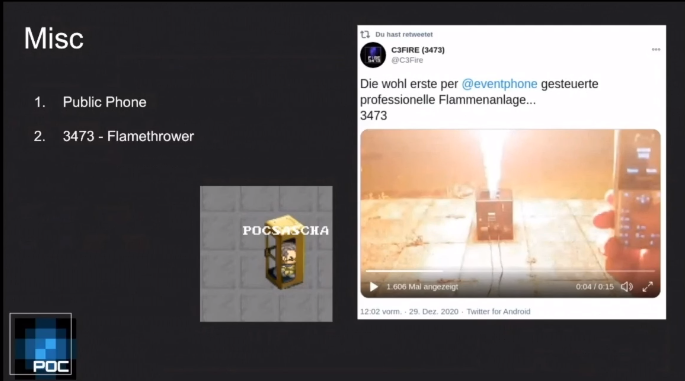
The RC3 world contained a phone that you could virtually use to call a SIP number. Someone made a flamethrower that could be controlled by a DECT Handset - C3 Fire. The team also made pictures available over SSTV on DECT, where you could get an image from an audio waveform. #rc3
Next is GSM team that had a setup across Germany, Berlin and one in Mexico. #rc3
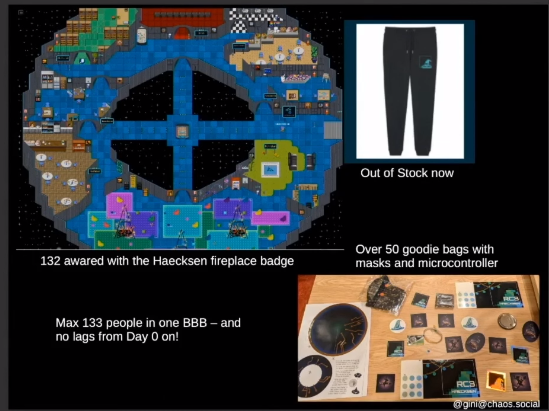
Next is the Haecksen team which used over 7 million pixels to display the world with hundreds of git commits. 132 people received badges for testing the virtual swimming pool. They had 133 people with zero lag. Over 50 goodie bags with masks and microcontrollers were made. #rc3
The ChaosPat team set up a number of mentor and mentee sessions in the virtual RC3 world. #rc3
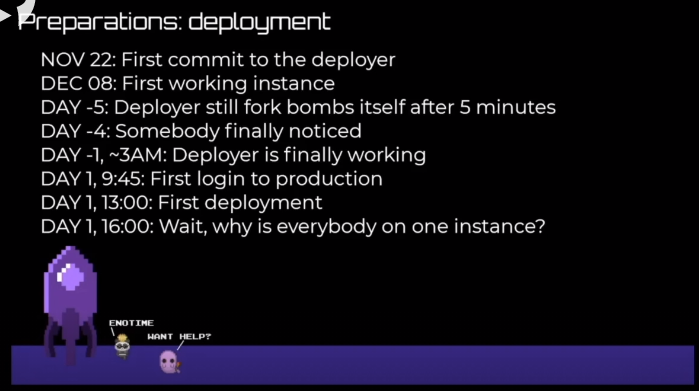
Next is the adventure world team that built the RC3 world. Work started in November, There were several upstream merge issues. Some of the issues with instance jumps were fixed on day 2. Over 400 commits for the initial world deployment. #rc3
A faulted loop caused a lot of logs to be generated. This was fixed on day -5. On day -1, the deployer was finally working. A bug in the application causes people to not see each other. #rc3
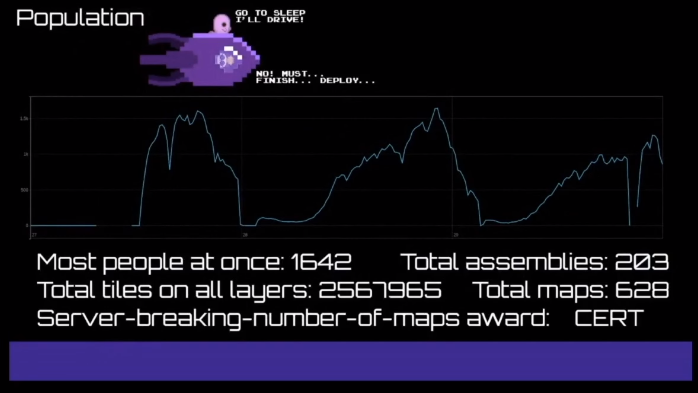
The most popular place was the lobby followed by the hardware hacking area. The most people in RC3 world at once was 1642. Over 2 millions tiles were used to create 628 maps which represented over 203 assemblies. #rc3
Lots of people worked really hard to get these maps to where they are. Thank you! 405 servers were deleted by a typo. Automation for the win! Huge thanks to Hetzner for sponsoring the hardware that run the RC3 world. #rc3
Thanks to the RC3 lounge artists from many countries from around the world. #rc3

More from Software

buffalo uses dominion scoreboard software so not really


DEAD PEOPLE SCORED FOR BUFFALO!

A truck delivered off a suitcase full of points at halftime from Canada for Buffalo.

#StopTheSteel !!!!

I’ll be submitting sworn affidavits from Steelers fans than they saw the Buffalo rigging the game but I want to emphasize that I’m not under oath.
Kubernetes vs Serverless offerings

Why would you need Kubernetes when there are offerings like Vercel, Netlify, or AWS Lambda/Amplify that basically manage everything for you and offer even more?

Well, let's try to look at both approaches and draw our own conclusions!

🧵⏬

1️⃣ A quick look at Kubernetes

Kubernetes is a container orchestrator and thus needs containers to begin with. It's a paradigm shift to more traditional software development, where components are developed, and then deployed to bare metal machines or VMs.

There are additional steps now: Making sure your application is suited to be containerized (12-factor apps, I look at you:
https://t.co/nuH4dmpUmf), containerizing the application, following some pretty well-proven standards, and then pushing the image to a registry.

After all that, you need to write specs which instruct Kubernetes what the desired state of your application is, and finally let Kubernetes do its work. It's certainly not a NoOps platform, as you'll still need people knowing what they do and how to handle Kubernetes.


2️⃣ A quick look at (some!) serverless offerings

The offer is pretty simple: You write the code, the platform handles everything else for you. It's basically leaning far to the NoOps side. There is not much to manage anymore.

Take your Next.js / Nuxt.js app, point the ...
As the year wrap's up, let's run through some of the worst public security mistakes and delays in fixes by AWS in 2020. A thread.

First, that time when an AWS employee posted confidential AWS customer information including including AWS access keys for those customer accounts to


Discovery by @SpenGietz that you can disable CloudTrail without triggering GuardDuty by using cloudtrail:PutEventSelectors to filter all events.


Amazon launched their bug bounty, but specifically excluded AWS, which has no bug bounty.


Repeated, over and over again examples of AWS having no change control over their Managed IAM policies, including the mistaken release of CheesepuffsServiceRolePolicy, AWSServiceRoleForThorInternalDevPolicy, AWSCodeArtifactReadOnlyAccess.json, AmazonCirrusGammaRoleForInstaller.

You May Also Like

Recently, the @CNIL issued a decision regarding the GDPR compliance of an unknown French adtech company named "Vectaury". It may seem like small fry, but the decision has potential wide-ranging impacts for Google, the IAB framework, and today's adtech. It's thread time! 👇

It's all in French, but if you're up for it you can read:
• Their blog post (lacks the most interesting details):
https://t.co/PHkDcOT1hy
• Their high-level legal decision: https://t.co/hwpiEvjodt
• The full notification: https://t.co/QQB7rfynha

I've read it so you needn't!

Vectaury was collecting geolocation data in order to create profiles (eg. people who often go to this or that type of shop) so as to power ad targeting. They operate through embedded SDKs and ad bidding, making them invisible to users.

The @CNIL notes that profiling based off of geolocation presents particular risks since it reveals people's movements and habits. As risky, the processing requires consent — this will be the heart of their assessment.

Interesting point: they justify the decision in part because of how many people COULD be targeted in this way (rather than how many have — though they note that too). Because it's on a phone, and many have phones, it is considered large-scale processing no matter what.
The chorus of this song uses the shlokas taken from Sundarkand of Ramayana.

It is a series of Sanskrit shlokas recited by Jambavant to Hanuman to remind Him of his true potential.

1. धीवर प्रसार शौर्य भरा: The brave persevering one, your bravery is taking you forward.


2. उतसारा स्थिरा घम्भीरा: The one who is leaping higher and higher, who is firm and stable and seriously determined.

3. ुग्रामा असामा शौर्या भावा: He is strong, and without an equal in the ability/mentality to fight

4. रौद्रमा नवा भीतिर्मा: His anger will cause new fears in his foes.

5.विजिटरीपुरु धीरधारा, कलोथरा शिखरा कठोरा: This is a complex expression seen only in Indic language poetry. The poet is stating that Shivudu is experiencing the intensity of climbing a tough peak, and likening

it to the feeling in a hard battle, when you see your enemy defeated, and blood flowing like a rivulet. This is classical Veera rasa.

6.कुलकु थारथिलीथा गम्भीरा, जाया विराट वीरा: His rough body itself is like a sharp weapon (because he is determined to win). Hail this complete

hero of the world.

7.विलयगागनथाला भिकारा, गरज्जद्धरा गारा: The hero is destructive in the air/sky as well (because he can leap at an enemy from a great height). He can defeat the enemy (simply) with his fearsome roar of war.