social media use really calls for something closer to a driver's license than terms of service... most apparent bad behavior here is more incompetence than malice, like not knowing how to change lanes or take turns at a 4-way stop..
Road test would actually expose you to routine provocations. Like, "make a left turn" = "deal with this concern troll"
each medium would be a vehicle class... twitter is basic cars, FB is semi trucks, whatsapp is motorcycles in the 3rd world without helmets
Having a big following/reach and being a good social media driver are entirely different things.
More from Venkatesh Rao
I’m guessing these responses really reflect people’s weighted averages (age*current average effort fraction) though I kept it simple and asked for just averages.
I suspect a healthy weighted average should be ~ (age-20)/2. So a 30 year old should be at 5, a 40 year old at 10, a 50 year old at 15 etc.
Standard deviation should be ~average/3 maybe, so distribution spreads as you age and accumulate projects and get better at them.
Other things being equal, people get good at starting in their 20s, at follow through in 30s, at finishing in 40s.
No point learning food follow through until you’ve found a few good starts to bet on. No point getting good at finishing until a few projects have aged gracefully.
I’m in the 7+ range myself. Probably 8-9. Slightly less than healthy for my age.
I suspect most self-judgments on being good starters/follow-through-ers/finishers are really flawed because of the non-ergodicity of project management skill learning. You can’t learn good practices for the 3 phases in an arbitrary order. On,y one order actually works.
Poll: where is the temporal center of gravity of all your live projects based on average age of start-dates?
— Venkatesh Rao (@vgr) January 17, 2021
I suspect a healthy weighted average should be ~ (age-20)/2. So a 30 year old should be at 5, a 40 year old at 10, a 50 year old at 15 etc.
Standard deviation should be ~average/3 maybe, so distribution spreads as you age and accumulate projects and get better at them.
Other things being equal, people get good at starting in their 20s, at follow through in 30s, at finishing in 40s.
No point learning food follow through until you’ve found a few good starts to bet on. No point getting good at finishing until a few projects have aged gracefully.
I’m in the 7+ range myself. Probably 8-9. Slightly less than healthy for my age.
I suspect most self-judgments on being good starters/follow-through-ers/finishers are really flawed because of the non-ergodicity of project management skill learning. You can’t learn good practices for the 3 phases in an arbitrary order. On,y one order actually works.
Both this thread and the outraged response threads are... something.
This is why I never wanted kids. Way too much responsibility for another human’s development. Depending on the child, this might either be the day they discovered who they were or the day that traumatized them into a lifelong fuckup. Either way I don’t want to direct the show.
As far as the can opener goes, it wouldn’t even occur to me to try and turn it into a teachable moment. That sounds vaguely quixotic. I’d just show them how immediately. I think my default is to try and instruct clearly but not demonstrate unless the person is truly disoriented.
I think there’s basically a right answer here: show the kid. If the kid has the aptitude they’ll enjoy the mechanism so much they’ll develop the figure-it-out skill with other devices. If not, it’s a training data point that will build remedial levels of intuition more slowly.
I think perseverance is both misframed and over-rated as a virtue. Misframed as in: everybody has potential for it in some areas and lacks it in others. Aptitude is those areas where perseverance comes easily to you. Meta-skill of knowing where/why you persist is more important.
So, yesterday my daughter (9) was hungry and I was doing a jigsaw puzzle so I said over my shoulder \u201cmake some baked beans.\u201d She said, \u201cHow?\u201d like all kids do when they want YOU to do it, so I said, \u201cOpen a can and put it in pot.\u201d She brought me the can and said \u201cOpen it how?\u201d
— john roderick (@johnroderick) January 2, 2021
This is why I never wanted kids. Way too much responsibility for another human’s development. Depending on the child, this might either be the day they discovered who they were or the day that traumatized them into a lifelong fuckup. Either way I don’t want to direct the show.
As far as the can opener goes, it wouldn’t even occur to me to try and turn it into a teachable moment. That sounds vaguely quixotic. I’d just show them how immediately. I think my default is to try and instruct clearly but not demonstrate unless the person is truly disoriented.
I think there’s basically a right answer here: show the kid. If the kid has the aptitude they’ll enjoy the mechanism so much they’ll develop the figure-it-out skill with other devices. If not, it’s a training data point that will build remedial levels of intuition more slowly.
I think perseverance is both misframed and over-rated as a virtue. Misframed as in: everybody has potential for it in some areas and lacks it in others. Aptitude is those areas where perseverance comes easily to you. Meta-skill of knowing where/why you persist is more important.
More from Social media


Enter the thread if you dare. 😈
We’re counting down 13 of the best ways to Halloween on Snapchat. First up – matching Lens costumes for you and your pet.
https://t.co/J0Zn7CfM1q

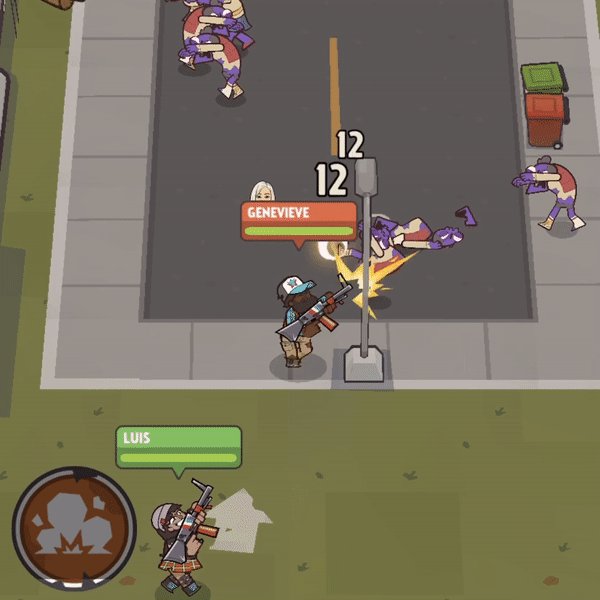
Tis the season to slay some ghouls. Grab some friends and dive in to Zombie Rescue Squad from @PikPokGames. How long can you survive?
https://t.co/FC9dvafUiV
Is it even Halloween if you're not FREAKED OUT? Scare yourself silly with a Dead of Night S1 rewatch.
https://t.co/LtoE7yHgaG
Be careful! Things aren’t always what they seem. Our Lenses start off cute, but are filled with spooky surprises!
https://t.co/xq45JlYeQ7

Craving candy early? Our new stickers were made to satisfy your sweet tooth.

We’re counting down 13 of the best ways to Halloween on Snapchat. First up – matching Lens costumes for you and your pet.
https://t.co/J0Zn7CfM1q
Tis the season to slay some ghouls. Grab some friends and dive in to Zombie Rescue Squad from @PikPokGames. How long can you survive?
https://t.co/FC9dvafUiV
Is it even Halloween if you're not FREAKED OUT? Scare yourself silly with a Dead of Night S1 rewatch.
https://t.co/LtoE7yHgaG
Be careful! Things aren’t always what they seem. Our Lenses start off cute, but are filled with spooky surprises!
https://t.co/xq45JlYeQ7
Craving candy early? Our new stickers were made to satisfy your sweet tooth.
You May Also Like

Fake chats claiming to be from the Irish African community are being disseminated by the far right in order to suggest that violence is imminent from #BLM supporters. This is straight out of the QAnon and Proud Boys playbook. Spread the word. Protest safely. #georgenkencho

There is co-ordination across the far right in Ireland now to stir both left and right in the hopes of creating a race war. Think critically! Fascists see the tragic killing of #georgenkencho, the grief of his community and pending investigation as a flashpoint for action.

Across Telegram, Twitter and Facebook disinformation is being peddled on the back of these tragic events. From false photographs to the tactics ofwhite supremacy, the far right is clumsily trying to drive hate against minority groups and figureheads.
Declan Ganley’s Burkean group and the incel wing of National Party (Gearóid Murphy, Mick O’Keeffe & Co.) as well as all the usuals are concerted in their efforts to demonstrate their white supremacist cred. The quiet parts are today being said out loud.
The best thing you can do is challenge disinformation and report posts where engagement isn’t appropriate. Many of these are blatantly racist posts designed to drive recruitment to NP and other Nationalist groups. By all means protest but stay safe.
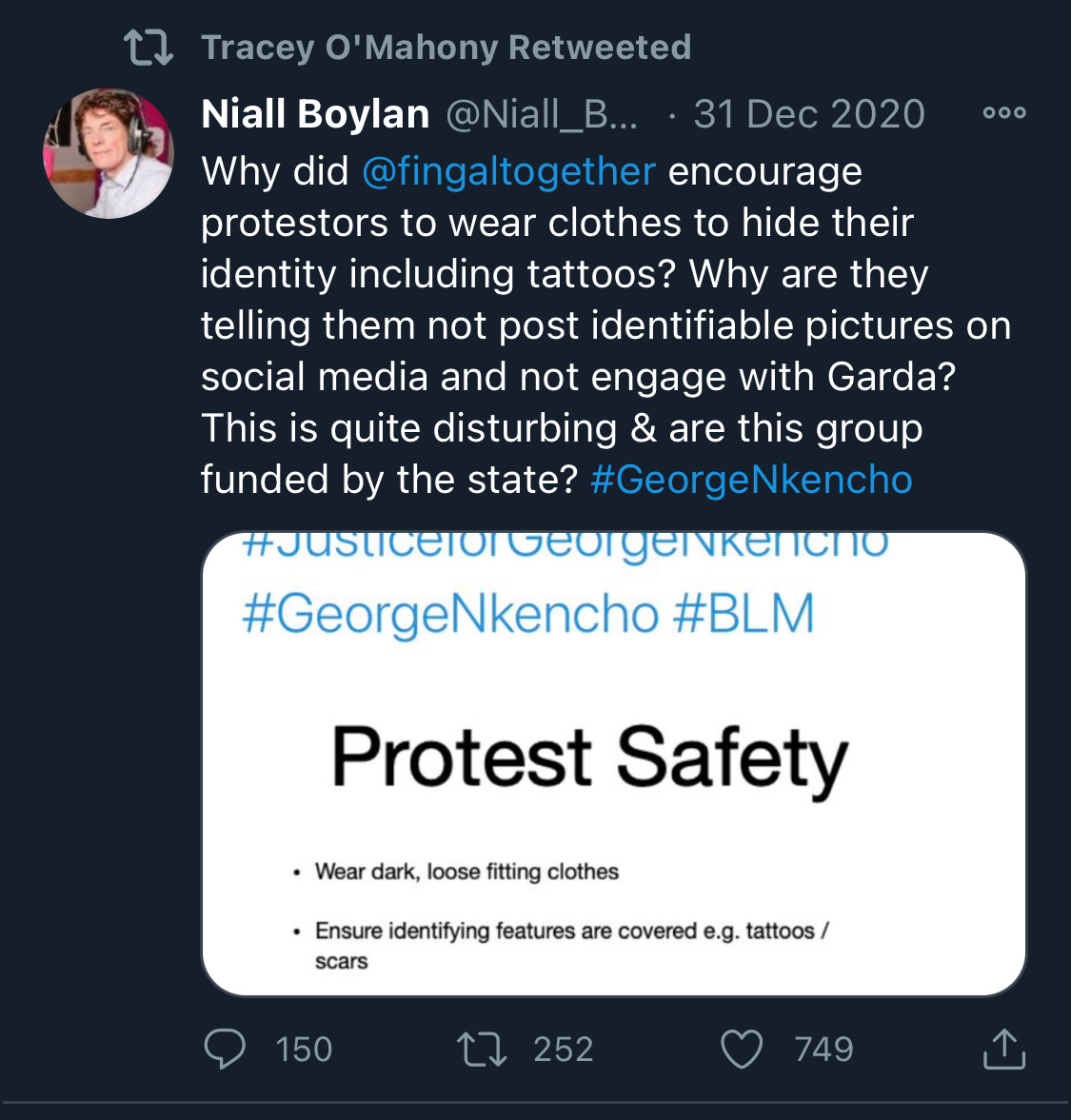
There is co-ordination across the far right in Ireland now to stir both left and right in the hopes of creating a race war. Think critically! Fascists see the tragic killing of #georgenkencho, the grief of his community and pending investigation as a flashpoint for action.
Across Telegram, Twitter and Facebook disinformation is being peddled on the back of these tragic events. From false photographs to the tactics ofwhite supremacy, the far right is clumsily trying to drive hate against minority groups and figureheads.
Be aware, the images the #farright are sharing in the hopes of starting a race war, are not of the SPAR employee that was punched. They\u2019re older photos of a Everton fan. Be aware of the information you\u2019re sharing and that it may be false. Always #factcheck #GeorgeNkencho pic.twitter.com/4c9w4CMk5h
— antifa.drone (@antifa_drone) December 31, 2020
Declan Ganley’s Burkean group and the incel wing of National Party (Gearóid Murphy, Mick O’Keeffe & Co.) as well as all the usuals are concerted in their efforts to demonstrate their white supremacist cred. The quiet parts are today being said out loud.
There is a concerted effort in far-right Telegram groups to try and incite violence on street by targetting people for racist online abuse following the killing of George Nkencho
— Mark Malone (@soundmigration) January 1, 2021
This follows on and is part of a misinformation campaign to polarise communities at this time.
The best thing you can do is challenge disinformation and report posts where engagement isn’t appropriate. Many of these are blatantly racist posts designed to drive recruitment to NP and other Nationalist groups. By all means protest but stay safe.