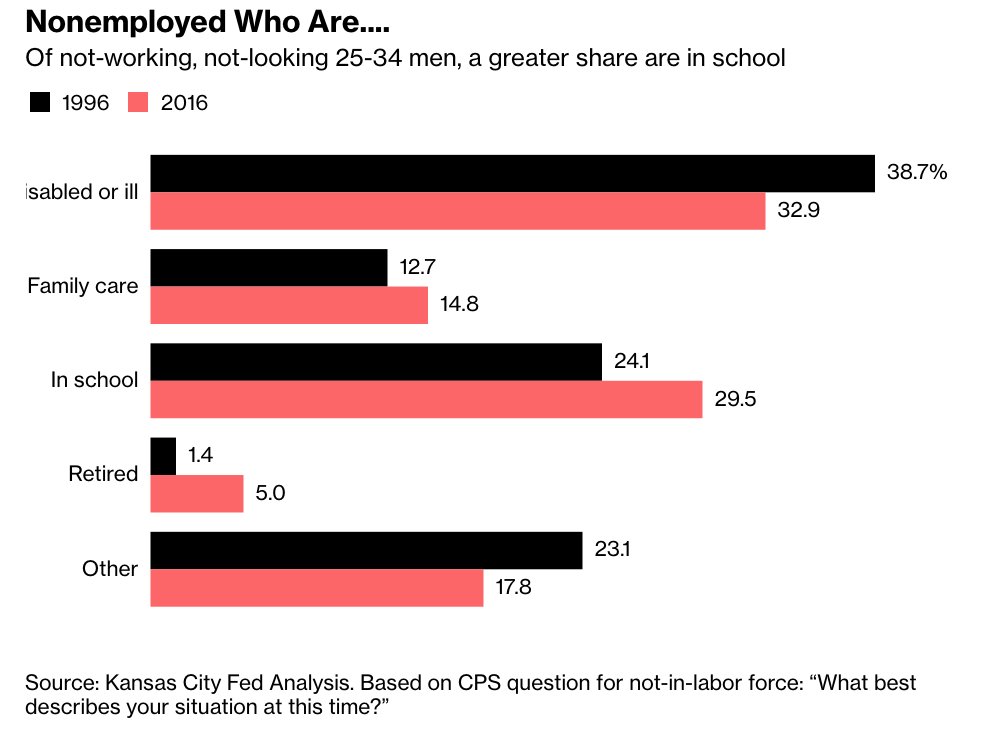
During this time, we saw an increased number of men living with parents & choosing unemployment over lower paying jobs.
Shocking fact: Millennial men are less likely to work than any other age and gender demographic in America.
Today, there are 500,000 young men missing from the U.S. workforce.
Research suggests video games & improved leisure tech plays a role in the problem. 👇 Thread:
During this time, we saw an increased number of men living with parents & choosing unemployment over lower paying jobs.
1 in 4 living in their parents’ home neither go to school nor work.
What's more surprising? 9 in 10 who lived with their parents a year ago are still living there w/ no plans to leave.
https://t.co/iv3mNx3Wi1
According to economist David Dorn:
“If you get to the point where you’re turning 30, you’ve never held a real job and you don’t have a college education, then it is very hard to recover at that point.”
Forbes interview w/ a high school educated man:
"I’m very quick to get frustrated when people refuse to pay me what I’m worth."
“People feel that they have choice nowadays, and they do.”
https://t.co/CQwgpGrPow
A large % of disability is mental health & substance abuse related.
According to the CDC: men are much more likely to overdose on drugs or die from suicide. https://t.co/7w0Gv85dBI
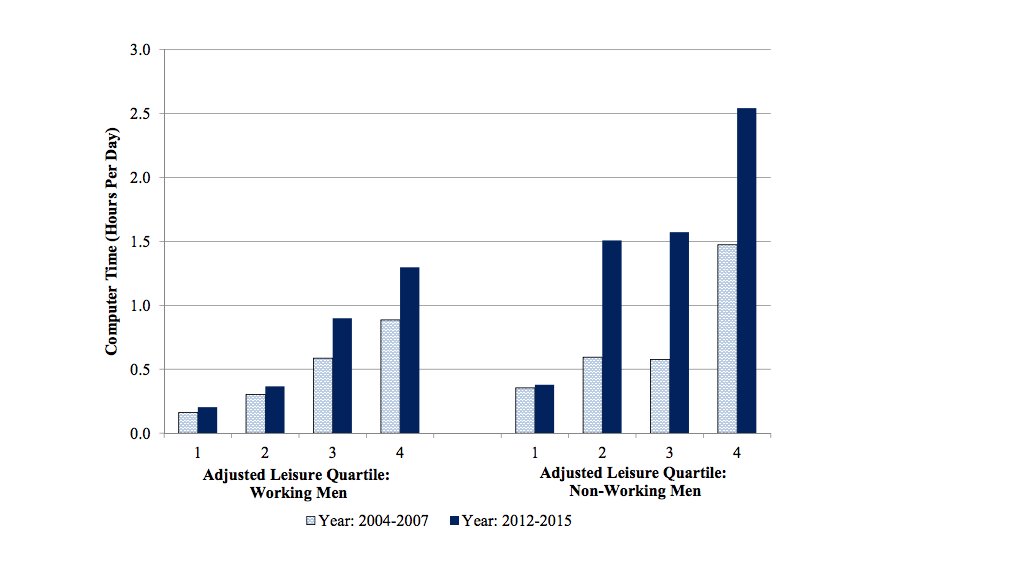
Unemployed millennial men spend 10+ hours per week on recreational computer activities.
Full report: https://t.co/T5rg7D2dt0
Researchers suggest over time videos games become a crutch & form of escapism for unemployed men.
Unlike low to middle skill jobs, video games provide:
The ability to make choices
Feeling of mastery and achievement
Visible achievement & status
Remember: "People feel that they have choice nowadays, and they do.” 🎮
Imagine: the future of work = more time to play video games 🎮.
More from Society


global health policy in 2020 has centered around NPI's (non-pharmaceutical interventions) like distancing, masks, school closures
these have been sold as a way to stop infection as though this were science.
this was never true and that fact was known and knowable.
let's look.
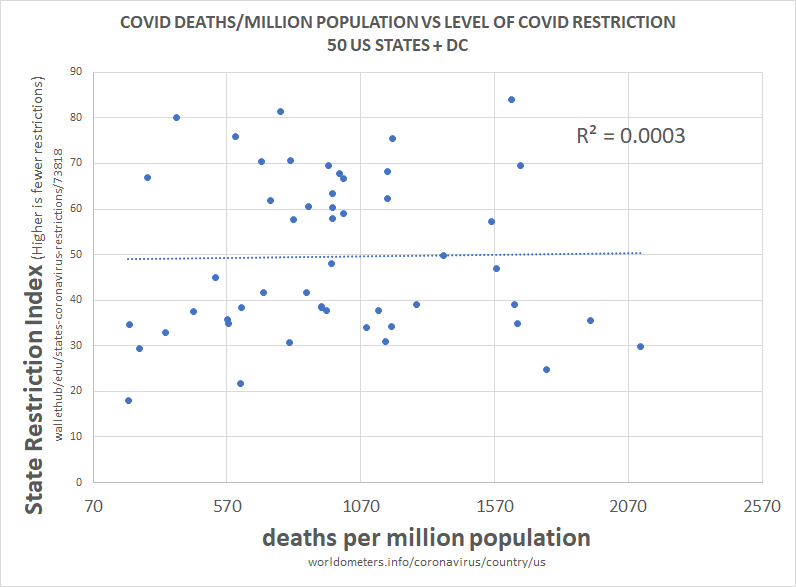
above is the plot of social restriction and NPI vs total death per million. there is 0 R2. this means that the variables play no role in explaining one another.
we can see this same relationship between NPI and all cause deaths.
this is devastating to the case for NPI.
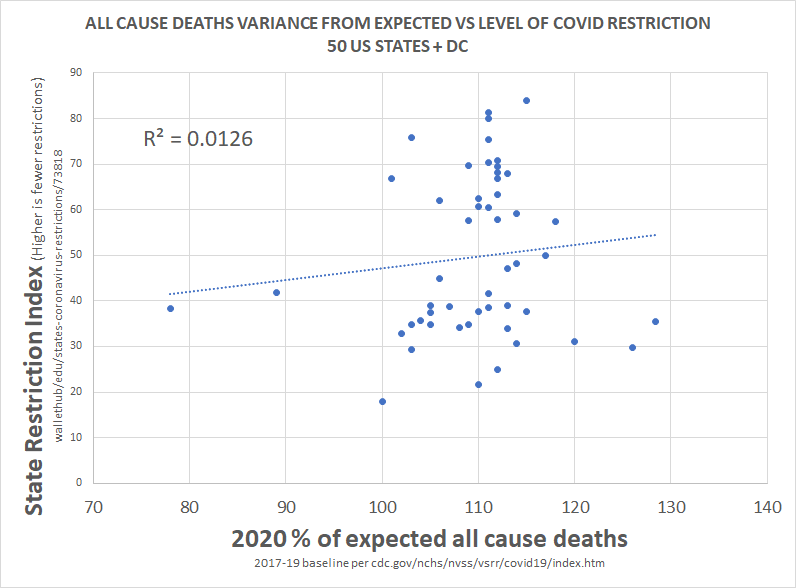
clearly, correlation is not proof of causality, but a total lack of correlation IS proof that there was no material causality.
barring massive and implausible coincidence, it's essentially impossible to cause something and not correlate to it, especially 51 times.
this would seem to pose some very serious questions for those claiming that lockdowns work, those basing policy upon them, and those claiming this is the side of science.
there is no science here nor any data. this is the febrile imaginings of discredited modelers.
this has been clear and obvious from all over the world since the beginning and had been proven so clearly by may that it's hard to imagine anyone who is actually conversant with the data still believing in these responses.
everyone got the same R
these have been sold as a way to stop infection as though this were science.
this was never true and that fact was known and knowable.
let's look.
above is the plot of social restriction and NPI vs total death per million. there is 0 R2. this means that the variables play no role in explaining one another.
we can see this same relationship between NPI and all cause deaths.
this is devastating to the case for NPI.
clearly, correlation is not proof of causality, but a total lack of correlation IS proof that there was no material causality.
barring massive and implausible coincidence, it's essentially impossible to cause something and not correlate to it, especially 51 times.
this would seem to pose some very serious questions for those claiming that lockdowns work, those basing policy upon them, and those claiming this is the side of science.
there is no science here nor any data. this is the febrile imaginings of discredited modelers.
this has been clear and obvious from all over the world since the beginning and had been proven so clearly by may that it's hard to imagine anyone who is actually conversant with the data still believing in these responses.
everyone got the same R
this methodology is a little complex, so let me explain what i did.
— el gato malo (@boriquagato) May 30, 2020
a few EU countries provide real day of death data. this lets us plot meaningful curves to show rate of disease change.
what struck me is how similar all the curves were.
everyone got the same shape. pic.twitter.com/bN0hILzoSl

1/ A thread of comments & observations about the death of the cackling vampire Rush Limbaugh.
My first observations in the main thread are here, but this offshoot is needed because there's been so many wise & witty things I've
2/ First, re: those who in their wayward moral obtuseness feel we "can't speak ill of the dead." I've said that this is what abuse enablers say, but I hear that some religious traditions preach this. Oy.
So there's this: https://t.co/7Ky4RA3nkZ &
3/ Drucker is another great wit, and this carries the proper mood
4/ There's definitely a Jewish Tradition angle for how to treat evil people who die: the only respect is to justice, right & wrong, and above all compassion's existence necessitates condemning cruelty
5/ We're coming up on #Purim, and that's all about how to remember evil. There may be a reason, then, that I share the attitude of many other people committed to righting
My first observations in the main thread are here, but this offshoot is needed because there's been so many wise & witty things I've
37.90/ Limbaugh was a cruel hate-machine who made a fortune off hurting people. To say "don't speak ill of the dead" is the attitude of abuse enablers.
— Joshua Cypess (@JoshuaCypess) February 18, 2021
If you can't condemn a ghoul who dedicated his life to destroying society, you're part of the problem! https://t.co/ijvG2zDACH
2/ First, re: those who in their wayward moral obtuseness feel we "can't speak ill of the dead." I've said that this is what abuse enablers say, but I hear that some religious traditions preach this. Oy.
So there's this: https://t.co/7Ky4RA3nkZ &
This is how Rush's death should be honored. Let's not speak ill of the dead, let's quote Rush speaking ill of the dead.
— Sane English (@SaneEnglish) February 17, 2021
3/ Drucker is another great wit, and this carries the proper mood
It's easy to make fun of Rush Limbaugh right now, but it's important to remember that he also brought a lot of people a lot of joy by dying
— Mike Drucker (@MikeDrucker) February 17, 2021
4/ There's definitely a Jewish Tradition angle for how to treat evil people who die: the only respect is to justice, right & wrong, and above all compassion's existence necessitates condemning cruelty
It\u2019s ok\u2014essential, even\u2014to speak the truth about people who caused great harm.
— Rabbi Danya Ruttenberg (@TheRaDR) February 17, 2021
Even after their death.
5/ We're coming up on #Purim, and that's all about how to remember evil. There may be a reason, then, that I share the attitude of many other people committed to righting
today i said Jewish culture requires dancing on the graves of those who have wronged us and i picked up like 300 followers LMAO
— Erin Biba (@erinbiba) February 18, 2021
people love Jewish vengeance \U0001f923\U0001f923
wait till they hear about Purim