1. Galilean Relativity
We can never fully grasp, define, or understand a system we are part of.
“Distance provides perspective” and wisdom in life is often about perspective.
2. The Laws of Thermodynamics
The study of the large-scale behavior of systems exchanging work and heat with connected systems or their environment.
- The Transitive Law
- The Law of Conservation
- The “Contrast Advantage” Law
- The “Absolute Zero” Law
3. Newton’s Laws of Motion
Describe how objects in the world move and react to forces.
- The Inertia Law: An object at rest, stays at rest
- Force = Mass * Acceleration (F = ma)
- The Law of Reciprocity: For every action there is an equal and opposite reaction
4. Complexity
A complex system exhibits emergent behavior due to the collective interaction of many individual agents according to simple rules.
Complex systems are sensitive to original conditions, influenced by feedback loops, and buffeted by random outside variables.
5. Chaos Theory
Chaos leads to complicated, non-periodic behavior from iteration of a simple rule(s), whereas complexity leads to rich, collective behavior from simple interactions between large numbers of subunits.
Complexity lies in between order and chaos.
6. Emergence
A process where higher-order behavior emerges from the interaction of lower-order components.
These smaller or simpler entities do not exhibit the properties that the higher-order entity ends up exhibiting.
The whole is greater than the sum of its parts.
7. Momentum
The quantity of motion of a moving body, measured as a product of its mass and velocity: Momentum = Mass * Velocity
Momentum is broadly applicable outside of physics as it can help you understand how things change and how difficult or easy it is to change them.
8. Velocity
Velocity has magnitude and direction whereas speed does not.
While nobody knows why nature favors velocity over mass, she does, and we should harness it.
There's a stark difference between potential energy and kinetic energy.
9. Friction
Friction is the force that causes the resistance felt when two objects are moving against one another.
Inertia is a prime example of friction.
10. Equilibrium
Equilibrium is a state of balance between opposing forces, powers, or influences.
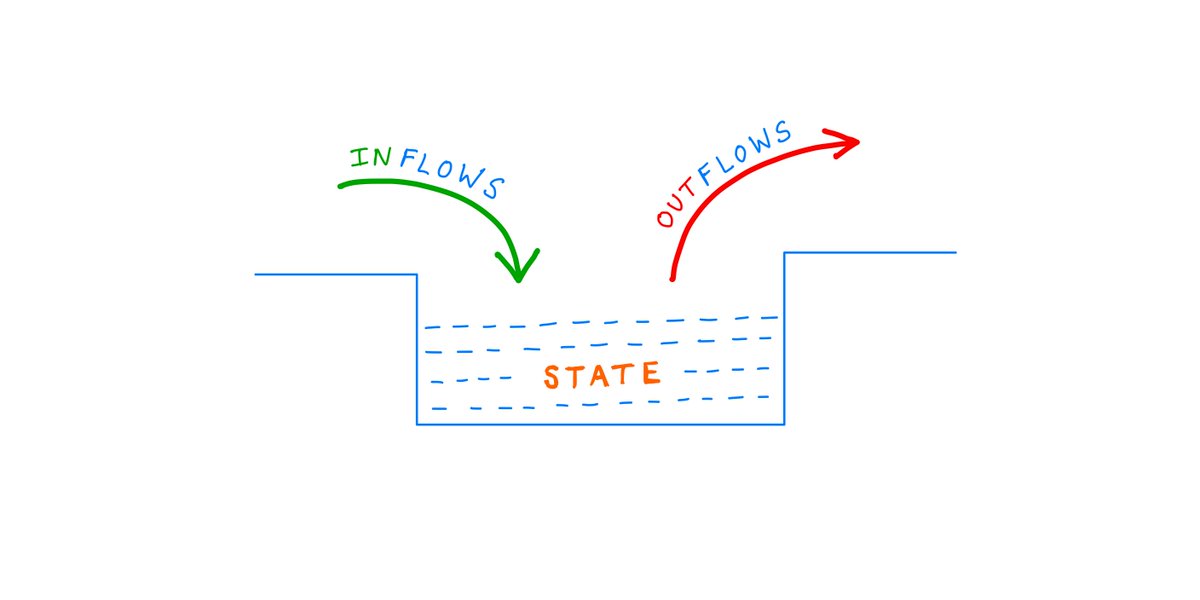
In dynamic equilibrium, you have a system that stays the same though it is always changing (inflows exactly equal outflows).
11. Hysteresis
Hysteresis is when the state of a system is dependent on its history – what happened previously influences what happens next.
It can also be thought of as delayed feedback, where a result lags behind that which causes it. Another word for this is springloading.