Ct values can be used to estimate epidemic dynamics UPDATE! Ct values are expected to change depending on whether the epidemic is growing or declining, and we harness this to estimate the epidemic trajectory. Lots of cool new analyses and methods!

Highlights:
- Cts from symptom-based surveillance change over time, but the effect is weaker
- Methods to infer incidence using single cross-sections of Cts
- Unbiased by changing testing coverage
- Gaussian process (wiggly line) model for incidence tracking using Ct values
2/12
This work is *JOINTLY led* with @LeekShaffer and PI’d by @michaelmina_lab. Thank you also to the ever insightful @mlipsitch and to coauthors @SanjatKanjilal @gabriel_stacey and @nialljlennon. 3/12
Premise: times since infection depend on the epidemic trajectory. Distributions of randomly sampled viral loads proxy times since infection. With calibration, Ct values can estimate growth rate. We focus on qPCR in SARS-CoV-2, but the principle applies to any outbreak. 4/12
Result 1: viral loads are shifted higher (Cts lower) during epidemic growth and lower (Cts higher) during decline when individuals are sampled *based on the onset of symptoms*. We simulated linelist data under symptom-based surveillance and looked at TSI and Cts over time. 5/12
This is crucial when considering virulence in emerging SARS-CoV-2 variants. Lower Cts over time do not *necessarily* mean newly dominant variants have higher virulence. If incidence of a new variant is increasing, then we expect to see more recent infections and lower Cts. 6/12
**However, the effect is smaller than under random surveillance, so I would not rule out the possibility of increased virulence.** But important to consider. Thank you to @charliewhittak for chatting through this! 7/12
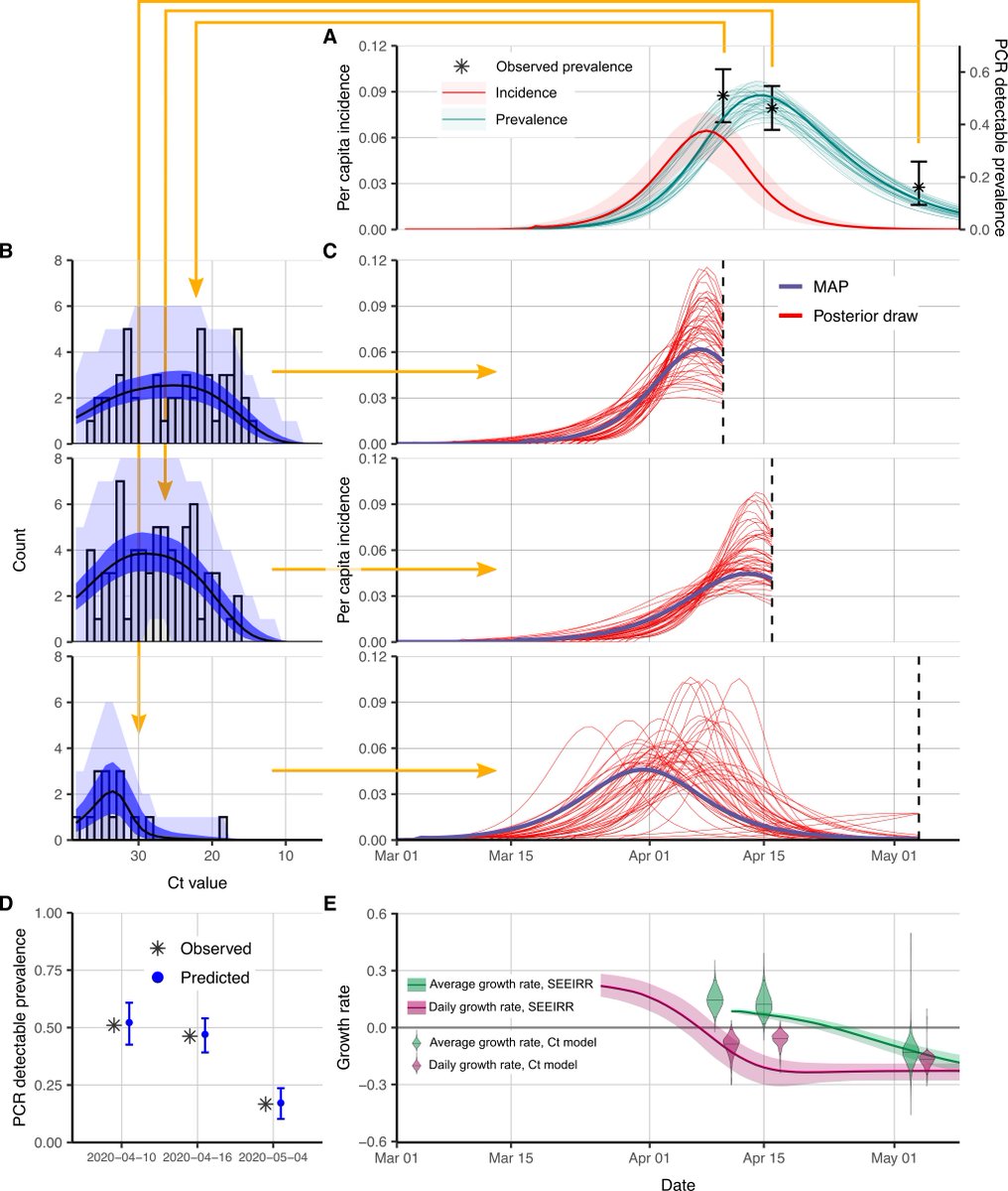
Result 2: we reconstructed the epidemic curve using single-cross sectional samples from well-observed nursing homes, finding that single cross sections using the full Ct distribution provided similar insights to point prevalence across three sample times. 8/12
Result 3: we compared Ct-based to case-count based methods when testing is changing. Rt estimates are biased when testing is increasing or decreasing (not a problem with the method, just the data!). Our method uses the Ct distribution so does not care about test numbers. 9/12
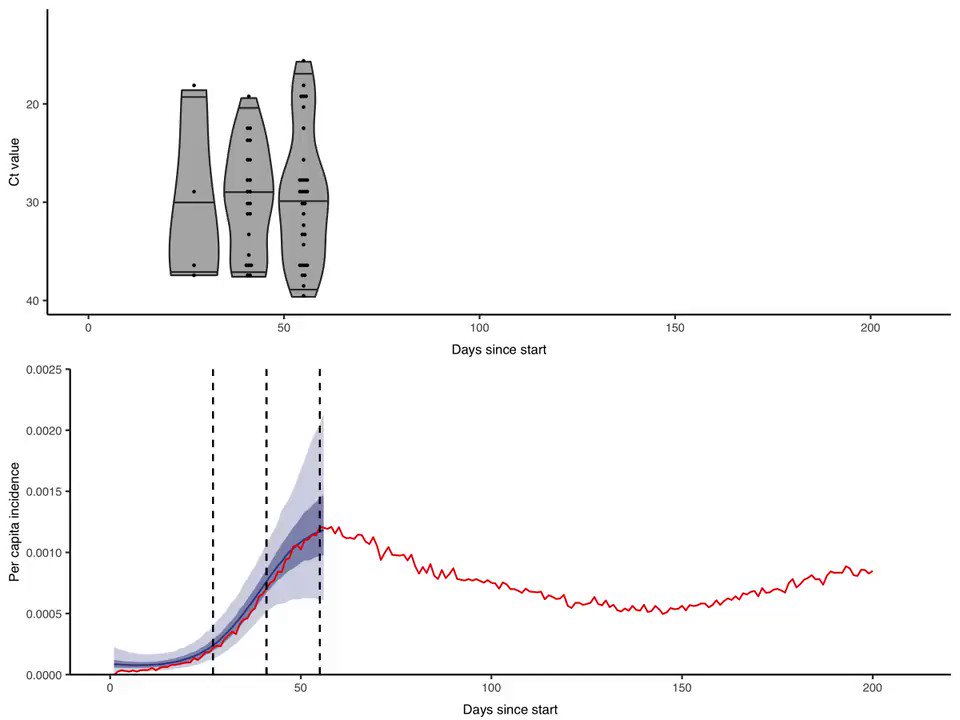
Result 4: we use multiple cross-sectional samples to reconstruct incidence without making assumptions about the trajectory shape (a Gaussian “wiggly” process model). We can track the incidence curve in MA using routinely collected hospital tests. 10/12
… and here is a gif that reminds me of a nematode worm. Every week we add on a new cross section of Cts and accurately track true incidence (in simulation, red line). 11/12
Conclusion: we are generating loads of (semi) quantitative data in the form of Cts. We can harness these to get unbiased estimates of the epidemic trajectory. Hopefully these ideas will help public health surveillance efforts and interpret data in the light of new variants. 12/12

More from Science

1. I find it remarkable that some medics and scientists aren’t raising their voices to make children as safe as possible. The comment about children being less infectious than adults is unsupported by evidence.


2. @c_drosten has talked about this extensively and @dgurdasani1 and @DrZoeHyde have repeatedly pointed out flaws in the studies which have purported to show this. Now for the other assertion: children are very rarely ill with COVID19.

3. Children seem to suffer less with acute illness, but we have no idea of the long-term impact of infection. We do know #LongCovid affects some children. @LongCovidKids now speaks for 1,500 children struggling with a wide range of long-term symptoms.

4. 1,500 children whose parents found a small campaign group. How many more are out there? We don’t know. ONS data suggests there might be many, but the issue hasn’t been studied sufficiently well or long enough for a definitive answer.

5. Some people have talked about #COVID19 being this generation’s Polio. According to US CDC, Polio resulted in inapparent infection in more than 99% of people. Severe disease occurred in a tiny fraction of those infected. Source:

You May Also Like

Moderna CEO Stephane Bancel was previously CEO of bioMerieux in France from 07-10.

Alain Merieux, who owns bioMerieux, was instrumental in the creation of the Wuhan Institute of Virology P4 Lab.

The same people who helped create the virus, also helped to create the vaccines...


Moderna partnered with French Pasteur Institute in 2015 to develop mRNA vaccine technology.

Pasteur Institute partnered with the Wuhan P4 Laboratory in 2017 along with the Merieux Foundation to study emerging viruses...
https://t.co/yFsHwrNYaK
https://t.co/9M5lydBKhM


Nobel prize winning scientist Luc Montagnier asserts that Sars-Cov-2 is man-made and originated from the Wuhan Institute of Virology.

Montagnier did extensive work with the Pasteur Institute in France which was partnered with the Wuhan P4.

Merieux Foundation & the Chinese government have worked together since 1965, and partnered to study emerging pathogens in Africa in 2015.

Their research included "PATHOGENS CARRIED BY BATS" that provoke respiratory diseases.

🚨🚨🚨
https://t.co/gVwpT0ssqI
क्या आप जानते हैं कि क्या है, पितृ पक्ष में कौवे को खाना देने के पीछे का वैज्ञानिक कारण!

श्राद्ध पक्ष में कौओं का बड़ा ही महत्व है। कहते है कौआ यम का प्रतीक है, यदि आपके हाथों दिया गया भोजन ग्रहण कर ले, तो ऐसा माना जाता है कि पितरों की कृपा आपके ऊपर है और वे आपसे ख़ुश है।


कुछ लोग कहते हैं की व्यक्ति मरकर सबसे पहले कौवे के रूप में जन्म लेता है और उसे खाना खिलाने से वह भोजन पितरों को मिलता है

शायद हम सबने अपने घर के किसी बड़े बुज़ुर्ग, किसी पंडित या ज्योतिषाचार्य से ये सुना होगा। वे अनगिनत किस्से सुनाएंगे, कहेंगे बड़े बुज़ुर्ग कह गए इसीलिए ऐसा करना

शायद ही हमें कोई इसके पीछे का वैज्ञानिक कारण बता सके।

हमारे ऋषि मुनि और पौराणिक काल में रहने वाले लोग मुर्ख नहीं थे! कभी सोचियेगा कौवों को पितृ पक्ष में खिलाई खीर हमारे पूर्वजों तक कैसे पहुंचेगी?

हमारे ऋषि मुनि विद्वान थे, वे जो बात करते या कहते थे उसके पीछे कोई न कोई वैज्ञानिक कारण छुपा होता था।

एक बहुत रोचक तथ्य है पितृ पक्ष, भादो( भाद्रपद) प्रकृति और काक के बीच।

एक बात जो कह सकते कि हम सब ने स्वतः उग आये पीपल या बरगद का पेड़/ पौधा किसी न किसी दीवार, पुरानी

इमारत, पर्वत या अट्टालिकाओं पर ज़रूर देखा होगा। देखा है न?

ज़रा सोचिये पीपल या बरगद की बीज कैसे पहुंचे होंगे वहाँ तक? इनके बीज इतने हल्के भी नहीं होते के हवा उन्हें उड़ाके ले जा सके।