
On election night, Fox News called Arizona very early. This surprised pretty much everyone. The Fox News team had improved their election model in 2020, and was confident their call was correct, even if unconventional.
Conservatives love to complain about the media.
But there's an inside baseball media that reveals how destructive the conservative media criticism environment can be to the conservative movement.
Enter, Fox News:
On election night, Fox News called Arizona very early. This surprised pretty much everyone. The Fox News team had improved their election model in 2020, and was confident their call was correct, even if unconventional.
Who stole the election changed over time. Fox News. Some rando in Atlanta. Poll workers. China.
There was less true uncertainty about who would win at 11:20 PM on election night than in any election ever, because sooooo many votes had been cast early.
Analysts in finance get paid lots of money for that kind of call!
1) Fox News recruited high-quality analytic talent into the conservative movement
2) That talent delivered, providing accurate results faster than competitors
3) Those results didn't fit "The Narrative" that the Trumpist echo chamber wanted
4) Fired
But our media critics really need to pay attention to stuff like this. It's open hostility on even *irrelevant* truth claims.
It didn't matter what Fox called! The results weren't influenced by that!
But in the media-and-commentary-addicted mind of politics-overdosed Trump supporters.... it really mattered what The Media said.
.... but we don't really fund "data stuff." We're more interested in commentary. Do you want to repackage this as some op-eds?
Not quite. They got rid of two people responsible for *reporting* that decision. But the guy who actually *made* the decision - Arnon Mishkin - is still there, afaik. Decision Desk is still sacrosanct, apparently.
— Ezra Glinter (@EzraG) January 22, 2021
More from Lyman Stone 石來民
Ulysses S. Grant would like a WORD
Or Teddy Roosevelt. Or Dwight Eisenhower. Or Andrew Jackson. Or Abraham Lincoln. Or George Washington. Or Zachary Taylor. Or any of numerous presidents who were honest-to-goodness battle-hardened warriors.
James Monroe fought the Hessians at Trenton and nearly died of wounds sustained there, then wintered in Valley Forge, then fought until Monmouth, then repeatedly tried to raise new regiments for the war until he went bankrupt doing it.
James Monroe, of the Era of Good Feelings, longest serving president of all time.... was in the boats crossing the icy Delaware.
Andrew Jackson was in a duel. He was shot in the chest right by his heart.
But he didn't go down. He stood there and, while bleeding out, steadily took aim and killed the dude who shot him.
Stone cold.
Hogan Gidley: Trump is "the most masculine person to ever hold the White House as the president of the United States" https://t.co/fcoYWyaEhz
— Eliza Relman (@eliza_relman) January 11, 2021
Or Teddy Roosevelt. Or Dwight Eisenhower. Or Andrew Jackson. Or Abraham Lincoln. Or George Washington. Or Zachary Taylor. Or any of numerous presidents who were honest-to-goodness battle-hardened warriors.
James Monroe fought the Hessians at Trenton and nearly died of wounds sustained there, then wintered in Valley Forge, then fought until Monmouth, then repeatedly tried to raise new regiments for the war until he went bankrupt doing it.
James Monroe, of the Era of Good Feelings, longest serving president of all time.... was in the boats crossing the icy Delaware.
Andrew Jackson was in a duel. He was shot in the chest right by his heart.
But he didn't go down. He stood there and, while bleeding out, steadily took aim and killed the dude who shot him.
Stone cold.
So a few days back I was tweeting about SSRIs. The big question with these drugs is: why do controlled trials routinely show such small effects when practitioners and patients report life-changingly-large effects?
So first off, at this point the evidence is pretty clear that SSRIs and other anti-anxiety/anti-depression drugs truly don't do very much. Their average effects are beneath clinical significance, as I tweeted about here:
Basically, the problem these drugs face is that while they actually see relatively LARGE effects.... but that placebos in those trials ALSO see large effects (and most untreated depression improves within a year anyways).
So basically you have this problem where:
1. The condition tends to improve on its own in a majority of cases
2. Placebo effects for the condition are unusually large
Which means the large crude effects of SSRIs get swamped.
So that raises two new questions.
1. (Not my focus here) Are we treating these conditions appropriately given their untreated prognosis is usually (though certainly not always!!) "goes away in a few months"?
2. Why are placebo effects so unusually large?
So first off, at this point the evidence is pretty clear that SSRIs and other anti-anxiety/anti-depression drugs truly don't do very much. Their average effects are beneath clinical significance, as I tweeted about here:
What's the best recent empirical assessment of SSRI/SNRI effectiveness which deals with heterogeneity and long-term effects in a plausible way?
— Lyman Stone \u77f3\u4f86\u6c11 (@lymanstoneky) December 4, 2020
Basically, the problem these drugs face is that while they actually see relatively LARGE effects.... but that placebos in those trials ALSO see large effects (and most untreated depression improves within a year anyways).
So basically you have this problem where:
1. The condition tends to improve on its own in a majority of cases
2. Placebo effects for the condition are unusually large
Which means the large crude effects of SSRIs get swamped.
So that raises two new questions.
1. (Not my focus here) Are we treating these conditions appropriately given their untreated prognosis is usually (though certainly not always!!) "goes away in a few months"?
2. Why are placebo effects so unusually large?
More from Politics


You May Also Like



@EricTopol @NBA @StephenKissler @yhgrad B.1.1.7 reveals clearly that SARS-CoV-2 is reverting to its original pre-outbreak condition, i.e. adapted to transgenic hACE2 mice (either Baric's BALB/c ones or others used at WIV labs during chimeric bat coronavirus experiments aimed at developing a pan betacoronavirus vaccine)
@NBA @StephenKissler @yhgrad 1. From Day 1, SARS-COV-2 was very well adapted to humans .....and transgenic hACE2 Mice
@NBA @StephenKissler @yhgrad 2. High Probability of serial passaging in Transgenic Mice expressing hACE2 in genesis of SARS-COV-2
@NBA @StephenKissler @yhgrad B.1.1.7 has an unusually large number of genetic changes, ... found to date in mouse-adapted SARS-CoV2 and is also seen in ferret infections.
https://t.co/9Z4oJmkcKj

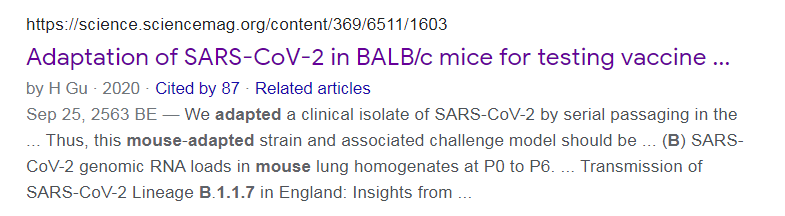
@NBA @StephenKissler @yhgrad We adapted a clinical isolate of SARS-CoV-2 by serial passaging in the ... Thus, this mouse-adapted strain and associated challenge model should be ... (B) SARS-CoV-2 genomic RNA loads in mouse lung homogenates at P0 to P6.
https://t.co/I90OOCJg7o
@NBA @StephenKissler @yhgrad 1. From Day 1, SARS-COV-2 was very well adapted to humans .....and transgenic hACE2 Mice
1. From Day 1, SARS-COV-2 was very well adapted to humans .....and transgenic hACE2 Mice
— Billy Bostickson \U0001f3f4\U0001f441&\U0001f441 \U0001f193 (@BillyBostickson) January 30, 2021
"we generated a mouse model expressing hACE2 by using CRISPR/Cas9 knockin technology. In comparison with wild-type C57BL/6 mice, both young & aged hACE2 mice sustained high viral loads... pic.twitter.com/j94XtSkscj
@NBA @StephenKissler @yhgrad 2. High Probability of serial passaging in Transgenic Mice expressing hACE2 in genesis of SARS-COV-2
1. High Probability of serial passaging in Transgenic Mice expressing hACE2 in genesis of SARS-COV-2!
— Billy Bostickson \U0001f3f4\U0001f441&\U0001f441 \U0001f193 (@BillyBostickson) January 2, 2021
2 papers:
Human\u2013viral molecular mimicryhttps://t.co/irfH0Zgrve
Molecular Mimicryhttps://t.co/yLQoUtfS6s https://t.co/lsCv2iMEQz
@NBA @StephenKissler @yhgrad B.1.1.7 has an unusually large number of genetic changes, ... found to date in mouse-adapted SARS-CoV2 and is also seen in ferret infections.
https://t.co/9Z4oJmkcKj
@NBA @StephenKissler @yhgrad We adapted a clinical isolate of SARS-CoV-2 by serial passaging in the ... Thus, this mouse-adapted strain and associated challenge model should be ... (B) SARS-CoV-2 genomic RNA loads in mouse lung homogenates at P0 to P6.
https://t.co/I90OOCJg7o


