
the strange reality of strict calvinism is that it makes a mockery of God's claims to hate, abhort, or even be theoretically opposed to evil
Because we all know that God's response to the Flood was, "I REALLY liked that, it was AWESOME, it satisfied my will and purposes to obliterate my creation!"
1) If God knew how things would go, exercising his sovereignty in that way is only a little different
2) Evil begins BEFORE man's fall! Satan fell first! We know little about this, but locating first-evil in *human* free will is an error.
The key point is simply that the origin of evil is certainly *before* "original sin."
This is formally equivalent to the question, "Could the Father discontinue the existence of the Son?" since both are questions about if God has sovereignty over His own attributes.
Who can say! Not even the Son was told the day or the hour! But if God is taking His time there must be a reason. We can't reason about what that may be, as God has not revealed it.
.... love me all my Presby family and friends (literally both sides of the family and many of my best friends!)....
.... and your theology is interesting...
.... but very, very, very wrong.
More from Lyman Stone 石來民
So a few days back I was tweeting about SSRIs. The big question with these drugs is: why do controlled trials routinely show such small effects when practitioners and patients report life-changingly-large effects?
So first off, at this point the evidence is pretty clear that SSRIs and other anti-anxiety/anti-depression drugs truly don't do very much. Their average effects are beneath clinical significance, as I tweeted about here:
Basically, the problem these drugs face is that while they actually see relatively LARGE effects.... but that placebos in those trials ALSO see large effects (and most untreated depression improves within a year anyways).
So basically you have this problem where:
1. The condition tends to improve on its own in a majority of cases
2. Placebo effects for the condition are unusually large
Which means the large crude effects of SSRIs get swamped.
So that raises two new questions.
1. (Not my focus here) Are we treating these conditions appropriately given their untreated prognosis is usually (though certainly not always!!) "goes away in a few months"?
2. Why are placebo effects so unusually large?
So first off, at this point the evidence is pretty clear that SSRIs and other anti-anxiety/anti-depression drugs truly don't do very much. Their average effects are beneath clinical significance, as I tweeted about here:
What's the best recent empirical assessment of SSRI/SNRI effectiveness which deals with heterogeneity and long-term effects in a plausible way?
— Lyman Stone \u77f3\u4f86\u6c11 (@lymanstoneky) December 4, 2020
Basically, the problem these drugs face is that while they actually see relatively LARGE effects.... but that placebos in those trials ALSO see large effects (and most untreated depression improves within a year anyways).
So basically you have this problem where:
1. The condition tends to improve on its own in a majority of cases
2. Placebo effects for the condition are unusually large
Which means the large crude effects of SSRIs get swamped.
So that raises two new questions.
1. (Not my focus here) Are we treating these conditions appropriately given their untreated prognosis is usually (though certainly not always!!) "goes away in a few months"?
2. Why are placebo effects so unusually large?
Ulysses S. Grant would like a WORD
Or Teddy Roosevelt. Or Dwight Eisenhower. Or Andrew Jackson. Or Abraham Lincoln. Or George Washington. Or Zachary Taylor. Or any of numerous presidents who were honest-to-goodness battle-hardened warriors.
James Monroe fought the Hessians at Trenton and nearly died of wounds sustained there, then wintered in Valley Forge, then fought until Monmouth, then repeatedly tried to raise new regiments for the war until he went bankrupt doing it.
James Monroe, of the Era of Good Feelings, longest serving president of all time.... was in the boats crossing the icy Delaware.
Andrew Jackson was in a duel. He was shot in the chest right by his heart.
But he didn't go down. He stood there and, while bleeding out, steadily took aim and killed the dude who shot him.
Stone cold.
Hogan Gidley: Trump is "the most masculine person to ever hold the White House as the president of the United States" https://t.co/fcoYWyaEhz
— Eliza Relman (@eliza_relman) January 11, 2021
Or Teddy Roosevelt. Or Dwight Eisenhower. Or Andrew Jackson. Or Abraham Lincoln. Or George Washington. Or Zachary Taylor. Or any of numerous presidents who were honest-to-goodness battle-hardened warriors.
James Monroe fought the Hessians at Trenton and nearly died of wounds sustained there, then wintered in Valley Forge, then fought until Monmouth, then repeatedly tried to raise new regiments for the war until he went bankrupt doing it.
James Monroe, of the Era of Good Feelings, longest serving president of all time.... was in the boats crossing the icy Delaware.
Andrew Jackson was in a duel. He was shot in the chest right by his heart.
But he didn't go down. He stood there and, while bleeding out, steadily took aim and killed the dude who shot him.
Stone cold.
More from For later read


1. The death of Silicon Valley, a thread
How did Silicon Valley die? It was killed by the internet. I will explain.
Yesterday, my friend IRL asked me "Where are good old days when techies were
2. In the "good old days" Silicon Valley was about understanding technology. Silicon, to be precise. These were people who had to understand quantum mechanics, who had to build the near-miraculous devices that we now take for granted, and they had to work
3. Now, I love libertarians, and I share much of their political philosophy. But you have to be socially naive to believe that it has a chance in a real society. In those days, Silicon Valley was not a real society. It was populated by people who understood quantum mechanics
4. Then came the microcomputer revolution. It was created by people who understood how to build computers. One borderline case was Steve Jobs. People claimed that Jobs was surrounded by a "reality distortion field" - that's how good he was at understanding people, not things
5. Still, the heroes of Silicon Valley were the engineers. The people who knew how to build things. Steve Jobs, for all his understanding of people, also had quite a good understanding of technology. He had a libertarian vibe, and so did Silicon Valley
How did Silicon Valley die? It was killed by the internet. I will explain.
Yesterday, my friend IRL asked me "Where are good old days when techies were
Where are good old days when techies were libertarians.
— Cranky (@rushingdima) January 9, 2021
2. In the "good old days" Silicon Valley was about understanding technology. Silicon, to be precise. These were people who had to understand quantum mechanics, who had to build the near-miraculous devices that we now take for granted, and they had to work
3. Now, I love libertarians, and I share much of their political philosophy. But you have to be socially naive to believe that it has a chance in a real society. In those days, Silicon Valley was not a real society. It was populated by people who understood quantum mechanics
4. Then came the microcomputer revolution. It was created by people who understood how to build computers. One borderline case was Steve Jobs. People claimed that Jobs was surrounded by a "reality distortion field" - that's how good he was at understanding people, not things
5. Still, the heroes of Silicon Valley were the engineers. The people who knew how to build things. Steve Jobs, for all his understanding of people, also had quite a good understanding of technology. He had a libertarian vibe, and so did Silicon Valley


I should mention, this is why I keep talking about this. Because I know so many people who legally CAN'T.
How do I know they have NDAs, if they can't talk legally about them? Because they trusted me with their secrets... after I said something. That's how they knew I was safe.
Some of the people who have reached out to me privately have been sitting with the pain of what happened to them and the regret that they signed for YEARS. But at the time, it didn't seem like they had any other option BUT to sign.
I do not blame *anyone* for signing an NDA, especially when it's attached to a financial lifeline. When you feel like your family's wellbeing is at stake, you'll do anything -- even sign away your own voice -- to provide for them. That's not a "choice"; that's survival.
And yes, many of the people whose stories I now know were pressured into signing an NDA by my husband's ex-employer. Some of whom I *never* would have guessed. People I thought "left well." Turns out, they've just been *very* good at abiding by the terms of their NDA.
(And others who have reached out had similar experiences with other Christian orgs. Turns out abuse, and the use of NDAs to cover up that abuse, is rampant in a LOT of places.)
How do I know they have NDAs, if they can't talk legally about them? Because they trusted me with their secrets... after I said something. That's how they knew I was safe.
And if the environment at the org was toxic or abusive, it is not uncommon to not realize the extent of that toxicity/abuse until after you're out. But by the time you realize that you signed under duress and presumed good faith where none existed, you're out of options.
— Lauren Thoman (@LaurenThoman) February 16, 2021
Some of the people who have reached out to me privately have been sitting with the pain of what happened to them and the regret that they signed for YEARS. But at the time, it didn't seem like they had any other option BUT to sign.
I do not blame *anyone* for signing an NDA, especially when it's attached to a financial lifeline. When you feel like your family's wellbeing is at stake, you'll do anything -- even sign away your own voice -- to provide for them. That's not a "choice"; that's survival.
And yes, many of the people whose stories I now know were pressured into signing an NDA by my husband's ex-employer. Some of whom I *never* would have guessed. People I thought "left well." Turns out, they've just been *very* good at abiding by the terms of their NDA.
(And others who have reached out had similar experiences with other Christian orgs. Turns out abuse, and the use of NDAs to cover up that abuse, is rampant in a LOT of places.)
You May Also Like






Neo-nazi group #PatriotFront held a photo op in #Chicago last weekend & is currently marching around #DC so it's as good time as any to compile a list of their identified members for folks to watch for
Who are these chuds?
Patriot Front broke away from white nationalist org Vanguard America following #unitetheright in #charlottesville after James Alex Fields was seen with a VA shield before driving his car into a crowd, murdering Heather Heyer & injuring dozens of others
Syed Robbie Javid a.k.a. Sayed Robbie Javid or Robbie Javid of Alexandria,
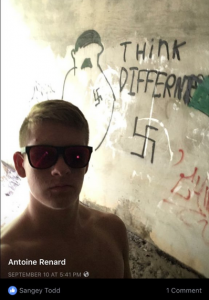
Antoine Bernard Renard (a.k.a. “Charlemagne MD” on Discord) from Rockville, MD.
https://t.co/ykEjdZFDi6
Brandon Troy Higgs, 25, from Reisterstown,
Who are these chuds?
Patriot Front broke away from white nationalist org Vanguard America following #unitetheright in #charlottesville after James Alex Fields was seen with a VA shield before driving his car into a crowd, murdering Heather Heyer & injuring dozens of others
Syed Robbie Javid a.k.a. Sayed Robbie Javid or Robbie Javid of Alexandria,
Happy Monday everyone :-) Let's ring in September by reacquainting ourselves with Virginia neo-Nazi and NSC Dixie affiliate Sayed "Robbie" Javid, now known by "Reform the States". Robbie is an explicitly genocidal neo-Nazi, so lets get to know him a bit better!
— Garfield but Anti-Fascist (@AntifaGarfield) August 31, 2020
CW on this thread pic.twitter.com/3gzxrIo9HD
Antoine Bernard Renard (a.k.a. “Charlemagne MD” on Discord) from Rockville, MD.
https://t.co/ykEjdZFDi6
Brandon Troy Higgs, 25, from Reisterstown,
