
"Fail to prepare, prepare to fail" has gone from being an irritating statement trotted out on a training course to a description of the UK government's modus operandi. And as well as on covid restrictions we're seeing it in EU negotiations - deal or no-deal. And here's why... 1/
More from David Henig
We need to talk about UK politics. More specifically we need to talk about the absence of opposition to a no-deal Brexit risking Scottish independence, Northern Irish peace, the end of the mass market car industry, more expensive food, and damaged relations with US and EU 1/n
Project fear and the red wall. The first meaning that every serious threat, such as that of Nissan that their plant will be unsustainable, is dismissed with little discussion. The red wall, apparently so angry with Labour about the EU they are afraid to have a position. 2/
Because 'sovereignty' apparently. But a particularly nefarious form of sovereignty in which the normal kind of things you discuss in a Free Trade Agreement - shared rules, access to waters - become when discussed with the EU unacceptable infringements and threats. 3/
You note in the UK we aren't having a discussion on what level playing field rules or access to fishing waters might be acceptable. Or normal. Or even what we might want, like shared increased commitments on climate change. No, all rumours. Evil EU. Worse French. 4/
Those who follow closely see incredible briefings in the papers, like today claiming the EU demand for raising minimum shared standards was only raised on Thursday, treated as fact. This was known months ago. But the media too often just reports the spin as fact. 5/
UK cabinet to back Johnson over no-deal Brexit - The Times https://t.co/uCuOTsNdJL pic.twitter.com/88x5Tw2g53
— Reuters (@Reuters) December 6, 2020
Project fear and the red wall. The first meaning that every serious threat, such as that of Nissan that their plant will be unsustainable, is dismissed with little discussion. The red wall, apparently so angry with Labour about the EU they are afraid to have a position. 2/
Because 'sovereignty' apparently. But a particularly nefarious form of sovereignty in which the normal kind of things you discuss in a Free Trade Agreement - shared rules, access to waters - become when discussed with the EU unacceptable infringements and threats. 3/
You note in the UK we aren't having a discussion on what level playing field rules or access to fishing waters might be acceptable. Or normal. Or even what we might want, like shared increased commitments on climate change. No, all rumours. Evil EU. Worse French. 4/
Those who follow closely see incredible briefings in the papers, like today claiming the EU demand for raising minimum shared standards was only raised on Thursday, treated as fact. This was known months ago. But the media too often just reports the spin as fact. 5/
More from Economy








You May Also Like











@EricTopol @NBA @StephenKissler @yhgrad B.1.1.7 reveals clearly that SARS-CoV-2 is reverting to its original pre-outbreak condition, i.e. adapted to transgenic hACE2 mice (either Baric's BALB/c ones or others used at WIV labs during chimeric bat coronavirus experiments aimed at developing a pan betacoronavirus vaccine)
@NBA @StephenKissler @yhgrad 1. From Day 1, SARS-COV-2 was very well adapted to humans .....and transgenic hACE2 Mice
@NBA @StephenKissler @yhgrad 2. High Probability of serial passaging in Transgenic Mice expressing hACE2 in genesis of SARS-COV-2
@NBA @StephenKissler @yhgrad B.1.1.7 has an unusually large number of genetic changes, ... found to date in mouse-adapted SARS-CoV2 and is also seen in ferret infections.
https://t.co/9Z4oJmkcKj

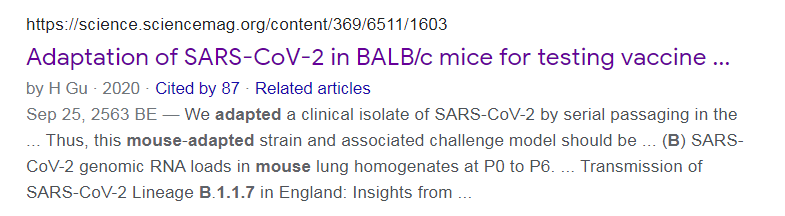
@NBA @StephenKissler @yhgrad We adapted a clinical isolate of SARS-CoV-2 by serial passaging in the ... Thus, this mouse-adapted strain and associated challenge model should be ... (B) SARS-CoV-2 genomic RNA loads in mouse lung homogenates at P0 to P6.
https://t.co/I90OOCJg7o
@NBA @StephenKissler @yhgrad 1. From Day 1, SARS-COV-2 was very well adapted to humans .....and transgenic hACE2 Mice
1. From Day 1, SARS-COV-2 was very well adapted to humans .....and transgenic hACE2 Mice
— Billy Bostickson \U0001f3f4\U0001f441&\U0001f441 \U0001f193 (@BillyBostickson) January 30, 2021
"we generated a mouse model expressing hACE2 by using CRISPR/Cas9 knockin technology. In comparison with wild-type C57BL/6 mice, both young & aged hACE2 mice sustained high viral loads... pic.twitter.com/j94XtSkscj
@NBA @StephenKissler @yhgrad 2. High Probability of serial passaging in Transgenic Mice expressing hACE2 in genesis of SARS-COV-2
1. High Probability of serial passaging in Transgenic Mice expressing hACE2 in genesis of SARS-COV-2!
— Billy Bostickson \U0001f3f4\U0001f441&\U0001f441 \U0001f193 (@BillyBostickson) January 2, 2021
2 papers:
Human\u2013viral molecular mimicryhttps://t.co/irfH0Zgrve
Molecular Mimicryhttps://t.co/yLQoUtfS6s https://t.co/lsCv2iMEQz
@NBA @StephenKissler @yhgrad B.1.1.7 has an unusually large number of genetic changes, ... found to date in mouse-adapted SARS-CoV2 and is also seen in ferret infections.
https://t.co/9Z4oJmkcKj
@NBA @StephenKissler @yhgrad We adapted a clinical isolate of SARS-CoV-2 by serial passaging in the ... Thus, this mouse-adapted strain and associated challenge model should be ... (B) SARS-CoV-2 genomic RNA loads in mouse lung homogenates at P0 to P6.
https://t.co/I90OOCJg7o