Today's UK-EU trade deal reflection - what is rarely stated in discussions about the deal's shortcomings is that they reflect UK government policy choices - in particular that control of immigration and a US trade deal are a higher priority than an EU deal.
More from David Henig
Morning. And its Groundhog Day today. https://t.co/gRs4Dc8RH2
Some useful threads will follow, first on the Northern Ireland protocol, where unfettered is still being defined...
And on fish and level playing field. The latter seems, has always seemed, the most problematic, because the UK has apparently ruled out any compromise on shared minumum levels even if not automatic. That would be a deal breaker, but seems... unnecessary.
Your reminder closing complex deals is never easy. But there are ways to facilitate and EU is good at doing this if you meet their red lines. But still the biggest concern that the UK never understood level playing field terms are fundamental to the EU.
In the UK, one man's decision. Allegedly backed by a Cabinet who in reality will be quite happy to blame the PM either way. The temptation to send Michael Gove to seal the deal and end his leadership ambitions must be there...
Source say Michel Barnier has told EU ambassadors that there has been no breakthrough on the fisheries question, and that reports to that effect were \u201ccompletely untrue\u201d
— Tony Connelly (@tconnellyRTE) December 7, 2020
Some useful threads will follow, first on the Northern Ireland protocol, where unfettered is still being defined...
The trouble with \u2018unfettered access\u2019...
— JPCampbellBiz - Wash your hands keep your distance (@JP_Biz) December 6, 2020
And on fish and level playing field. The latter seems, has always seemed, the most problematic, because the UK has apparently ruled out any compromise on shared minumum levels even if not automatic. That would be a deal breaker, but seems... unnecessary.
1/ On fish, both sides are far apart, but it sounds like the UK wants the EU to jump first before it, in turn, shows flexibility. The UK is offering a three year phase in but with an upfront payment of \u20ac300m in demersal fish (ie, out of the \u20ac650m EU boats catch in UK waters)
— Tony Connelly (@tconnellyRTE) December 6, 2020
Your reminder closing complex deals is never easy. But there are ways to facilitate and EU is good at doing this if you meet their red lines. But still the biggest concern that the UK never understood level playing field terms are fundamental to the EU.
In case it wasn't obvious the final choreography of a complex trade deal is complex. The big issues, and potentially some smallprint / related matters of relevance to both sides (for example I wonder if soon after a deal we hear about data or financial services equivalence?)
— David Henig (@DavidHenigUK) December 6, 2020
In the UK, one man's decision. Allegedly backed by a Cabinet who in reality will be quite happy to blame the PM either way. The temptation to send Michael Gove to seal the deal and end his leadership ambitions must be there...
Fact is: EU objectives/focus unlikely to change much in remaining 24-48 hours: fish, non-regression & ability to retaliate across sectors/entire agreement in case of systematic divergence by HMG
— Mujtaba Rahman (@Mij_Europe) December 7, 2020
Most in Cabinet want a deal. @BorisJohnson has big decision he now needs to make https://t.co/mJ49WLt3Qd
Going to have to disagree with my learned friend here. If anyone moved on level playing field it was the UK, on the principle of a ratchet, or tariffs for divergence which was still being denied midweek. Changing the way in this might be achieved (many options) is insignificant.
It is the same "I move in principle you move in detail" shift we saw with the Northern Ireland protocol last year, when no PM could accept a border between GB and NI suddenly did, just as recently no PM would accept tariffs for divergence and seems to have done.
So, are we at deal yet? No, and it remains far from certain, but better than the gloom of Saturday. I still think the PM wants his ideal where everyone is happy, still hopes if only he can speak to Macron and Merkel he could get it, still to decide.
And even if there is a deal it is now too late for either business to adjust to it, or the EU to ratify it according to normal procedure. In both cases you'd think we'd need an extension, but there is a big shrug on this whole question. Nobody knows.
And so, yet again on Brexit, we wait. In particular, those who actually do the trade, the businesses we rely on, are forced to wait for a formal outcome while preparing as best they can. Let's see what happens.
Fish was never a deal breaker. Level playing field was
— Mujtaba Rahman (@Mij_Europe) December 14, 2020
But LPF now more likely to come together after @EU_Commission move (on trade test for unlocking remedial measures & scope of arbitration over remedial measures)
If it does, expect deal on \U0001f420\U0001f421 too
It is the same "I move in principle you move in detail" shift we saw with the Northern Ireland protocol last year, when no PM could accept a border between GB and NI suddenly did, just as recently no PM would accept tariffs for divergence and seems to have done.
So, are we at deal yet? No, and it remains far from certain, but better than the gloom of Saturday. I still think the PM wants his ideal where everyone is happy, still hopes if only he can speak to Macron and Merkel he could get it, still to decide.
Second, I still maintain that Johnson has not made a decision here. Some days he leans towards Deal, sometimes towards No Deal
— Jon Worth (@jonworth) December 14, 2020
He has been stuck for weeks, and still is. He\u2019d ideally just not decide *anything*
And even if there is a deal it is now too late for either business to adjust to it, or the EU to ratify it according to normal procedure. In both cases you'd think we'd need an extension, but there is a big shrug on this whole question. Nobody knows.
And so, yet again on Brexit, we wait. In particular, those who actually do the trade, the businesses we rely on, are forced to wait for a formal outcome while preparing as best they can. Let's see what happens.
Quick intro to more analysis later - since Freeports are mentioned in this article worth making the point that it seems to me under the UK-EU deal that if the UK provides subsidies for them, or relaxes labour or environmental rules in them, the EU can take retaliatory action.
There has never been level playing field content like this in a trade deal. The idea it is any kind of UK win, when the UK's opening position was no enforceable commitments whatsoever, is ridiculous.
The EU can take retaliatory action against the UK if we weaken labour standards, weaken pretty firm climate change targets, unfairly subsidise, or just in general seem to be out of line. There are processes to follow, but it looks like the PM did it again...
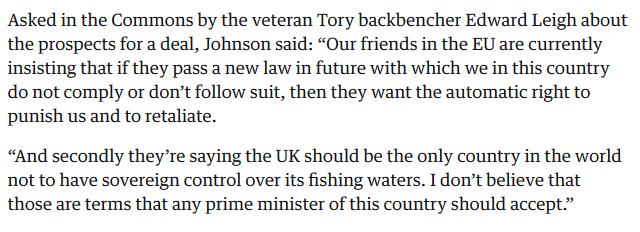
Final one for now. Quite how Labour gets itself in such a fuss about whether to support a deal with the strongest labour and environment commitments ever seen in a trade deal is a sign of just how far it hasn't moved on from leaving.
PS well... (sorry DAG). It certainly didn't have a good effect. And I think if we had settled LPF issues with the EU much earlier there is a good chance the conditions would have been far less stringent. By making an issue, we made it much worse.
Michael Gove: "Outside the EU, with a good trade deal in place, we can tackle the injustices and inequalities that have held Britain back."
— Jennifer Rankin (@JenniferMerode) December 26, 2020
The UK did not need to leave the EU to tackle injustices and inequalities at home. Not a new point, but true.https://t.co/fE4glUAylc
There has never been level playing field content like this in a trade deal. The idea it is any kind of UK win, when the UK's opening position was no enforceable commitments whatsoever, is ridiculous.
For the lawyers. Night. pic.twitter.com/5XvFMhcaeE
— Sam Lowe (@SamuelMarcLowe) December 25, 2020
The EU can take retaliatory action against the UK if we weaken labour standards, weaken pretty firm climate change targets, unfairly subsidise, or just in general seem to be out of line. There are processes to follow, but it looks like the PM did it again...
Final one for now. Quite how Labour gets itself in such a fuss about whether to support a deal with the strongest labour and environment commitments ever seen in a trade deal is a sign of just how far it hasn't moved on from leaving.
PS well... (sorry DAG). It certainly didn't have a good effect. And I think if we had settled LPF issues with the EU much earlier there is a good chance the conditions would have been far less stringent. By making an issue, we made it much worse.
As a lay person is it fair to say that the \u201cthreat\u201d to break international law in Ireland was possibly a strategic blunder that has now determined the future trajectory of the UK for the next 20 years? I can imagine most countries will study what\u2019s baked into this and replicate?
— Meister 1 (@blueelmacho) December 26, 2020
More from Brexit


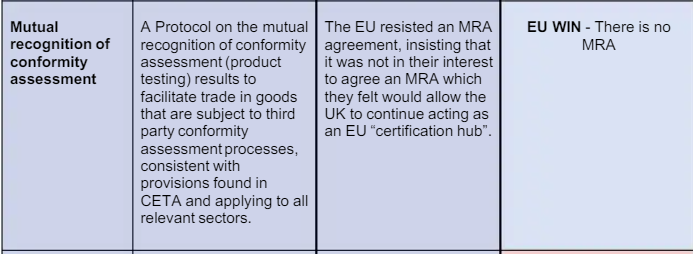


Brexit also brings UK pork sector to standstill. Surprise eh? @RichardAENorth 🙄
UK pork processors are experiencing significant issues in exporting products to the EU, which has already brought part of the industry to a complete standstill, risking knock-on impacts on farm.
The widely seen footage of overzealous Dutch (*my edit: "no they were not"*) inspection officials confiscating ham sandwiches transported by British hauliers is just the tip of the iceberg as far as the UK pig sector is concerned.
The NPA’s processor members have reported that
excessive (*my edit: only for non-EU members*) bureaucracy associated with paperwork requirements are causing delays at Dover, Calais and other ports. With pork being a perishable product, these delays are making UK shipments unattractive to buyers in the EU, forcing processors
to reject shipments and cancel future orders.
Despite the trade deal agreed between the EU & UK just before Christmas, the UK’s formal departure from the EU Customs Union and Single Market was always going to mean additional checks, new labelling and certification requirements
and delays at ports. While the full overall impact of the new rules is yet to be felt, as UK export volumes remain lower than normal for the time of year, the UK pig sector is already feeling the effect. Processors have reported a number of issues, including:
UK pork processors are experiencing significant issues in exporting products to the EU, which has already brought part of the industry to a complete standstill, risking knock-on impacts on farm.
Sector by sector falling overhttps://t.co/6HIXzf8qq8
— Morgan Leahy (@MorganLeahy) January 14, 2021
The widely seen footage of overzealous Dutch (*my edit: "no they were not"*) inspection officials confiscating ham sandwiches transported by British hauliers is just the tip of the iceberg as far as the UK pig sector is concerned.
The NPA’s processor members have reported that
excessive (*my edit: only for non-EU members*) bureaucracy associated with paperwork requirements are causing delays at Dover, Calais and other ports. With pork being a perishable product, these delays are making UK shipments unattractive to buyers in the EU, forcing processors
to reject shipments and cancel future orders.
Despite the trade deal agreed between the EU & UK just before Christmas, the UK’s formal departure from the EU Customs Union and Single Market was always going to mean additional checks, new labelling and certification requirements
and delays at ports. While the full overall impact of the new rules is yet to be felt, as UK export volumes remain lower than normal for the time of year, the UK pig sector is already feeling the effect. Processors have reported a number of issues, including:
You May Also Like

Fake chats claiming to be from the Irish African community are being disseminated by the far right in order to suggest that violence is imminent from #BLM supporters. This is straight out of the QAnon and Proud Boys playbook. Spread the word. Protest safely. #georgenkencho

There is co-ordination across the far right in Ireland now to stir both left and right in the hopes of creating a race war. Think critically! Fascists see the tragic killing of #georgenkencho, the grief of his community and pending investigation as a flashpoint for action.
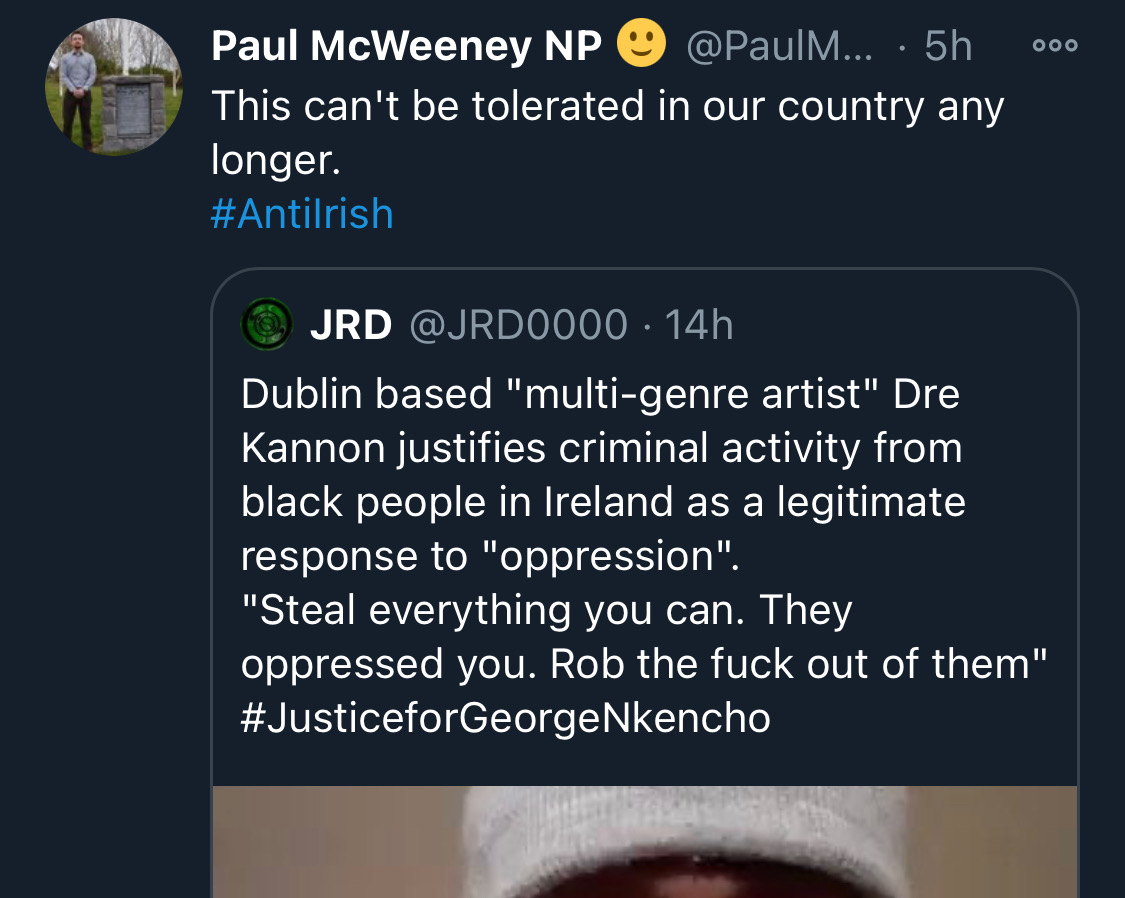
Across Telegram, Twitter and Facebook disinformation is being peddled on the back of these tragic events. From false photographs to the tactics ofwhite supremacy, the far right is clumsily trying to drive hate against minority groups and figureheads.
Declan Ganley’s Burkean group and the incel wing of National Party (Gearóid Murphy, Mick O’Keeffe & Co.) as well as all the usuals are concerted in their efforts to demonstrate their white supremacist cred. The quiet parts are today being said out loud.
The best thing you can do is challenge disinformation and report posts where engagement isn’t appropriate. Many of these are blatantly racist posts designed to drive recruitment to NP and other Nationalist groups. By all means protest but stay safe.
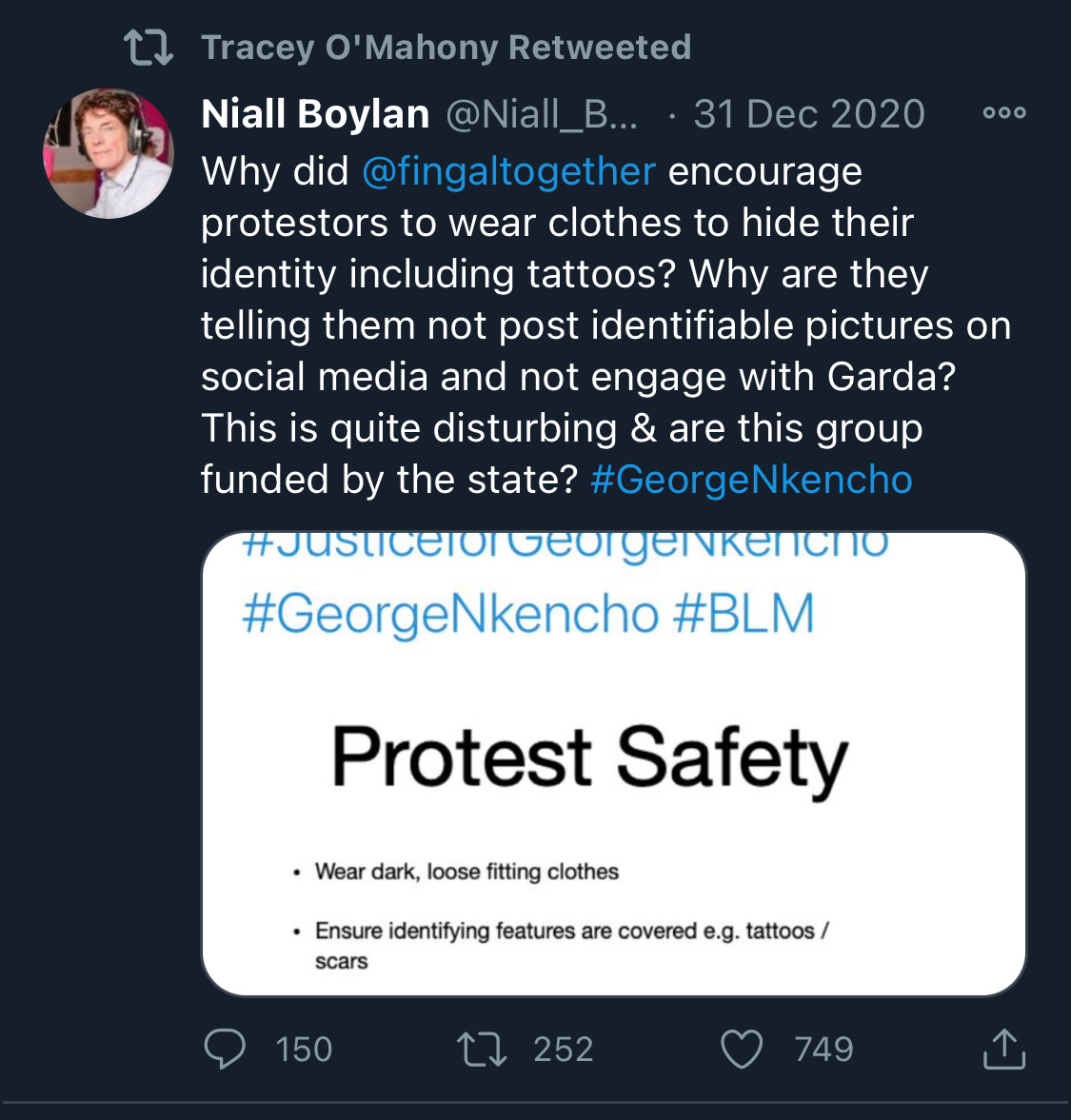
There is co-ordination across the far right in Ireland now to stir both left and right in the hopes of creating a race war. Think critically! Fascists see the tragic killing of #georgenkencho, the grief of his community and pending investigation as a flashpoint for action.
Across Telegram, Twitter and Facebook disinformation is being peddled on the back of these tragic events. From false photographs to the tactics ofwhite supremacy, the far right is clumsily trying to drive hate against minority groups and figureheads.
Be aware, the images the #farright are sharing in the hopes of starting a race war, are not of the SPAR employee that was punched. They\u2019re older photos of a Everton fan. Be aware of the information you\u2019re sharing and that it may be false. Always #factcheck #GeorgeNkencho pic.twitter.com/4c9w4CMk5h
— antifa.drone (@antifa_drone) December 31, 2020
Declan Ganley’s Burkean group and the incel wing of National Party (Gearóid Murphy, Mick O’Keeffe & Co.) as well as all the usuals are concerted in their efforts to demonstrate their white supremacist cred. The quiet parts are today being said out loud.
There is a concerted effort in far-right Telegram groups to try and incite violence on street by targetting people for racist online abuse following the killing of George Nkencho
— Mark Malone (@soundmigration) January 1, 2021
This follows on and is part of a misinformation campaign to polarise communities at this time.
The best thing you can do is challenge disinformation and report posts where engagement isn’t appropriate. Many of these are blatantly racist posts designed to drive recruitment to NP and other Nationalist groups. By all means protest but stay safe.