New: the U.K. is claiming victory over the EU in the Brexit talks. Let's take a closer look... 1/

.@EuroGuido has shared a `scorecard' of the negotiations, claiming Britain `won' 43% of the issues in the talks. EU won 17%, 40% were mutual compromise. Bear in mind, this is the British negotiating team marking its own work.. 2/ https://t.co/R4OitKqy3F
The key q is *how important* are the issues. Just tallying them up doesn't say much. If you won lots of small, low-impact areas, but lost in big areas important to your economy, that's what matters 3/
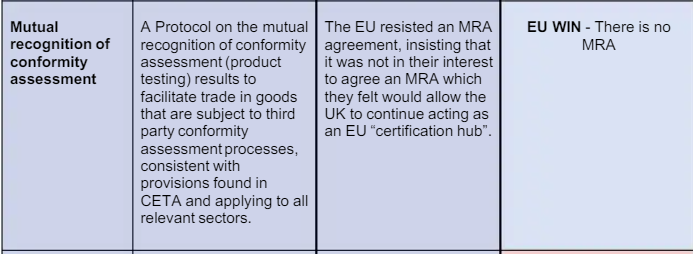
And at first glance, there are some important things missing for the UK. 1) No mutual recognition of conformity assessment. This means companies will have to pay to certify their products in both the UK and EU. Double regulation = double the cost 4/
We discussed the cost of bureaucracy duplication due to Brexit here 5/ https://t.co/VkBrwDZfM5
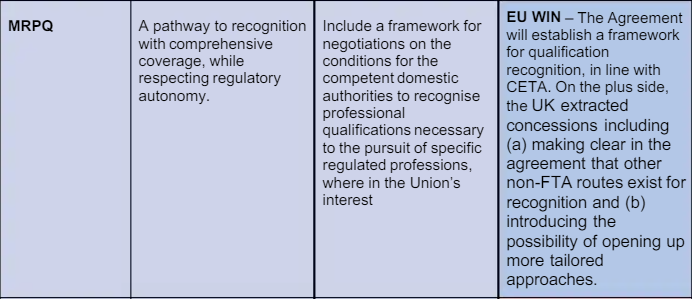
Also - no automatic recognition of professional qualifications. This is big for the services industry - 80% of UK economy - and means if you're an architect, accountant or consultant, it'll be harder for you to sell your services in the EU 6/
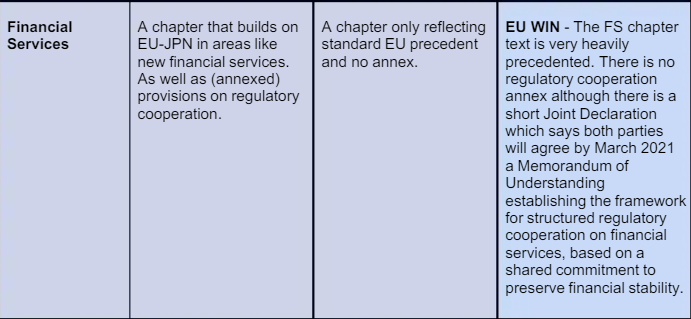
Financial services - ~7% of UK economy - is deemed an EU win. UK wanted something ambitious, covering new areas and with provisions on regulatory cooperation. But the end result is what we normally see in EU FTAs 7/
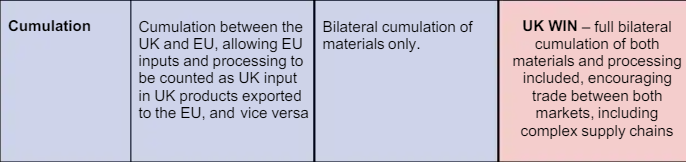
And some of the claimed `wins' don't accurately reflect the opening negotiating positions. The UK claims bilateral cumulation on rules of origin is a win - but its opening ask was actually more ambitious, it wanted diagonal cumulation 8/
To get up to speed on rules of origin and Brexit (it's critical to understanding how trade will work from 2021), we covered the issues here 9/ https://t.co/MS0jJu9EV2
The U.K. seems to have got what it wanted in removing any role for the ECJ, and it won't have to dynamically align with EU laws. So, good on the sovereignty account - but we still need to see the full text. Watch this space.. ends/ https://t.co/VWZRQ3hM6I

More from Brexit

Two excellent questions at the end of a very sensible thread summarising the post-Brexit UK FP debate. My own take at attempting to offer an answer - ahead of the IR is as follow:


1. The two versions have a converging point: a tilt to the Indo-pacific doesn’t preclude a role as a convening power on global issues;
2. On the contrary, it underwrites the credibility for leadership on global issues, by seeking to strike two points:

A. Engaging with a part of the world in which world order and global issues are central to security, prosperity, and - not least - values;
B. Propelling the UK towards a more diversified set of economic, political, and security ties;

3. The tilt towards the Indo-Pacific whilst structurally based on a realist perception of the world, it is also deeply multilateral. Central to it is the notion of a Britain that is a convening power.
4. It is as a result a notion that stands on the ability to renew diplomacy;

5. It puts in relation to this a premium on under-utilised formats such as FPDA, 5Eyes, and indeed the Commonwealth - especially South Pacific islands;
6. It equally puts a premium on exploring new bilateral and multilateral formats. On former, Japan, Australia. On latter, Quad;

You May Also Like