$BTC views
Price needs to let volatility wear off before its next big move. Thinking 30K-40K range for the next 1-2 weeks. Then either 50K straight or after piercing 30K and bouncing back above 30K within 1-2 days.
My $BTC short-term view after long deliberation and some flip flopping is rangebound in 30K-40K until the curve and vols come off a further. Then, 50K. I wouldn't be surprised if 30K is briefly breached but the risk is to the upside. Those calling for 20K missing the big picture.
— Alex (@classicmacro) January 12, 2021
Simple.
I'm trading the range against a core position. Buying when price pushes lower, selling when higher. It's like playing the achordeon. There's always air left inside.
Nowhere.
I don't use limits for that. $BTC is liquid enough to trade at market without issues.
I'm watching PA, volume and rates for buying and euphoria as reflected in rates for reducing.
The Fed is the key. The next FOMC is Jan/29.
I'm fully expecting the large stream of positive headlines to resurface (e.g. Paypal treasury).
Real money wants in, and it will get in.
Corporates want in as well, inspired by Microstrategy. And retail is pouring in.
More from Bitcoin

1/THREAD: WHEN WAS IT CLEAR?
Oct. 8, 2020: The purpose of this thread is to document and timestamp when it first became clear that #Bitcoin was likely to become a major reserve asset for public corporations, and eventually states, with Square's purchase of $50M in BTC.
The purpose is to give something to cite when ppl later claim "But there was NO WAY OF KNOWING..."
h/t @ErikSTownsend who used the same format to call out the impact of Covid on Feb 8 and made me personally aware of the looming shutdown of the country https://t.co/opuiNgSeqC !
Bitcoiners smarter than me have been predicting the takeover of the dollar by Bitcoin for many years.
In 2014 with Bitcoin barely at $1B, @pierre_rochard wrote https://t.co/EGHa58KqHq, covering all the incorrect narratives of Bitcoin and stating it will overtake the dollar.
"[skeptics] misunderstand how strong currencies like bitcoin overtake weak currencies like the dollar: it is through speculative attacks and currency crises caused by investors, not through the careful evaluation of tech journalists and 'mainstream consumers'" - @pierre_rochard
I first became bullish on Bitcoin in the summer of 2016, around a $3B market cap, but it was still a toy project at that time in the eyes of most in the financial world, while many technologists thought of it as a v1 technology to be improved on.
Oct. 8, 2020: The purpose of this thread is to document and timestamp when it first became clear that #Bitcoin was likely to become a major reserve asset for public corporations, and eventually states, with Square's purchase of $50M in BTC.
The purpose is to give something to cite when ppl later claim "But there was NO WAY OF KNOWING..."
h/t @ErikSTownsend who used the same format to call out the impact of Covid on Feb 8 and made me personally aware of the looming shutdown of the country https://t.co/opuiNgSeqC !
1/THREAD: WHEN WAS IT CLEAR?
— Erik Townsend \U0001f6e2\ufe0f (@ErikSTownsend) February 8, 2020
Feb. 8, 2020: The purpose of this thread is to document and timestamp when it first became clear that nCov was likely to lead to a global pandemic.
The purpose is to give something to cite when ppl later claim "But there was NO WAY OF KNOWING..."
Bitcoiners smarter than me have been predicting the takeover of the dollar by Bitcoin for many years.
In 2014 with Bitcoin barely at $1B, @pierre_rochard wrote https://t.co/EGHa58KqHq, covering all the incorrect narratives of Bitcoin and stating it will overtake the dollar.
"[skeptics] misunderstand how strong currencies like bitcoin overtake weak currencies like the dollar: it is through speculative attacks and currency crises caused by investors, not through the careful evaluation of tech journalists and 'mainstream consumers'" - @pierre_rochard
I first became bullish on Bitcoin in the summer of 2016, around a $3B market cap, but it was still a toy project at that time in the eyes of most in the financial world, while many technologists thought of it as a v1 technology to be improved on.

1/ #Bitcoin FUD-busting time!
claim: bitcoin ownership is heavily concentrated.
@business published an article claiming "2% of accounts control 95% of all Bitcoin" 🤣
truth: the facts, my friends, simple don't line up. let's dive in!
2/ interrogating on-chain addresses is tricky.
address =/ account.
one person can control multiple addresses.
one address can hold bitcoin belonging to multiple ppl.
exchanges and trading firms will have addresses with large balances that represent client funds.
3/ the fine folks @glassnode published an excellent analysis of on-chain address balances in January
the ownership distribution of bitcoin among wallets is actually much more diverse than one might expect.
full piece here:
https://t.co/n5IdIQdNoA
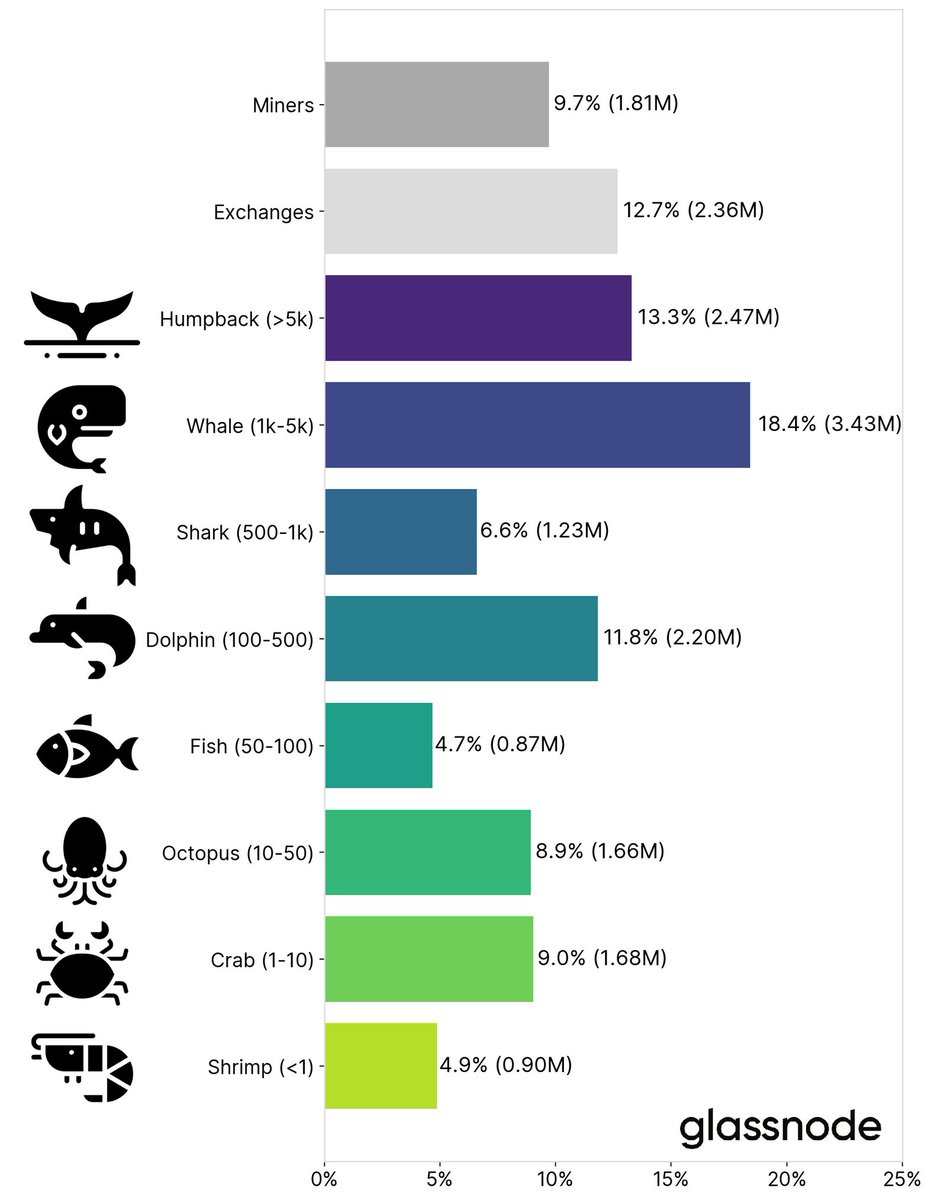
4/ 31% of BTC is held in addresses not identified as exchange wallets.
these are likely institutions, funds, custodians, and OTC desks.
our analysis at @CoinSharesCo indicates >15% of all bitcoin is held in third party custody, including @coinbase and our own @KomainuCustody
5/ in fact, between asset managers @Grayscale ($36B in BTC) and our @xbtprovider ($4B in BTC), 4% of bitcoin is locked up by fund providers and asset managers!
our @CoinSharesCo research team publishes an EXCELLENT weekly report on fund flows and AUMs -
claim: bitcoin ownership is heavily concentrated.
@business published an article claiming "2% of accounts control 95% of all Bitcoin" 🤣
truth: the facts, my friends, simple don't line up. let's dive in!
2/ interrogating on-chain addresses is tricky.
address =/ account.
one person can control multiple addresses.
one address can hold bitcoin belonging to multiple ppl.
exchanges and trading firms will have addresses with large balances that represent client funds.
3/ the fine folks @glassnode published an excellent analysis of on-chain address balances in January
the ownership distribution of bitcoin among wallets is actually much more diverse than one might expect.
full piece here:
https://t.co/n5IdIQdNoA
4/ 31% of BTC is held in addresses not identified as exchange wallets.
these are likely institutions, funds, custodians, and OTC desks.
our analysis at @CoinSharesCo indicates >15% of all bitcoin is held in third party custody, including @coinbase and our own @KomainuCustody
5/ in fact, between asset managers @Grayscale ($36B in BTC) and our @xbtprovider ($4B in BTC), 4% of bitcoin is locked up by fund providers and asset managers!
our @CoinSharesCo research team publishes an EXCELLENT weekly report on fund flows and AUMs -




You May Also Like





The entire discussion around Facebook’s disclosures of what happened in 2016 is very frustrating. No exec stopped any investigations, but there were a lot of heated discussions about what to publish and when.
In the spring and summer of 2016, as reported by the Times, activity we traced to GRU was reported to the FBI. This was the standard model of interaction companies used for nation-state attacks against likely US targeted.
In the Spring of 2017, after a deep dive into the Fake News phenomena, the security team wanted to publish an update that covered what we had learned. At this point, we didn’t have any advertising content or the big IRA cluster, but we did know about the GRU model.
This report when through dozens of edits as different equities were represented. I did not have any meetings with Sheryl on the paper, but I can’t speak to whether she was in the loop with my higher-ups.
In the end, the difficult question of attribution was settled by us pointing to the DNI report instead of saying Russia or GRU directly. In my pre-briefs with members of Congress, I made it clear that we believed this action was GRU.
The story doesn\u2019t say you were told not to... it says you did so without approval and they tried to obfuscate what you found. Is that true?
— Sarah Frier (@sarahfrier) November 15, 2018
In the spring and summer of 2016, as reported by the Times, activity we traced to GRU was reported to the FBI. This was the standard model of interaction companies used for nation-state attacks against likely US targeted.
In the Spring of 2017, after a deep dive into the Fake News phenomena, the security team wanted to publish an update that covered what we had learned. At this point, we didn’t have any advertising content or the big IRA cluster, but we did know about the GRU model.
This report when through dozens of edits as different equities were represented. I did not have any meetings with Sheryl on the paper, but I can’t speak to whether she was in the loop with my higher-ups.
In the end, the difficult question of attribution was settled by us pointing to the DNI report instead of saying Russia or GRU directly. In my pre-briefs with members of Congress, I made it clear that we believed this action was GRU.