1/ #Bitcoin FUD-busting time!

claim: bitcoin ownership is heavily concentrated.

@business published an article claiming "2% of accounts control 95% of all Bitcoin" 🤣

truth: the facts, my friends, simple don't line up. let's dive in!

2/ interrogating on-chain addresses is tricky.

address =/ account.

one person can control multiple addresses.

one address can hold bitcoin belonging to multiple ppl.

exchanges and trading firms will have addresses with large balances that represent client funds.
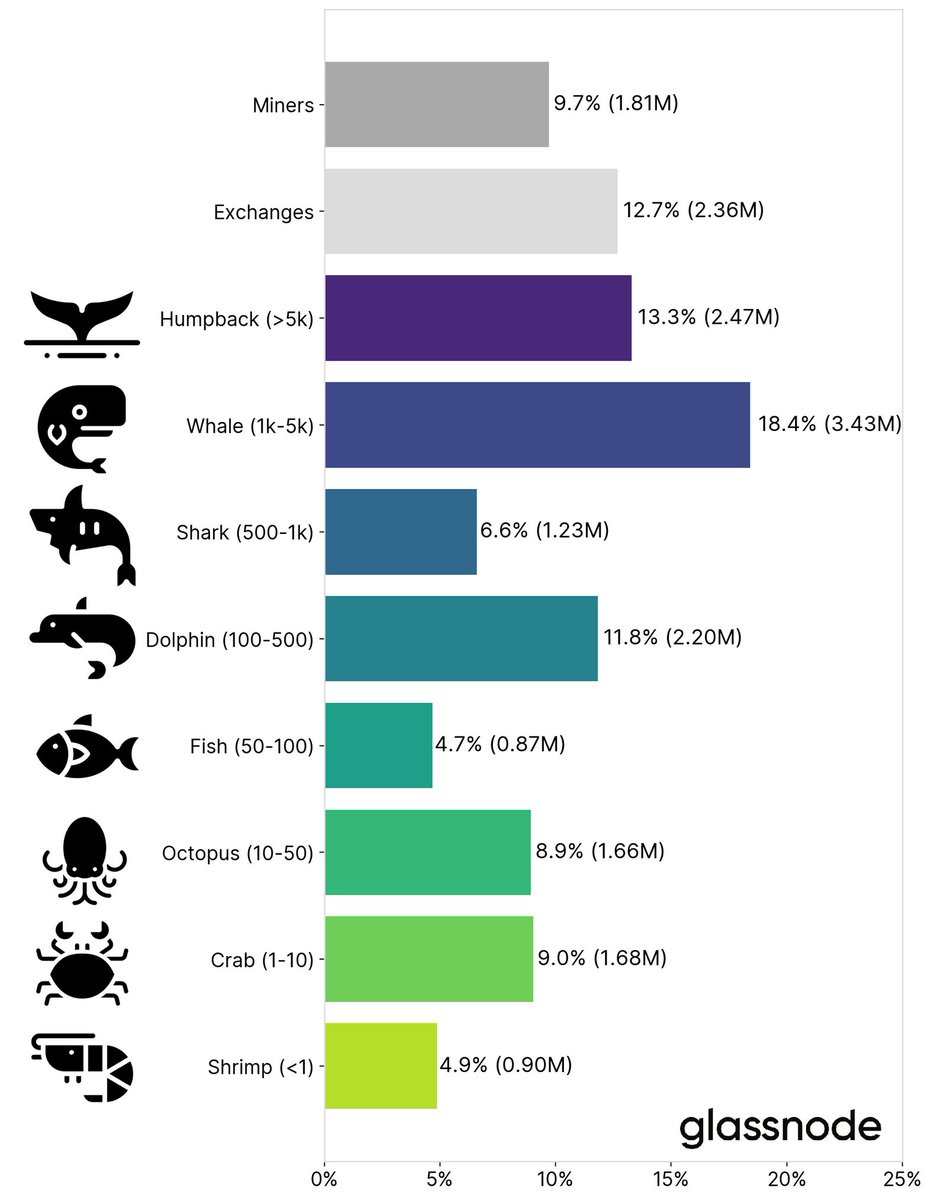
3/ the fine folks @glassnode published an excellent analysis of on-chain address balances in January

the ownership distribution of bitcoin among wallets is actually much more diverse than one might expect.

full piece here:
https://t.co/n5IdIQdNoA
4/ 31% of BTC is held in addresses not identified as exchange wallets.

these are likely institutions, funds, custodians, and OTC desks.

our analysis at @CoinSharesCo indicates >15% of all bitcoin is held in third party custody, including @coinbase and our own @KomainuCustody
5/ in fact, between asset managers @Grayscale ($36B in BTC) and our @xbtprovider ($4B in BTC), 4% of bitcoin is locked up by fund providers and asset managers!

our @CoinSharesCo research team publishes an EXCELLENT weekly report on fund flows and AUMs - https://t.co/6Kky96m3ob
6/ distribution of bitcoin over time has also changed a lot

as new market microstructure emerges, the way market participants manage and store their coins also changes.

with more institutions and more AUM in structured products and funds, inevitably we see more clustering
7/ if we look at number of participants, the trend looks as we might expect. there is a very fat tail, with the majority of wallets (22M) holding less than one bitcoin.
8/ ultimately, bitcoin ownership is not as heavily concentrated as reported. this is because the large wallets holding much of the bitcoin supply represent thousands if not millions in user funds.

these types of misconceptions lead to all sorts of wild, wrong claims.
9/ bitcoin DOES represents equality of opportunity.

you don't need a bank.

you don't need a brokerage account.

you don't need to be an accredited investor or well connected.

anyone with a smartphone and an internet connection can buy $5 of bitcoin easily and quickly.
10/ let me know what other misconceptions you want to talk about! it's important that we arm ourselves with the *facts* and support our claims with empirical evidence and data.

luckily the #bitcoin ecosystem is comprised of incredibly intelligent people who do this research!

More from Bitcoin

The is no Devcoin Gold yet. But then again, we've never been one to "peg" to anything. I came across an interesting article about 'recreating' addresses with Bgold that @bitcoincoreorg cut out since 0.13.0 - perhaps one day we can do a similar thing in future Devcoin software :)


https://t.co/cv4UqsaVAK

That being said I hold some Doge @blockio in an "A-" address myself after 0. 1. "9-" versions :). Don't believe Bitcoin Core the Coin (Utility) is the only visible value on Core chain. Color me crazy. I believe in script. And FOSS that is used to export📜


And that's just a guy @MeniRosenfeld who put his identity and ideas out in the public to build a Web of Trust back when the web was much less of a safe place. His identity at stake and the implementation of a branch in source code by another unsung hero @killerstorm reveals value

Some of those who set up our bright future quietly implemented it in a branch on the main source code before it was officially the Bitcoin Core main repository, before a "Bitcoin Core" entity existed

Just because Bitcoin Core nodes dominate and do not read "smart" colored satoshis or display them, doesn't mean they do not exist on chain. The example of recreating P2WSH-over-P2SH address from BTC https://t.co/ZWSP2MO5bY wallets in Bitcoin Core Gold I shared proves -rescan's $
I will be a buyer under 13800 levels, but depending upon the reversal on smaller timeframe.

You May Also Like

A brief analysis and comparison of the CSS for Twitter's PWA vs Twitter's legacy desktop website. The difference is dramatic and I'll touch on some reasons why.

Legacy site *downloads* ~630 KB CSS per theme and writing direction.

6,769 rules
9,252 selectors
16.7k declarations
3,370 unique declarations
44 media queries
36 unique colors
50 unique background colors
46 unique font sizes
39 unique z-indices

https://t.co/qyl4Bt1i5x


PWA *incrementally generates* ~30 KB CSS that handles all themes and writing directions.

735 rules
740 selectors
757 declarations
730 unique declarations
0 media queries
11 unique colors
32 unique background colors
15 unique font sizes
7 unique z-indices

https://t.co/w7oNG5KUkJ


The legacy site's CSS is what happens when hundreds of people directly write CSS over many years. Specificity wars, redundancy, a house of cards that can't be fixed. The result is extremely inefficient and error-prone styling that punishes users and developers.

The PWA's CSS is generated on-demand by a JS framework that manages styles and outputs "atomic CSS". The framework can enforce strict constraints and perform optimisations, which is why the CSS is so much smaller and safer. Style conflicts and unbounded CSS growth are avoided.