CodyyyGardner Categories Society
7 days
30 days
All time
Recent
Popular






#Thread: Though it's important to shed light on the ongoing humanitarian crisis in #Yemen, you could read this entire @reuters article (and most articles written about Yemen) and not know why this boy is starving or who is responsible for these conditions:
The boy travelled from Al-Jawf to Sana'a because al-Jawf is among "high intensity battlefronts" & is the target of repeated civilian airstrikes. https://t.co/1KlIN5ixTf
Also, roads are "damaged" because they're frequently bombed by US/Saudi airstrikes:
Shockingly, he's one of the lucky ones who managed to make it to a hospital.
Only 51% of health facilities are (barely) functioning: https://t.co/GBgKXM562t
And hospitals have been frequently targeted by airstrikes: For example:
International aid & donations are necessary for Faid & millions to survive because of the Saudi/US/UAE blockade that prevents Yemenis from trade and makes them reliant on aid instead. Before the war, Yemen imported 90% of its food; now, 80% rely on aid.
Famine hasn't been declared because the UN faces immense pressure from its top donors, the US & Saudi, who are also causing the famine in Yemen.
The US went as far as pressuring the UN to restrict aid to Northern Yemen, where 70% of Yemenis live:
The boy travelled from Al-Jawf to Sana'a because al-Jawf is among "high intensity battlefronts" & is the target of repeated civilian airstrikes. https://t.co/1KlIN5ixTf
Also, roads are "damaged" because they're frequently bombed by US/Saudi airstrikes:
Shockingly, he's one of the lucky ones who managed to make it to a hospital.
Only 51% of health facilities are (barely) functioning: https://t.co/GBgKXM562t
And hospitals have been frequently targeted by airstrikes: For example:
International aid & donations are necessary for Faid & millions to survive because of the Saudi/US/UAE blockade that prevents Yemenis from trade and makes them reliant on aid instead. Before the war, Yemen imported 90% of its food; now, 80% rely on aid.
Famine hasn't been declared because the UN faces immense pressure from its top donors, the US & Saudi, who are also causing the famine in Yemen.
The US went as far as pressuring the UN to restrict aid to Northern Yemen, where 70% of Yemenis live:


1/ Some people are looking at this map and saying: "it must have come from Europe". Here are a few reasons why that is unlikely.
2/ Though B.1.1.7 was especially prominent in Kent, the 2nd sequence ever sequenced was found in London, a day after the 1st. Due to superspreading it isn't possible to pinpoint for sure whether it originated in Kent or London. (If London, there's no argument for the continent).
3/ And suppose we did believe the new variant was introduced from abroad. Would we expect it to be introduced by sea or air? Far more arrivals to the UK in August/September occurred by air compared to sea.
4/ Genetic evidence. Suppose this highly transmissible variant had arisen in some other country, and made its way through France to the UK. It would also have left lots of descendants in Europe. We can look at a genetic tree of sequences and see that that is not the case.
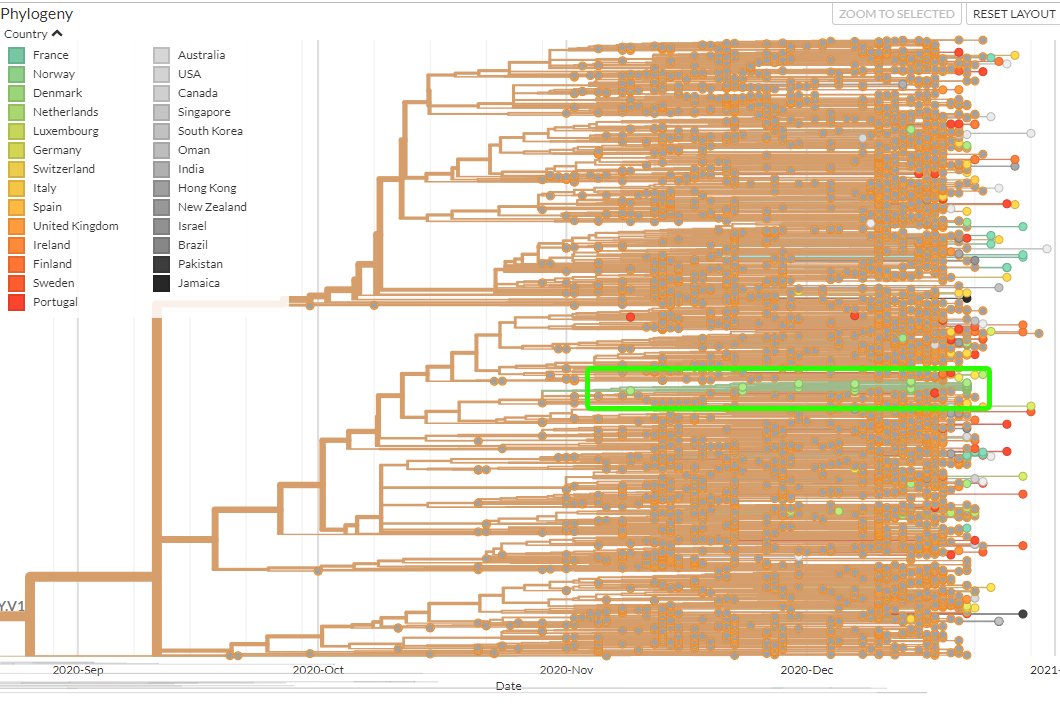
5/ The grey/orange sequences here are UK sequences and the others are from an array of other countries. Specifically I've highlighted a lineage in Denmark which represents spread from a single introduction to Denmark, ultimately from the UK.
The spread of B.1.1.7 through England over November and December, with London inset at top-right. pic.twitter.com/fVfL0xijcx
— Theo Sanderson (@theosanderson) January 8, 2021
2/ Though B.1.1.7 was especially prominent in Kent, the 2nd sequence ever sequenced was found in London, a day after the 1st. Due to superspreading it isn't possible to pinpoint for sure whether it originated in Kent or London. (If London, there's no argument for the continent).
3/ And suppose we did believe the new variant was introduced from abroad. Would we expect it to be introduced by sea or air? Far more arrivals to the UK in August/September occurred by air compared to sea.
4/ Genetic evidence. Suppose this highly transmissible variant had arisen in some other country, and made its way through France to the UK. It would also have left lots of descendants in Europe. We can look at a genetic tree of sequences and see that that is not the case.
5/ The grey/orange sequences here are UK sequences and the others are from an array of other countries. Specifically I've highlighted a lineage in Denmark which represents spread from a single introduction to Denmark, ultimately from the UK.









Modellers believe that spreading out our limited supply of vaccine as single doses for 3 months will save up to 6000 lives. One concern though is whether single doses might lead to 'vaccine resistance' through virus mutation. (1)
If we assume that over the next 12 weeks 12-20 million people get one dose of a vaccine and are told or believe it gives 90% protection what % will actually go for a second jab? We might assume second dose coverage is at best 70%. (2)
That means between 4 and 6.7 million people might have fading protection. Will the risk of creating a vaccine resistant mutant in this group of people, which could spread rapidly to 7 billion people around the world, outweigh the benefits of 6000 deaths prevented. (3)
I was initially reassured by a paper sent to me by an eminent virologist. https://t.co/UyTQZ0CFsW (4)
Essentially vaccine resistance is rare compared with drug resistance, first because multiple mutations are needed unlike for drugs, and second because vaccines tend to keep pathogens from ever achieving large population sizes within hosts. (5)
If we assume that over the next 12 weeks 12-20 million people get one dose of a vaccine and are told or believe it gives 90% protection what % will actually go for a second jab? We might assume second dose coverage is at best 70%. (2)
That means between 4 and 6.7 million people might have fading protection. Will the risk of creating a vaccine resistant mutant in this group of people, which could spread rapidly to 7 billion people around the world, outweigh the benefits of 6000 deaths prevented. (3)
I was initially reassured by a paper sent to me by an eminent virologist. https://t.co/UyTQZ0CFsW (4)
Essentially vaccine resistance is rare compared with drug resistance, first because multiple mutations are needed unlike for drugs, and second because vaccines tend to keep pathogens from ever achieving large population sizes within hosts. (5)


I want to add an addendum to this thread from the other day to show why publishing an n=1 is so bad. It's because I can likely identify and put a name to this student.
(I'm not going to do that here but I am going to show you how easy it is.)
To do that, let's talk about the IPEDS data set. IPEDS is a US database that contains a range of information about US universities, such as enrollment, test scores, graduation rates, etc.
One notable data table shows graduated students by major and ethnicity.
(FYI, here is the IPEDS data: https://t.co/K4OwsyLLsE It's an open database so you can explore at your leisure.)
Back to the "Completions" table which shows ethnicity by major. This happens to line up with the n=1 from the offending article which identified a student by their ethnicity and major.
Sorry, the n=1 was year in school and ethnicity but I've now used the IPEDS data to find out their major. Linking datasets on minority populations is very very powerful.
(I'm not going to do that here but I am going to show you how easy it is.)
I'm angry at everything right now, including the new the latest problematic article from C&RL.
— Dr. Kristin Briney (@KristinBriney) January 6, 2021
So I think it's time we talked about C&RL's history of publishing identifying information in articles.
(Yes, @LibSkrat I'm finally telling this story)https://t.co/JPCks3tohr
To do that, let's talk about the IPEDS data set. IPEDS is a US database that contains a range of information about US universities, such as enrollment, test scores, graduation rates, etc.
One notable data table shows graduated students by major and ethnicity.
(FYI, here is the IPEDS data: https://t.co/K4OwsyLLsE It's an open database so you can explore at your leisure.)
Back to the "Completions" table which shows ethnicity by major. This happens to line up with the n=1 from the offending article which identified a student by their ethnicity and major.
Sorry, the n=1 was year in school and ethnicity but I've now used the IPEDS data to find out their major. Linking datasets on minority populations is very very powerful.