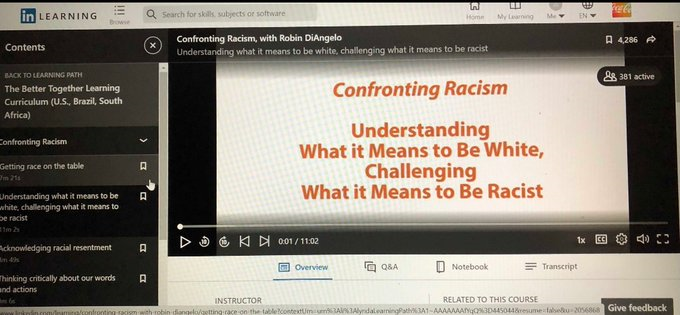
I want to add an addendum to this thread from the other day to show why publishing an n=1 is so bad. It's because I can likely identify and put a name to this student.

(I'm not going to do that here but I am going to show you how easy it is.)

To do that, let's talk about the IPEDS data set. IPEDS is a US database that contains a range of information about US universities, such as enrollment, test scores, graduation rates, etc.

One notable data table shows graduated students by major and ethnicity.
(FYI, here is the IPEDS data: https://t.co/K4OwsyLLsE It's an open database so you can explore at your leisure.)
Back to the "Completions" table which shows ethnicity by major. This happens to line up with the n=1 from the offending article which identified a student by their ethnicity and major.
Sorry, the n=1 was year in school and ethnicity but I've now used the IPEDS data to find out their major. Linking datasets on minority populations is very very powerful.
At this point, I can do a little digging either by department "happy graduation" announcements or even the graduation program to winnow the list down to all of the majors for that degree for the year. Now it's a matter of figuring out which minority student is the n=1.
This may not be foolproof to get me the exact name of the student, but using only publicly available data I've gotten *really* close to identifying them.
Again, I'm not actually doing this to identify that n=1 student but rather I want to show you how easily it can be done. Give me 30 minutes and I will have a list of potential names, and if one name is not "white" I might actually have THE name.
This is the danger of publishing n=1. I CAN IDENTIFY THAT STUDENT FROM PUBLICLY AVAILABLE DATA. It's not that hard.
All that tells me is that they were in the study, not actually what they did at the library.

BUT it also tells me that you don't care enough to protect the identities of your minority students.
And it tells me that the journal and peer reviewers don't know enough about de-identification and re-identification to prevent a paper with n=1 to be published.
So if you were curious in my thread from the other day about why n=1 is so bad, this is why. I have enough information to identify a student in the study by name.
I would really really like this to be the last time I have to write a thread like this or do an exercise to potentially identify a student who in NO WAY deserves to be identified just because they use the library.
So let's never published n=1 ever again. Basically, if your n's are under 10, you should see a red flag and either group small n's together or obscure the data in some way (e.g. "n<20").
I'll end with the fact that none of this is okay. In any field but especially in a field that is supposed to protect patron's privacy. We need to do better. All of us. Researchers, writers, reviewers, editors, etc. to make sure this doesn't happen again.
And finally, thanks to @hedgielib and @IandPangurBan who suggested I add this information on exactly how easy it is to identify someone by name in a published example of n=1.

More from Society

Patriotism is an interesting concept in that it’s excepted to mean something positive to all of us and certainly seen as a morally marketable trait that can fit into any definition you want for it.+


Tolstoy, found it both stupid and immoral. It is stupid because every patriot holds his own country to be the best, which obviously negates all other countries.+

It is immoral because it enjoins us to promote our country’s interests at the expense of all other countries, employing any means, including war. It is thus at odds with the most basic rule of morality, which tells us not to do to others what we would not want them to do to us+

My sincere belief is that patriotism of a personal nature, which does not impede on personal and physical liberties of any other, is not only welcome but perhaps somewhat needed.

But isn’t adherence to a more humane code of life much better than nationalistic patriotism?+

Göring said, “people can always be brought to the bidding of the leaders. That is easy. All you have to do is tell them they are being attacked, and denounce the peacemakers for lack of patriotism and exposing the country to danger. It works the same in any country.”+
Like most movements, I have learned that the definition of feminism has expanded to include simply treating women like human beings.

(A thread for whoever feels like reading)


I have observed feminists on Twitter advocating for rape victims to be heard, rapists to be held accountable, for people to address the misogyny that is deeply rooted in our culture, and for women to be treated with respect.

To me, very easy things to get behind.

And the amount of pushback they receive for those very basic requests is appalling. I see men trip over themselves to defend rape and rapists and misogyny every chance they get. Some accounts are completely dedicated to harassing women on this site. It’s unhealthy.

Furthermore, I have observed how dedicated these misogynists are by how they treat other men that do not immediately side with them. There is an entire lexicon they have created for men who do not openly treat women with disrespect.

Ex: simp, cuck, white knight, beta

All examples of terms they use to demean a man who respects women.

To paraphrase what a wise man on this app said:

Some men hate women so much, they hate men who don’t hate women

You May Also Like

A brief analysis and comparison of the CSS for Twitter's PWA vs Twitter's legacy desktop website. The difference is dramatic and I'll touch on some reasons why.

Legacy site *downloads* ~630 KB CSS per theme and writing direction.

6,769 rules
9,252 selectors
16.7k declarations
3,370 unique declarations
44 media queries
36 unique colors
50 unique background colors
46 unique font sizes
39 unique z-indices

https://t.co/qyl4Bt1i5x


PWA *incrementally generates* ~30 KB CSS that handles all themes and writing directions.

735 rules
740 selectors
757 declarations
730 unique declarations
0 media queries
11 unique colors
32 unique background colors
15 unique font sizes
7 unique z-indices

https://t.co/w7oNG5KUkJ


The legacy site's CSS is what happens when hundreds of people directly write CSS over many years. Specificity wars, redundancy, a house of cards that can't be fixed. The result is extremely inefficient and error-prone styling that punishes users and developers.

The PWA's CSS is generated on-demand by a JS framework that manages styles and outputs "atomic CSS". The framework can enforce strict constraints and perform optimisations, which is why the CSS is so much smaller and safer. Style conflicts and unbounded CSS growth are avoided.