1/Alright, let's talk about Southeast Asia! One of the most interesting stories in the world that tons of people are

2/When most people think about economic development, they think of China. But Southeast Asia is coming up!

Already Singapore is super-rich, Malaysia is on the cusp of being a developed country, and Thailand isn't too far behind!
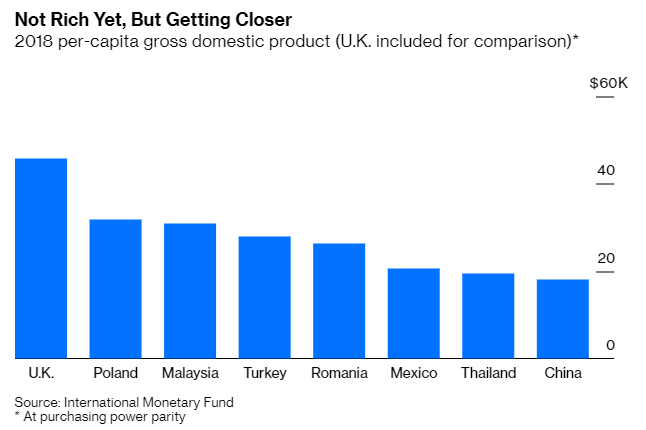
3/But the really encouraging sign is how nearly every poor country in the region is now growing steadily and exponentially.

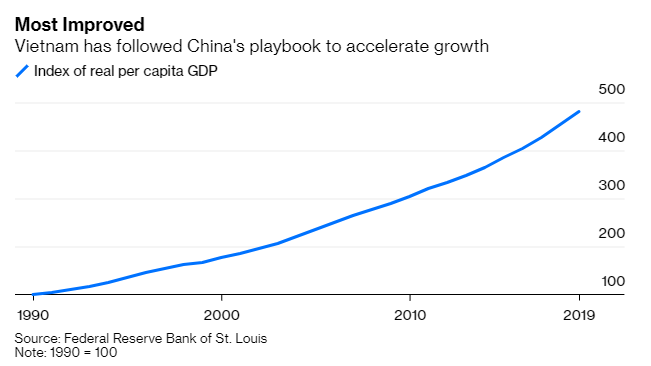
The star performer, of course, is Vietnam, where incomes have almost quintupled since 1990.
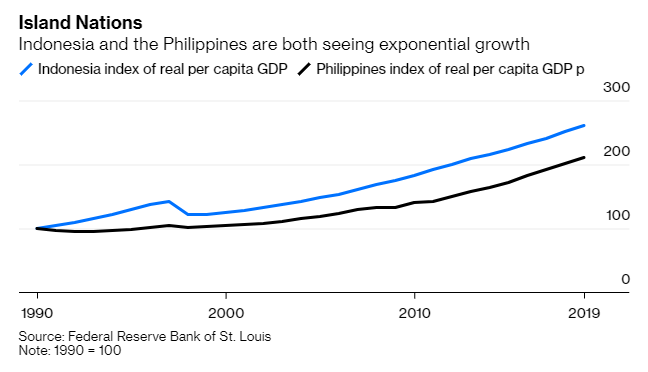
4/And watch out, here come Indonesia and the Philippines!
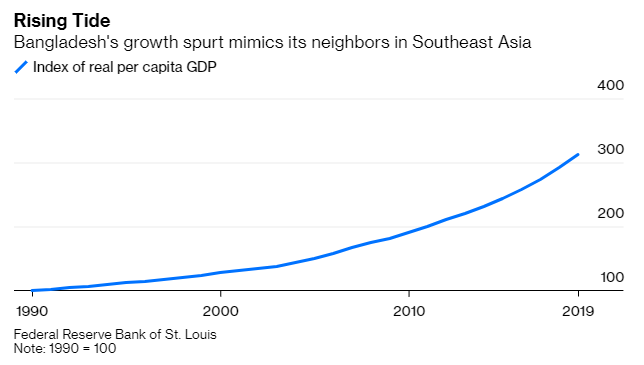
5/And you know what? It's not technically in Southeast Asia, but it's really close, and its economic situation looks very similar, so let's include Bangladesh!
6/Myanmar, Laos, and Cambodia are all growing rapidly as well.

Pretty much ALL of Southeast Asia is growing rapidly.

What's going on? What is the region getting right??
7/The simple answer is: Export-oriented manufacturing.

All of these countries have a lot of manufacturing exports, usually of labor-intensive goods like clothing. Even Indonesia, whose industrialization took a big hit after the 1997 crisis.
8/As China becomes more expensive, companies are looking for cheaper places to make things, and retailers are looking for cheaper places to buy things.

Southeast Asia (+Bangladesh) is fulfilling much of that demand.
9/But what policies did the Southeast Asian countries do in order to hop on the manufacturing export train?

They did a lot of different things...but maybe in the end the most important factor was that they were in the right place at the right time.
10/Southeast Asian countries are close to China, where the supply chains are trying to relocate out of.

They have cheap wages.

And they have huge nearby sources of investment -- Japan, Taiwan, South Korea, and Singapore, with whom Southeast Asian countries have close ties.
11/So what does this imply for other regions -- particularly Africa -- that need to develop and industrialize?

"Be in the right place at the right time" is pretty useless advice...
12/What Africa really needs is a "seed" of development. One or two countries that get rich before the others, like Japan and Singapore did in Asia.

Those early leaders can then be sources of inspiration, ideas, expertise, capital, and market demand for all the others.
13/Perhaps Ghana could be one seed of African development?

https://t.co/f5ydiLgpDv
14/Anyway, the amazing growth of Southeast Asia is a testament to the success of decolonization and of globalization.

It's one more big step toward making the entire human race materially comfortable and secure.

(end)

https://t.co/cqXNjLxxHJ

More from Noah Smith 🐇

Time for panel #3: Big Tech and regulation!

I will be live-tweeting again, and you can also watch video at either the Twitter or Facebook links below!


Kaissar: Every industry gets regulated when it gets big. The question is what kind of regulation Big Tech will get,and whether the companies will be proactive in shaping it.

Kaissar: More profitable companies have higher returns. Why? Maybe it's a risk factor, because more profit = higher risk of getting regulated.

Bershidskyis showing a diagram of GDPR complaince pop-ups. What a massive ill-conceived bureaucratic mess.

Ritholtz: It's 2018 and we're still talking about Facebook privacy settings?! If you're still giving your personal data to Facebook, you just don't care about privacy!
To be honest, I think this is just the effect of Twitter.

If you're on Twitter all the time - as every political commentator now is - it's easy to think that whiny, big-talking Twitter slacktivists are "the Dems".

But what's happening out there on the ground?


This is another reason I think Twitter is so bad for society.

It convinces intellectuals and commentators that practically everyone who's on their side is an extremist.

Which makes them tolerate extremism out of a (false) feeling of necessity.

If you stay on Twitter too much (which we all do now), you start to think that the typical left-of-center person is some British wanker who quote-tweets "Imagine thinking this" to anyone who doesn't like the idea of "ending capitalism".

But he is not typical.

A majority of Americans are not on Twitter.

But *every* journalist, commentator, and intellectual *has* to be on Twitter.

So every journalist, commentator, and intellectual comes face to face with big-talking slacktivist faux-extremists day in and day out.

It's a problem!!

Online bubbles full of shouty faux-extremists are, in general, fine.

The difference is that every journalist, commentator, and intellectual is essentially forced to exist in THIS bubble, because their jobs require it.

Twitter is a dystopian technology.

(end)

More from World

In 2016,Turkey arrested Abdulkadir Yapcan, a prominent Uighur political activist living in the country since 2001 and initiated his extradition. In 2017, Turkey and China signed an agreement allowing extradition even if the purported offense is only illegal in 1of the 2️⃣countries


Since early 2019, Turkey has arrested hundreds of Uighurs and sent them to deportation centers. And Erdogan’s remarks have turned diplomatically bland, just like any Uighur-related coverage in newspapers controlled by Erdogan and his supporters.

You May Also Like