Chinese president Xi Jinping is the lead speaker at this week's Davos Agenda, the World Economic Forum's online summit.
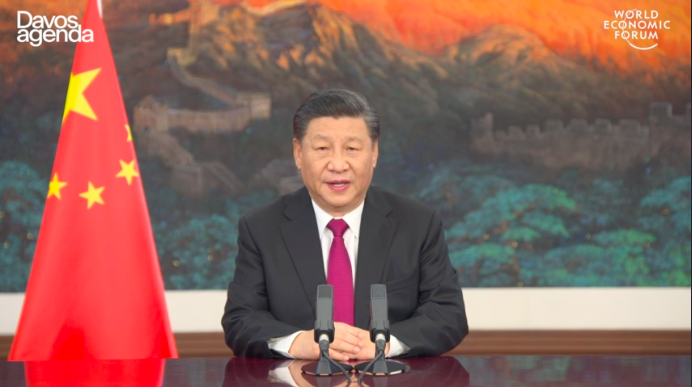
Xi lays out four priorities for world:

1) Step up "macroeconomic policy coordination" and promote "strong, sustainable, balanced and inclusive growth of the world economy";
2) Abandon ideological prejudice and "jointly follow a path of peaceful coexistence." Says no country is superior to another. "There would be no human civilization without diversity," he adds, taking aim at "arrogance, prejudice and hatred";
3) Close the divide between developed and developing countries. "With the growth of developing countries, global prosperity and security will be put on a more (solid) footing"; and,
4) "Come together against global challenges and jointly create a better future for humanity." "No global problem can be solved by any one country alone. There must be global action, global response, and global cooperation."
Xi calls on the world to take down trade barriers and bolster G-20 as predominant body for "global economic governance."
This is rich. Xi says countries should rely on international law rather than seeking "supremacy."
Xi says a UN-led international order must be maintained, which I think speaks to China's understanding of its domination of multilateral bodies like the WHO.
"The misguided approach of antagonism and confrontation...would eventually hurt all countries' interests," Xi says as he rejects cold wars, hot wars, and trade wars.
"We need to deliver on the Paris agreement on climate change and promote green development...implement the 2030 agenda for sustainable development," Xi says.
Xi says China has built a "moderately prosperous" society, and "moderate socialist" society.
"It serves no one's interests to use the pandemic as an excuse to reverse globalization," Xi says, asserting China is still committed to "opening up" and keeping global supply chains "smooth and stable."
"Winner-takes-all is not the guiding philosophy of the Chinese people," Xi says.
Xi takes another swipe at "arrogant isolationism," saying, "Let us all join hands and let multilateralism light our way to a community with a shared future for mankind."
That concludes Xi Jinping's virtual Davos agenda keynote Key takeaways:

- We need to embrace UN-led international world order, and international law;
- Don't retreat from globalization – double down on it;
- Reject isolationism, embrace nondiscrimination
- Paris/2030 are great
WEF executive chairman Klaus Schwab is now heaping praise onto Xi, who very much knows what he's doing. He's not speaking to ordinary people, but to world leaders. China's embrace of the international order says little more than that China sees itself winning under this system.

More from World

I'll bite, Mr. Gray. We can even play by your rather finicky rules.

Let's begin with some of the things you have said about Xinjiang, notably absent from your more recent media appearances, but still present in your blog about your 2014 biking trip.


The following is taken from an ongoing list I keep of people who have been to Xinjiang and written/spoken about their experiences. It is separate from the testimony of detainees and their relatives I also keep. Jerry is on this

Jerry, your article for CGTN, as well as your various Medium pieces, belabor themselves to emphasize the smoothness of your time in Xinjiang. Why did you leave out so many details from your log of your 2014 trip? They seem relevant.

For example, would CGTN not let you speak about Shanshan, the town that evidently disturbed you so much?


Why, pray tell, after noting how kind and hospitable Xinjiang police were to you in 2019 for CGTN—and how you were never told where you could or could not go—would you omit these details?
Ladies and Gentlemen, it's time! https://t.co/xPMGL36VGy


So today, I am going to quickly talk about 4 or 5 countries where you can get residence visas.

Why residence visas?

For starters, they are cheaper, FAR CHEAPER than passports, and offer almost all the benefits, not not, but a large swathe of them.

Second, residencies can be...

a pathway to citizenship.

In one or two of the countries I will talk about tonight, if you renew your residencies long enough, and fulfill all requirements, according to their law, which differs from country to country, you become eligible to apply for full citizenship.

So...

you can see why they are good enough?

Cool. Alright, let's begin.

The first country is

1. Barbados

Yes, @Rihanna's country.

The first thing I love about it is it's fully black, majority descendants of ex-slaves of Igbo extraction.

That's why they refer to their country...

Barbados last year officially launched its 12-month Barbados Welcome Stamp, a new visa that allows remote workers to live and work from the Caribbean country for up to a year.

Applicants must electronically submit documents, such as a copy of their international passport and...
🧵 ⚡️ #Navalny, in handcuffs, expects his second verdict in one day NOW, about to be ready any minute now. He’s joking about cucumbers he pickles in his cell. I will translate his SECOND last address in one day but here is the previous trial coverage


Extracts from #Navalny last address #2 today: “Putin’s party is akin a swine devouring oil and gas dollars from a trough, & when poked & reminded that $ are for everyone, growls, “What about the WWII? What about veterans?!” The verdict is due any minute now. #FreeNavalny 👇🏼☝🏼

The judge is back and reads the verdict now.

“The politician criticized the participants in the [RT] video in support of the amendments to the Constitution, calling the presenters "corrupt lackeys", "traitors" and "people without conscience."

The judge says Navalny pleaded not guilty and called the persecution politicized.

You May Also Like