A lot of leftists are imposing their ideology on Gamestonk, rather than analyzing the conditions. This is a good explainer by
@JamesSurowiecki. Using social media, options, and discount brokers, the mob figured out a way to exploit Wall Street.
https://t.co/1YdfWGpbua
Of course it's not so simple. Wall Street loses, Wall Street wins.
@alexisgoldstein explains how some hedge funds make a killing even as some take a bath. But 1000s of retail investors are being screwed by Wall St and Washington in all of this.
https://t.co/Se8LpPt54w
Additionally, three Wall Street oligarchs have made a collective $2 billion of GameStop alone. Michael Bury, one of the famous traders from "The Big Short," has also apparently made $250 million. So, yes, rich are getting richer.
https://t.co/zpxOGjfwE9 https://t.co/Ef8rsm8LGN
But if all you focus on is the wealthy, than you cannot explain why there is blatant market manipulation going on with many brokers suddenly preventing retail investors from buying "meme stocks" like GME, AMC, BB, NOK, BBBY. In fact, they can only sell. Who does that benefit?
AOC, Rashida Tlaib, Ro Khanna (and Ted Cruz) are lambasting Robinhood and calling for a probe as to its "market manipulation." Lots of small investors are losing their shirts. Yeah, it was a laughable, absurd get-rich-quick scheme. BUT
https://t.co/BEBqGGp1aZ
Small investors were collectively manipulating edges of a system rigged for big banks and brokers by Washington & Federal Reserve. Since markets crashed last March, the Fed has created a massive stock bubble, which has seen trillion$ flow to uber-rich.
https://t.co/QQIFFmZ6fG
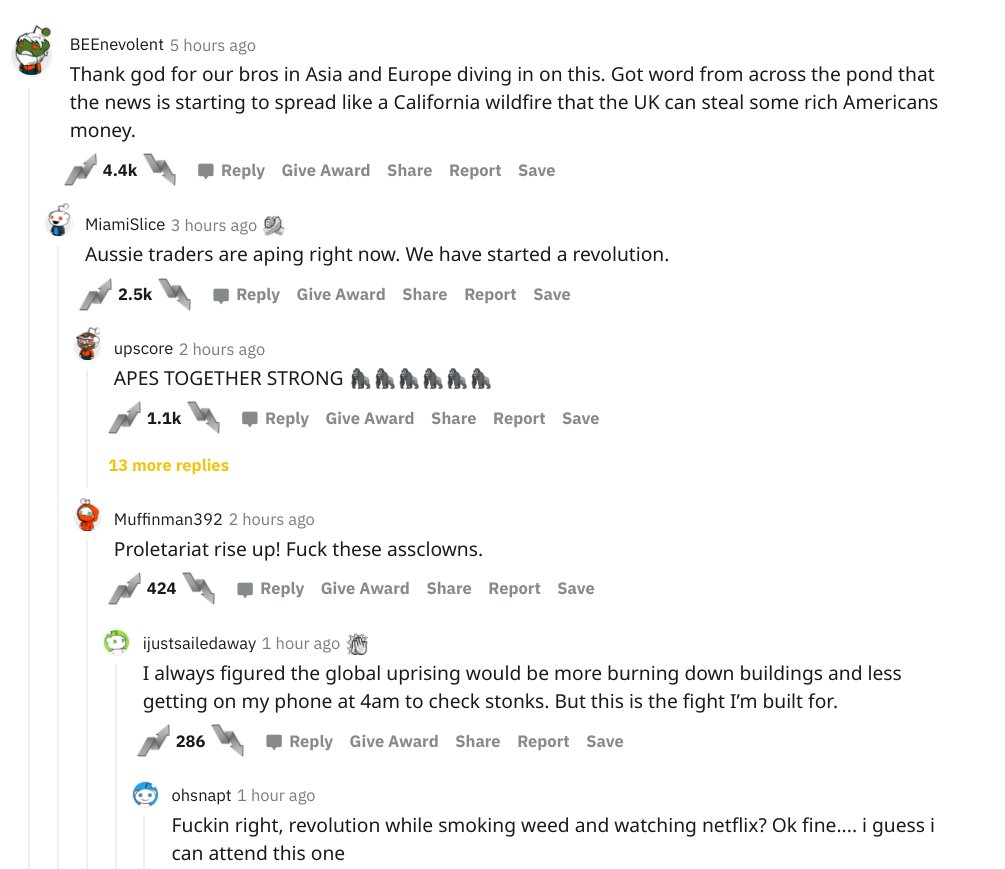
People want to burn down Wall Street, calling for a revolution, protests. This is sentiment on many sites, not just r/WallStreetbets. The mob is furious that having figured out how to make fast bucks at expense of *some* firms, they are being shut down probably illegally.
This from
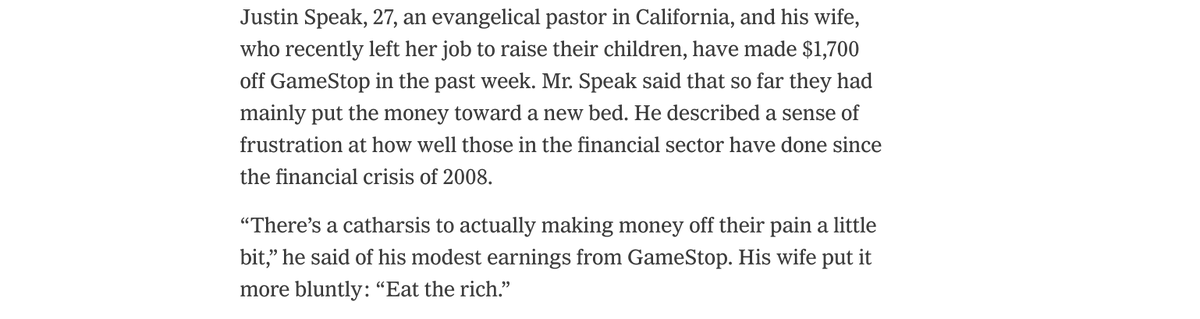
@nytimes says everything ab America right now. An Evangelical pastor and his wife made $1,700 from GameStop and put it toward a new bed. How sad is that? They are pissed at how much the rich made off the 2008 financial crisis. "Eat the rich" is literally their attitude
Compare this to general market, not just FAANG. Companies like Tesla, Palantir, Airbnb have seen massive run-ups in stocks. Thet are all shit in terms of profit, but Fed's easy money has allowed banks and pros to rake in hundreds of billions of $$.
TSLA has market cap close to $1 trillion. It's earning per share is $.50. Nrmal price to earnings ratio is about 15. TSLA? It's p/e is 1,675. Elon Musk the wealthiest man in world this month. (And Musk has joined in the Gamestonk bubble.)
https://t.co/33OvbBiv5j
Tesla soaring like a rocket has created a massive bubble in electric vehicle stocks. Take Blink Charging, BLNK. It's a small manufacturer of charging stations losing money. It's a crap compann, but its shares are up 5,000% in last year. This is considered "normal."
Since, March, Dow has soared 63%. It's insane and absurd. It's pure market manipulation by the Fed, combined with Trump's deregulation, on top of decades of bipartisan deregulation. This is what people are pissed about.
https://t.co/J3QVTzQp70
It's a huge mistake to dismiss Gamestonk as battle between the rich or see small investors as equivalent of Capitol Hill riot - which some Leftists do. Few Americans have faith in "the system," and fewer have faith in the Left. But there is a real opportunity here.
Others sneer at small investors, "Oh now you realize the system is rigged?" That's dumb. Good organizers know you work w/ people where they're at. And people are furious. It's also dumb to think this a revolution, but that anger could be harnessed against Wall St.
People are seeing system rigged against them in real time. Left-leaning politicians like
@AOC agree. No, you are not going to convince denizens of r/WallStreetBets to become socialists, but you could convince them to break up big banks and crack down on market manipulation.
If you don't harness this anger against Wall Street, then fascists will. They will paint this as a nefarious international conspiracy w/ or w/o blatant anti-Semitic overtones. Use it as a battering ram against the ruling class, rather than let the right exploit it. END
One more thing. There are obviously lots of Trump-type bros in Gamestonk. But they differ from fascist mob on 1/6. They are in it for money. But these bubbles also draw in tons of small investors across political spectrum. Don't lose sight of that.
The
@nytimes found an out-of-work Black-Latino cook, a teen, and the Evangelical couple who all made money on GameStop, some very little. That many people see more hope in Gamestonk than social movements should be grappled with seriously.
https://t.co/bJ9yFtf2EX