In much of SF, you can’t walk 20 feet without seeing a sign declaring that Black lives matter and no human being is illegal. Those signs sit in yards zoned for single families, in communities that organize against the new housing that would bring those values closer to reality.

Poorer families — disproportionately nonwhite and immigrant — are pushed into long commutes, overcrowded housing and homelessness. Those inequalities have turned deadly during the pandemic.

And it's not just SF:
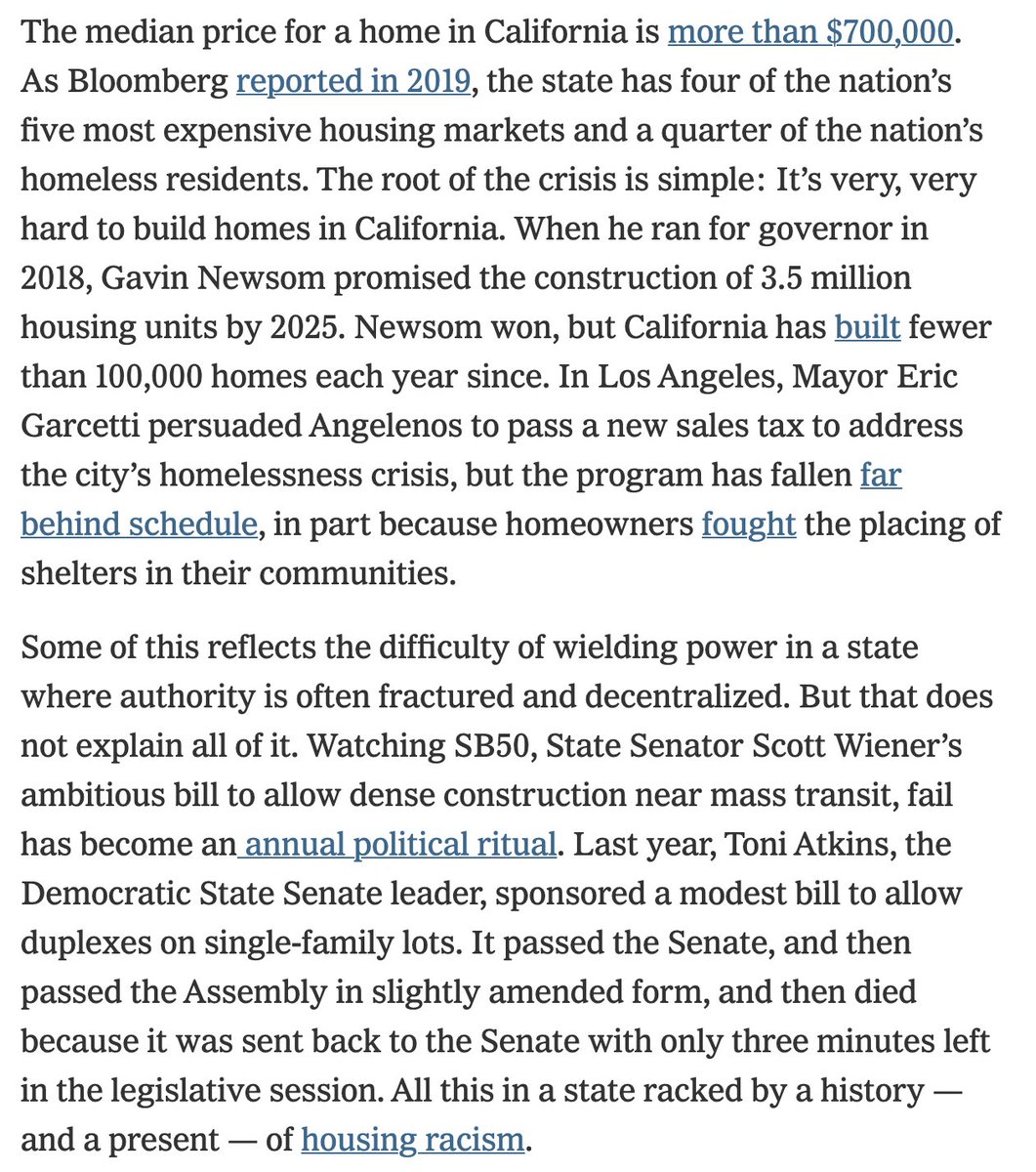
"What we see at times is people with a Bernie Sanders sign and a ‘Black Lives Matter’ sign in their window, but they’re opposing an affordable housing project or an apartment complex down the street," @Scott_Wiener told me.
There is a danger — not just in California, but everywhere — that politics becomes an aesthetic rather than a program.

It’s a danger on the right, where Donald Trump modeled a presidency that cared more about retweets and owning the libs than passing bills.
It’s also a danger on the left, where the symbols of progressivism are often preferred to the sacrifices and risks those ideals demand.
California, as the biggest state in the nation, and one where Democrats hold total control of the government, carries a special burden. If progressivism cannot work here, why should the country believe it can work anywhere else?

More here: https://t.co/5ipDXQhgKQ
One thing I do want to draw out, though. This isn't all just a question of public opinion. As I argue in the piece, old governance structures and misused laws end up empowering organized incumbents over everyone else.
I remember sitting in an SF city meeting, watching a long line of people testify against a 5G tower. Most people in the community didn't care about the 5G tower, so they didn't show up. That happens on everything. When those meetings have a lot of power, paralysis results.
I'm writing about CA, because it's where I live. But this is a much broader problem. This piece on why New York keeps failing to fix Penn Station is one of the best pieces of the last few years, and a window into the split soul of progressive governance. https://t.co/JSARYsoSv9

More from Ezra Klein

So I'd recommend reading this thread from Dave, but I thought about some of these policies, and how they fit into the whole, a lot, and want to offer a different interpretation.


I think California is world leading on progressivism that doesn't ask anyone to give anything up, or accept any major change, right now.

That's what I mean by symbolically progressive, operationally conservative.

Take the 100% renewable energy standard. As @leahstokes has written, these policies often fail in practice. I note our leadership on renewable energy in the piece, but the kind of politics we see on housing and transportation are going foil that if they don't change.

Creating a statewide consumer financial protection agency is great! But again, you're not asking most voters to give anything up or accept any actual changes.

I don't see that as balancing the scales on, say, high-speed rail.

CA is willing to vote for higher taxes, new agencies, etc. It was impressive when LA passed Measure H, a new sales tax to fund homeless shelters. And depressing to watch those same communities pour into the streets to protest shelters being placed near them. That's the rub.
This is a good @mattyglesias post about techno-politics but I want to quibble with the part of it that’s about my essay on the policy feedback loops you can build by Just Helping People Fast. Matt writes: https://t.co/MuBlgQV6LW


Over at Mischiefs of Faction, @Smotus makes a similar point:
https://t.co/al6fS5tZXP


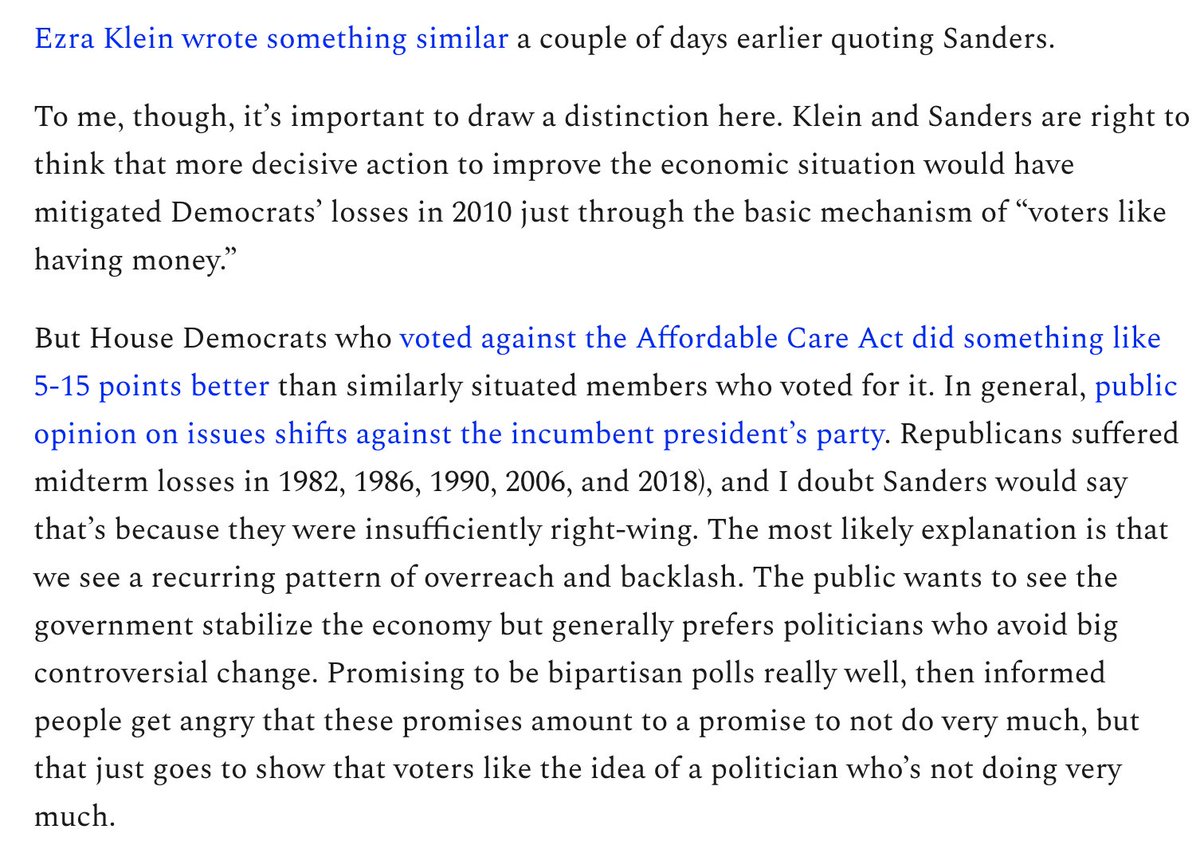
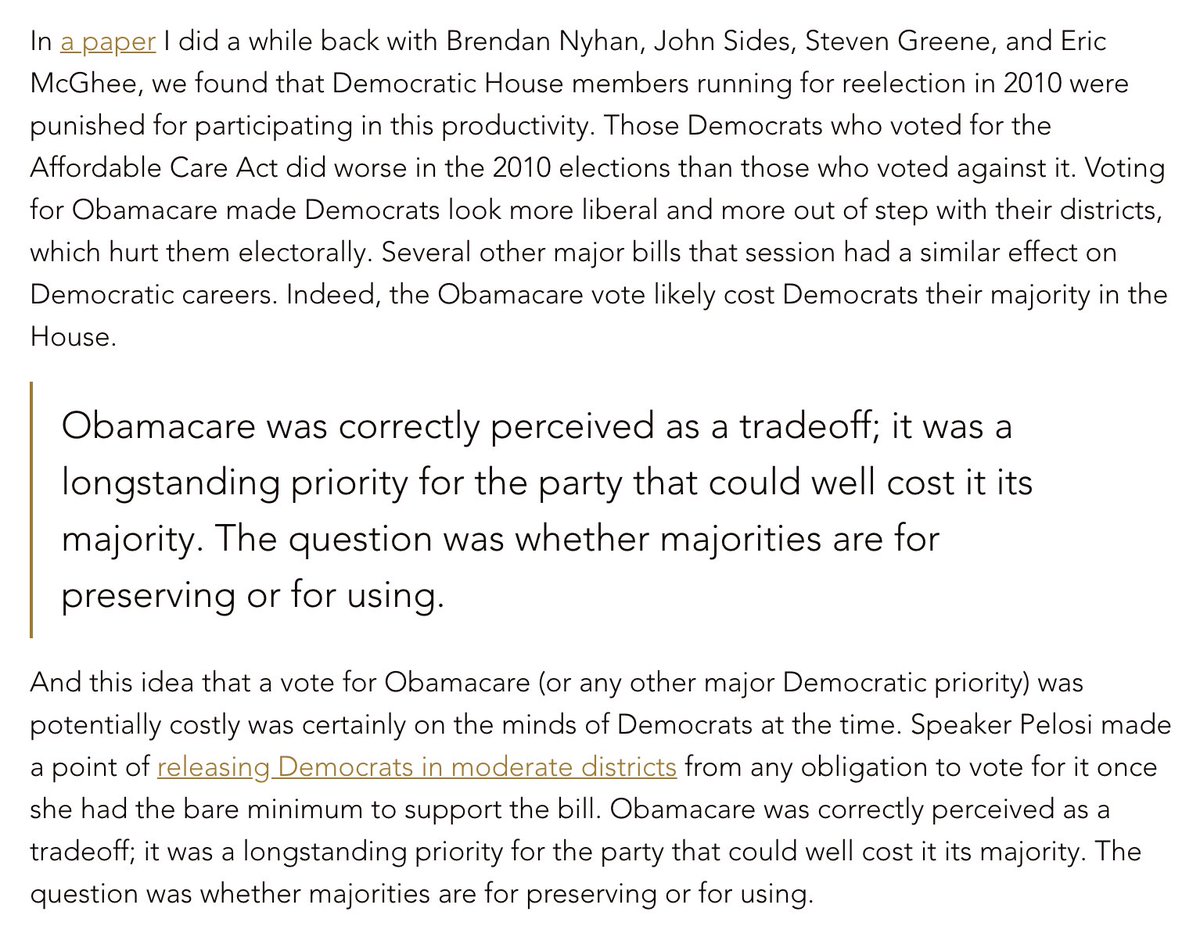
I want to be clear here: I’m saying that the Affordable Care act was, from a political perspective, badly designed, and that *a different health care plan* might’ve led to a better Dem performance in 2010. But these arguments don't grapple with that.

To @Smotus’s point, Pelosi released those House Democrats at the end, not the beginning. Having covered the beginning of this, I can tell you a lot of those Democrats thought a bipartisan health care bill would be great politics for them!

But they didn’t get that.

This is key. The ACA was built on the political theory that:

1. Bipartisan policy is easier to pass — and more popular once passed.

2. Working off of the Heritage Foundation/Romney template could get you a bipartisan health bill.

1 was probably right. 2 was utterly wrong.
This is a piece I've been thinking about for a long time. One of the most dominant policy ideas in Washington is that policy should, always and everywhere, move parents into paid labor. But what if that's wrong?

My reporting here convinced me that there's no large effect in either direction on labor force participation from child allowances. Canada has a bigger one than either Romney or Biden are considering, and more labor force participation among women.

But what if that wasn't true?

Forcing parents into low-wage, often exploitative, jobs by threatening them and their children with poverty may be counted as a success by some policymakers, but it’s a sign of a society that doesn’t value the most essential forms of labor.

The problem is in the very language we use. If I left my job as a New York Times columnist to care for my 2-year-old son, I’d be described as leaving the labor force. But as much as I adore him, there is no doubt I’d be working harder. I wouldn't have stopped working!

I tried to render conservative objections here fairly. I appreciate that @swinshi talked with me, and I'm sorry I couldn't include everything he said. I'll say I believe I used his strongest arguments, not more speculative ones, in the piece.
What we're seeing from Trump and his allies today is an autocratic attempt. It's not a competent one, and it probably won't be an effective one. But that's what it is. And far worse would follow if it succeeded.


As @mashagessen explained in this interview, using Balint Magyar's framework, an autocratic attempt is "the first stage when autocracy is still reversible by electoral means."

The point is to make the regime's rule irreversible by electoral means, which is explicitly what Trump, et al, are trying right now.

"Then, at some point, there comes the autocratic breakthrough when you can no longer use electoral means to reverse that autocracy."

"Then autocratic consolidation, where it’s just consolidating ever more power and money, making it ever less possible to change."

There is an element of farce to Trump's tweets, his actions, his cronies. It makes it easy for many to discount what he's actually saying, and trying. https://t.co/GwC3KGbpkC

It's fitting for the internet era, when the worst ideas and figures come layered in irony.

More from Society

So, as the #MegaMillions jackpot reaches a record $1.6B and #Powerball reaches $620M, here's my advice about how to spend the money in a way that will truly set you, your children and their kids up for life.

Ready?

Create a private foundation and give it all away. 1/

Let's stipulate first that lottery winners often have a hard time. Being publicly identified makes you a target for "friends" and "family" who want your money, as well as for non-family grifters and con men. 2/

The stress can be damaging, even deadly, and Uncle Sam takes his huge cut. Plus, having a big pool of disposable income can be irresistible to people not accustomed to managing wealth.
https://t.co/fiHsuJyZwz 3/

Meanwhile, the private foundation is as close as we come to Downton Abbey and the landed aristocracy in this country. It's a largely untaxed pot of money that grows significantly over time, and those who control them tend to entrench their own privileges and those of their kin. 4

Here's how it works for a big lotto winner:

1. Win the prize.
2. Announce that you are donating it to the YOUR NAME HERE Family Foundation.
3. Receive massive plaudits in the press. You will be a folk hero for this decision.
4. Appoint only trusted friends/family to board. 5/

You May Also Like

So the cryptocurrency industry has basically two products, one which is relatively benign and doesn't have product market fit, and one which is malignant and does. The industry has a weird superposition of understanding this fact and (strategically?) not understanding it.


The benign product is sovereign programmable money, which is historically a niche interest of folks with a relatively clustered set of beliefs about the state, the literary merit of Snow Crash, and the utility of gold to the modern economy.

This product has narrow appeal and, accordingly, is worth about as much as everything else on a 486 sitting in someone's basement is worth.

The other product is investment scams, which have approximately the best product market fit of anything produced by humans. In no age, in no country, in no city, at no level of sophistication do people consistently say "Actually I would prefer not to get money for nothing."

This product needs the exchanges like they need oxygen, because the value of it is directly tied to having payment rails to move real currency into the ecosystem and some jurisdictional and regulatory legerdemain to stay one step ahead of the banhammer.