Categories Science


From now until 6pm GMT we have a new researcher every 20 minutes ready to share their work with you!
What's going on? Check out the schedule below for info on all presenters!
First up at 12.20pm is @JessieW_Palaeo
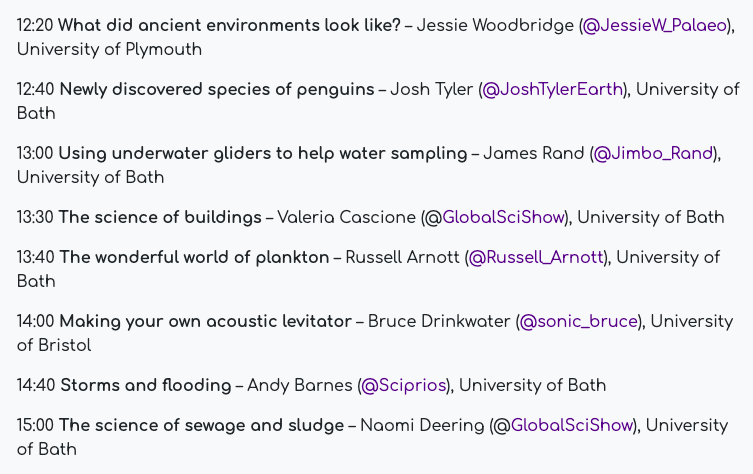
All presenters will post content to their Twitter account highlighted in the schedule above. We'll then retweet in the thread below!
You can also check out everything going on by following the hashtag #GlobalScienceshow
A strong opening to the day discussing fossils, climate and theres even A QUIZ.
If you know me, then you know I LOVE A
Hi, my name is Jessie Woodbridge and I'm taking part in the #GlobalScienceShow
— Jessie Woodbridge (@JessieW_Palaeo) November 28, 2020
I'll be discussing #PastEnvironmentalChanges. Follow along with the whole show and check out @JoshTylerEarth who's up next! #FUTURES2020 @GlobalSciShow pic.twitter.com/1PfM7cLQgR
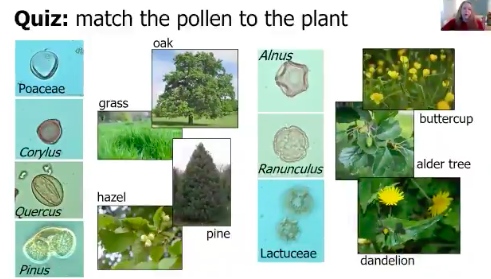
Here's a screenshot of Jessie's quiz, if you would like to try and match the pollen to the plant!
@JessieW_Palaeo #FUTURES2020
I am genuinely smiling so much. Penguins (and specifically Gentoo's) are my favourite animal.
It's so exciting that three new species of Gentoo penguins were recently discovered
Hi, my name is Josh Tyler and I'm taking part in the #GlobalScienceShow & #FUTURES2020.
— Josh Tyler (@JoshTylerEarth) November 28, 2020
I'll be tweeting about cryptic species and how we discovered three new species of gentoo penguin\U0001f427. Follow along with the whole show and check out @Jimbo_Rand who is up next. 1/12 pic.twitter.com/4TnkM9dnDB



You can tell 2020 was the worst because I didn’t describe a single new synapsid species this year. In part, that’s due to spending most of my energy on larger-scale synthetic projects, but I had a few new taxa that were supposed to come out and got delayed by #2020 stuff...
Thankfully my colleagues in the synapsid research community have not been so idle, naming 13 new species this year. The vast majority (9) were cynodonts, there were also 2 pelycosaurs, 1 dicynodont, and 1 therocephalian.
For new pelycosaurs the highlight was definitely the long-awaited description by Berman et al. of Martensius, the Bromacker caseid, a plesiomorphic early member of the group known from beautiful material: https://t.co/GUJRKvtNwc

No new biarmosuchians or dinocephalians (though watch out next year…), but there was one new dicynodont: a basal dicynodontoid, Taoheodon, part of an increasingly diverse upper Permian fauna from China: https://t.co/lpq2ElPADw


Unfortunately the observed ORF8 inactivation or the nsp6 SGF deletion are both indicative of T cell depletion, yet the deletion of HV and Y suggest functional B cell immunity—specifically the HV deletion is not observed in the patient nor the ORF8

Deactivation. The nsp6 SGF is located in an ER exposed loop that is conserved even in long passage within immunocompromised patients. The loop likely interacts with nsp3 and help antagonizing cellular autophagy. And human-like B cell immunity does not cause deletion here.
Cellular autophagy help display peptides on MHC class II molecules, and ORF8 removed MHC class I molecules. The loss of both functions suggest the host cytotoxic T cell immunity is not functional yet the S deletions are consistent with B cell immunity in an altered host
Environment. As the long covid-associated immnocompromisation was not found to cause either SGF deletions (or any deletions) in ORF1ab nor does it inactivate ORF8, Cytotoxic T cells are functional enough in these patients to require both functions to remain intact.
It can not be HIV since that https://t.co/yKJIxeSzlf depletes helper T cells instead of cytotoxic T cells https://t.co/h0aN2vnkLk ,ironically creating a patient condition that is B-cell deficient but not T-cell deficient.

@AcademicChatter #WorkYourCareer
As @JonathanMalloy and I argue in this @ConversationCA article, Ph.D. students can't wait for programs and universities to meet their professional development needs. While some offer great options, availability is uneven.
#AcademicTwitter
In #WorkYourCareer, we provide students with clear guidance on how to prepare for both academic & non-academic careers at every stage of their program. We outline our approach in the first chapter (available free online).
#AcademicTwitter #phdChat
In Chapter 2 of #WorkYourCareer, we walk you through questions to consider when applying to PhD programs - including whether to apply and if so, to which ones (free excerpt linked below).
#AcademicTwitter #phdChat
https://t.co/Mif6bTErgT
#AcademicTwitter #phdChat
Are you a potential PhD student deciding which programs to apply to? Check out this except from "Work Your Career" where @loleen_berdahl and I give guidance on choosing the PhD program that best suits you. https://t.co/2G328d6O38
— Dr. Jonathan Malloy (@JonathanMalloy) November 27, 2020
We also include this handy table. pic.twitter.com/V4BOr7YI1B
Chapter 2 of #WorkYourCareer also includes our somewhat-controversial 'should I do a PhD?' flowchart. A PhD can be a great choice for many people - but it is a big life decision.
#AcademicTwitter #phdChat
Thinking of applying for a PhD? @JonathanMalloy and I created a flowchart to help you think through the decision (from our @utpress book, Work Your Career, which devotes a chapter to how to apply for PhD programs).@AcademicChatter #AcademicTwitter #gradschool https://t.co/nvTpqLjq0v
— Loleen Berdahl (@loleen_berdahl) November 23, 2020

1/
(I thought I'd answer you here as it will take several posts and that thread is saturated already)
You know I just had to share. . .
Once again, I'm sharing my thoughts based mostly on the work of Dr. Michael Heiser (Theology, Ancient History. . .
Who are \u201cthe watchers\u201d or fallen angels?
— Mimi J (@TheKanehB) December 9, 2020
Aliens? Angels? Or A diff species?
They seem to be pretty consistent across stories and I\u2019m curious as to what ppl think they actually were
2/
Near East Studies, and Semitic Languages) as well as what I could remember about the book of 1st “Enoch”. Basically, mainstream Biblical study in academia.
The word "angel" (from the Greek word meaning "messenger") is not the nature of something or referring to species.
3/
It's a *job description*, just like you are a woman who takes on the role/function of an *entrepreneur*. These are spiritual beings, the “host of heaven” who surround God. A "divine council" is revealed in Psalm 82 and Job 1: 6.
They have:
1. Free will
2. Rank
3. Function
4/
Angels and demons actually occupy a low rank among divine beings. The higher-ranked ones don't leave the heavenly realms (unless ordered by God). Some are the "guardians of the throne" of God and his presence (i.e. - cherubim).
5/
What about “the Watchers” mentioned in Gen. 6 (as well as in the book of Daniel) and had a much more detailed account in the Books of Enoch? The Greek equivalent of their name (“Grigori”) meant spiritual beings who were “awake”, “watchful”. . .

#ProcB Application of ecological and evolutionary theory to #microbiome community dynamics @jamesemcdonald @bkoskella https://t.co/fqOH0kVkaE. All Special Feature papers Free to Read - https://t.co/S02w5ODyHQ pic.twitter.com/jLk3eai1eO
— Royal Society Publishing (@RSocPublishing) January 1, 2021
Application of ecological and evolutionary theory to microbiome community dynamics across systems | Proceedings of the Royal Society B: Biological Sciences https://t.co/LzzUDDE7Qg @jamesemcdonald
@gut_health
@bkoskella
@RSocPublishing
Transmission efficiency drives host–microbe associations | Proceedings of the Royal Society B: Biological Sciences https://t.co/bBdGS1XdTo
@PhilipLeftwich
Matthew P. Edgington
and Tracey Chapman
Host–microbiota–insect interactions drive emergent virulence in a complex tree disease | Proceedings of the Royal Society B: Biological Sciences https://t.co/RpwpxgHgY4
@clydeandforth1
Martin Broberg
Sandra Denman
@jamesemcdonald
A game theory model for gut bacterial nutrient utilization strategies during human infancy | Proceedings of the Royal Society B: Biological Sciences https://t.co/o3kIzv0ZbR
Inga Leena Angell
Knut Rudi


(04/25/2017) An artificial womb successfully grew baby sheep — and humans could be
(05/17/2017) Exposure to BPA potentially induces permanent reprogramming of painted turtles'
(07/23/2017) A Spanish scientist is making robots that he thinks could end sex between
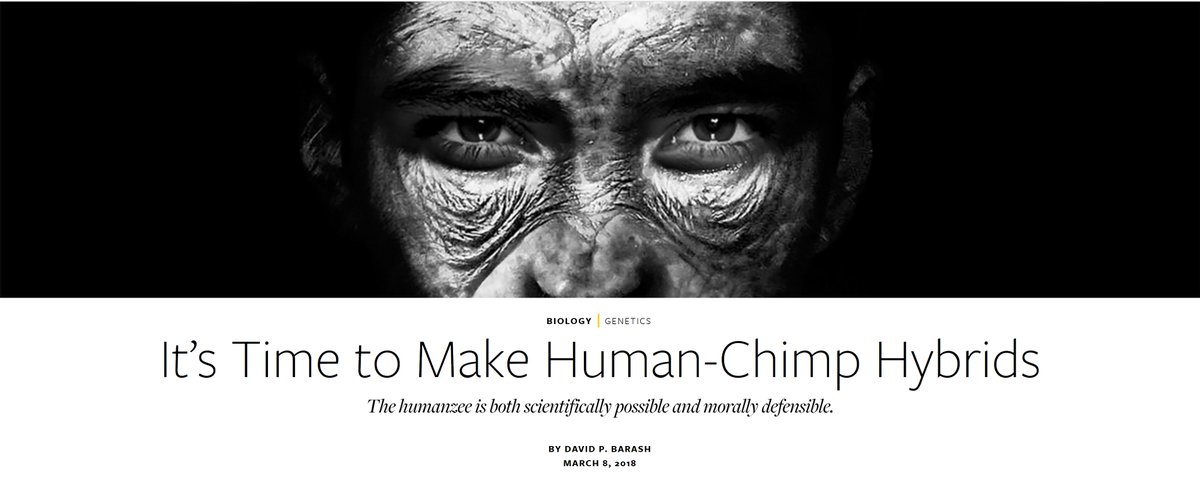
(03/08/2018) It’s Time to Make Human-Chimp Hybrids.
The humanzee is both scientifically possible and morally defensible.
https://t.co/R925n7ieWz