Let’s talk about ORGANIC.

Robert Paarlberg’s new book on the food system is out today, and here’s an excerpt.

He’s not a fan of organic, and he makes some good points but misses others.

Here we go.

Organic's biggest shortcoming is that you need more land to grow the same amount of food.

The yield penalty happens in almost every crop, in almost every study.

The gap could narrow with more research/varieties, but it won’t go away.

This has big, bad climate implications.
The second issue I have with organic, which Paarlberg shares, is that its basic criterion is naturalness.

Natural doesn’t mean safe, or even safer. A farming standard based on it forces farmers to sometimes use more dangerous, less effective tools.
https://t.co/Kh8TCgPEBp
On human health, there’s scant evidence that pesticide residues on conventional produce are harmful to consumers (though it’s possible farmworkers could be at risk).

What I don’t want is for folks who can’t afford organic to worry about feeding their kids conventional produce.
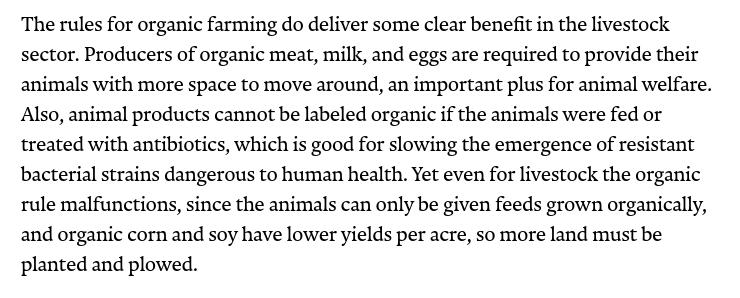
On the plus side, Paarlberg acknowledges that the organic standard has some real advantages for animal welfare.

This is why I buy organic animal products.

Many in the organic world would like more regs ensuring animals have decent lives.
Now, what Paarlberg misses. First, there are some environmental advantages. I wrote this a while back, and have since seen some evidence that organic systems may sequester carbon deeper in the soil, where it’s less likely to be re-released.
https://t.co/s1VfzlOmgK
He also misses organic’s success for farmers.

It enables growers to find like-minded consumers willing to pay a premium, and organic farmers are more profitable. This is good for a couple of reasons.
First, as a farmer, but also as a human, I'm in favor of farmers making a living.

If they all could, maybe we wouldn’t have to subsidize them to the tune of $20 billion a year.

But profitable farmers also have the cushion to experiment with new ways to farm better.
The last thing Paarlberg misses is an opportunity.

There has been, in the conventional ag community, a tendency toward sneering superciliousness about organic. Some call to boycott it!

Why? Because SCIENCE!
And I have to say that Paarlberg kicks off his piece with some smugness that I find off-putting.
Why does ORGANIC vs. CONVENTIONAL have to be war?

Because organic is a small slice of ag, I'll trade off its yield penalty for farmer livelihoods & the benefits from the experimentation I’ve seen on farms.

No, we can’t turn all acres organic, but I don’t think that’s a risk.
Bottom line:

ORGANIC: Some enviro benefits; better conditions for animals; farmers make a living

CONVENTIONAL: Better yields; unconstrained by “naturalness,” so can sometimes use safer/better practices; more affordable

I want a food supply with both.

Thanks for listening.

More from Health

You May Also Like

Recently, the @CNIL issued a decision regarding the GDPR compliance of an unknown French adtech company named "Vectaury". It may seem like small fry, but the decision has potential wide-ranging impacts for Google, the IAB framework, and today's adtech. It's thread time! 👇

It's all in French, but if you're up for it you can read:
• Their blog post (lacks the most interesting details):
https://t.co/PHkDcOT1hy
• Their high-level legal decision: https://t.co/hwpiEvjodt
• The full notification: https://t.co/QQB7rfynha

I've read it so you needn't!

Vectaury was collecting geolocation data in order to create profiles (eg. people who often go to this or that type of shop) so as to power ad targeting. They operate through embedded SDKs and ad bidding, making them invisible to users.

The @CNIL notes that profiling based off of geolocation presents particular risks since it reveals people's movements and habits. As risky, the processing requires consent — this will be the heart of their assessment.

Interesting point: they justify the decision in part because of how many people COULD be targeted in this way (rather than how many have — though they note that too). Because it's on a phone, and many have phones, it is considered large-scale processing no matter what.