It's 2021! Time for a crash course in four terms that I often see mixed up when people talk about testing: sensitivity, specificity, positive predictive value, negative predictive value.
These terms help us talk about how accurate a test is, but from different viewpoints. 1/
A test that is very *specific* will be very good at accurately ruling out infection in people who are not infected. 3/
Of the 10 people infected, 8 test + (true +), 2 test - (false -).
Of the 90 people uninfected, 89 test - (true -), 1 tests + (false +). 7/
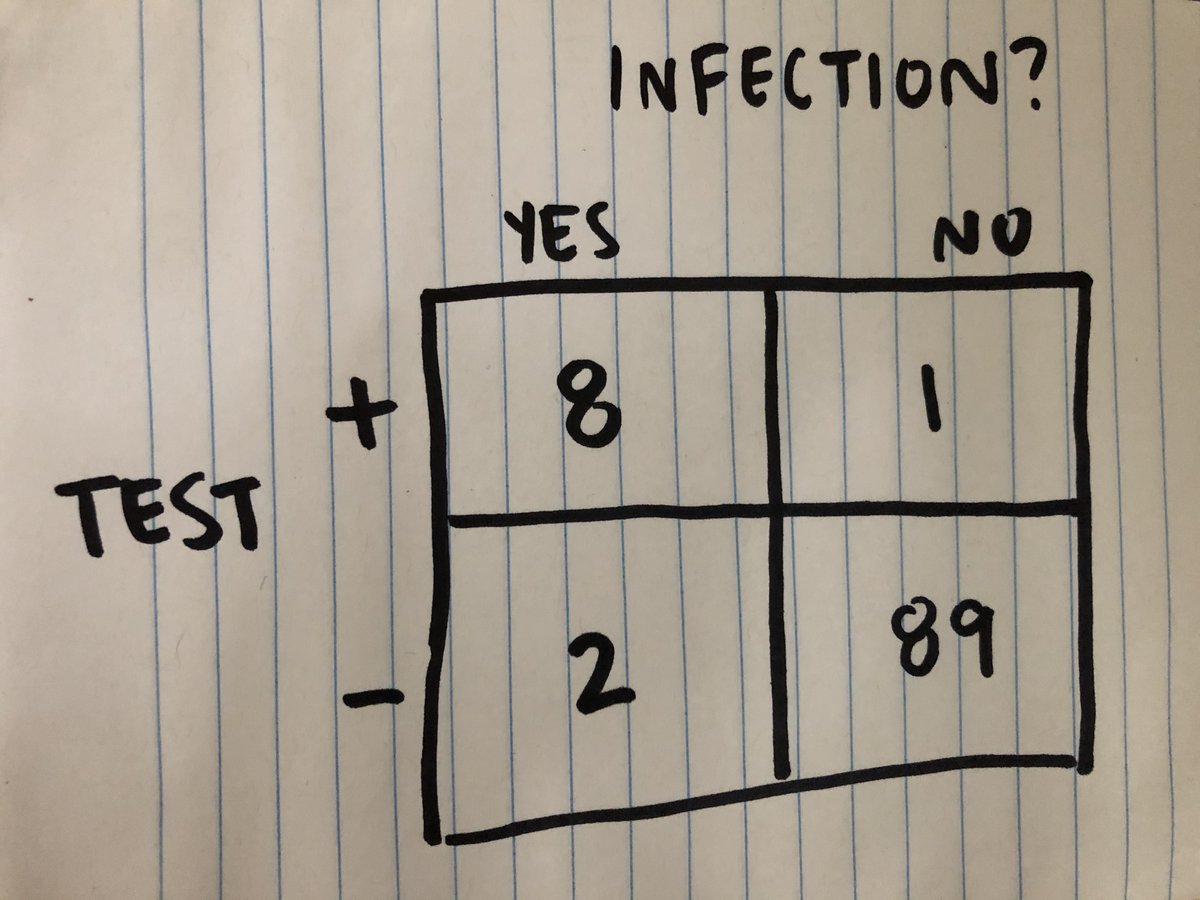
The test's positive predictive value is true positives/(true positives + false positives): 8/9, or 88.9%. It's the proportion of positives, out of all the positives, that were accurate. 10/
More from Education
New from me:
I’m launching my Forecasting For SEO course next month.
It’s everything I’ve learned, tried and tested about SEO forecasting.
The course: https://t.co/bovuIns9OZ
Following along 👇
Why forecasting?
Last year I launched https://t.co/I6osuvrGAK to provide reliable forecasts to SEO teams.
It went crazy.
I also noticed an appetite for learning more about forecasting and reached out on Twitter to gauge interest:
The interest encouraged me to make a start...
I’ve also been inspired by what others are doing: @tom_hirst, @dvassallo and @azarchick 👏👏
And their guts to be build so openly in public.
So here goes it...
In the last 2 years I’ve only written 3 blog posts on my site.
- Probabilistic thinking in SEO
- Rethinking technical SEO audits
- How to deliver better SEO strategies.
I only write when I feel like I’ve got something to say.
With forecasting, I’ve got something to say. 💭
There are mixed feelings about forecasting in the SEO industry.
Uncertainty is everywhere. Algorithm updates impacting rankings, economic challenges impacting demand.
It’s difficult. 😩
I’m launching my Forecasting For SEO course next month.
It’s everything I’ve learned, tried and tested about SEO forecasting.
The course: https://t.co/bovuIns9OZ
Following along 👇
Why forecasting?
Last year I launched https://t.co/I6osuvrGAK to provide reliable forecasts to SEO teams.
It went crazy.
I also noticed an appetite for learning more about forecasting and reached out on Twitter to gauge interest:
The interest encouraged me to make a start...
I’ve also been inspired by what others are doing: @tom_hirst, @dvassallo and @azarchick 👏👏
And their guts to be build so openly in public.
So here goes it...
In the last 2 years I’ve only written 3 blog posts on my site.
- Probabilistic thinking in SEO
- Rethinking technical SEO audits
- How to deliver better SEO strategies.
I only write when I feel like I’ve got something to say.
With forecasting, I’ve got something to say. 💭
There are mixed feelings about forecasting in the SEO industry.
Uncertainty is everywhere. Algorithm updates impacting rankings, economic challenges impacting demand.
It’s difficult. 😩
A thread about online teaching and learning (T&L).
@wv012 @Passengercis @thebandb @carelstolker @BieTanjade @C4Innovation @rianneletscher @PietVdBossche @wijmenga_cisca @Pduisenberg @QMProgram #highered #edtech #teaching @threadreader unroll (1)
Here is a university road map on how the strengths of conventional, face-to-face teaching and online T&L can be optimally used to address today’s lecture room challenges.
I am not an instructional designer, but I have been teaching online internationally for over 10 years (2)
In the last 2+ years, I taught hybrid & online undergraduate courses at the University of Maryland Global Campus, among the largest top-20 online colleges in the USA.
UMGC has received numerous awards for its innovations: https://t.co/jd7JkHIK8Q and https://t.co/IPKizZwclA (3)
15+ years ago UMGC was one of the founding members of QM “Quality Matters” a non-profit with 1,500+ members in 26 countries.
QM offers membership of a community of practice, numerous free resources, online training, and review/accreditation services https://t.co/ZoFVsgcBC7 (4)
It is obvious that universities will also be affected by the 4th industrial revolution, and things can not stay the same as they were after the invention of the printing press.
Until recently, a lecture room looked the same as 900 years ago incl. flirting and sleeping (5)
@wv012 @Passengercis @thebandb @carelstolker @BieTanjade @C4Innovation @rianneletscher @PietVdBossche @wijmenga_cisca @Pduisenberg @QMProgram #highered #edtech #teaching @threadreader unroll (1)
Here is a university road map on how the strengths of conventional, face-to-face teaching and online T&L can be optimally used to address today’s lecture room challenges.
I am not an instructional designer, but I have been teaching online internationally for over 10 years (2)
In the last 2+ years, I taught hybrid & online undergraduate courses at the University of Maryland Global Campus, among the largest top-20 online colleges in the USA.
UMGC has received numerous awards for its innovations: https://t.co/jd7JkHIK8Q and https://t.co/IPKizZwclA (3)
15+ years ago UMGC was one of the founding members of QM “Quality Matters” a non-profit with 1,500+ members in 26 countries.
QM offers membership of a community of practice, numerous free resources, online training, and review/accreditation services https://t.co/ZoFVsgcBC7 (4)
It is obvious that universities will also be affected by the 4th industrial revolution, and things can not stay the same as they were after the invention of the printing press.
Until recently, a lecture room looked the same as 900 years ago incl. flirting and sleeping (5)
You May Also Like
So friends here is the thread on the recommended pathway for new entrants in the stock market.
Here I will share what I believe are essentials for anybody who is interested in stock markets and the resources to learn them, its from my experience and by no means exhaustive..
First the very basic : The Dow theory, Everybody must have basic understanding of it and must learn to observe High Highs, Higher Lows, Lower Highs and Lowers lows on charts and their
Even those who are more inclined towards fundamental side can also benefit from Dow theory, as it can hint start & end of Bull/Bear runs thereby indication entry and exits.
Next basic is Wyckoff's Theory. It tells how accumulation and distribution happens with regularity and how the market actually
Dow theory is old but
Here I will share what I believe are essentials for anybody who is interested in stock markets and the resources to learn them, its from my experience and by no means exhaustive..
First the very basic : The Dow theory, Everybody must have basic understanding of it and must learn to observe High Highs, Higher Lows, Lower Highs and Lowers lows on charts and their
Even those who are more inclined towards fundamental side can also benefit from Dow theory, as it can hint start & end of Bull/Bear runs thereby indication entry and exits.
Next basic is Wyckoff's Theory. It tells how accumulation and distribution happens with regularity and how the market actually
Dow theory is old but
Old is Gold....
— Professor (@DillikiBiili) January 23, 2020
this Bharti Airtel chart is a true copy of the Wyckoff Pattern propounded in 1931....... pic.twitter.com/tQ1PNebq7d